



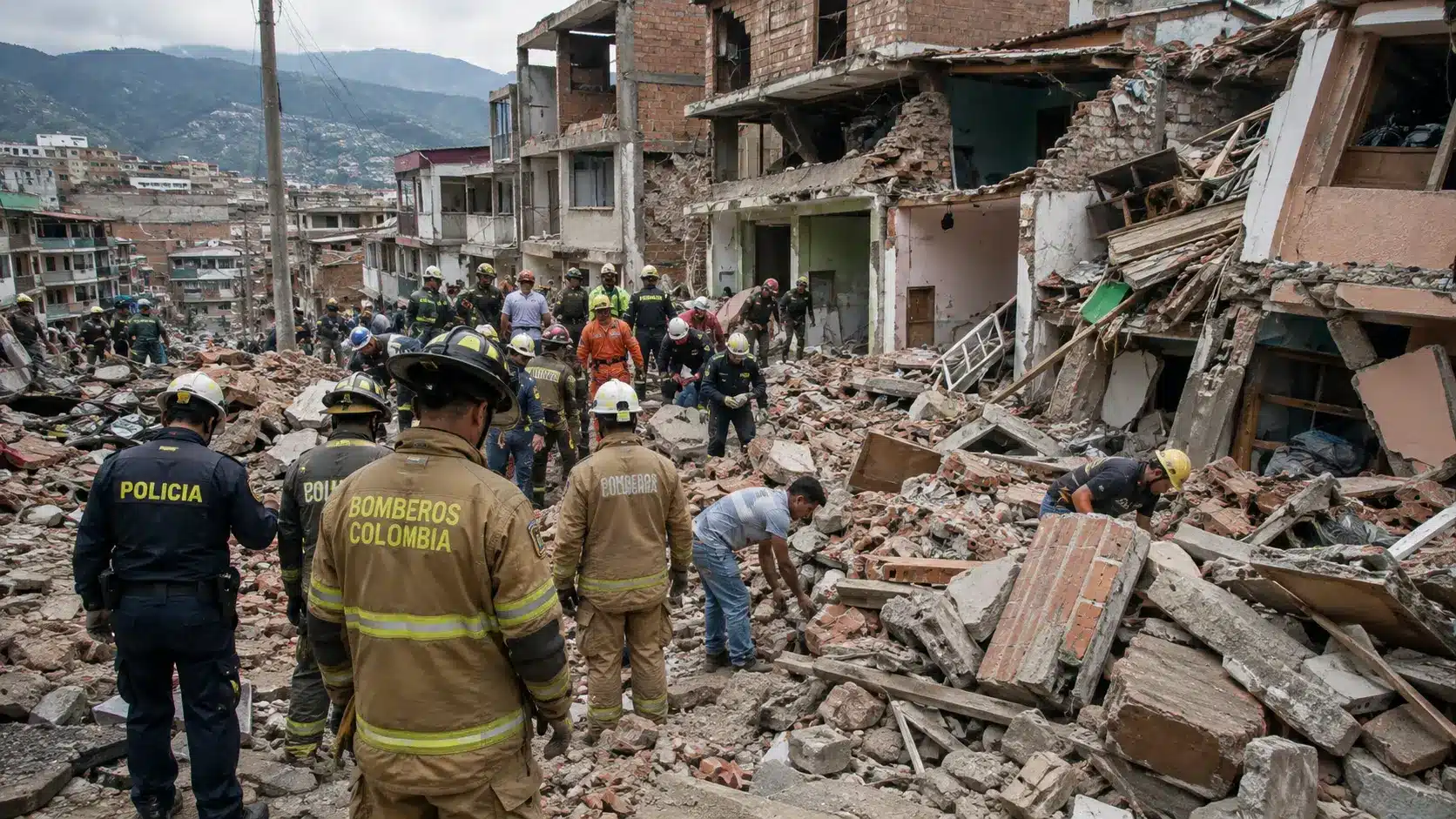
Colombia Earthquake: Death Toll Rises to 132 After 7.4-Magnitude Quake
A powerful 7.4-magnitude earthquake struck western Colombia on August 10, killing at least 132 people and injuring about 570 others, according to the latest figures reported by the Colombian Association of Capital Cities. The scale of the destruction has left emergency teams searching damaged buildings while authorities assess the impact across several cities.
The earthquake was centered near San José del Palmar in the department of Chocó, with the tremor strongly felt across western and central parts of the country. Reports of casualties and structural damage emerged from areas including Cali, Pereira, Quibdó and Manizales.
Rescue teams face a difficult recovery operation
The immediate priority has been locating people who may still be trapped beneath collapsed structures.
More than 1,500 homes were reported affected, while 61 buildings were said to have collapsed completely. In Cali, local officials reported damage to multiple structures and the possibility that people remained trapped inside some buildings.
The emergency response has been complicated by damage to infrastructure and communication problems in some of the worst-hit areas. Chocó, in particular, includes remote and difficult-to-access terrain, making rapid assessments more challenging.
Hospitals and schools were also among the facilities affected, while airport operations were disrupted at several locations because of damage and safety concerns.
Why the casualty numbers could still change
In the aftermath of a major earthquake, the first death toll is rarely final.
Search-and-rescue teams must inspect collapsed buildings, reach isolated communities and verify reports from local authorities. In western Colombia, difficult terrain and communication disruptions can slow that process.
That means the reported figure of 132 deaths should be understood as a developing toll rather than a final assessment. Earlier reports had placed the number substantially lower, illustrating how quickly casualty figures can change as rescue operations progress.
The earthquake was felt far beyond the epicentre
Although the epicentre was in Chocó, the earthquake affected a much wider area.
Strong shaking was reported in cities including Cali, Pereira and Manizales, while tremors were also felt in neighbouring parts of South America. The epicentre was located roughly 400 kilometres west of Bogotá, according to reporting based on seismic data.
Colombia is a seismically active country, and the Colombian Geological Service maintains a national earthquake monitoring network. Its records show repeated seismic activity around Chocó and other parts of the country, including previous earthquakes near San José del Palmar.
The August 10 earthquake therefore comes against a broader background of seismic risk rather than as an isolated geological event.
Emergency response expands
Colombian authorities have moved resources toward the affected areas as rescue and damage assessments continue. International assistance has also been offered, with the United States pledging financial support and countries including Mexico, Chile and El Salvador offering assistance.
The disaster also represents an early major test for President Abelardo de la Espriella, whose administration had only recently begun when the earthquake struck. The government declared an emergency to accelerate the mobilisation of resources for affected communities.
For residents, however, the immediate concern is more basic: finding missing relatives, reaching medical care and determining whether homes and workplaces are safe to re-enter.
Sources Used
Colombian Geological Service earthquake monitoring data
CNN — Colombia earthquake live coverage
What happens next
The coming days will be critical. Rescue teams will continue searching damaged buildings, while authorities assess infrastructure, housing and public facilities.
Officials will also need to determine the full scale of the economic and humanitarian damage. The final casualty count, the number of displaced residents and the extent of structural losses are expected to become clearer as field teams reach more communities.
The earthquake has already demonstrated how quickly a major seismic event can affect cities far from its epicentre. For Colombia, the next phase will be about more than rescue: it will involve restoring essential services, supporting affected families and determining how vulnerable buildings and infrastructure performed under extreme shaking.
केरल का नाम अब ‘केरलम’ करने की दिशा में बड़ा कदम, लोकसभा ने पारित किया नाम परिवर्तन विधेयक
स्ट्रेट ऑफ होर्मुज पर ट्रंप का बड़ा दावा, ईरान से मांगा युद्ध का मुआवजा