

Critical minerals have moved from being a mining issue to becoming a major geopolitical and national-security issue.
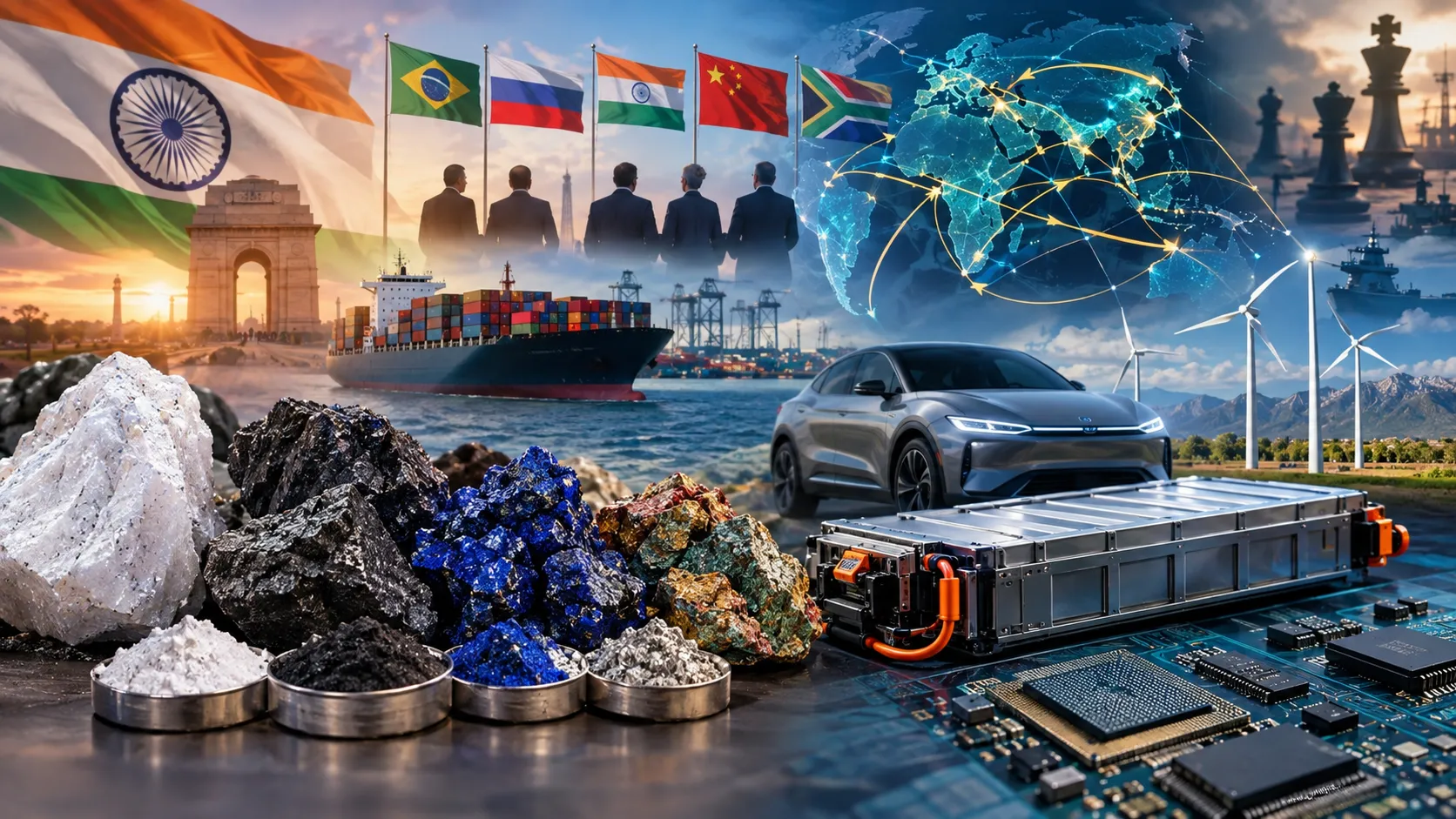
At the 2026 BRICS Summit in New Delhi, Prime Minister Narendra Modi warned that the “weaponisation” of technology and critical minerals could become an obstacle to shared development and prosperity. He called for greater cooperation, resilience and inclusive access to strategic resources and technology.
The warning came at a time when governments around the world are competing to secure supplies of minerals needed for electric vehicles, batteries, semiconductors, renewable-energy systems, telecommunications, aerospace and defence.
The issue is particularly important for India because the country is trying to expand manufacturing and clean-energy industries while reducing vulnerabilities created by concentrated global supply chains.
India’s message at BRICS was therefore not simply about mining.
It was about who controls the raw materials needed for the next generation of technology and what happens if those materials become tools of geopolitical pressure.
What is critical minerals weaponization?
Critical minerals weaponization is the use of control over strategically important minerals, mining, processing or exports to create economic or geopolitical leverage over another country.
A country does not necessarily have to stop exporting a mineral completely to exercise such leverage.
It could:
- Restrict exports
- Introduce licensing requirements
- Impose quotas
- Increase tariffs
- Delay approvals
- Restrict processing technology
- Prioritize domestic industries
- Use supply disruptions as diplomatic or economic pressure
The effect can be significant when alternative suppliers are limited.
For example, if a country needs a particular rare-earth material to manufacture electric motors, missiles or advanced electronics and only a small number of suppliers can provide it, an export restriction can quickly increase costs or disrupt production.
That is why supply concentration is at the heart of the critical-minerals debate.
Why did India raise critical minerals at BRICS 2026?
Prime Minister Modi raised the issue during the concluding session of the 2026 BRICS Summit in New Delhi.
He argued that growing geopolitical tensions, supply-chain disruptions and other global crises are affecting ordinary people and that BRICS should respond through cooperation and inclusive growth. Within that broader argument, he warned against the weaponization of technology and critical minerals.
The message is significant because BRICS includes several countries that are major producers, consumers or processors of strategic resources.
The bloc’s 2026 declaration also specifically emphasized the need for reliable, responsible, diversified, resilient, fair, sustainable and just critical-mineral supply chains. It called for benefit-sharing, value addition and economic diversification in resource-rich countries while recognizing national sovereignty over mineral resources.
In other words, India was pushing a broader principle:
Critical minerals should support development rather than become instruments of coercion.
Why are critical minerals so important?
Critical minerals are materials that are economically or strategically important but may face supply risks because production or processing is geographically concentrated.
They include different minerals depending on the country and its industrial requirements.
Examples include:
- Lithium
- Cobalt
- Nickel
- Graphite
- Rare-earth elements
- Tungsten
- Vanadium
- Titanium
- Gallium
India has identified 24 minerals as Critical and Strategic Minerals under changes to its mining framework.
Their importance comes from their role in modern technologies.
Electric vehicles
Lithium, nickel, cobalt, graphite and rare-earth materials are used across different parts of the EV ecosystem, including batteries and electric motors.
Renewable energy
Critical minerals are required for technologies such as wind turbines, solar systems, batteries and electricity infrastructure.
Semiconductors
Several strategically important minerals and specialty materials are used in semiconductor manufacturing and advanced electronics.
Defence
Rare earths and other specialized materials are important for systems including precision-guided weapons, radar, communications equipment and aerospace technologies.
Telecommunications
Advanced communications infrastructure depends on specialized materials and components.
That is why a disruption can potentially affect entire industrial ecosystems rather than one individual product.
Why does China matter in the critical-minerals debate?
China is central to the global discussion because of its major role in the mining, processing and refining of several critical minerals and rare-earth materials.
The geopolitical issue is not simply who has mineral deposits underground.
It is also about who can process those minerals into usable industrial materials.
A country may possess lithium, rare earths or other resources but still depend on foreign processing capacity.
That creates a potential vulnerability.
This is why India and other countries increasingly emphasize the development of complete supply chains — from exploration and mining to refining, processing, manufacturing and recycling.
Is India directly accusing China of weaponizing critical minerals?
India’s BRICS warning did not explicitly name China as the country responsible for weaponizing critical minerals.
Modi’s comments were framed more broadly around the dangers of weaponizing technology and critical minerals.
However, the timing and geopolitical context make the China angle difficult to ignore.
China is a dominant player in several critical-mineral processing chains, while the United States, India, Japan, Europe and other economies are attempting to diversify their supply sources.
India’s strategy is therefore better understood as de-risking rather than simply targeting one country.
A July 2026 analysis by the Indian Council of World Affairs described India’s engagement through both BRICS and the Quad as a strategy to reduce vulnerabilities caused by excessive concentration in critical-mineral supply chains.
How could critical minerals become a geopolitical weapon?
Imagine a simplified supply chain.
A manufacturer needs a specific mineral to produce an advanced battery.
There are ten potential suppliers in the world, but one country controls most of the processing capacity.
If that country suddenly restricts exports, the manufacturer may have difficulty finding alternatives.
Prices could rise.
Factories could slow production.
Strategic industries could face shortages.
Governments could then be forced to negotiate with the supplier country.
That is what makes critical minerals different from ordinary commodities.
The weaponization chain
Resource concentration → Processing dominance → Export restriction → Supply shortage → Higher prices → Industrial disruption → Political leverage
The vulnerability becomes greater when substitutes are unavailable or take years to develop.
Why processing matters more than mining
One of the most misunderstood aspects of the critical-minerals race is the difference between having resources and controlling the supply chain.
Mining is only the first step.
A mineral typically has to be:
- Explored
- Extracted
- Concentrated
- Refined
- Processed
- Converted into industrial materials
- Manufactured into components
The real strategic bottleneck can appear anywhere along that chain.
India’s Science and Technology Ministry recently emphasized the need to build capabilities across the entire critical-minerals value chain, from exploration and extraction to refining, processing, engineering and manufacturing.
That is a crucial part of India’s strategy.
What is India doing to secure critical minerals?
India has been building a multi-layered strategy rather than relying exclusively on domestic mining.
1. Expanding domestic exploration
The Indian government has classified 24 minerals as critical and strategic and has been auctioning mineral blocks to increase domestic production.
By March 2026, six auction tranches had resulted in 46 critical and strategic mineral blocks being auctioned, with a seventh tranche offering another 19 blocks.
The objective is to create a stronger domestic resource base.
2. Building processing capabilities
Mining alone cannot eliminate supply-chain dependence.
India therefore wants greater domestic capability in refining, processing and manufacturing.
The government has explicitly argued that the country needs capabilities across the complete value chain rather than simply extracting raw materials.
This is potentially more important than increasing the number of mines alone.
3. Building international partnerships
India is also pursuing partnerships with other countries.
In May 2026, India and the United States signed a framework for cooperation on securing supplies of critical minerals and rare earths. The agreement was aimed at strengthening stable and resilient supply chains.
Such partnerships can provide India with access to resources, technology, investment and alternative suppliers.
4. Recycling critical minerals
Recycling can become an important part of mineral security.
If lithium, cobalt, nickel, rare earths and other materials can be recovered efficiently from used batteries, electronics and industrial equipment, countries can reduce their dependence on newly mined materials.
India’s science ministry has also highlighted global and recycling models among its strategic priorities for advanced materials and critical minerals.
Why BRICS is important for critical minerals
BRICS provides India with a platform that is different from Western-led institutions.
The expanded grouping includes countries with significant natural resources, large industrial bases and growing demand for energy and technology.
That creates an opportunity to build supply-chain partnerships.
The 2026 BRICS declaration explicitly called for diversified and resilient critical-mineral supply chains and emphasized value addition in resource-rich countries.
This could eventually translate into cooperation in areas such as:
- Mineral exploration
- Mining investment
- Refining
- Processing technology
- Recycling
- Supply-chain finance
- Research and development
- Trade
However, BRICS also faces a practical challenge.
Its members have different economic interests.
Some are major mineral producers.
Others are major consumers.
Some possess processing capabilities.
And some compete directly in global manufacturing.
Turning a political declaration into a truly integrated mineral supply chain will therefore be difficult.
Why critical minerals matter for India’s EV ambitions
India wants to expand electric mobility and domestic battery manufacturing.
But an EV transition requires more than vehicle factories.
It needs secure supplies of battery materials, processing facilities, battery cells, permanent magnets and other components.
If critical-mineral supplies are disrupted, EV manufacturers could face:
- Higher battery costs
- Production delays
- Increased import dependence
- Greater price volatility
- Slower domestic manufacturing
That makes mineral security an important part of India’s broader clean-energy strategy.
Why critical minerals matter for India’s defence sector
The issue extends beyond civilian technology.
Modern defence systems require sophisticated electronics, sensors, communications equipment, aerospace components and precision systems.
These can depend on specialized materials.
A country that cannot reliably access strategically important materials may become vulnerable to external supply shocks during a geopolitical crisis.
That is why India’s Science and Technology Ministry now explicitly links critical minerals with energy security, industrial competitiveness and national security.
The shift in language is important.
Critical minerals are increasingly being treated as strategic assets, not merely commodities.
The hidden battle: minerals vs technology
There is another reason Modi’s BRICS warning is significant.
He mentioned technology and critical minerals together.
That combination reflects how modern geopolitical competition works.
Technology needs minerals.
Minerals need technology.
Advanced processing requires sophisticated equipment.
AI and semiconductor industries require specialized materials.
Electric vehicles require batteries and magnets.
Defence industries require advanced electronics.
The result is a tightly connected system.
The new strategic equation
Minerals → Materials → Components → Technology → Economic power → National security
Whoever controls important parts of this chain can potentially gain significant geopolitical leverage.
Could critical-mineral weaponization affect ordinary consumers?
Yes.
Consumers may never see the mineral itself, but supply disruptions can eventually reach everyday products.
Potential effects include:
- More expensive EVs
- Higher battery prices
- Increased electronics costs
- Higher renewable-energy equipment costs
- Delays in industrial production
- Higher infrastructure costs
The impact depends on the mineral, the duration of the disruption and how quickly alternative suppliers can respond.
This is why governments increasingly talk about resilient supply chains rather than simply cheap supply chains.
The cheapest supplier is not always the safest supplier.
What does India want BRICS countries to do?
India’s message can be reduced to several broad priorities.
Diversify supply
Avoid excessive dependence on one country or one processing hub.
Add value locally
Resource-rich countries should be able to process minerals and capture more economic value rather than exporting only raw materials.
Cooperate on technology
Mining and processing technologies can help countries turn mineral reserves into industrial capabilities.
Build resilient supply chains
Governments and businesses should prepare alternatives before a crisis occurs.
Keep access inclusive
Strategic materials should not become tools for coercion that prevent developing countries from accessing technologies needed for economic development.
These principles broadly align with the critical-mineral language in the 2026 BRICS declaration.
Is the world entering a critical-minerals race?
Increasingly, yes.
The global energy transition, AI expansion, defence modernization and semiconductor competition are all increasing demand for materials with concentrated supply chains.
Governments are responding through:
- Domestic mining
- Strategic reserves
- Foreign partnerships
- Export controls
- Processing investments
- Recycling
- Supply-chain agreements
The competition is therefore not simply about finding new mineral deposits.
It is about controlling the entire ecosystem around those minerals.
What happens next?
India’s BRICS warning is unlikely to resolve the critical-minerals problem by itself.
The more important question is whether countries can turn political commitments into actual projects.
For India, that means accelerating domestic exploration, refining and processing while building partnerships with resource-rich countries.
For BRICS, it means determining whether members can cooperate despite their competing interests.
And for the global economy, it means reducing the risk that a small number of countries or companies can disrupt materials essential to modern technology.
India’s own policy direction already points toward a combination of domestic capabilities and international partnerships. The government says reducing vulnerabilities from external dependence is essential for energy security and the country’s future technological development.
The bottom line
Critical minerals weaponization means using control over strategically important mineral supply chains as a tool of economic or geopolitical pressure.
India’s warning at the 2026 BRICS Summit reflects a broader concern: the global energy transition and technology race are making minerals such as lithium, graphite, rare earths and other strategic materials increasingly valuable.
The 2026 BRICS declaration responded by calling for diversified, resilient and fair critical-mineral supply chains.
For India, the answer is not simply to find more minerals.
It is to build the complete chain — exploration, mining, refining, processing, manufacturing and recycling — while creating partnerships with other countries.
That is why critical minerals are becoming one of the defining geopolitical issues of the next decade.
FAQ
What is critical minerals weaponization?
Critical minerals weaponization is the use of control over the production, processing or export of strategically important minerals to create economic or geopolitical leverage over other countries.
Why did PM Modi warn about critical minerals at BRICS 2026?
Modi warned that the weaponization of technology and critical minerals could hinder shared development and prosperity. He called for cooperation, resilience and inclusive access within the Global South.
Which critical minerals are important for India?
India has officially identified 24 minerals as Critical and Strategic Minerals. These include resources such as lithium, graphite, rare earth elements, tungsten, vanadium and titanium that are important for energy, technology and strategic industries.
Why are rare earths important?
Rare earth elements are used in advanced magnets, electronics, renewable-energy equipment, electric motors, defence systems and other high-technology applications. Their strategic importance is increased when mining or processing is concentrated in relatively few locations.
Is China the only country that can weaponize critical minerals?
No. Any country with significant control over a strategically important mineral or its processing chain could potentially use supply restrictions as economic leverage. China’s dominant position in several supply chains makes it particularly important to the current debate.
What is India doing to reduce critical-mineral dependence?
India is expanding domestic exploration and mineral auctions, developing processing capabilities, pursuing international partnerships and emphasizing recycling. The government has auctioned 46 critical and strategic mineral blocks through its first six auction tranches.
How do critical minerals affect electric vehicles?
EV batteries and motors rely on several critical minerals and processed materials. Supply disruptions can increase battery and vehicle costs or slow manufacturing.
Why are critical minerals important for national security?
They are used in defence, aerospace, communications, semiconductors, energy systems and other strategic technologies. Losing reliable access can therefore create economic and security vulnerabilities. India’s government explicitly describes critical minerals as important to energy security, industrial competitiveness and national security.
Can BRICS create a critical-minerals alternative supply chain?
Potentially, but it would require substantial cooperation in mining, processing, investment, technology and trade. BRICS has already called for diversified and resilient critical-mineral supply chains, but implementing that vision across countries with different interests will be the bigger challenge.