



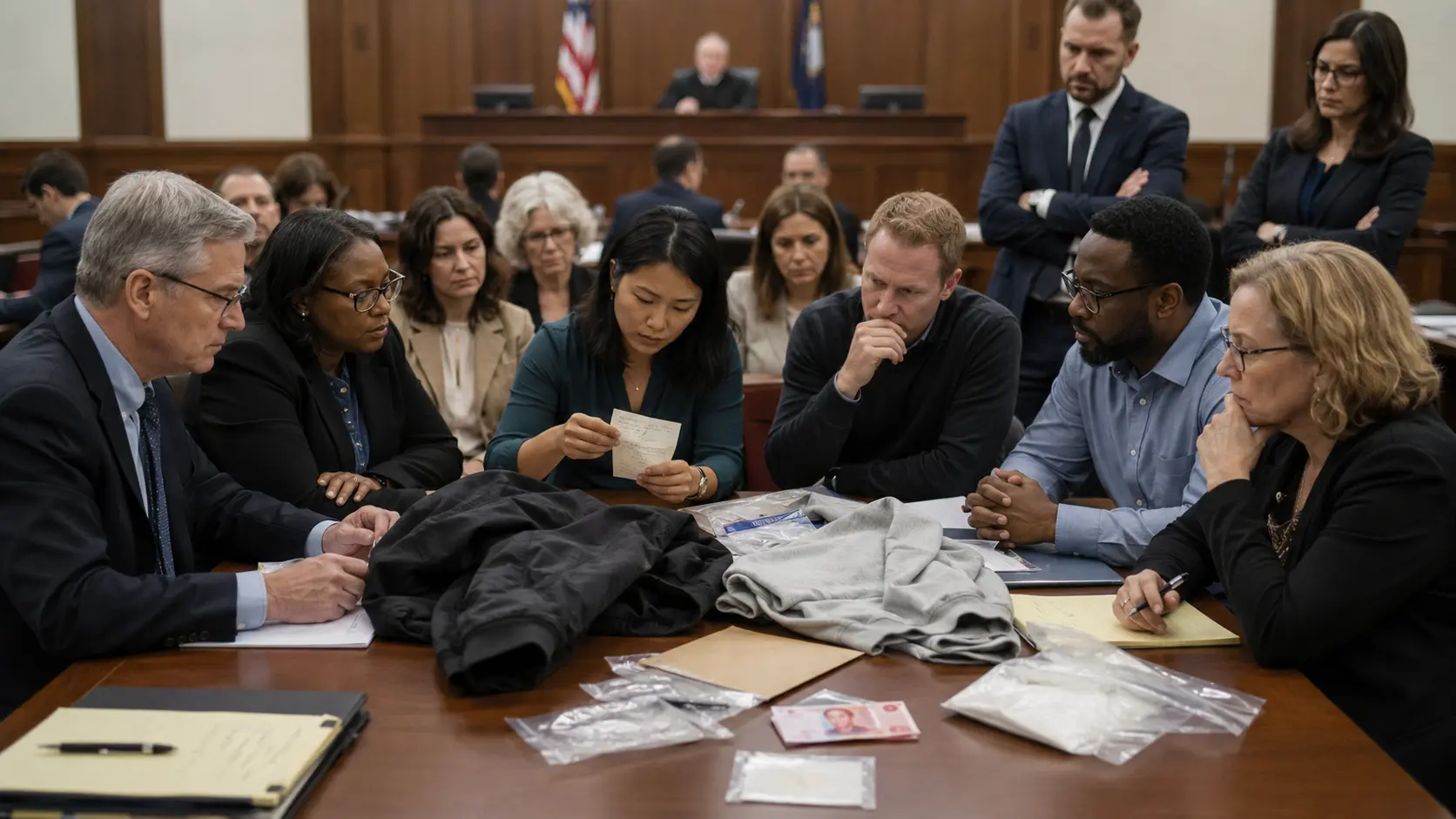
A monthlong federal robbery trial in Washington, D.C., took an unexpected turn when jurors examining evidence discovered a Chinese yuan note and a white powdery substance hidden inside clothing that had already been presented in court.
The items had apparently gone unnoticed by investigators, prosecutors and defense lawyers before the jury began deliberating in the case against Shamell Naquan Joyner. U.S. District Judge Rudolph Contreras later expressed strong concern about the failure to identify the material earlier.
The discovery did not lead to a complete collapse of the prosecution’s case. After questioning jurors individually, the judge instructed them that the newly discovered items were not part of the evidence admitted at trial and should not influence their deliberations.
The jury ultimately convicted Joyner on 13 counts but could not reach agreement on another 15 charges.
What the jury discovered
The unexpected discovery occurred during deliberations on July 22.
According to the trial record cited in reporting, jurors were examining a jacket that had been introduced as evidence. One juror reached into a pocket and found what appeared to be a folded piece of paper containing a white powdery substance.
The jurors also examined a sweatshirt and found a Chinese yuan note inside a pocket.
Neither item had been identified as evidence during the trial. That distinction became critical because evidence discovered independently by jurors can create serious questions about whether it could unfairly influence their view of a defendant.
Judge Contreras brought the jurors into court individually and explained that the newly discovered material was outside the evidence presented to them. Each juror indicated that they could put the discovery aside and continue considering only the evidence properly admitted at trial.
A case involving 28 federal charges

Joyner’s case was unusually large for a federal robbery prosecution.
Court records show that he faced 28 counts involving alleged armed robberies, carjackings, stolen vehicles and firearm-related offenses. Prosecutors alleged that the crimes occurred across the District of Columbia, Maryland and Virginia between April and May 2023.
An earlier federal indictment announced in 2023 accused Joyner of offenses connected to armed robberies and a carjacking. A later superseding indictment expanded the case to 28 counts involving 10 alleged commercial robberies and two alleged armed carjackings.
The trial began in June 2026 and lasted roughly a month, with testimony spread across multiple trial days before the jury began deliberating.
Why the discovery mattered
The significance of the discovery was not simply that the items might have been incriminating.
The central legal concern was whether the jury could remain impartial after unexpectedly finding material that had never been presented as part of the prosecution’s case.
The clothing itself was important to the prosecution’s evidence because it was connected to alleged robberies and was recovered from a vehicle involved in the investigation. That made the discovery of additional material inside the pockets particularly sensitive.
The judge’s response focused on preventing the jurors from considering information that had not been properly introduced at trial.
The episode also highlighted a basic but consequential part of criminal trials: evidence must be identified, examined and presented through established procedures rather than discovered for the first time by jurors.
The jury reached a partial verdict
The discovery did not prevent the jury from reaching a verdict on some of the charges.
Jurors convicted Joyner on 13 counts related to several armed robberies and a carjacking. They remained deadlocked on 15 other counts, saying they could not agree on issues including reasonable doubt and whether the evidence established the defendant’s identity beyond that standard.
The U.S. Attorney’s Office said the convictions carry a mandatory minimum sentence of 31 years.
Joyner’s defense lawyers have not yet appealed the convictions, according to the reporting available at the time of publication.
Sources Used
https://edition.cnn.com/2026/08/10/politics/dc-trial-doj-fbi-error
Evidence handling remains a key question
The unusual discovery has placed attention on how physical evidence was processed and reviewed before being presented to the jury.
Court records from earlier stages of the case show that Joyner’s defense had already raised questions concerning evidence and disclosure during the proceedings. In July, Judge Contreras denied a defense motion seeking a mistrial and additional relief.
The latest episode is different: the items were apparently physically present inside evidence that the jury was permitted to examine but had not previously been identified as relevant evidence.
The FBI did not comment publicly on why the material was not discovered earlier, according to the reporting.
For now, the convictions stand, while the unresolved charges and any potential appeal remain separate legal questions. The case illustrates how even a late and seemingly minor discovery can create significant procedural concerns in a criminal trial.
Colombia Earthquake: Death Toll Reaches 132 After 7.4-Magnitude Quake, Rescue Efforts Continue
केरल का नाम अब ‘केरलम’ करने की दिशा में बड़ा कदम, लोकसभा ने पारित किया नाम परिवर्तन विधेयक