


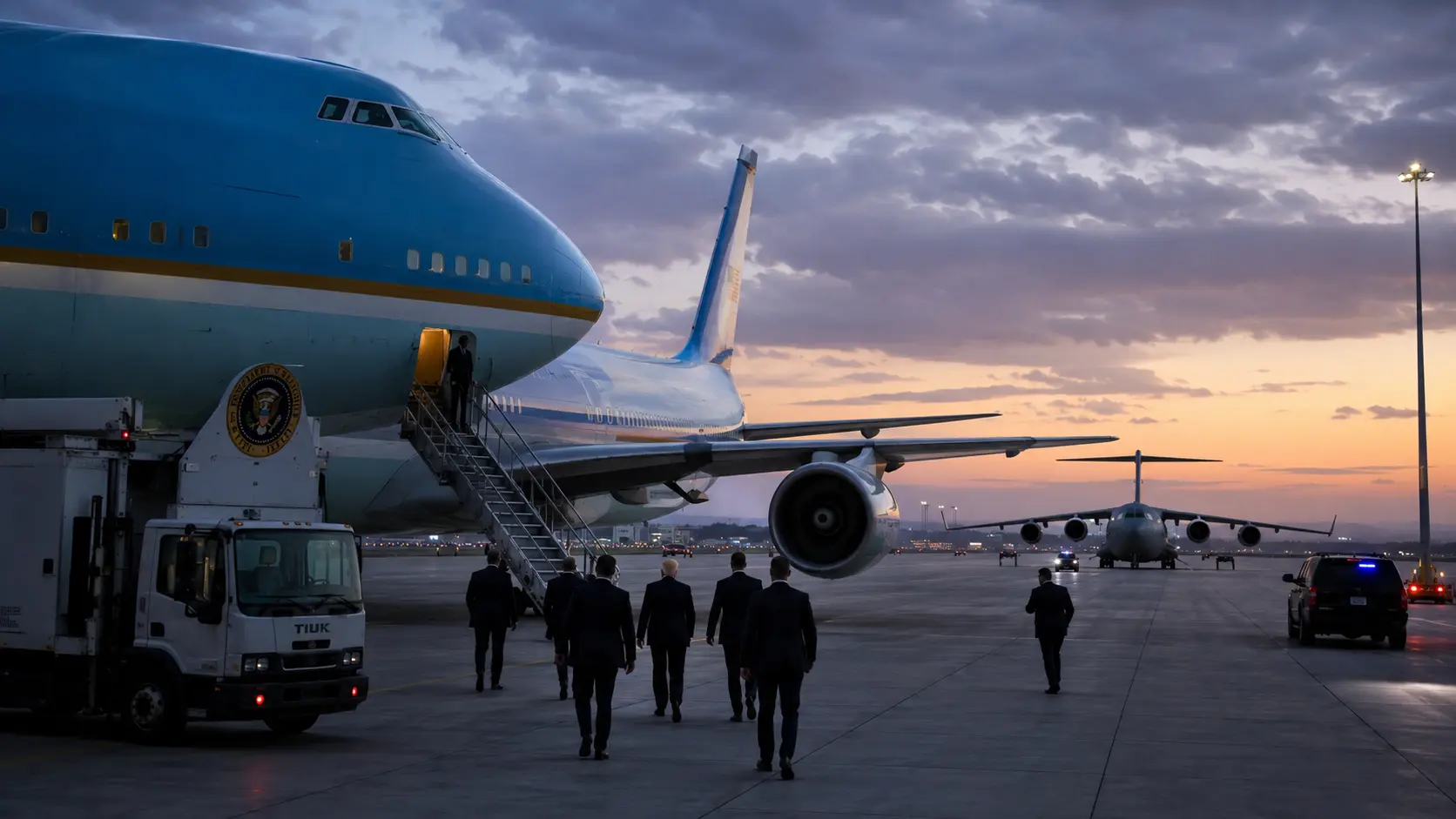
Trump Air Force One Turkey became the focus of new security questions after Donald Trump revealed that he was secretly moved from his presidential aircraft during his departure from Turkey.
President Donald Trump has confirmed that his unexpected change of aircraft while leaving Turkey last month was driven by security concerns, offering the first direct explanation for a mysterious episode that had already raised questions about the safety of his presidential travel.
Trump said the Secret Service and military advised him to leave his usual aircraft and take another plane because of a threat linked to Iran. He also suggested that the aircraft he ultimately used may itself have been at greater risk because an attacker would be more likely to target the plane associated with the president.
The revelation adds a new layer to an incident that initially appeared to be a relatively straightforward aircraft swap after the NATO summit in Ankara. Earlier reports had established that Trump left Turkey aboard an older Air Force One rather than the newly refurbished Boeing 747-8 donated by Qatar. Later reporting, however, described a far more elaborate operation in which Trump was secretly moved to a separate military aircraft.
A routine-looking departure concealed a much bigger security operation
Trump had arrived in Ankara aboard the newer Boeing 747-8, which had recently been provided by Qatar and refurbished for presidential use.
When he departed Turkey on July 8, the public saw a different aircraft: one of the older planes traditionally used as Air Force One. At the time, the White House and Trump offered explanations that did not fully reveal the security concerns behind the decision.
Reporting later indicated that the Secret Service had pushed for Trump to use the older aircraft because of concerns connected to escalating conflict with Iran. U.S. officials told CBS News that intelligence indicated a credible threat involving a missile attack against the president or his aircraft.
The latest account is considerably more unusual.
According to reporting by the Washington Post, Trump was secretly transferred from the presidential aircraft to a smaller military jet. The operation involved an airport catering vehicle, allowing the president to move without being publicly identified as he changed aircraft. Associated Press reporting said the operation was organized by the Secret Service and military personnel and that journalists and some White House personnel were unaware of the change.
That means the aircraft publicly identified as Trump’s departure plane functioned, at least temporarily, as a decoy.
Why the new details matter
Presidential travel is built around layers of security. The aircraft, route, timing and movements of the president are routinely protected because revealing them can create opportunities for an attack.
The unusual element in this case was not simply that Trump changed aircraft. Presidents have used secret travel arrangements and decoy movements before.
What makes the Turkey episode significant is the extent to which the operation appears to have concealed the president’s actual location from people traveling with him.
Reuters reported that Trump said he followed the instructions of the Secret Service and military officials rather than seeking detailed information about the threat. He characterized the decision as one made by the people responsible for protecting him.
That explanation also illustrates the dilemma facing presidential security teams: information that could help protect the president can itself become dangerous if too many people know it.
The Iran connection
The episode unfolded against the backdrop of sharply heightened tensions between Washington and Tehran.
Earlier reporting indicated that U.S. officials believed there was a credible threat from Iran or Iranian-linked forces against Trump. CBS reported that intelligence suggested a possible missile attack involving the president’s aircraft.
Trump has previously faced threats from Iran. The broader security environment therefore was not hypothetical, even though many details of the specific intelligence behind the Turkey operation remain classified or undisclosed.
It is also important to distinguish what is established from what remains uncertain.
There is now substantial reporting that security concerns connected to Iran influenced the aircraft decision. But the precise intelligence received by U.S. authorities, the identity of any intended attacker and the exact nature of the threat have not been publicly established in full.
Those gaps matter because presidential protection decisions are often based on intelligence that cannot be disclosed publicly without revealing sources or methods.
The new Qatar aircraft is part of the story
The incident also revived questions about the security configuration of the new aircraft donated by Qatar.
The Boeing 747-8 had been presented as a temporary presidential aircraft while Boeing works on replacement Air Force One planes. Trump had begun using it for international travel, including the trip to Turkey.
But the aircraft did not initially possess every defensive capability associated with the long-established presidential aircraft fleet.
After the Turkey incident, the White House said the newer aircraft would undergo additional security upgrades. CBS later reported that the administration planned to continue using the older Air Force One while the new aircraft received further enhancements.
That sequence is significant because it suggests the aircraft’s readiness was not simply a question of luxury, comfort or appearance. Presidential aviation requires specialized communications, defensive systems and other security capabilities that go far beyond those of a conventional civilian 747.
The older Air Force One aircraft, by contrast, has been developed and modified over many years specifically for presidential operations.
What happened to the people who thought Trump was aboard?
One of the most sensitive questions concerns the people who remained associated with the publicly identified aircraft.
According to the latest reports, journalists and some White House personnel believed Trump was traveling on the older Air Force One. The aircraft subsequently continued toward Britain, while Trump traveled separately.
That raises an uncomfortable question about the balance between presidential secrecy and the safety of people accompanying the president.
The White House’s likely security rationale is straightforward: revealing that the president had switched aircraft could have undermined the very deception intended to protect him.
But the episode also raises questions about whether those unaware passengers could have been placed in greater danger if an adversary had targeted the aircraft believing Trump was aboard.
Those questions are likely to remain part of the debate over the operation, particularly because the press pool serves a distinct role in presidential travel. Journalists traveling with a president are not merely passengers; they provide independent documentation of presidential movements.
Secret presidential travel is not unprecedented
The use of deception to protect a president is not without precedent.
U.S. presidents have periodically traveled secretly when security conditions required it. Decoy aircraft, undisclosed routes and restricted information have all been used in different circumstances.
The existence of such practices, however, does not answer the central question raised by the Turkey episode: how much information should be shared with people traveling alongside the president when the threat itself may make disclosure dangerous?
That question becomes particularly complicated when the people involved include journalists, aides and other personnel who may themselves become targets if an adversary believes the president is present.
What comes next
The immediate issue is no longer simply why Trump changed planes in Turkey. The episode has become a test of how the administration balances presidential protection, the security of accompanying personnel and transparency.
There are also practical questions surrounding the Qatar-donated aircraft.
The White House has said the jet will receive additional upgrades, while Trump is expected to continue using the older presidential aircraft for some travel during that process.
The unanswered questions include how extensive those upgrades will be, what defensive capabilities were missing or incomplete when Trump first traveled on the aircraft, and whether similar aircraft changes will be required during future trips to regions considered high risk.
For Trump, the episode is a reminder that presidential travel can change in seconds when intelligence officials identify a credible threat.
For the public, the more consequential story is what the unusual escape from Turkey reveals about the security demands surrounding the presidency and how far officials are prepared to go to keep the president’s location hidden when they believe an attack may be possible.
स्ट्रेट ऑफ होर्मुज पर ट्रंप का बड़ा दावा, ईरान से मांगा युद्ध का मुआवजा
Colombia Earthquake: Death Toll Reaches 132 After 7.4-Magnitude Quake, Rescue Efforts Continue
Jurors Find Suspected Drugs and Chinese Yuan Hidden in Evidence During D.C. Trial