



US-Iran latest news: Tensions between the United States and Iran have entered a dangerous phase for global energy markets. Iran has warned that further US attacks could trigger retaliation against energy infrastructure across the Gulf, while attacks and disruptions around the Strait of Hormuz are already putting pressure on international oil supplies.
The immediate impact is visible in crude markets. Brent crude has moved above $97 per barrel, while WTI has also climbed as traders assess the possibility of further disruption to Gulf oil shipments.
For readers looking for the wider impact of the conflict on crude prices, India and the global economy, HNN24x7 has also covered the issue in [US-Iran War: Oil Price, India and Global Impact]. US-Iran War: Oil Price, India and Global Impact
The key question now is not simply whether the US and Iran will exchange more attacks. It is whether the conflict could spread to oil terminals, refineries, pipelines, tankers and other energy assets across the Persian Gulf.
What is the latest US-Iran development?
Iranian officials have warned that Gulf energy infrastructure could become a target if the United States continues military action against Iranian assets.
Reuters reported that Iranian officials warned the US that regional energy assets were vulnerable and threatened retaliation. Tehran has also discussed establishing a new restricted maritime zone and a new shipping corridor around the Strait of Hormuz.
The warning comes after a series of military and maritime incidents involving the US, Iran and commercial shipping.
The situation has already affected tanker movement. Reuters reported that shipping traffic through the Strait of Hormuz slowed after Iran threatened retaliation for further US attacks.
That creates a significant risk for the global energy market because Hormuz is not an ordinary shipping route.
It is one of the world’s most important oil chokepoints.
Why is the Strait of Hormuz so important?
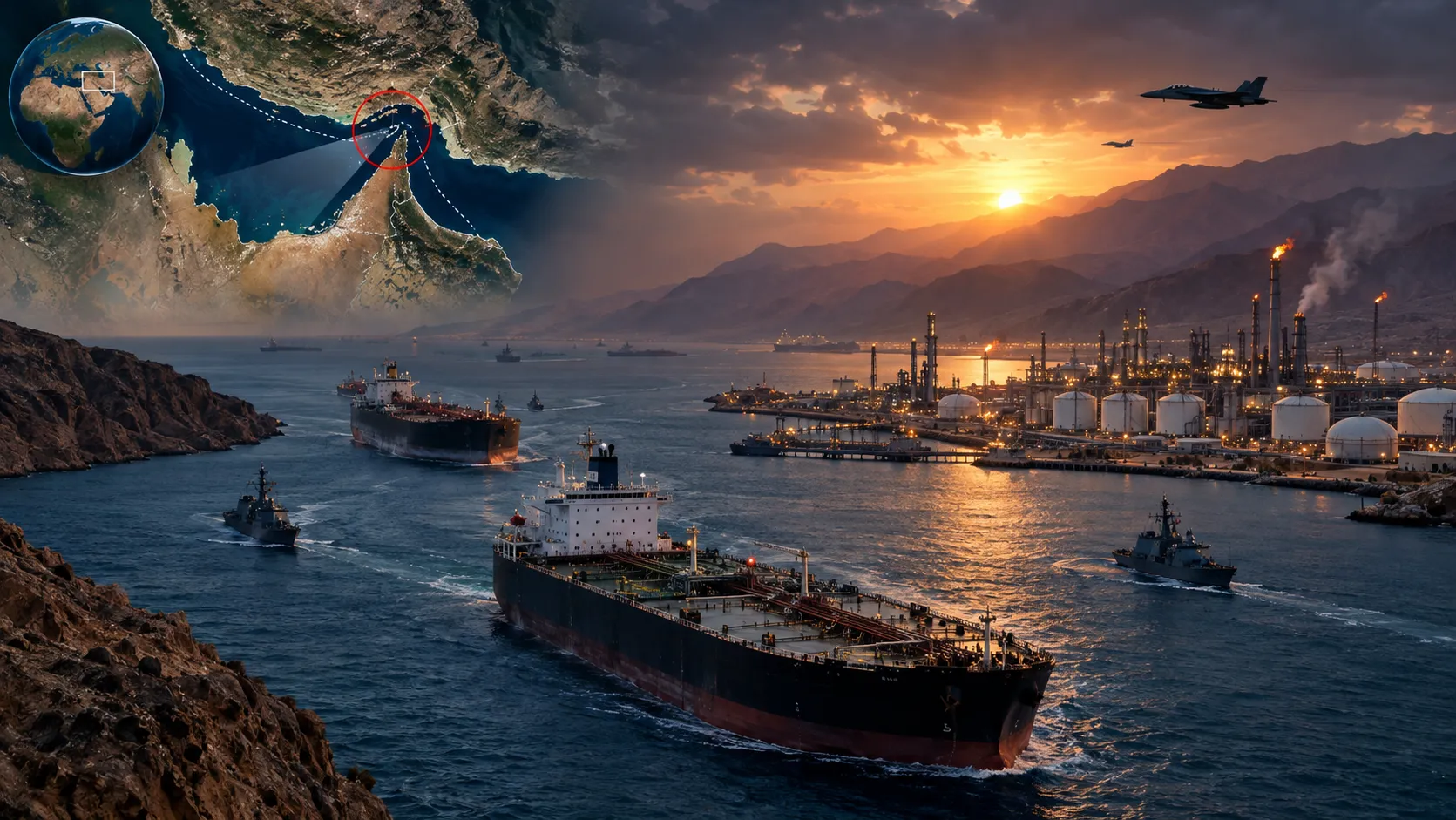
The Strait of Hormuz is a narrow waterway between Iran and Oman that connects the Persian Gulf with the Gulf of Oman and the Arabian Sea.
According to the U.S. Energy Information Administration, around 20 million barrels per day of oil moved through the strait in 2024, equivalent to roughly 20% of global petroleum liquids consumption. The International Energy Agency says about 20 million barrels per day of crude and oil products were shipped through Hormuz in 2025, representing around one-quarter of global seaborne oil trade.
That makes any serious disruption potentially global rather than regional.
What makes Hormuz difficult to replace?
The biggest problem is that alternative routes cannot easily absorb the same volume.
Saudi Arabia and the UAE have pipelines that can bypass part of the Strait of Hormuz. EIA estimates that these alternatives could provide roughly 4.7 million barrels per day of bypass capacity — far below the normal volumes moving through the waterway.
This is why markets react sharply whenever there is a threat to Hormuz.
Even without a complete closure, insurance costs, tanker delays, security concerns and companies avoiding the route can reduce effective supply.
Why is Gulf oil infrastructure now at greater risk?
There are several reasons.
1. The conflict is moving from military targets toward economic pressure
Oil is central to Iran’s economic and geopolitical position.
At the same time, the United States has been using sanctions, economic pressure and measures aimed at restricting Iran’s oil exports. Reuters reported that Washington’s campaign to restrict Iran’s oil trade and sanctions evasion has intensified.
If Iran believes its energy exports and economic lifelines are being targeted, Gulf energy infrastructure becomes a potential pressure point.
That does not mean an attack on Gulf oil facilities is certain. It means the market is increasingly pricing in the possibility of further escalation.
2. Gulf infrastructure is highly concentrated
The Persian Gulf contains some of the world’s most important oil-producing and refining facilities.
Saudi Arabia, the UAE, Kuwait, Qatar, Bahrain and Iraq all have energy infrastructure connected directly or indirectly to the Gulf shipping system.
A major incident involving a refinery, export terminal, pipeline or tanker could therefore affect both physical supply and market confidence.
3. Tanker attacks have already increased the risk premium
The threat is no longer theoretical.
Reuters reported that two tankers carrying Saudi crude were attacked by unidentified projectiles while transiting the Strait of Hormuz on September 1. No casualties were reported, but the incidents demonstrated how vulnerable commercial shipping has become.
The US also recently struck three Iranian oil tankers after Iranian ballistic missiles targeted US Navy vessels, according to Associated Press.
Each new incident increases the possibility that the next escalation could involve more commercial shipping or energy infrastructure.
Iran warns US energy assets in Gulf are vulnerable after latest clashes
Why has Brent crude reached around $97?
Oil prices are driven not only by actual supply losses but also by expectations about future supply.
That distinction is important in the current Iran US conflict.
Brent crude moved above $97 as traders assessed the possibility of prolonged disruption to oil shipments. Reuters reported that oil prices reached a six-week high after Iran threatened energy infrastructure across the Middle East.
On September 8, Brent was around the $97 level, while WTI was above $92.
The market is essentially adding a geopolitical risk premium.
If traders believe that:
- tanker traffic could decline,
- Gulf terminals could be attacked,
- insurance costs could rise,
- shipping companies could avoid Hormuz,
- or a wider war could reduce production,
they bid up crude prices before the physical shortage fully develops.
What happens if Gulf oil infrastructure is attacked?
The impact would depend on the scale and location of an attack.
Scenario 1: Limited attack
A small or isolated attack on an oil facility could temporarily disrupt production or exports.
Oil prices could rise sharply, but markets might stabilize if repairs are quick and shipping continues.
Scenario 2: Multiple energy facilities are hit
If several export terminals, refineries or pipelines were attacked at the same time, physical supply could fall substantially.
That could push Brent considerably higher and increase fuel costs around the world.
Scenario 3: Strait of Hormuz shipping is severely disrupted
This would be the most serious scenario.
The Strait carried about 20 million barrels per day in 2024 and around 20 million barrels per day in 2025, according to EIA and IEA data.
A sustained disruption would therefore affect crude, petroleum products and LNG shipments.
The consequences could include:
Higher crude prices → higher fuel costs → higher transport costs → higher inflation → pressure on central banks.
Goldman Sachs has warned that oil could potentially reach $120 per barrel if attacks on Middle East shipping intensify, although that is a risk scenario rather than a prediction that $120 is inevitable.
How could the Strait of Hormuz crisis affect India?
India is particularly sensitive to developments in the Gulf because of its dependence on imported crude oil.
The Asian market is also highly exposed to Hormuz. EIA estimates that in 2024 around 84% of crude oil and condensate moving through Hormuz went to Asian markets. China, India, Japan and South Korea together accounted for a major share of those flows.
For India, prolonged disruption could affect:
- Petrol and diesel prices
- Aviation turbine fuel
- LPG and other petroleum products
- Transport costs
- Manufacturing expenses
- Fertilizer and chemical costs
- Inflation
- The current account balance
- The Indian rupee
The impact would depend on how long the disruption lasted and how much crude India could source from alternative suppliers.
Could Gulf countries keep exporting oil if Hormuz is disrupted?
Partially, but not at the same scale.
Saudi Arabia and the UAE have alternative pipeline routes that can bypass the Strait of Hormuz. EIA estimates that Saudi and UAE pipelines together could provide about 4.7 million barrels per day of bypass capacity.
Iran also has the Goreh-Jask pipeline and Jask export terminal designed to move some oil without using Hormuz. However, EIA has noted that the system’s effective capacity is much smaller than the volumes normally passing through the strait.
Therefore, bypass routes can reduce the damage but cannot completely replace Hormuz.
Is a complete closure of the Strait of Hormuz inevitable?
No.
This is an important distinction.
Current warnings and military incidents increase the risk of disruption, but they do not automatically mean that Iran will completely close the waterway.
A full closure would also carry enormous economic consequences for Iran and other Gulf states whose oil exports depend heavily on the route.
The more immediate concern is partial disruption.
Even slower tanker movement, attacks on individual vessels, higher insurance premiums or temporary restrictions can reduce effective supply and push prices higher.
Why are oil markets reacting before a major shortage?
Because energy markets are forward-looking.
Traders do not wait until millions of barrels disappear from the market.
They react to the possibility that supply could disappear.
This is why a statement from Iranian officials about Gulf energy infrastructure can move oil prices even before an oil facility is physically damaged.
The same mechanism works in the opposite direction. Any credible diplomatic agreement, reopening of shipping routes or reduction in military activity could quickly remove some of the risk premium.
What does this mean for the global economy?
A prolonged Strait of Hormuz crisis could become more than an oil-market problem.
Higher crude prices can increase the cost of:
- Transportation
- Manufacturing
- Air travel
- Electricity generation in some markets
- Petrochemicals
- Food distribution
- Consumer goods
If inflation rises because of energy costs, central banks may find it harder to cut interest rates.
That creates a second-round economic effect: geopolitical conflict can translate into higher inflation and tighter financial conditions.
The biggest risk therefore comes from a combination of supply disruption and prolonged uncertainty.
What should markets watch next?
The next few developments will be particularly important.
1. Movement of commercial tankers
A further decline in tanker traffic through Hormuz would indicate that shipping companies are becoming more concerned about security.
2. Attacks on energy infrastructure
Any confirmed attack on a major Gulf refinery, export terminal, pipeline or storage facility could trigger another sharp move in oil prices.
3. Iranian statements on Hormuz
Tehran’s position on the restricted maritime zone and shipping access will be closely watched.
4. US military response
Any further US strikes against Iranian military or economic targets could increase the probability of Iranian retaliation.
5. Diplomatic negotiations
A credible diplomatic arrangement that protects shipping and reduces military confrontation could quickly ease the oil-market risk premium.
US-Iran Tension: What is the biggest risk for oil markets?
The biggest risk is not necessarily one isolated attack.
It is an escalation cycle.
A possible chain could look like this:
US strike → Iranian retaliation → tanker/energy infrastructure attack → shipping disruption → oil supply concerns → higher Brent prices → inflation pressure → further geopolitical and economic instability.
That is why the current US Iran latest news is being watched so closely by energy markets.
The situation remains fluid, and claims about future attacks should be treated as warnings or scenarios rather than confirmed events.
For now, the clearest market signal is the rise in crude prices toward $97 per barrel, combined with increased concern about tanker traffic and the security of Gulf energy infrastructure.
FAQ
Why is Brent crude near $97?
Brent crude has risen toward $97 per barrel because escalating US-Iran tensions are increasing fears of further disruptions to Gulf oil production and shipping, particularly around the Strait of Hormuz.
Why is the Strait of Hormuz important for oil?
The Strait of Hormuz is one of the world’s most important oil chokepoints. Around 20 million barrels per day of oil moved through it in 2024, equivalent to roughly one-fifth of global petroleum liquids consumption.
Could Iran attack Gulf oil infrastructure?
Iranian officials have warned that regional energy infrastructure could be targeted in retaliation for further US attacks. However, a future attack is not guaranteed and should be treated as a potential escalation scenario.
What happens if the Strait of Hormuz is blocked?
A prolonged disruption could sharply reduce global oil and LNG shipments, push crude prices higher and increase inflationary pressure. Alternative pipelines exist, but their capacity is significantly smaller than normal Hormuz flows.
How could the Iran-US conflict affect India?
India could face higher crude-import costs, potentially affecting petrol, diesel, aviation fuel, LPG, transportation, inflation and the rupee if Gulf supply disruptions persist.
Can Saudi Arabia and the UAE bypass Hormuz?
Partially. Saudi Arabia and the UAE have pipeline routes that can bypass the Strait, but their combined estimated capacity is much smaller than the normal oil volumes moving through Hormuz.
Could oil reach $120?
It is a possible risk scenario rather than a certainty. Goldman Sachs has estimated that oil could reach as high as $120 per barrel if attacks on Middle East shipping intensify.