

India-China relations in 2026 are showing a cautious shift from confrontation toward structured engagement, although the relationship remains far from fully normal.
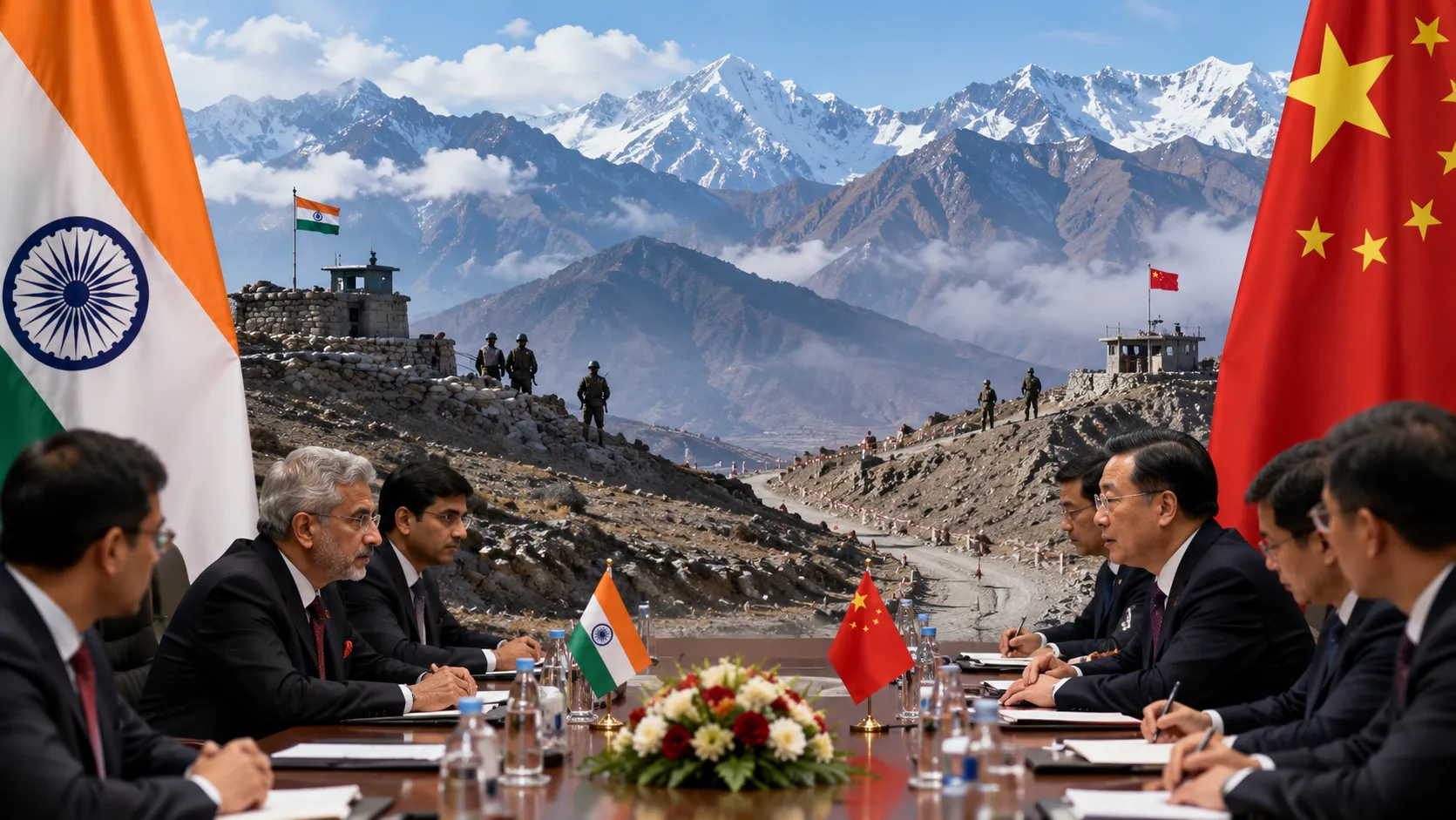
The biggest recent development came in early September when Indian and Chinese military commanders held talks at the Wacha-Damai border meeting point in Arunachal Pradesh’s Kibithoo sector. The meeting focused on the situation along the Line of Actual Control (LAC) and maintaining peace and tranquillity on the frontier.
The military dialogue came just days after India’s National Security Adviser Ajit Doval and Chinese Foreign Minister Wang Yi held the 25th round of Special Representatives’ talks on the boundary question in Beijing.
For readers looking for the background to the military dialogue, HNN24x7 has previously covered the India-China border talks and Corps Commander meeting in 2026.
The latest developments suggest that New Delhi and Beijing are attempting to build “guardrails” around their rivalry — managing military tensions while gradually reopening diplomatic, economic and people-to-people channels.
But this should not be interpreted as a complete resolution of the border dispute.
What is the latest India-China development?
The immediate development is the Corps Commander-level meeting in Arunachal Pradesh.
Indian and Chinese military representatives reviewed the situation along the LAC in the eastern sector. The meeting was held on the Indian side at the Wacha-Damai border meeting point in the Kibithoo area. India’s delegation was headed by Lieutenant General Girish Kalia, commander of the Army’s III Corps.
The talks took place amid reports of tensions in the Taksing area of Upper Subansiri district.
The significance of the meeting lies in its timing.
Rather than allowing localised border tensions to escalate, both sides used a military communication mechanism to discuss the situation directly.
This is important because the India-China relationship has been heavily affected by the 2020 border crisis.
What happened in the latest India-China border talks?
On August 25, 2026, Ajit Doval and Wang Yi held the 25th round of Special Representatives’ talks on the boundary question in Beijing.
The two sides agreed on an eight-point set of outcomes and consensus.
According to China’s Foreign Ministry, both sides reaffirmed the need to maintain peace and tranquillity in border areas and agreed to continue negotiations toward a fair, reasonable and mutually acceptable settlement of the boundary question.
The talks also linked the border question with the broader India-China relationship.
That is significant because New Delhi and Beijing are increasingly trying to prevent the unresolved boundary dispute from completely blocking cooperation in other areas.
The talks do not mean that the territorial dispute has been solved.
Instead, they indicate that both governments are trying to create a more stable framework for managing their differences.
Why is the Corps Commander meeting important?
The military meeting is important because diplomacy at the political level needs a functioning military communication system on the ground.
The LAC is not a mutually demarcated international boundary, and the two countries have different perceptions of parts of it.
As a result, patrols and infrastructure activity can sometimes create friction even when both governments are trying to prevent escalation.
Military-level meetings can therefore help:
- communicate developments directly;
- prevent local incidents from becoming larger crises;
- maintain peace and tranquillity;
- clarify concerns about troop movements;
- strengthen confidence-building mechanisms;
- keep communication channels open during periods of tension.
India’s Embassy in Beijing says the two countries have continued discussions through mechanisms such as the Working Mechanism for Consultation and Coordination (WMCC) and Senior Commanders’ Meetings since the 2020 crisis. It says the latest WMCC meeting was held in Beijing on May 28, 2026.
Is India-China relations actually improving?
Yes, but only cautiously.
The relationship is moving toward greater engagement, but it would be inaccurate to describe it as a complete return to pre-2020 normalcy.
There are three different layers to understand.
1. Border management is improving
The two countries have resumed more structured dialogue and military communication.
The August Special Representatives’ talks and September Corps Commander meeting are evidence of this.
2. Political engagement has increased
India and China have resumed higher-level political engagement through multilateral forums and bilateral channels.
The relationship has also been influenced by meetings between Prime Minister Narendra Modi and Chinese President Xi Jinping.
3. Economic and people-to-people ties are gradually reopening
Direct flights were resumed in October 2025, according to India’s Embassy in Beijing.
The Kailash Mansarovar Yatra also resumed after a nearly five-year interruption, with the 2026 pilgrimage continuing through routes including Nathu La.
These developments show that the relationship is no longer defined exclusively by the 2020 border crisis.
However, major strategic differences remain.
What changed after the 2020 Galwan clash?
The Galwan Valley clash of June 2020 transformed India-China relations.
The confrontation resulted in deaths on both sides and led to a prolonged military standoff in eastern Ladakh.
For several years, diplomatic relations, military confidence and people-to-people exchanges were affected.
India’s position has consistently emphasized that peace and tranquillity along the border are essential for the broader relationship.
The Indian government has also maintained that the two sides must respect the LAC, avoid unilateral attempts to change the status quo and adhere to existing agreements and understandings.
The gradual disengagement process subsequently created space for political dialogue.
By 2025, both countries were publicly discussing a broader improvement in bilateral relations.
Why is 2026 becoming an important year for India-China relations?
2026 is significant because several channels of engagement are operating simultaneously.
The border dialogue is active.
Military commanders are communicating.
Diplomatic discussions have resumed.
People-to-people exchanges have expanded.
And the two countries are preparing for another major multilateral interaction through BRICS.
The BRICS Summit is scheduled to be held in New Delhi on September 12–13, 2026, creating another opportunity for high-level India-China engagement. Recent reporting indicates that Chinese President Xi Jinping is expected to attend.
This makes the timing of the latest border meeting particularly important.
Both countries have an incentive to prevent a new border crisis from overshadowing a major diplomatic gathering.
India-China relations: From confrontation to “managed competition”
The emerging relationship is better described as managed competition rather than friendship.
India and China remain strategic competitors in several areas:
- Border security
- Infrastructure
- Indian Ocean geopolitics
- Technology
- Trade
- Supply chains
- Regional influence
- Relations with neighbouring countries
At the same time, both countries have reasons to cooperate.
They are major Asian economies and members of platforms such as BRICS, SCO and G20-related multilateral mechanisms.
This creates an unusual situation: India and China can compete in one area while cooperating in another.
That is why the phrase “cooperation versus competition” increasingly describes the relationship. Recent analysis of the upcoming BRICS summit also highlights this tension between strategic competition and institutional cooperation.
What about India-China trade?
Trade remains one of the most complicated parts of the relationship.
China remains a major source of imports for India, particularly in areas such as electronics, machinery, chemicals, components and industrial goods.
But India has also maintained restrictions and regulatory scrutiny around some Chinese investments and technology-related activities because of national-security and economic concerns.
Ahead of the 2026 BRICS summit, economic discussions are expected to include India’s restrictions on Chinese technology imports and investment-related measures.
This creates a central contradiction:
India wants economic resilience and reduced strategic dependence, but it cannot completely ignore the scale of its economic relationship with China.
That tension will remain a major part of India-China relations.
Are border tensions over?
No. The border dispute remains unresolved.
This is perhaps the most important point for understanding the latest India China latest news.
The recent meetings indicate better communication and crisis management. They do not represent a final boundary settlement.
The August 2026 Special Representatives’ talks specifically referred to continued negotiations for a long-term boundary settlement.
The latest Corps Commander meeting also occurred amid reports of military tensions in Arunachal Pradesh.
Therefore, the correct description is:
Tensions have become more manageable, but the underlying dispute remains.
Why is Arunachal Pradesh important?
Arunachal Pradesh is strategically important because China claims the territory and refers to it as “Zangnan,” while India considers Arunachal Pradesh an integral part of the country.
The eastern sector is therefore one of the most sensitive areas of the India-China border.
Recent reports of military activity around the Taksing area made the September Corps Commander talks particularly relevant.
Direct military communication in this region can help prevent misunderstandings from escalating.
What role will Modi and Xi play?
Political leadership remains critical.
Prime Minister Narendra Modi and President Xi Jinping have already established a framework for improving bilateral ties after the deterioration caused by the 2020 crisis.
During their 2025 bilateral meeting in Tianjin, Modi said that an atmosphere of peace and stability had been established after border disengagement and emphasized rebuilding relations on the basis of mutual trust, respect and sensitivity. The two sides also discussed direct flights, the Kailash Mansarovar Yatra and economic relations.
The next challenge is turning those political commitments into stable conditions on the ground.
What does the latest change mean for India?
For India, improved communication with China has several advantages.
Border stability
The most immediate benefit is reducing the risk of an unexpected military escalation.
Economic predictability
More stable relations could make trade and investment decisions easier for businesses.
Diplomatic flexibility
India can maintain strategic autonomy while engaging with China, Russia, the United States and other major powers.
Regional stability
A stable India-China relationship can reduce the risk of wider geopolitical competition across Asia.
But India is unlikely to abandon its security concerns.
New Delhi continues to strengthen infrastructure and military preparedness along sensitive border areas while maintaining diplomatic dialogue.
What does the change mean for China?
China also has reasons to reduce tensions with India.
Stable relations can support:
- BRICS cooperation;
- SCO coordination;
- trade;
- regional stability;
- broader Global South diplomacy;
- reduced risk of another prolonged Himalayan military standoff.
China has also publicly emphasized that stable China-India relations serve the interests of both countries and the wider Global South.
However, Beijing’s position on the boundary dispute remains fundamentally different from India’s, meaning the strategic competition is unlikely to disappear.
What happens next in India-China relations?
The next phase is likely to focus on stability rather than a dramatic breakthrough.
Several developments will be worth watching.
1. More military-level communication
The latest Corps Commander meeting could become part of a broader effort to institutionalize military communication in the eastern sector.
2. Continued Special Representatives’ talks
The two countries have agreed to continue negotiations on the boundary question.
3. BRICS diplomacy
The September 12–13 BRICS Summit in New Delhi could provide another opportunity for Modi and Xi to engage.
4. Economic discussions
Trade, technology restrictions and investment rules are likely to remain difficult but important issues.
5. People-to-people exchanges
Direct flights, tourism and the Kailash Mansarovar Yatra could continue supporting the gradual normalization process. India’s Embassy in Beijing says direct flights resumed in October 2025 and the pilgrimage continued in 2026.
India-China Relations 2026: What is the real picture?
The simplest way to understand India China relations 2026 is this:
The relationship is moving away from uncontrolled confrontation toward controlled competition and dialogue — but it has not reached full normalization.
The most visible change is the return of multiple communication channels.
At the border, military commanders are talking.
At the diplomatic level, Ajit Doval and Wang Yi are discussing the boundary question.
At the political level, Modi and Xi have reopened high-level engagement.
At the people-to-people level, flights and the Kailash Mansarovar Yatra have resumed.
And at the multilateral level, India and China continue to work together through platforms such as BRICS and SCO.
Yet the fundamental border dispute remains unresolved, strategic competition continues and local tensions can still emerge.
Therefore, the latest phase of India-China relations should not be described as a friendship reset.
It is better understood as a cautious attempt to build stability without eliminating strategic rivalry.
That distinction will be crucial as India and China enter another important diplomatic phase in 2026.
FAQ
What is the latest India-China news in September 2026?
Indian and Chinese military commanders held talks at the Wacha-Damai border meeting point in Arunachal Pradesh to discuss the LAC situation and maintaining peace along the frontier. The meeting followed Special Representatives’ talks between Ajit Doval and Wang Yi in Beijing.
Are India-China relations improving in 2026?
Relations are showing cautious improvement through increased diplomatic, military and people-to-people engagement. However, the border dispute remains unresolved and strategic competition continues.
What happened in the latest India-China border talks?
On August 25, 2026, Ajit Doval and Wang Yi held the 25th round of Special Representatives’ talks. The two sides agreed to continue negotiations toward a fair, reasonable and mutually acceptable boundary settlement.
Why is the India-China Corps Commander meeting important?
Military-level talks provide a direct communication channel for managing tensions along the LAC and can help prevent local incidents from escalating into larger confrontations.
Is the India-China border dispute solved?
No. The border dispute remains unresolved. The latest talks are aimed at maintaining peace, managing the LAC and continuing negotiations toward a long-term settlement.
What changed in India-China relations after 2020?
The 2020 Galwan crisis severely damaged bilateral trust. Since then, disengagement, diplomatic negotiations and renewed political engagement have gradually created space for a cautious improvement in relations.
Are direct flights between India and China operating again?
India’s Embassy in Beijing says direct flight services between designated points resumed in October 2025.
Has the Kailash Mansarovar Yatra resumed?
Yes. The pilgrimage resumed in 2025 after a nearly five-year interruption and continued in 2026, including through the Nathu La route.
What is likely to happen next between India and China?
The most likely near-term direction is continued dialogue and military communication rather than an immediate final settlement of the border dispute. The BRICS Summit in New Delhi and future boundary talks will be important tests of the relationship.