




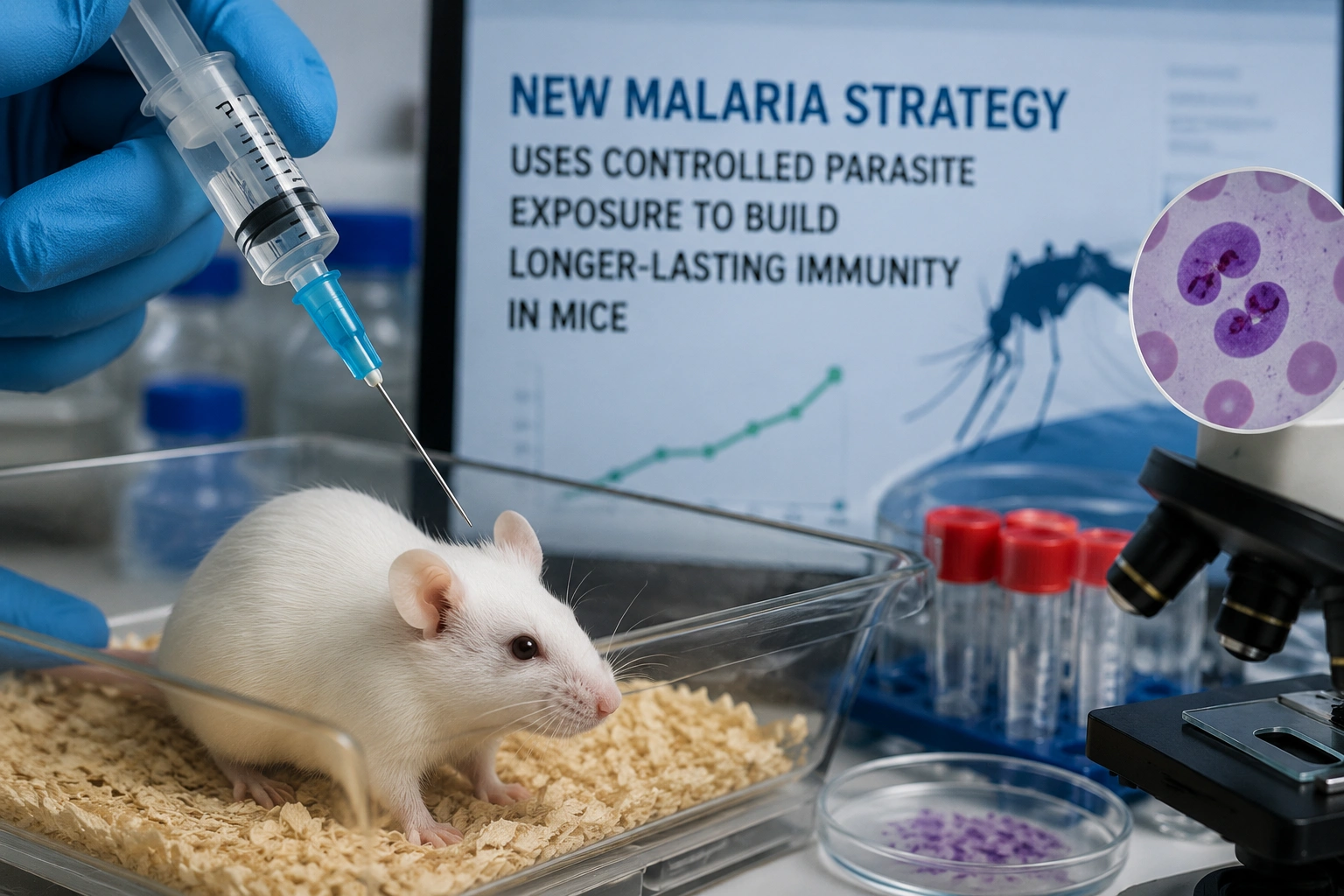
A research team in Australia has reported a potentially different way of thinking about malaria prevention: instead of trying to eliminate every parasite immediately after a mosquito bite, researchers are testing whether carefully controlled exposure can train the immune system while preventing the infection from reaching the bloodstream.
The experimental approach, developed by scientists at the Walter and Eliza Hall Institute of Medical Research (WEHI) with MSD, combines mosquito-delivered malaria parasites with an investigational antimalarial drug. In mice, the strategy produced protection that lasted for up to two years, according to the research described by the team.
The finding is significant because it targets one of malaria prevention’s longstanding challenges: generating strong, durable immunity without allowing the parasite to cause disease.
But the research is still at the preclinical stage. The results in mice do not establish that the approach will protect people, and a potential vaccine or preventive treatment based on the method would require further testing.
The key is stopping malaria before it reaches the blood
Malaria begins when an infected female Anopheles mosquito injects parasites into a person. The parasites first travel to the liver, where they multiply before entering red blood cells. It is the blood-stage infection that produces the familiar symptoms and can progress to severe disease.
The Australian researchers are exploiting that interval.
Their approach, described as chemovaccination, uses an investigational drug that acts against malaria parasites during the later liver stage. Rather than allowing the parasites to proceed into the bloodstream, the treatment arrests them before they can establish blood-stage infection.
At the same time, the immune system is exposed to parasite material and can develop a response against it.
WEHI researchers have previously described this strategy as targeting the malaria parasite’s plasmepsin IX and X enzymes. These proteins are important to the parasite’s development, making them attractive targets for new antimalarial drugs. Earlier research found that compounds targeting these enzymes could interfere with several stages of the parasite’s life cycle.
The newer work takes that drug discovery a step further by using the parasite’s controlled development inside the liver as part of an immune-training strategy.
Why the mosquito-bite idea is unusual
The phrase “mosquito bites as boosters” can sound counterintuitive because mosquito bites are normally associated with malaria transmission.
The researchers’ concept is different. The mosquitoes would deliver malaria parasites, but the accompanying drug would prevent those parasites from progressing to disease. Subsequent exposure could then repeatedly stimulate an immune system that has already been primed.
WEHI has previously proposed that a long-acting formulation of a late-liver-stage antimalarial could potentially be incorporated into seasonal malaria prevention programmes in endemic regions. The institute says the goal is to develop better ways to prevent malaria while also generating protective immunity.
That could eventually address an important limitation of conventional prevention: protection from a drug can disappear when the drug leaves the body, whereas an immune response has the potential to persist.
The study’s mouse results suggest that possibility is worth investigating. Researchers reported protection lasting as long as two years, although that result should not be interpreted as equivalent to two years of proven protection in humans.
A potential response to a changing malaria threat
The need for new approaches is substantial. The World Health Organization estimates that malaria caused 282 million cases and 610,000 deaths in 2024. About 95% of those deaths occurred in the WHO African Region, where children under five accounted for roughly three-quarters of malaria deaths.
Existing tools have saved millions of lives, including insecticide-treated nets, seasonal preventive medicines and malaria vaccines. WHO says expanded use of newer interventions helped avert an estimated 170 million malaria cases and 1 million deaths in 2024.
Yet progress is threatened by drug resistance. WHO’s latest malaria report says partial resistance to artemisinin-based treatments has been confirmed or suspected in at least eight African countries. Resistance affecting insecticides and diagnostic tests is also complicating malaria control.
That makes drugs that work at different stages of the parasite’s life cycle particularly attractive to researchers.
The WEHI-MSD programme is already moving beyond laboratory research. An investigational plasmepsin IX/X inhibitor, MK-7602, has entered early human studies, with 2026 research reporting encouraging initial findings on its tolerability.
However, testing a drug in humans is not the same as proving the broader chemovaccination concept works in humans. Safety, dosing, immune responses, effectiveness against different malaria parasites and practical delivery in endemic communities will all have to be established.
Sources Used :
Walter and Eliza Hall Institute — malaria research programme — background on WEHI’s malaria research and vaccine-development work.
The Xinhua research report supplied with the source material.
What happens next
The most important question is whether the durable immune protection seen in mice can be reproduced safely in people.
Researchers are now interested in long-acting formulations that could potentially make the strategy practical in areas where malaria transmission follows seasonal patterns. Such an approach could theoretically combine two functions: preventing illness during exposure while giving the immune system repeated opportunities to learn what the parasite looks like.
That remains a research goal rather than an available public-health intervention.
For now, the significance of the Australian work lies in its underlying idea. Instead of treating mosquito exposure solely as something to prevent, researchers are asking whether controlled parasite exposure—combined with a drug that blocks progression to disease—could be converted into a mechanism for building stronger immunity.
If that principle eventually succeeds in human trials, it could add another layer to malaria prevention at a time when the disease continues to cause hundreds of thousands of deaths each year and resistance is making existing tools harder to rely on.
Vitamin D Deficiency Widespread Among Children in Qatar, Study Finds
Coffee Consumption Linked to Leaner Body Composition and Distinct Hormone Patterns in Men and Women
Circadian Oncology: Could the Time of Day Change How Cancer Treatment Works?