


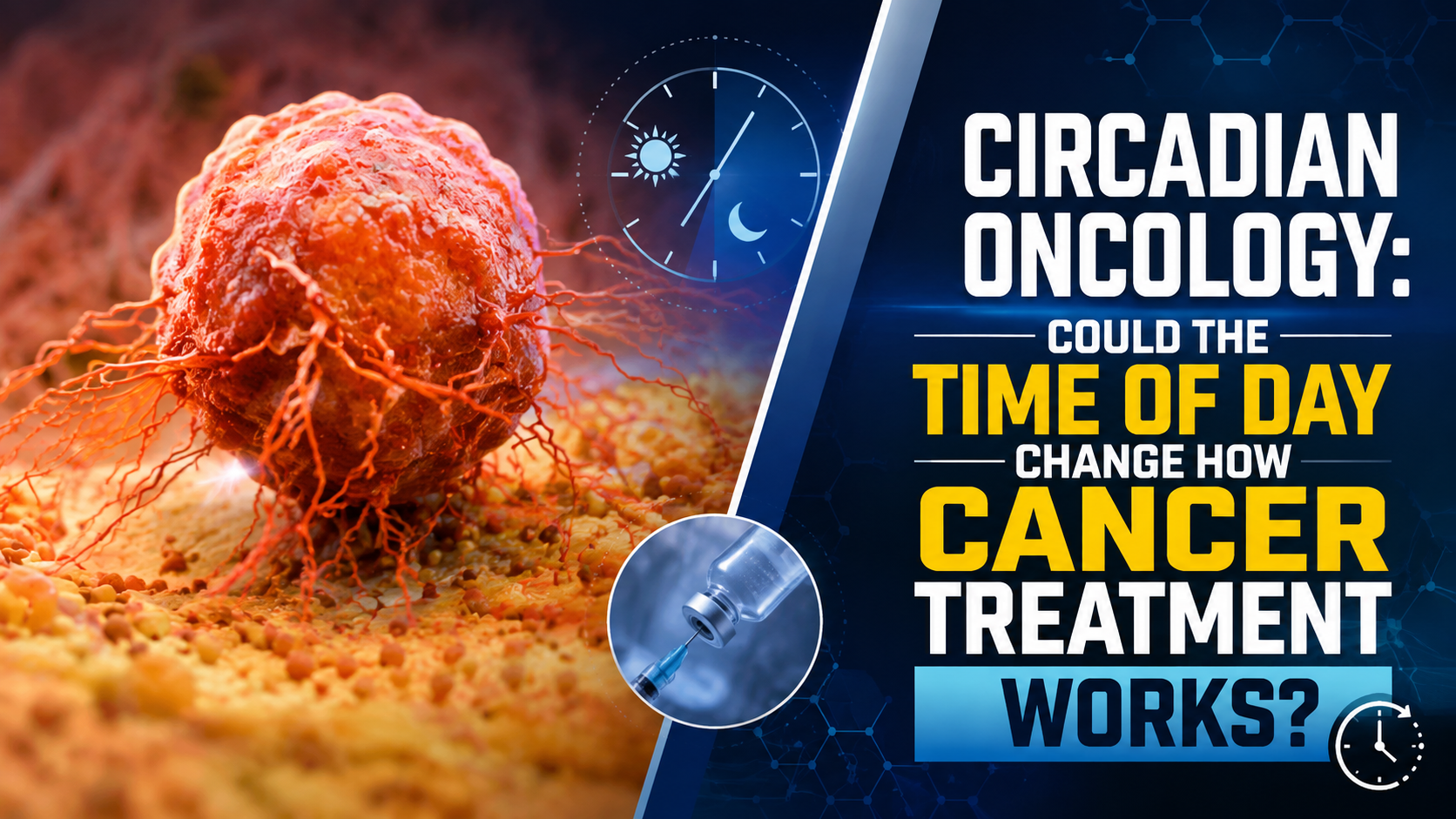
Cancer treatment is usually scheduled around clinical logistics: when a hospital has staff, when a patient can arrive, and how a treatment fits into a broader care plan. But a growing area of oncology research is asking a different question: does the body’s biological clock also matter?
The field, known as cancer chronotherapy, studies whether chemotherapy, immunotherapy and other treatments can be given at particular times of day to improve tolerability or, in some cases, treatment effectiveness.
The idea is grounded in a basic feature of human biology. Circadian rhythms regulate sleep and wakefulness, hormone release, metabolism, immune activity and numerous cellular processes over roughly 24-hour cycles. These rhythms can also influence processes relevant to cancer, including DNA repair, cell-cycle activity and drug metabolism.
But the evidence does not support a simple rule such as “morning treatment is better” or “evening treatment is better.” The optimal timing may vary according to the drug, cancer type, patient characteristics and individual circadian phase.
That distinction is becoming increasingly important as researchers move chronotherapy from an intriguing biological concept toward something that could eventually contribute to more personalized cancer care.
Why the body’s clock matters in cancer
The circadian system is coordinated by a central biological clock in the brain’s suprachiasmatic nucleus, while clocks in tissues throughout the body help regulate local biological activity. At the molecular level, proteins including CLOCK, BMAL1, PER and CRY participate in feedback loops that produce rhythmic changes in gene expression.
These rhythms are not limited to sleep.
DNA repair, cell division, hormone signaling, metabolism and immune responses can all vary according to biological time. That creates a potential opportunity in cancer treatment: if healthy tissues and cancer cells respond differently at different points in the circadian cycle, treatment might theoretically be timed for a period when cancer cells remain vulnerable while normal tissues are better able to tolerate the therapy.
Researchers are also studying what happens when the circadian system is repeatedly disrupted. Shift work, irregular sleep and exposure to light at night have been associated with altered circadian biology, and epidemiological studies have reported associations between chronic circadian disruption and several cancers. However, these associations do not mean that disrupted sleep or shift work directly causes cancer in every individual.
For people who already have cancer, the relationship becomes even more complicated. Cancer itself, along with chemotherapy, medication, hospital stays, pain and psychological stress, can disturb normal sleep and rest-activity patterns.
A 2023 review found that circadian and sleep disruption among people with cancer is associated with outcomes including fatigue, depression and reduced quality of life. The authors also emphasized that much of the evidence is observational, meaning it cannot by itself prove that circadian disruption causes poorer cancer outcomes.
Chronotherapy is not simply about choosing morning or night
The central idea behind chronotherapy is straightforward: the timing of treatment may influence the balance between benefit and toxicity.
Cancer medicines are processed by the body through complex systems involving absorption, metabolism, transport and elimination. Many of the enzymes and cellular pathways involved in these processes are themselves influenced by circadian rhythms.
That means the same medicine could theoretically produce a different biological response depending on when it is administered.
Chemotherapy has been one of the most extensively studied areas. Research has examined agents including 5-fluorouracil, cisplatin and doxorubicin, with studies suggesting that particular dosing schedules can influence toxicity and treatment response.
The strongest clinical signal so far may be reduced side effects rather than a dramatic improvement in survival.
A systematic review published in The Lancet Oncology examined 18 randomized controlled trials involving 2,547 adult cancer patients. Eleven studies—61%—reported a significant reduction in toxicity with chronomodulated chemotherapy while maintaining anticancer activity. Three studies, or 17%, reported improved efficacy measures. The researchers concluded that larger and better-designed trials are still needed before firm clinical recommendations can be made.
That finding puts the promise of chronotherapy into perspective. The evidence is encouraging, but it does not establish that changing the clock time of chemotherapy will improve outcomes for every cancer patient.
The timing problem becomes more complicated with immunotherapy
Chronotherapy research is now extending beyond traditional chemotherapy.
The immune system follows circadian patterns, raising the possibility that the timing of immune checkpoint inhibitors could influence how effectively the immune system responds to cancer.
Some retrospective studies have reported associations between later-day immunotherapy administration and poorer outcomes in certain patient populations. But retrospective evidence can be affected by differences between patients, treatment schedules and disease characteristics. It cannot establish that receiving an infusion later in the day directly causes a worse outcome.
The question is now being tested prospectively. The U.S. National Cancer Institute lists an active phase IV study examining whether the timing of immune checkpoint inhibitor treatment affects effectiveness in patients with advanced or metastatic non-small-cell lung cancer and other solid tumors.
That kind of research matters because it moves the question beyond retrospective observations toward controlled clinical testing.
Why there is no universal “best time” for cancer treatment
One of the biggest obstacles to chronotherapy is that human biological clocks are not identical.
Two patients may have different sleep schedules and chronotypes. Age, sex, medications, diet, physical activity, genetics and underlying health conditions can all influence circadian timing. Cancer cells may also have their own altered or disrupted rhythms.
As a result, a treatment that appears beneficial at one time in one cancer population cannot automatically be prescribed at the same time for everyone.
This is one reason researchers increasingly discuss biological time, rather than simply clock time.
A treatment scheduled at 4 p.m. is based on the assumption that patients’ relevant biological processes are aligned with that clock time. In reality, circadian phase can differ between individuals.
Future chronotherapy may therefore require biomarkers capable of identifying where a patient’s circadian cycle is at a particular moment. Researchers are investigating wearable devices, actigraphy, sleep-wake measurements and other biological signals that could help characterize these rhythms.
Hospitals face a practical challenge
Even if researchers identify better treatment windows, implementing them in routine oncology care could be difficult.
Cancer centers operate with finite staffing, infusion-chair availability, transportation schedules and laboratory requirements. Asking patients to receive treatment late at night or very early in the morning could create significant practical burdens.
The problem is particularly relevant for treatments that require long infusions or repeated visits.
Chronotherapy therefore has to demonstrate enough clinical benefit to justify the additional complexity. A small theoretical advantage may not be sufficient if implementing the schedule substantially increases inconvenience for patients or costs for healthcare systems.
This is one reason the field has not yet become standard practice across oncology.
Sleep and circadian health may still matter even without timed chemotherapy
The potential importance of circadian biology is not limited to changing the hour at which a drug is administered.
Cancer patients frequently experience sleep disruption, fatigue and irregular activity patterns. The 2023 Frontiers in Oncology review found evidence supporting interventions such as cognitive behavioral therapy for insomnia, physical activity and light therapy for improving sleep-related outcomes in some cancer populations.
That does not mean these approaches have been proven to extend survival.
The distinction is important. Improving sleep, reducing fatigue and supporting quality of life can be valuable outcomes in their own right, but they should not be presented as established cancer cures or substitutes for evidence-based cancer treatment.
Sources Used
U.S. National Cancer Institute. Clinical trial evaluating treatment timing and immune checkpoint inhibitor effectiveness.
El-Tanani M, Rabbani SA, Ali AA, et al. “Circadian rhythms and cancer: implications for timing in therapy.” Discover Oncology (2024).
Amiama-Roig A, Verdugo-Sivianes EM, Carnero A, Blanco JR. “Chronotherapy: Circadian Rhythms and Their Influence in Cancer Therapy.” Cancers (2022).
Jagielo AD, Benedict C, Spiegel D. “Circadian, hormonal, and sleep rhythms: effects on cancer progression implications for treatment.” Frontiers in Oncology (2023).
Printezi MI, Kilgallen AB, Bond MJG, et al. “Toxicity and efficacy of chronomodulated chemotherapy: a systematic review.” The Lancet Oncology (2022).
What comes next for cancer chronotherapy?
The next phase of research is likely to focus on personalization.
Scientists need to determine not only whether treatment timing matters, but for whom, for which cancer, with which drug and at what biological phase it matters.
Researchers are also investigating whether wearable sensors and computational models could help estimate an individual’s circadian rhythm. Artificial intelligence could eventually assist in analyzing large amounts of sleep, activity and physiological data, but AI-guided chronotherapy remains a research area rather than an established clinical method.
The most realistic near-term goal may therefore be more modest than a complete overhaul of oncology schedules: identifying specific treatments and patient groups in which timing reliably reduces toxicity or improves treatment response.
The concept has moved beyond laboratory biology, but it has not yet reached the point where patients should independently change when they receive cancer medicines.
For now, treatment timing should remain a decision made by the oncology team. The emerging evidence suggests that biological time could eventually become another variable in precision medicine but proving that it improves patient outcomes will require carefully controlled clinical trials.
iPhone 18 Pro Launch Date: सितंबर में लॉन्च के पीछे मांग से ज्यादा बड़ी है पूरी सप्लाई चेन की रणनीति
रवि किशन की मिर्जापुर: द मूवी एंट्री: मीम्स से मिली नई पहचान अब पर्दे पर कितनी काम आएगी?
Jana Nayagan Box Office Day 20: Vijay’s Film Needs ₹6.3 Crore for ₹200 Crore, But Can It Still Get There?