




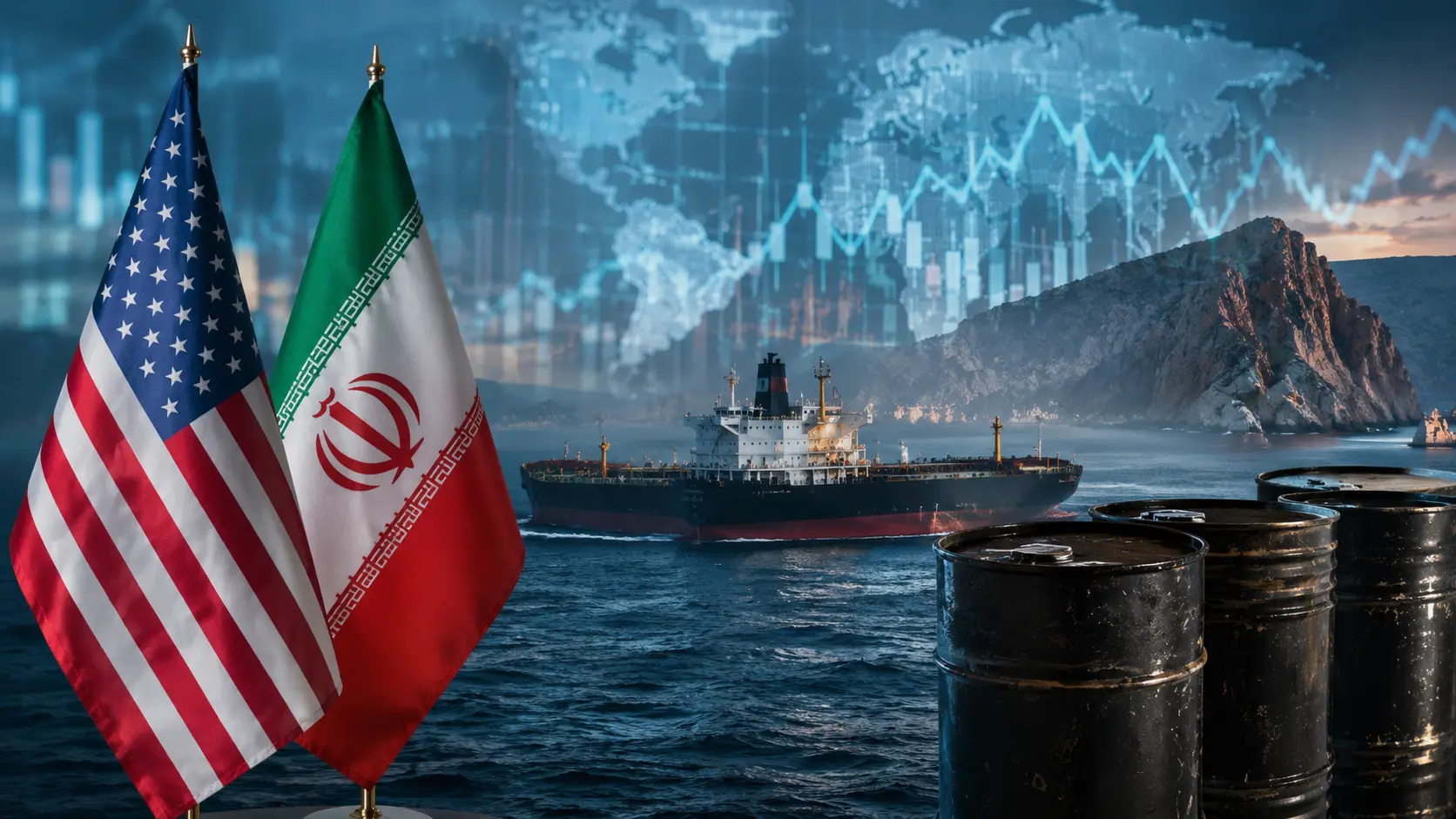
Iran-US Conflict Latest Update: The economic confrontation between the United States and Iran has entered a new phase, with Washington threatening what U.S. Treasury Secretary Scott Bessent described as the “toughest sanctions in history” against Tehran. The announcement has intensified concerns about oil supplies, shipping through the Strait of Hormuz and the wider global economy.
The timing is particularly important for India. The country is one of the world’s largest crude-oil importers, and a sustained rise in international oil prices can feed into transport costs, inflation, the current account and the value of the rupee. On August 20, Brent crude moved above $93 a barrel, while the Indian rupee remained under pressure near ₹95.70 per U.S. dollar.
The immediate question for markets is therefore not simply whether Iran will face more sanctions. It is how far the sanctions go, whether they affect Iranian oil exports and whether the confrontation disrupts the Strait of Hormuz.
What are the latest US sanctions against Iran?
Washington has been steadily expanding economic pressure on Iran.
On August 7, 2026, the U.S. Treasury’s Office of Foreign Assets Control announced sanctions against networks it said were helping Iran move hundreds of millions of dollars through clandestine currency channels. The Treasury said the measures were intended to cut Iranian access to the U.S. financial system.
On the same day, Treasury announced action against two digital-asset exchanges and a network of companies that it said were helping Iranian actors launder money and support the Islamic Revolutionary Guard Corps (IRGC).
Washington had also targeted maritime networks linked to Iran’s activities around the Strait of Hormuz and entities connected to Mahan Air and the IRGC. On July 30, Treasury designated six individuals and entities in China, India, Russia and Iran in an action concerning networks supporting Mahan Air and the IRGC.
The latest escalation goes beyond individual designations.
The U.S. administration has signalled an effort to impose much broader economic pressure, including the possibility of penalties affecting countries and businesses that continue certain dealings with Iran. AP reported that potential secondary sanctions could create risks for countries including China and India.
That is where the issue becomes particularly important for Indian businesses.
Why is the Strait of Hormuz so important?
The Strait of Hormuz is one of the world’s most strategically important energy chokepoints.
Large volumes of oil and other energy products move through the waterway connecting the Persian Gulf with the Gulf of Oman and the Arabian Sea.
For India, the route is especially significant because a substantial share of its oil supplies has historically moved through the region.
An Indian Express analysis citing shipping and trade data estimated that around 40% of India’s oil needs are linked to flows through the Strait of Hormuz.
This means that even if India does not directly buy large quantities of Iranian crude, a disruption around Hormuz can still affect India.
The reason is simple:
Global oil prices respond to the availability and security of the entire regional supply chain—not just India’s direct imports from Iran.
How could new Iran sanctions affect India?
1. Higher crude oil prices are the biggest risk
The first and most direct impact could come through crude oil.
When markets fear that Iranian exports will fall or shipping through Hormuz could be disrupted, traders generally add a geopolitical risk premium to oil.
On August 20, Brent crude rose sharply and reached around $94.60 a barrel, with the Iran confrontation and sanctions contributing to market concerns.
For India, expensive crude creates a difficult economic equation.
India imports most of the crude oil it consumes. Higher oil prices can increase:
- Petrol and diesel production costs
- Aviation fuel costs
- Freight expenses
- Manufacturing costs
- Fertiliser and chemical costs
- Logistics expenses
- Household inflation
The longer oil remains elevated, the greater the potential economic impact.
2. The Indian rupee could face additional pressure
Higher crude prices generally mean India needs to spend more foreign currency on energy imports.
That can increase demand for dollars and put pressure on the rupee.
The rupee was trading around ₹95.70 per U.S. dollar on August 20, according to Reuters, while Brent crude had climbed above $93.
The Reserve Bank of India has already been intervening across currency markets to contain volatility. Reuters reported that the RBI intervened in spot, futures and non-deliverable forward markets amid pressure from oil prices and global yields.
A prolonged oil shock could therefore make currency management more difficult.
Why does a weaker rupee matter?
A weaker rupee makes imports more expensive.
For India, this can affect not only crude oil but also:
- Electronics
- Machinery
- Chemicals
- Industrial inputs
- Precious metals
- Some food commodities
That can increase inflationary pressure.
3. India’s inflation outlook could become more complicated
Oil is a major input across the economy.
If crude rises substantially and remains high, the impact does not stop at petrol pumps.
Transport companies may face higher costs. Those costs can eventually move through supply chains into prices of goods and services.
Reuters reported that analysts were already warning that rising oil prices could push Indian consumer inflation toward or potentially above the RBI’s 6% tolerance ceiling, depending on how long the energy shock lasts.
This creates a policy dilemma.
If inflation rises sharply, the RBI may have less room to support growth through lower interest rates.
4. Indian stock markets could remain volatile
Geopolitical shocks generally increase uncertainty for investors.
The impact on Indian equities would depend heavily on the direction of crude oil prices.
Sectors that could face pressure
Oil marketing companies: Higher crude can increase input costs, although the final impact depends on pricing policies and refining margins.
Airlines: Aviation turbine fuel is a major operating cost, so sustained oil-price increases can hurt profitability.
Paint and chemical companies: Many depend on petroleum-linked raw materials.
Logistics and transport: Higher diesel and fuel costs can raise operating expenses.
Consumer companies: Higher transportation and input costs can squeeze margins.
Potential beneficiaries
Some oil producers and companies with strong refining margins could benefit from certain price scenarios.
However, the relationship is complicated because a geopolitical oil shock can simultaneously increase costs elsewhere in the economy.
The key point for investors is that the severity and duration of the oil shock matter more than one day’s market reaction.
5. Shipping costs could rise
Oil is not the only concern.
The conflict also creates a shipping and insurance problem.
The U.S. Treasury has already targeted an Iranian-linked maritime insurance scheme associated with the Strait of Hormuz.
If shipping companies perceive greater risk around the waterway, they may face:
- Higher insurance premiums
- Longer routes
- Higher freight rates
- Delayed deliveries
- Increased tanker costs
These additional expenses can eventually affect importers and consumers.
Could India buy more oil from other countries?
Yes—and India has already been diversifying its crude sourcing.
Russia became a major supplier to India after changes in global oil trade following the Russia-Ukraine war.
An Indian Express analysis found that India paid around $15 billion worth of imports in rupees during March-May 2026, with the payments likely linked largely to Russian oil purchases.
This diversification provides India with some protection against a disruption in any single supply source.
However, replacing Iranian or Gulf-region crude is not simply a matter of finding another supplier.
Refineries are designed to process particular crude blends, and alternative supplies can involve different:
- Prices
- Quality
- Freight costs
- Payment arrangements
- Delivery times
So diversification reduces risk but does not eliminate it.
What about India’s direct trade with Iran?
India has historically maintained commercial and strategic ties with Iran, particularly around energy, connectivity and the Chabahar Port project.
The biggest risk from broader U.S. sanctions is therefore not limited to crude oil.
Indian companies dealing with sanctioned Iranian entities could face compliance challenges if Washington expands secondary sanctions.
This is particularly relevant because the U.S. has already named entities in India in recent sanctions actions involving Iranian networks.
For Indian companies, the practical issue is therefore:
Which Iranian counterparty, bank, shipping company or intermediary is involved in a transaction?
Businesses will need to undertake careful sanctions screening rather than assuming that all Iran-related trade is automatically prohibited or automatically permitted.
Could the sanctions affect global oil markets?
Yes. Oil is likely to be the most important global-market transmission channel.
Iran is a significant oil producer, and any sustained reduction in its exports tightens the global supply-demand balance.
But the bigger risk is the Strait of Hormuz.
If shipping through the waterway remains largely operational, the market impact could remain manageable even with sanctions.
If the waterway becomes severely restricted, the shock could be much larger.
That distinction is critical.
What happens if the Strait of Hormuz is disrupted?
A prolonged disruption could trigger a chain reaction:
Shipping disruption → lower available oil supply → higher crude prices → higher inflation → higher interest-rate expectations → pressure on stocks and bonds.
The consequences could extend beyond Asia.
Oil-importing economies in Europe and other regions would also face higher energy costs.
Meanwhile, oil-producing countries outside the affected region could benefit from higher prices.
This is why investors are watching shipping activity almost as closely as the sanctions announcements themselves.
What is happening to global markets?
Global markets have already reacted to the uncertainty.
Reuters reported on August 21 that Asian equity markets were heading toward weekly losses amid elevated oil prices, bond yields and inflation concerns. Brent crude had reached as high as $94.71. Gold also gained during the week as investors sought protection amid uncertainty.
The impact is not uniform.
Oil
Bullish risk: Supply fears can push crude higher.
Gold
Potentially supportive: Geopolitical uncertainty can increase safe-haven demand.
Bonds
Potential pressure: Higher inflation expectations can push yields higher.
Equities
Higher volatility: Companies exposed to energy costs may come under pressure.
Currencies
Oil-importing countries can see their currencies weaken if energy-import costs rise significantly.
Could gold prices rise because of the Iran-US conflict?
Gold could benefit from two separate forces.
First, geopolitical uncertainty can increase demand for safe-haven assets.
Second, if investors become concerned about inflation and currency instability, gold can become more attractive.
Reuters reported that gold rose 3.1% during the week ending August 21, amid the broader market uncertainty.
However, gold does not necessarily rise every time geopolitical tensions increase. Movements in U.S. interest rates, Treasury yields and the dollar remain important drivers.
Will the Iran sanctions trigger a global recession?
It is too early to say.
Sanctions alone do not automatically cause a global recession.
The economic outcome will depend on several variables:
- How much Iranian oil production is removed from the market.
- Whether Hormuz shipping remains operational.
- How long oil prices stay elevated.
- Whether other producers increase supply.
- Whether governments subsidise or absorb higher energy costs.
- How central banks respond to inflation.
- Whether the conflict expands geographically.
A short-lived oil-price spike would have a very different economic impact from a prolonged energy shock.
What does this mean for Indian consumers?
The impact on ordinary Indian households would depend largely on how the government and oil companies respond to higher crude prices.
Potential effects include:
- Higher fuel prices
- Higher transport costs
- More expensive air travel
- Higher logistics costs
- Pressure on household inflation
- Potentially higher prices for petroleum-linked products
But domestic fuel prices do not necessarily move one-for-one with international crude prices.
Taxes, refinery margins, exchange rates and government pricing decisions also matter.
What should Indian investors watch now?
For Indian markets, five indicators are particularly important.
1. Brent crude
A sustained move well above recent levels would increase pressure on India’s external balance and inflation outlook.
2. Strait of Hormuz shipping
Actual disruption would be much more significant than rhetoric alone.
3. USD/INR
A rapidly weakening rupee could amplify the inflationary impact of expensive oil.
4. RBI policy
Markets will watch whether inflation expectations change enough to alter the central bank’s policy path.
5. US sanctions enforcement
The most important question for Indian businesses will be whether Washington moves from targeting Iranian entities to aggressively enforcing secondary sanctions against third-country companies.
Iran-US Conflict: Best-Case and Worst-Case Scenarios
| Scenario | Oil | India | Global Markets |
|---|---|---|---|
| Diplomatic de-escalation | Falls/normalises | Lower inflation pressure | Risk appetite improves |
| Sanctions expand but shipping continues | Higher | Moderate pressure | Volatility rises |
| Iranian exports fall sharply | Higher | Import bill rises | Inflation concerns |
| Major Hormuz disruption | Potentially very high | Severe energy shock | Broad risk-off move |
| Prolonged conflict | Sustained risk premium | Growth and inflation pressure | Higher volatility |
These are scenario analyses, not forecasts.
The Bigger Risk: Sanctions vs. Secondary Sanctions
For India, the most important distinction may be between sanctions directly targeting Iran and secondary sanctions that penalise third-country businesses for specified transactions with sanctioned Iranian entities.
The latter could create a much wider impact.
Indian companies could potentially face difficult choices if they have commercial relationships involving Iran while also maintaining significant exposure to the U.S. financial system.
That is why the details of the next U.S. sanctions package will matter.
What happens next?
The immediate focus is on Washington’s promised additional measures.
The U.S. administration says it intends to use economic pressure alongside its broader strategy toward Iran. Iran has rejected the pressure and described the U.S. approach as economic coercion.
Markets will now watch:
- The exact sanctions announced by Washington
- Whether secondary sanctions are included
- Iran’s response
- The status of the Strait of Hormuz
- Iranian oil exports
- Asian refinery purchases
- Shipping insurance costs
- Brent crude
- USD/INR
- Central-bank responses to inflation
The next phase could therefore be decided as much by energy markets and shipping lanes as by diplomatic statements.
FAQ
How will new US sanctions on Iran affect India?
The biggest potential effects are higher crude oil prices, increased shipping costs, rupee pressure and higher inflation. The impact will depend on whether sanctions materially reduce Iranian oil exports or disrupt the Strait of Hormuz.
Will Iran sanctions increase crude oil prices?
They could. Sanctions that reduce Iranian exports or increase the perceived risk of shipping through the Persian Gulf can add a geopolitical premium to crude prices. Brent was around $94.60-$94.70 per barrel during the latest market reaction.
Why is the Strait of Hormuz important to India?
A significant share of India’s energy imports is connected to Persian Gulf shipping routes. An Indian Express analysis estimated that around 40% of India’s oil needs are linked to flows through Hormuz.
Will the Iran-US conflict weaken the Indian rupee?
It could put additional pressure on the rupee if higher crude prices increase India’s dollar demand and import bill. The rupee was around ₹95.70 per dollar on August 20.
Which Indian sectors could be affected?
Airlines, transportation, chemicals, paints and other energy-intensive businesses could face higher costs. Oil and gas companies may respond differently depending on crude prices, refining margins and government pricing.
Could Indian stock markets fall because of Iran sanctions?
They could become more volatile, particularly if crude prices rise sharply. However, the eventual market impact will depend on the duration and severity of the energy shock.
Could gold prices rise?
Gold may benefit from geopolitical uncertainty and safe-haven demand. However, U.S. interest rates, Treasury yields and the dollar also strongly influence gold prices.
Could the Iran conflict cause a global recession?
It is not inevitable. A temporary oil-price spike would have a smaller impact than a prolonged disruption to Iranian exports or the Strait of Hormuz.
What should investors monitor?
Brent crude, Strait of Hormuz shipping, USD/INR, global bond yields, RBI policy and the exact scope of U.S. secondary sanctions are the most important indicators.
“Sources Used“
https://www.reuters.com/world/middle-east/us-says-it-will-impose-toughest-sanctions-history-iran-2026-08-20/
https://home.treasury.gov/news/press-releases
https://apnews.com/article/iran-war-trump-sanctions-economic-fury-oil-d28206ea288a3d4a9b82260ab44ce460
https://indianexpress.com/article/explained/explained-economics/india-rupee-trade-russia-oil-imports-explained-10801161/
Conclusion
The latest Iran-US conflict and sanctions escalation has created a new source of uncertainty for the global economy.
For India, the biggest immediate risk is not necessarily direct exposure to Iranian trade—it is the effect of higher oil prices, shipping costs and a potentially weaker rupee.
India’s diversified crude-supply base provides some protection, but it cannot completely insulate the economy from a global oil shock. The country remains highly dependent on imported energy, making the Strait of Hormuz a critical vulnerability.
For global markets, the key variable is the scale and duration of the supply disruption.
If sanctions remain primarily financial and oil continues to flow, the economic impact could be manageable.
If sanctions significantly reduce Iranian exports or the Strait of Hormuz becomes seriously disrupted, the consequences could be much larger—raising crude prices, inflation and market volatility.
For investors and businesses, the most important signals now are Brent crude, Hormuz shipping activity, the rupee and the exact scope of the new U.S. sanctions.
“Must Read”
Global Oil Prices Today: Why Crude Is Rising and What It Means for Petrol & Diesel
Gold Price Today: What Is Driving the Global Gold Market in 2026?
EPFO Latest Update 2026: What PF Account Holders Need to Know