




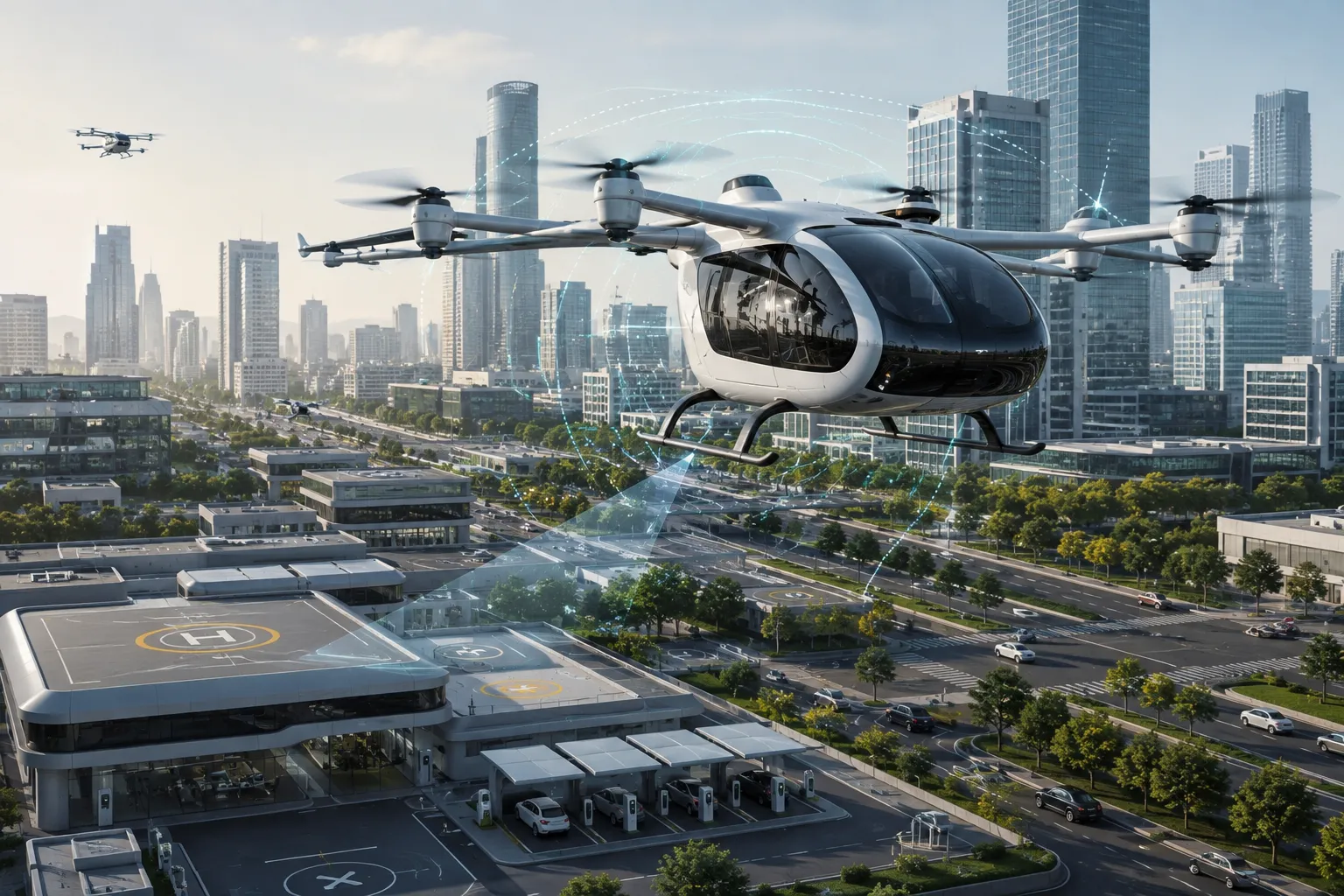
The idea of flying cars has existed in science fiction for decades. In 2026, however, the technology behind that idea is becoming much more concrete — although the reality looks different from the traditional image of a car that drives on a highway and then takes off.
Today’s most advanced “flying cars” are largely electric vertical takeoff and landing aircraft, or eVTOLs.
These aircraft are designed to take off vertically, fly through the air like aircraft and land vertically without needing a conventional runway. The FAA classifies many of these aircraft under the broader powered-lift category.
The technology brings together three major developments:
battery technology + electric propulsion + autonomous/AI systems.
Together, they could create a new form of transportation known as Advanced Air Mobility (AAM).
The U.S. Federal Aviation Administration says AAM includes systems that can move people and cargo using new types of aircraft, with many of the proposed aircraft being electric VTOLs.
For the wider technology landscape, see HNN24x7’s Future Technology 2026 pillar.
What Are Flying Cars in 2026?
In practical terms, today’s flying cars are mostly eVTOL aircraft designed to provide short-distance passenger or cargo flights rather than road-going cars that can also fly.
An eVTOL can combine:
- electric motors,
- multiple propellers or rotors,
- batteries,
- advanced flight-control computers,
- lightweight airframes,
- autonomous-flight technologies,
- digital navigation systems.
The aircraft can rise vertically from a compact landing area and then transition into forward flight.
This gives it a major potential advantage over traditional aircraft:
it may not need a conventional airport runway.
The FAA describes powered-lift aircraft as capable of vertical takeoff, vertical landing and low-speed flight before transitioning to airplane-like cruise flight.
That is why air taxi is currently a more accurate description than “flying car.”
How Do Flying Cars Work?
The basic operation is relatively easy to understand.
Step 1: Vertical Takeoff
Electric motors drive multiple rotors or propellers.
The aircraft rises vertically from a vertiport.
Step 2: Transition
Once airborne, the aircraft changes its configuration or thrust direction to move forward.
Step 3: Cruise
The aircraft flies toward its destination using electric propulsion and computerized flight controls.
Step 4: Vertical Landing
Near the destination, it transitions back to vertical flight and lands at another vertiport.
The entire process is controlled through sophisticated flight-control systems.
In a future autonomous aircraft, AI could assist with navigation, obstacle detection, route planning and decision-making.
Why Are Electric Motors Important for Flying Cars?
Electric propulsion is one of the technologies making eVTOL aircraft possible.
Traditional helicopters rely on combustion engines and mechanical systems to drive their rotors.
An eVTOL can distribute propulsion across multiple electric motors.
That creates several potential advantages:
- fewer mechanical components,
- precise motor control,
- rapid response,
- potentially lower local emissions,
- quieter operation than conventional helicopters in some configurations,
- easier computer-controlled thrust management.
But electricity alone does not solve the hardest problem.
The biggest issue remains energy density.
Battery Technology Is the Biggest Limitation
A battery-powered aircraft has to carry its energy source into the sky.
That makes battery weight extremely important.
An electric car can carry a heavy battery because the road supports the vehicle.
An aircraft cannot.
Every additional kilogram affects:
- takeoff energy,
- payload,
- range,
- efficiency,
- reserve requirements.
This creates a fundamental challenge:
Aircraft need extremely high energy density, while today’s batteries remain much heavier per unit of stored energy than aviation fuel.
That is why eVTOL manufacturers are generally targeting relatively short routes rather than trying to replace long-distance commercial aircraft.
The practical future of flying cars therefore depends heavily on advances in:
- battery chemistry,
- battery energy density,
- thermal management,
- charging speed,
- battery durability,
- electric motors,
- power electronics.
Could Next-Generation Batteries Make Flying Cars Better?
Yes.
Better batteries could have an enormous effect on electric aviation.
Imagine the same aircraft with a battery that is:
- lighter,
- more energy-dense,
- faster to charge,
- safer,
- longer-lasting.
The aircraft could potentially carry more passengers or luggage, fly farther or retain larger energy reserves.
This creates a direct connection between next-generation battery technology and flying cars.
However, battery improvements do not automatically solve every aviation problem.
Aircraft still need:
- certification,
- airspace integration,
- charging infrastructure,
- trained operators,
- maintenance,
- emergency procedures,
- vertiports.
Battery technology is therefore necessary, but not sufficient.
What Is an eVTOL?
eVTOL stands for electric Vertical Takeoff and Landing.
The term describes aircraft that use electric propulsion systems and can take off and land vertically.
Different eVTOL designs can use different combinations of:
- lift rotors,
- cruise propellers,
- tilting rotors,
- wings,
- distributed electric propulsion.
The goal is generally the same:
combine helicopter-like vertical takeoff with airplane-like forward flight.
The FAA’s powered-lift framework was created partly because these aircraft combine characteristics traditionally associated with helicopters and airplanes.
Are Flying Cars Actually Available in 2026?
Not as ordinary consumer vehicles that people can simply buy and drive on roads.
That distinction is important.
The industry in 2026 is moving toward commercial air-taxi operations and Advanced Air Mobility, not mass-market flying cars sitting in household garages.
The FAA says it has established regulations for powered-lift aircraft, including pilot certification and operational requirements.
At the same time, the U.S. Government Accountability Office reported in May 2026 that the FAA was still evaluating electric aircraft designs for certification and had not yet certified an electric aircraft for commercial operations.
Therefore, the 2026 reality is:
Flying-car technology is advancing, but mass consumer ownership is still far away.
What Is the Latest Flying-Car Progress in 2026?
2026 has been an important year for Advanced Air Mobility in the United States.
In March, the U.S. Department of Transportation and FAA announced eight selections for the new eVTOL and Advanced Air Mobility Integration Pilot Program. The projects cover 26 states and include concepts involving air taxis, cargo, emergency response, autonomous flight and energy-sector transportation.
The FAA says the program is intended to accelerate the safe integration of next-generation aircraft into the national airspace system.
That matters because building an aircraft is only one part of the problem.
The industry also needs to prove:
Where will they fly?
Where will they land?
How will they communicate with air-traffic systems?
How will passengers reach the vertiport?
How will the aircraft be charged?
Joby Aviation: One of the Leading eVTOL Programs
Joby Aviation is among the companies developing electric air taxis for commercial passenger service.
Joby said in March 2026 that its first FAA-conforming aircraft had begun flight testing for Type Inspection Authorization, a major step toward the FAA’s formal certification testing.
By August 2026, Joby said it had five aircraft flying and was in the final stage of the FAA type-certification process, while targeting its first eIPP flights in September and first passengers during 2026.
Joby has also been working on the infrastructure side.
In August, the company announced a partnership with Atoms to develop vertiport sites in several U.S. launch markets, emphasizing that landing, charging and passenger connections could become a critical part of scaling electric air taxis.
That illustrates an important point:
The future flying-car industry is not just about aircraft.
It is also about infrastructure.
Archer Aviation and the Midnight Air Taxi
Archer Aviation is another major player in the U.S. eVTOL sector.
Its Midnight aircraft is a piloted electric air taxi designed to carry up to four passengers.
In 2026, Archer has been progressing through FAA certification while preparing for early operations under the U.S. eIPP.
In August 2026, Archer reported that Midnight had completed a piloted round trip between Salinas Municipal Airport and Monterey Regional Airport in California, with each leg taking about nine minutes.
The company says it is preparing for operations later in 2026 under the eIPP.
The important takeaway is not that flying cars have suddenly become mainstream.
It is that the industry is moving from:
prototype → testing → certification → infrastructure → limited operations.
Will Flying Cars Be Autonomous?
Eventually, autonomy is likely to become one of the industry’s most important technologies, but today’s commercial air-taxi pathway still relies heavily on pilots and aviation certification.
The FAA’s current powered-lift pilot framework specifically addresses pilot certification and training.
This means the near-term model is more likely to be:
electric aircraft + trained pilot + advanced automation
rather than:
fully autonomous flying taxi with no pilot.
But the technology is moving toward autonomy.
How Could AI Control a Flying Car?
An autonomous eVTOL could potentially use AI and advanced computing for:
Navigation
The system can calculate routes and continuously update them.
Obstacle Detection
Sensors could identify other aircraft, buildings, terrain and unexpected objects.
Flight Stabilization
Software can constantly adjust motor output and aircraft attitude.
Weather Awareness
The aircraft could combine weather information with onboard sensors.
Traffic Management
AI systems could help coordinate large numbers of aircraft.
Emergency Response
Automated systems could identify failures and select safer landing options.
This is where autonomous AI becomes especially important.
AI Is Already Becoming Part of eVTOL Development
The connection between AI and flying cars is no longer purely theoretical.
Archer announced in January 2026 that it planned to use NVIDIA’s IGX Thor platform for next-generation AI technologies for aviation, including safety-capable onboard computing and autonomy-ready flight systems.
By August 2026, Archer said it had unveiled ZEE, an AI foundation model designed specifically for aviation, and autonomous aircraft platforms developed with Anduril.
This illustrates where the industry may be heading:
The aircraft itself becomes a flying computer.
Why AI Could Be Essential for Large-Scale Air Taxis
Imagine a future city with hundreds or thousands of eVTOL aircraft.
A human pilot in every aircraft could still be possible for some operations, but scaling the system would become difficult.
AI could potentially help manage:
- route optimization,
- traffic separation,
- weather avoidance,
- landing-slot coordination,
- battery management,
- predictive maintenance,
- emergency procedures.
But aviation autonomy has a much higher safety threshold than consumer software.
An AI recommendation inside a smartphone is one thing.
An AI decision controlling an aircraft carrying passengers is something entirely different.
Will Flying Cars Need Human Pilots?
In the near term, yes, many passenger eVTOL concepts are being developed around piloted operations.
The FAA’s powered-lift rules establish pilot certification requirements, including private, commercial and airline transport pilot pathways for powered-lift aircraft.
The agency’s current framework also does not cover unmanned powered-lift aircraft.
That means autonomous passenger operations will require additional regulatory and technological development.
A likely progression is:
Piloted aircraft
↓
Pilots with increasingly advanced automation
↓
Highly automated operations
↓
Potentially autonomous passenger aircraft
The timing of the final step remains uncertain.
What Is a Vertiport?
A vertiport is a landing and takeoff facility designed for powered-lift aircraft.
Think of it as an aviation equivalent of a bus terminal or airport designed specifically for short electric flights.
A future vertiport could include:
- landing pads,
- charging stations,
- passenger terminals,
- automated aircraft handling,
- battery systems,
- weather monitoring,
- security infrastructure.
The FAA defines a vertiport as land or a structure used for takeoffs and landings by powered-lift aircraft.
Vertiports could become one of the most important pieces of the future flying-car ecosystem.
Why Charging Infrastructure Matters
An electric air taxi cannot simply land and wait for hours if operators want frequent flights.
Commercial utilization depends on fast turnaround.
That means charging technology must improve alongside batteries.
A future vertiport could potentially operate like a highly automated electric-aircraft charging hub.
Aircraft arrives.
↓
Passengers exit.
↓
Aircraft charges.
↓
Battery and aircraft systems are checked.
↓
Next passengers board.
↓
Aircraft departs.
The economics of an air-taxi network could therefore depend heavily on how quickly and efficiently this cycle works.
Flying Cars vs Electric Cars
| Feature | Electric Car | eVTOL / “Flying Car” |
|---|---|---|
| Primary environment | Roads | Airspace |
| Energy source | Battery | Battery/electric propulsion |
| Takeoff | Not applicable | Vertical |
| Infrastructure | Roads + charging | Vertiports + charging |
| Autonomous AI | Increasingly common | Critical future technology |
| Main energy challenge | Battery range | Battery weight + range |
| Certification | Automotive | Aviation |
| Traffic management | Roads | Airspace |
| Weather impact | Moderate | Significant |
| Current maturity | Mass market | Emerging |
| Typical use case | Personal transport | Air taxi/short regional flight |
This is why calling an eVTOL simply a “flying car” can be misleading.
It is closer to an electric helicopter-airplane hybrid designed for a new transportation network.
Can Flying Cars Reduce Traffic?
Potentially — but only for certain journeys.
Suppose a city has severe congestion between two locations.
An air taxi could travel directly through the air instead of following roads.
That could turn a long road journey into a much shorter flight.
Archer’s July 2026 California demonstration, for example, covered a route in roughly nine minutes per leg that the company says can take more than 35 minutes by car.
But this does not mean flying cars automatically eliminate traffic.
Passengers still have to:
- reach the vertiport,
- check in,
- board,
- fly,
- exit,
- reach their final destination.
So the real comparison is not:
flying vs driving
but:
door-to-door air mobility vs door-to-door ground mobility.
Will Flying Cars Be Affordable?
This is one of the biggest unanswered questions.
Early air-taxi services are unlikely to cost the same as taking a city bus.
The initial system will require:
- expensive aircraft,
- pilots,
- specialized infrastructure,
- maintenance,
- charging stations,
- certification,
- air-traffic integration.
Over time, costs could fall through:
- mass production,
- better batteries,
- autonomous operations,
- higher aircraft utilization,
- standardized infrastructure,
- improved manufacturing.
The industry’s long-term goal is generally to make air mobility accessible to more people.
But mass-market pricing has not yet been demonstrated at scale.
Are Flying Cars Safe?
Safety is the central issue determining whether flying cars become a real transportation system.
A road vehicle can pull over after a problem.
An aircraft cannot.
eVTOL systems therefore need extremely high levels of reliability.
Important safety areas include:
- propulsion redundancy,
- battery safety,
- software reliability,
- flight-control redundancy,
- communications,
- weather detection,
- emergency landing procedures,
- airspace separation,
- pilot training.
The FAA says its powered-lift framework is designed to integrate the aircraft safely into the National Airspace System.
The agency also evaluates aircraft certification based on design, production, airworthiness and operation.
What Happens If a Battery Fails in Flight?
This is one reason eVTOL aircraft use multiple motors and propulsion systems.
A properly designed aircraft can potentially maintain controlled flight after individual component failures, depending on its architecture.
But battery failures create additional challenges:
- thermal runaway,
- loss of available energy,
- propulsion degradation,
- emergency landing requirements.
Engineers therefore have to design batteries as aviation systems, not simply as oversized EV battery packs.
Battery monitoring, thermal management and redundancy become critical.
Can Flying Cars Fly in Bad Weather?
Weather will remain an important limitation.
Aircraft must deal with:
- wind,
- rain,
- thunderstorms,
- low visibility,
- icing,
- turbulence.
An urban air-taxi network cannot simply assume perfect weather.
This means future operators will need:
- high-quality weather data,
- real-time forecasting,
- onboard sensors,
- automated weather avoidance,
- operational limits.
AI could help process these inputs, but weather safety ultimately remains an aviation problem.
Could Flying Cars Replace Helicopters?
For some missions, eVTOL aircraft could potentially compete directly with helicopters.
The strongest early applications may include:
- airport transfers,
- urban air taxis,
- emergency response,
- medical transport,
- cargo,
- regional connections.
Electric propulsion could potentially offer lower local emissions and lower noise than traditional helicopters, depending on aircraft design and operating conditions.
The FAA itself identifies air taxis, cargo delivery, air ambulance services and other urban and rural applications as potential powered-lift uses.
Could Flying Cars Replace Cars?
Probably not completely.
A flying aircraft is unlikely to be the best solution for every journey.
Cars will remain useful for:
- short local trips,
- shopping,
- rural transportation,
- transporting goods,
- family travel,
- journeys where aviation infrastructure is unavailable.
Flying cars are more likely to create a new transportation layer than eliminate roads.
The future could look like:
Walking → bike → car → train → eVTOL → conventional aircraft
depending on distance and location.
Flying Cars and Smart Cities
Flying cars could become part of the broader smart-city infrastructure.
A future urban mobility system could integrate:
- road traffic data,
- public transportation,
- EV charging,
- eVTOL routes,
- vertiports,
- weather systems,
- AI traffic management.
A passenger might use one app to determine:
Car → train → air taxi
for a single journey.
This makes eVTOL technology part of a larger transportation ecosystem rather than a standalone product.
What About Autonomous Flying Taxis?
Autonomous air taxis represent the more futuristic stage of the technology.
A fully autonomous system would need to handle:
- takeoff,
- navigation,
- traffic separation,
- weather,
- communication,
- landing,
- emergency scenarios.
The challenge is not simply teaching an AI to fly.
It is proving that the system can handle unexpected situations safely and consistently.
That is why autonomy is likely to develop gradually.
What Could Flying Cars Look Like by 2030?
If current development continues, the early 2030s could look very different from science-fiction predictions.
Instead of millions of privately owned flying cars, we may see:
- limited air-taxi networks,
- fixed routes,
- vertiports near airports,
- pilot-operated eVTOL aircraft,
- automated flight assistance,
- growing autonomous cargo operations,
- improved battery systems,
- integration with public transportation.
In other words:
the first flying-car revolution is more likely to resemble Uber + helicopter + electric aircraft than a flying version of a family sedan.
What Could Happen After 2030?
If certification, economics and infrastructure develop successfully, the industry could gradually expand toward:
Stage 1 — Demonstrations
Test flights and pilot programs.
Stage 2 — Limited Commercial Routes
Airport transfers and selected city routes.
Stage 3 — Larger Air-Taxi Networks
Multiple vertiports and operators.
Stage 4 — Increased Automation
AI handles more flight functions.
Stage 5 — Autonomous Operations
Potentially pilotless passenger or cargo flights where regulations permit.
Stage 6 — Mass Urban Air Mobility
A mature network integrated with other transportation.
There is no guarantee that every stage will occur on a predictable timeline.
Why Battery Technology, AI and Flying Cars Are Connected
The flying-car story is actually three technology stories happening at the same time.
Battery Technology
Better batteries determine how much energy the aircraft can carry.
AI
AI can improve navigation, automation, safety systems and airspace coordination.
Electric Propulsion
Electric motors turn battery energy into distributed aircraft propulsion.
Remove any one of these, and the economics or capabilities of many eVTOL concepts become much harder.
That is why flying cars belong in a future technology cluster rather than simply an aviation-news category.
The Biggest Challenges for Flying Cars
The industry still needs to solve several major problems.
Battery Energy Density
More range and payload require better batteries.
Certification
Aircraft must satisfy rigorous aviation safety requirements.
Infrastructure
Cities need vertiports and charging systems.
Airspace Integration
Thousands of aircraft cannot simply fly wherever they want.
Noise
Urban communities will determine how acceptable frequent flights are.
Weather
Operations must remain safe in changing conditions.
Cost
Aircraft and flights need to become economically competitive.
Public Acceptance
Passengers need to trust the aircraft and operators.
Autonomy
Pilotless operations require another level of technological and regulatory maturity.
The Future of Flying Cars Is Probably Electric Air Taxis
The phrase “flying car” makes for a powerful headline.
But the actual transportation revolution is likely to be more specific.
It is the emergence of:
electric vertical takeoff aircraft + AI + batteries + vertiports + digital airspace management.
The FAA has already created a regulatory framework for powered-lift aircraft, and in March 2026 it selected eight projects for its eVTOL/AAM Integration Pilot Program.
Manufacturers such as Joby and Archer are moving through certification and preparing for early operations rather than simply displaying prototypes.
That does not mean everyone will own a flying car tomorrow.
It means something more important is happening:
aviation is beginning to move toward an electric, software-defined and increasingly automated transportation model.
“Sources Used”
https://www.faa.gov/air-taxis/FAQ
https://www.gao.gov/products/gao-26-107816
https://www.jobyaviation.com/news/joby-s-first-faa-conforming-aircraft-takes-flight
https://investors.archer.com/news/news-details/2026/Archers-US-Air-Taxi-Operations-Take-Major-Step-Forward-as-Florida-New-York-and-Texas-Selected-for-White-House-Pilot-Program/default.aspx
Why Flying Cars Matter for Future Transportation
The long-term importance of eVTOLs may not be that people suddenly stop using roads.
It may be that cities gain another transportation layer.
A future passenger could:
Walk → take an autonomous car → reach a vertiport → board an electric air taxi → transfer to a train.
AI could coordinate the journey.
Battery technology could power the electric aircraft.
Digital infrastructure could manage the route.
Vertiports could connect air transportation to cities.
That is a much more realistic vision of future mobility than the classic flying-car fantasy.
And if battery technology, autonomous AI and aircraft certification continue progressing, 2026 could eventually be remembered as one of the early years of the electric-air-mobility era.
For the wider picture of emerging technologies, readers can explore HNN24x7’s Future Technology 2026 pillar.
FAQ
Are flying cars available in 2026?
Not as mass-market road-and-air vehicles. The closest real-world technology is eVTOL aircraft and electric air taxis, which are progressing through certification, pilot programs and early operational preparation.
What is an eVTOL?
eVTOL means electric Vertical Takeoff and Landing. These aircraft use electric propulsion and are designed to take off and land vertically.
How do flying cars work?
Most current flying-car concepts use electric motors and multiple rotors or propellers for vertical takeoff and then transition to forward flight. Advanced flight-control computers manage the aircraft throughout the journey.
Will flying cars be autonomous?
Some future aircraft are being developed with autonomous capabilities, but current U.S. passenger eVTOL operations are progressing through a piloted model. The FAA’s current powered-lift rules establish pilot certification requirements.
What batteries do flying cars use?
eVTOL manufacturers use advanced rechargeable battery systems designed specifically around aircraft requirements. The key challenge is achieving sufficient energy density while maintaining safety, thermal control and reserve energy.
How far can an electric flying car travel?
Range varies considerably by aircraft design, payload, battery and operating conditions. Current eVTOL concepts are primarily aimed at short urban or regional trips rather than long-distance airline routes.
Are flying cars safe?
They must meet aviation certification and operational requirements before carrying passengers commercially. Safety depends on aircraft design, propulsion redundancy, battery systems, software, pilot procedures, airspace management and emergency systems.
Will flying cars replace normal cars?
Probably not. eVTOL aircraft are more likely to complement road transportation by providing fast air travel on selected routes.
What is a vertiport?
A vertiport is a location or structure designed for vertical takeoffs and landings by powered-lift aircraft. It can become the equivalent of a small aviation hub for future air-taxi networks.
When will flying taxis become common?
There is no guaranteed date. In 2026, the industry is moving toward limited commercial operations and government-backed pilot programs, while certification and infrastructure remain important hurdles.