




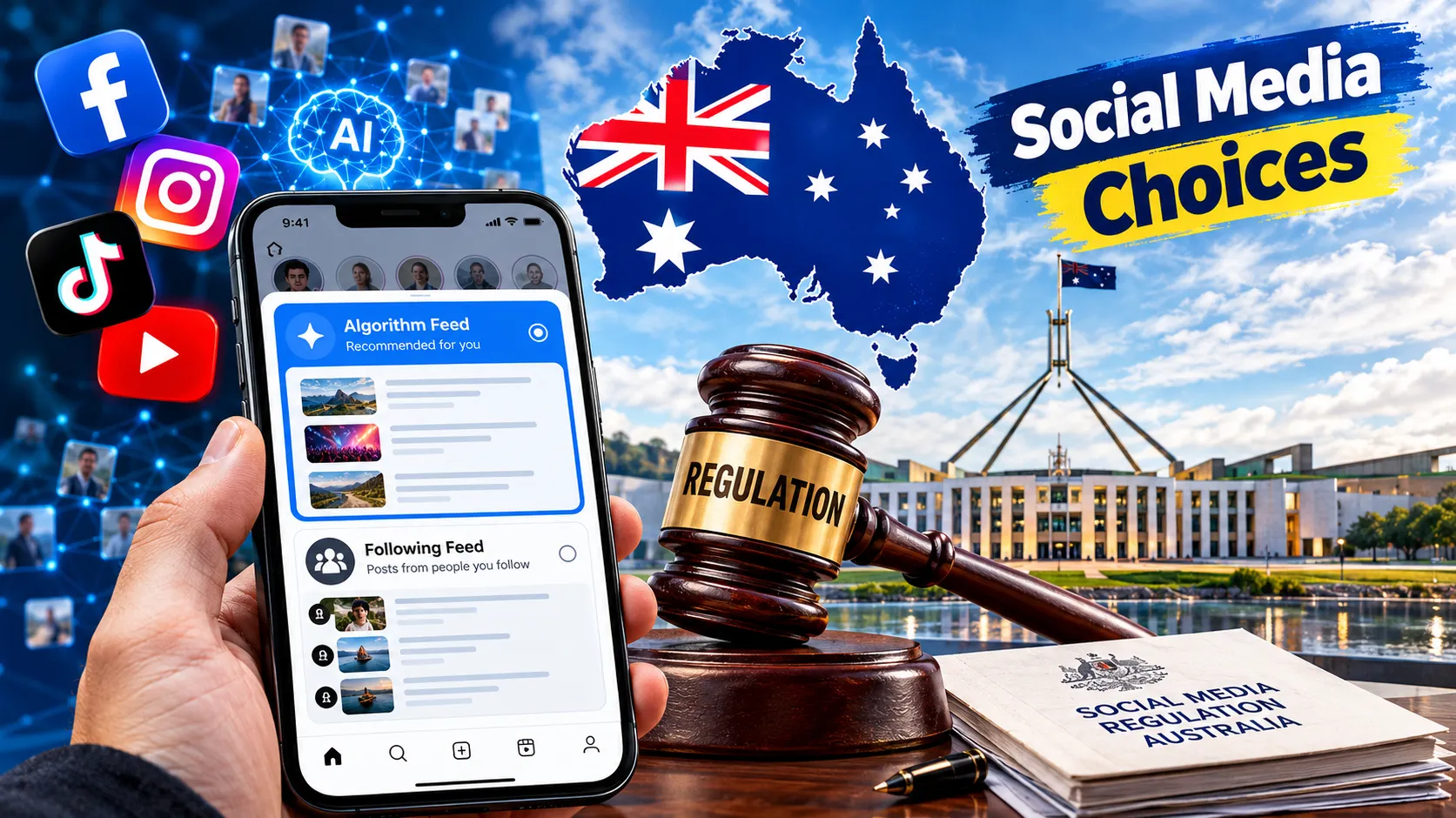
Australia is taking a major new step in its regulation of social media algorithms. On September 8, 2026, the Australian government released draft Digital Duty of Care legislation for targeted consultation, including a new initiative called “My Feed, My Way.”
Under the proposal, Australians aged over 16 would have to be given a genuine choice about the type of default feed they see when they open a social-media platform.
Users could choose to receive a personalised feed selected by the platform’s algorithm — or opt out of personalised recommendations and see posts from friends, creators and accounts they have chosen to follow.
The proposal is significant because it does not simply ask technology companies to explain their algorithms. Instead, it attempts to give users a direct choice over whether algorithmic recommendations control their default feed at all.
Australia says the approach is about user control rather than government control. Prime Minister Anthony Albanese described “My Feed, My Way” as a way to put choice back into the hands of Australians.
What is Australia’s “My Feed, My Way” law?
“My Feed, My Way” is a proposed Australian policy that would require social-media platforms to give users over 16 a choice between an algorithmically personalised feed and a feed based on accounts they have deliberately chosen to follow.
The proposal is part of the broader Digital Duty of Care framework.
Under the proposed system, platforms would have to notify new and existing users and ask them what they want their default feed to be.
There would effectively be two choices:
- Personalised algorithm feed — content recommended by the platform based on its algorithm.
- Following feed — content from friends, creators and other accounts the user has deliberately chosen to follow.
The user would also be able to change that decision later. Communications Minister Anika Wells said users would have the ability to make the choice repeatedly rather than being locked into their first selection.
Australia is not banning social-media algorithms
This is an important distinction.
Australia is not proposing to completely ban recommendation algorithms.
Instead, the government wants to make algorithmic personalisation a choice for users over 16.
A person who likes personalised recommendations could continue using them.
Someone who does not want a platform deciding what appears in the default feed could switch to a feed containing content from accounts they follow.
That makes the Australian proposal different from a blanket prohibition on algorithmic recommendations.
The government’s position is that adults should retain the freedom to use algorithms if they want them, while also having a meaningful alternative.
Why is Australia targeting social-media algorithms?
The debate centres on how modern social-media platforms decide what users see.
On many platforms, a user does not simply receive posts in chronological order from people they follow.
Instead, recommendation systems can analyse signals such as:
- what content a person watches;
- how long they watch it;
- what they like or share;
- which accounts they interact with;
- what similar users engage with;
- and other behavioural signals.
The system can then continuously recommend new material.
Australia’s broader online-safety reforms are based on concerns that some digital design features can contribute to harmful or addictive patterns, particularly among children and teenagers.
The government has therefore framed the Digital Duty of Care as a requirement for digital services to take reasonable steps to identify and reduce risks to users rather than simply responding after harm occurs.
What will change for an Australian social-media user?
Imagine a person opening a social-media app under the proposed system.
Instead of automatically receiving a feed determined entirely by the platform’s recommendation system, the platform would have to provide a choice.
The user could say:
“Show me personalised recommendations.”
Or:
“Show me content from the people and creators I follow.”
The second option would fundamentally change the experience of many social-media platforms.
Rather than the platform continuously selecting material designed to maximise engagement, the user’s feed could be much more closely connected to their own follow list.
That does not necessarily mean the feed would become completely chronological; the precise implementation will depend on the final legislation and rules.
Which platforms could be affected?
The policy is aimed at social-media services covered by the Australian regulatory framework.
That potentially puts major platforms such as Facebook, Instagram and TikTok under significant compliance pressure, depending on the final definitions and rules.
But the Digital Duty of Care is broader than social media.
The draft framework also covers digital services such as online games, apps and AI chatbots, particularly in relation to protections for people under 18.
This broader approach is important because Australia is attempting to regulate digital risks based on the features and potential harms of services rather than treating social media as the only source of online risk.
What happens to children under the new proposal?
The algorithm-choice element specifically applies to Australians over 16.
But children and teenagers under 18 are also at the centre of the broader Digital Duty of Care proposal.
The government says digital services should protect under-18s from harmful content and features, including material related to:
- eating disorders;
- hostile ideas about women and gender equality;
- pornography;
- glorification of crime;
- dangerous or life-endangering stunts;
- bullying and abuse;
- serious mental-health distress.
The framework also targets potentially harmful design features, including addictive mechanisms and features that can negatively affect young people’s self-esteem.
This means Australia’s approach has two connected layers:
For adults: more choice over personalised feeds.
For minors: stronger obligations on platforms to prevent exposure to serious harms.
https://www.pm.gov.au/media/my-feed-my-way
How does this connect to Australia’s under-16 social-media restrictions?
The new proposal follows Australia’s earlier landmark move to restrict social-media accounts for children under 16.
The Australian government says the minimum-age rules have already resulted in millions of accounts being removed or deactivated.
Australia’s regulators have also specifically identified features such as account-based recommender systems, endless feeds, feedback features and time-limited content when determining which services fall within the country’s age-restricted social-media framework.
The new Digital Duty of Care therefore represents a broader attempt to regulate the design of digital services rather than focusing exclusively on the age at which someone can create an account.
Could this change the business model of Big Tech?
Potentially.
This is where the proposal becomes important beyond Australia.
Recommendation algorithms are not merely technical systems. They are deeply connected to how many social-media companies keep users engaged.
A platform that continually recommends new videos, posts or accounts can encourage users to spend more time inside the service.
More engagement can create more opportunities for advertising, subscriptions, purchases and other forms of monetisation.
If large numbers of users choose a non-personalised following feed, platforms could face questions about whether reduced algorithmic discovery changes engagement patterns.
However, it is too early to conclude that the law will significantly reduce advertising revenue or user engagement.
The actual impact will depend on how many users opt out, how platforms design the alternative feed and how the final legislation is implemented.
What will happen if a platform ignores the rules?
The proposed Digital Duty of Care comes with significant potential penalties.
The Australian government says failure to comply could result in penalties of up to A$109.2 million.
The independent eSafety Commissioner would be responsible for compliance and enforcement.
The regulator would also receive stronger tools in other areas of online safety.
For example, the proposed framework would allow eSafety to issue removal notices relating to certain harmful services such as “nudify” apps or websites and streamline existing cyber-abuse mechanisms.
The message to technology companies is therefore clear: Australia wants online safety to become a formal corporate responsibility rather than a voluntary commitment.
Will platforms have to reveal their algorithms?
Not necessarily in the sense of publishing their source code.
The proposal is more focused on user choice, risk management and accountability.
Digital platforms would be required to document the measures they take to address identified risks to Australian users and demonstrate that those measures remain effective over time.
That is different from forcing companies to publicly reveal the technical code behind their recommendation systems.
The distinction matters because algorithm transparency and algorithm choice are two separate regulatory strategies.
Australia’s “My Feed, My Way” model focuses primarily on giving users an alternative to personalised recommendations.
Australia is not the only country questioning algorithms
Australia’s move comes amid growing international scrutiny of social-media recommendation systems.
The European Union has already introduced extensive digital-platform regulation through the Digital Services Act (DSA).
Australia’s government has pointed to its online-safety approach as part of a wider international movement.
However, the Australian proposal has a distinctive feature: it gives users a direct choice between a personalised algorithmic feed and a feed based on accounts they deliberately follow.
Australia has also already attracted attention globally for its minimum-age social-media restrictions.
If “My Feed, My Way” becomes law and proves workable, other governments could examine whether a similar user-choice model would fit their own digital markets.
Could other countries copy Australia?
Yes, that is possible — but it is not guaranteed.
Digital regulation is increasingly becoming a global policy issue, particularly around children’s safety, recommender systems, privacy and platform accountability.
Australia’s approach could become an important case study.
If users broadly adopt non-personalised feeds without abandoning platforms, regulators elsewhere could view the model as evidence that algorithmic choice is practical.
On the other hand, if users overwhelmingly keep personalised feeds, or if the alternative experience proves unpopular, the policy’s influence may be more limited.
The real test will therefore begin after implementation.
What are the criticisms of the proposal?
The proposal is already generating debate about the appropriate balance between safety, user autonomy, free expression and government regulation.
Critics can argue that giving regulators greater authority over online services could create risks of excessive government intervention or censorship.
The government, however, says the objective is the opposite: to give users more control rather than give government control over what people see. Albanese has explicitly framed the measure around user choice.
Another question is how platforms will technically implement the choice.
A company could comply formally while designing the non-personalised feed in a way that makes it less attractive than the algorithmic alternative.
That is why enforcement and the final technical standards will matter almost as much as the headline policy itself.
Australia has already proposed an “algorithm opt-out” bill separately
There is also an important legislative background to today’s proposal.
In April 2026, Senator Sarah Hanson-Young introduced the Online Safety Amendment (Fix Our Feeds) Bill 2026 in the Australian Senate.
That private member’s bill proposed requiring social-media services to let users opt out of algorithmically recommended content and also introduced reporting and risk-assessment obligations. The bill remains before the Senate.
The government’s new “My Feed, My Way” proposal is therefore part of a broader Australian political debate over whether users should have the right to escape algorithmically recommended content.
What happens next?
The Australian government has released draft legislation for targeted consultation, rather than announcing that the final law is already in force.
The government says it intends to introduce the legislation to Parliament later in 2026.
That means several steps remain:
- Consultation with digital platforms and other stakeholders.
- Possible changes to the draft.
- Formal introduction into Parliament.
- Parliamentary debate and scrutiny.
- Passage of the legislation.
- Development of implementation and enforcement arrangements.
So headlines saying Australia has already “banned social-media algorithms” would be inaccurate.
The country has proposed giving users the right to opt out of personalised algorithmic feeds; the final law still has to go through the legislative process.
Why the “My Feed, My Way” proposal matters globally
The significance of this Australian initiative extends far beyond one country’s social-media market.
For more than a decade, platforms have increasingly moved from a simple model — “show me what the people I follow post” — toward a recommendation model — “show me what our system thinks I will engage with.”
Australia is now asking a fundamental question:
Should users have the right to choose between those two models?
If the answer becomes yes in Australian law, it could establish an important precedent.
The debate is no longer simply about whether algorithms are good or bad.
It is increasingly about who should control the algorithmic experience — the platform or the user?
And that is why “My Feed, My Way” could become one of the most closely watched social-media regulatory experiments of 2026.
FAQ
What is Australia’s “My Feed, My Way” initiative?
It is a proposed policy under Australia’s Digital Duty of Care framework that would give users over 16 a choice between an algorithmically personalised social-media feed and a feed showing content from accounts they have chosen to follow.
Is Australia banning social-media algorithms?
No. The proposal does not ban algorithms. Users would be able to continue receiving personalised recommendations if they choose that option.
Who can opt out of social-media algorithms?
Under the government’s proposal, Australians over 16 would be given the choice to opt in or opt out of algorithmically personalised default feeds.
Will Facebook, Instagram and TikTok be affected?
Major social-media platforms covered by Australia’s regulatory framework could be affected, although the precise application will depend on the final legislation and regulatory rules.
What happens if a user opts out?
The proposed alternative feed would show content from friends, creators and other accounts the user has chosen to follow rather than personally recommended content selected by the platform’s algorithm.
How much could companies be fined?
The Australian government says violations of the proposed Digital Duty of Care could attract penalties of up to A$109.2 million.
Does the proposal apply only to social media?
No. The broader Digital Duty of Care also covers areas such as online games, apps and AI chatbots, particularly concerning protections for people under 18.
When will the law come into force?
It is not yet law. The Australian government has released the draft for consultation and says it plans to introduce legislation to Parliament later in 2026.
Could other countries adopt similar rules?
Potentially. Australia’s approach could become a regulatory model for governments considering greater user control over recommender systems, although each country would need to decide whether such a system fits its own laws and digital market.
Bottom Line
Australia’s proposed “My Feed, My Way” initiative does not ban social-media algorithms.
Instead, it would require platforms to give Australians over 16 a genuine choice between a personalised algorithmic feed and a feed based on friends, creators and accounts they actively follow.
At the same time, the broader Digital Duty of Care would impose stronger obligations on digital services to reduce serious harms affecting children and improve accountability for online safety.
The proposal is still at the draft legislation and consultation stage, with the government planning to introduce legislation to Parliament later this year.
If it becomes law, Australia could establish a significant new principle in digital regulation:
Social-media users should not only be able to choose what accounts they follow — they should also have a say in whether an algorithm decides what they see.