



Lab-grown meat is no longer just a futuristic food concept.
The technology, more precisely known as cultivated meat or cultured meat, involves growing animal cells in controlled environments rather than raising an entire animal and harvesting its meat.
Researchers and companies are now working on the difficult next step: moving from laboratory demonstrations to large-scale, affordable food production.
That challenge is much bigger than simply growing cells.
Cultivated meat requires advances in cell biology, biotechnology, growth media, bioreactors, tissue engineering, automation and process control. Recent research identifies scalable bioreactors, lower-cost growth media and suitable high-performing cell lines as some of the central requirements for commercial production.
And increasingly, AI and automation could become part of that production system.
For readers exploring the wider technology landscape, this article is part of HNN24x7’s Future Technology 2026 pillar.
What Is Lab-Grown Meat?
Lab-grown meat is meat produced by cultivating animal cells in a controlled environment instead of obtaining the meat by slaughtering an animal.
The cells can be expanded in nutrient-rich growth media and eventually organized into muscle, fat or other components of a meat product.
The term “lab-grown” can be slightly misleading because future commercial production would not take place in small laboratory dishes.
Instead, large facilities would use industrial bioreactors and other food-processing systems.
That is why terms such as:
- cultivated meat,
- cultured meat,
- cell-based meat,
- cellular agriculture
are increasingly used.
The fundamental idea is simple:
Grow the cells, rather than grow the whole animal.
The engineering challenge is anything but simple.
How Is Lab-Grown Meat Made?
The process can be simplified into several stages.
1. Cell Selection
Scientists identify suitable animal cells capable of producing the desired tissue.
2. Cell Expansion
The cells are provided with nutrients and controlled conditions so they multiply.
3. Bioreactor Cultivation
Large vessels provide controlled conditions for temperature, oxygen, nutrients and other parameters.
4. Differentiation
Cells can be guided toward specific types such as muscle or fat.
5. Tissue Formation
Scaffolds or other structures can help organize cells into a more meat-like form.
6. Harvesting and Processing
The resulting biomass is collected and processed into a food product.
This is fundamentally a biotechnology manufacturing process.
Recent research describes bioreactors as the central platform for expanding and differentiating animal cells at larger scales.
Why Biotechnology Is So Important
Traditional meat production depends on biology too, but it happens through an entire animal.
Cultivated meat attempts to control the process at the cellular level.
That creates a very different manufacturing model.
Scientists have to understand:
- cell growth,
- metabolism,
- differentiation,
- nutrients,
- oxygen requirements,
- temperature,
- pH,
- mechanical forces,
- tissue structure.
A successful cultivated-meat facility therefore looks partly like a food factory and partly like an industrial biotechnology plant.
This is one reason the technology sits at the intersection of:
food science + biotechnology + tissue engineering + chemical engineering + automation.
What Are Bioreactors and Why Do They Matter?
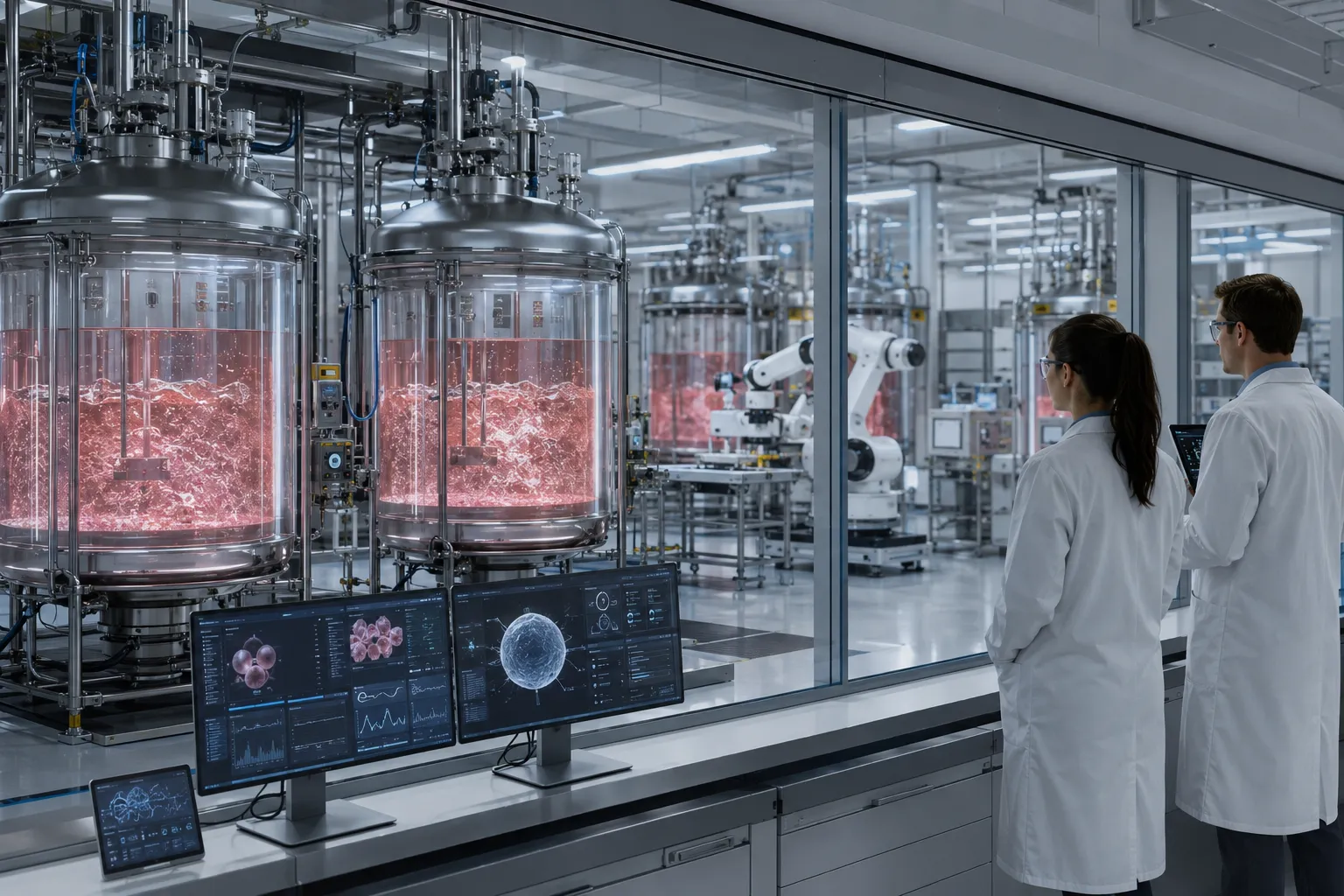
A bioreactor is a controlled vessel in which biological cells can be cultivated under carefully managed conditions.
For cultivated meat, bioreactors have to provide the right environment for large numbers of animal cells.
Important parameters include:
- temperature,
- pH,
- oxygen,
- nutrient availability,
- mixing,
- cell density,
- waste removal.
At small laboratory scales, controlling these conditions is relatively manageable.
At industrial scale, the problem becomes much harder.
Research published in 2026 highlights oxygen transfer, shear forces, mixing, operational stability, sterility and scale-up as important engineering challenges for cultivated-meat bioreactors.
Why Scaling Lab-Grown Meat Is So Difficult
The biggest misconception about cultivated meat is:
If scientists can grow meat cells in a laboratory, why can’t they simply put them into a much bigger tank?
Because biological processes do not necessarily scale linearly.
A small culture may have:
- efficient oxygen transfer,
- uniform nutrients,
- easy temperature control,
- manageable waste.
A giant reactor introduces problems involving:
- oxygen gradients,
- nutrient gradients,
- heat transfer,
- mixing,
- mechanical stress,
- contamination,
- energy consumption.
Research reviews describe scale-up as one of the most significant barriers to commercial cultivated meat production.
The Growth Medium Is Another Major Challenge
Cells need nutrients to grow.
That nutrient mixture is called the growth medium or culture medium.
It can contain components such as:
- amino acids,
- sugars,
- salts,
- vitamins,
- proteins,
- growth factors,
- other nutrients.
The problem is that producing these components at food-scale volumes can become extremely expensive.
Recent research therefore focuses heavily on reducing the cost of growth media, including plant-derived alternatives and recombinant components.
If cultivated meat is going to compete with conventional meat, the industry must dramatically improve the economics of this input.
Can AI Make Lab-Grown Meat Better?
AI could become an important optimization layer for cultivated-meat production.
The production process generates enormous amounts of biological and engineering data.
Sensors can continuously monitor:
- temperature,
- pH,
- dissolved oxygen,
- nutrient concentrations,
- cell density,
- metabolic indicators,
- reactor performance.
AI and machine-learning systems could analyze these signals and identify patterns that would be difficult for humans to detect manually.
The potential applications include:
- predicting cell growth,
- optimizing feeding schedules,
- detecting abnormalities,
- controlling bioreactor conditions,
- reducing failed batches,
- improving consistency,
- optimizing energy use,
- predicting equipment maintenance.
However, AI does not eliminate the underlying biological challenges.
It can help control and optimize the process, but the cells, media, bioreactors and manufacturing economics still have to work.
AI Could Turn Cultivated Meat Into a Data-Driven Factory
A future production facility could operate more like a highly automated semiconductor or pharmaceutical plant than a traditional meat-processing factory.
Imagine thousands of sensors continuously feeding data into a central system.
The AI system detects that:
oxygen levels are changing → cell growth is slowing → nutrient demand is increasing → reactor conditions should be adjusted.
Automation could then respond within predefined safety and operating limits.
This could reduce dependence on manual intervention.
A 2026 review of cultivated-meat bioreactor engineering specifically points toward the need for collaboration between bioprocess engineers, automation specialists, tissue engineers, cell biologists and food technologists.
That is a strong indication of where the industry is heading:
cultivated meat is becoming an automation problem as well as a biology problem.
What Role Could Robotics Play?
Automation could eventually handle repetitive tasks such as:
- transferring materials,
- sampling,
- cleaning,
- monitoring,
- feeding cultures,
- moving containers,
- packaging.
Robotic systems could also help maintain sterile environments.
This matters because contamination can destroy a production batch.
At industrial scale, reducing human intervention may therefore improve both consistency and operational efficiency.
Can AI Design Better Cell Lines?
Potentially.
One of the major research goals is to develop cell lines that:
- grow quickly,
- remain stable,
- tolerate industrial conditions,
- reach high cell densities,
- require fewer expensive growth factors,
- produce useful muscle or fat characteristics.
Research into cultivated-meat economics highlights highly expandable and functional cell lines as an important pathway to lower production costs.
AI could assist researchers by analyzing large biological datasets and helping identify promising cellular characteristics.
But this remains an area of research rather than a simple “AI solves meat production” scenario.
Is Lab-Grown Meat Actually Meat?
Cultivated meat is produced from animal cells, unlike plant-based meat, which is made primarily from plant ingredients.
That distinction is important.
Plant-based meat attempts to recreate the sensory characteristics of meat using plant proteins and other ingredients.
Cultivated meat attempts to produce animal-cell-derived tissue without raising and slaughtering the entire animal.
The resulting products can differ considerably in structure, composition and manufacturing process.
Lab-Grown Meat vs Plant-Based Meat
| Feature | Lab-Grown Meat | Plant-Based Meat |
|---|---|---|
| Primary source | Animal cells | Plant ingredients |
| Cell cultivation | Yes | No |
| Bioreactors | Important | Generally not central |
| Tissue engineering | Potentially important | Not generally required |
| Animal slaughter | Designed to avoid conventional slaughter | Avoided |
| Main technology | Cellular agriculture | Food formulation |
| AI potential | Cell/process optimization | Formulation and manufacturing |
| Major challenge | Cost and scale | Taste, texture, nutrition and consumer acceptance |
This means cultivated meat is not simply another version of plant-based meat.
It represents a fundamentally different food-production technology.
Is Lab-Grown Meat Available in 2026?
Cultivated meat has moved beyond pure laboratory research, but it is not yet a mainstream replacement for conventional meat.
Regulatory progress varies significantly by country.
In the United States, the FDA maintains an inventory of completed consultations for foods made from cultured animal cells. As of the FDA’s February 2026 update, the inventory included five entries covering cultured chicken, pork fat and salmon cell materials.
That does not mean all cultivated meat products are broadly available everywhere in the United States.
Regulatory authorization and commercial availability are separate questions, and market access can depend on product, jurisdiction and inspection requirements.
Why Regulation Matters
Food biotechnology has a very different regulatory pathway from a normal packaged food product.
Authorities need to consider:
- food safety,
- manufacturing conditions,
- cell lines,
- production inputs,
- contamination risks,
- labeling,
- nutritional characteristics,
- production controls.
The regulatory landscape also differs between countries.
Therefore, saying “lab-grown meat is legal” or “lab-grown meat is banned” without specifying the country can be misleading.
The correct question is:
Which cultivated-meat product, in which country, under which regulatory framework?
What About Lab-Grown Meat in India?
India represents a potentially important market for future food technology, but readers should distinguish research and development from commercial consumer availability.
The broader Indian food system is regulated through the country’s food-safety framework, and cultivated-meat commercialization would require the relevant regulatory approvals.
For HNN24x7 coverage, the safest approach is to verify the status of any specific cultivated-meat product with the applicable Indian regulator before claiming that it is commercially approved or available.
This is particularly important because cultivated meat regulation is changing internationally.
Why Is Lab-Grown Meat Still Expensive?
Cost is one of the biggest obstacles to mass adoption.
A 2025 review reported that the estimated cost of cultivated meat had fallen dramatically from the extraordinarily high cost of the first cultured-meat burger, but remained far above conventional meat at the time of the analysis.
The major cost drivers include:
- growth media,
- growth factors,
- bioreactors,
- energy,
- sterile production,
- labor,
- equipment,
- downstream processing,
- quality control.
The industry therefore needs simultaneous improvements across multiple stages.
Making only one component cheaper may not be enough.
Can Cultivated Meat Ever Become Cheap?
Potentially, but large-scale cost competitiveness has not yet been demonstrated.
Research suggests that price reductions could come from:
- cheaper growth media,
- better cell lines,
- higher cell densities,
- more efficient bioreactors,
- improved scaffolds,
- automation,
- better process control,
- larger and more efficient production facilities.
A 2024 Nature Food review concluded that under the technological assumptions used in existing techno-economic analyses, cultivated meat remained unlikely to compete with conventional meat, while identifying lower-cost media, food-grade production conditions and supply-chain scaling as important areas for improvement.
That is an important reality check.
The technology is promising, but commercial scale is not guaranteed.
What Is the Energy Problem With Lab-Grown Meat?
Cultivated meat is sometimes described as automatically being environmentally friendly because it does not require raising an entire animal.
That conclusion is too simplistic.
The production facility requires:
- electricity,
- heating and cooling,
- bioreactor operation,
- sterilization,
- pumping,
- mixing,
- nutrient production.
A 2026 review notes that cultivated-meat production can remain energy-intensive and that environmental performance depends heavily on how the technology is produced and powered.
This creates an important connection to another part of the future-technology landscape:
clean energy.
If large cultivated-meat facilities run on low-carbon electricity, their environmental profile could differ substantially from facilities relying on carbon-intensive energy.
Could Renewable Energy Help Cultivated Meat?
Yes, potentially.
Large food-biotechnology facilities could require substantial electricity.
That makes renewable electricity relevant to:
- bioreactor operation,
- cooling,
- pumping,
- sterilization,
- automation,
- refrigeration,
- processing.
This creates a technology chain:
Renewable energy → electricity → automated bioreactor → cultivated meat.
That is one reason future food technology cannot be viewed independently from future energy technology.
Can Lab-Grown Meat Reduce Land Use?
One of cultivated meat’s potential advantages is that production does not require raising an entire animal.
That could reduce some land requirements associated with livestock production.
However, environmental outcomes depend on the full production system.
Scientists therefore evaluate:
- energy consumption,
- feedstock,
- growth media,
- facility construction,
- electricity sources,
- waste,
- processing.
The latest research increasingly emphasizes that cultivated meat should be evaluated using detailed life-cycle and techno-economic analysis rather than assuming environmental benefits automatically.
Can Cultivated Meat Solve Food Security?
It could become one component of a more diversified food system, but it is not currently a proven solution to global food insecurity.
Potential advantages include:
- controlled production,
- reduced dependence on livestock,
- potentially smaller land footprint,
- production near consumers,
- less exposure to some livestock disease risks.
But the technology currently faces major cost and scaling barriers.
It therefore makes more sense to describe cultivated meat as a potential future protein-production platform rather than a guaranteed replacement for farming.
What About Taste and Texture?
Producing animal cells is only the beginning.
Consumers expect meat to have:
- recognizable texture,
- flavor,
- aroma,
- appearance,
- nutritional characteristics.
A piece of meat is not simply a collection of muscle cells.
Its structure involves:
- muscle fibers,
- fat,
- connective tissue,
- water,
- proteins,
- spatial organization.
That is why scaffolding and tissue engineering are important.
Researchers are investigating materials and structures that can help cells organize into more complex tissues.
Why 3D Tissue Engineering Matters
If the goal is to create a structured steak rather than minced or ground products, researchers need to control how cells grow in three dimensions.
Scaffolds can provide structural support.
Potential approaches include:
- edible scaffolds,
- hydrogels,
- microcarriers,
- porous structures,
- 3D tissue-engineering systems.
However, producing thick tissue creates another problem:
oxygen and nutrients must reach cells throughout the structure.
That is why sophisticated bioreactor and tissue-engineering systems remain important.
What Is Precision Fermentation’s Role?
Cultivated meat and precision fermentation are different technologies, but they can intersect.
Precision fermentation can produce specific biological ingredients such as proteins or other compounds using engineered microorganisms.
Those ingredients could potentially contribute to:
- growth media,
- food formulations,
- scaffolds,
- nutritional components.
Research published in 2026 highlights biomass and precision-fermentation inputs as an important area for cultivated-meat development, particularly around sustainability, food safety and production economics.
This creates another future-food connection:
AI + biotechnology + fermentation + cultivated cells.
Could AI Help Reduce Waste?
Potentially.
A failed bioreactor batch can represent a substantial loss of:
- cells,
- media,
- electricity,
- equipment time,
- labor.
Predictive systems could identify unusual patterns before a process failure becomes irreversible.
AI could potentially help with:
- anomaly detection,
- predictive maintenance,
- process optimization,
- quality control,
- batch consistency.
That could become economically important as facilities become larger.
What Will a Future Cultivated-Meat Factory Look Like?
A mature facility could contain:
Cell bank
↓
Cell expansion
↓
Media preparation
↓
Large bioreactors
↓
Automated monitoring
↓
Tissue formation
↓
Harvesting
↓
Food processing
↓
Quality control
↓
Packaging
Throughout the facility, sensors could continuously monitor production.
AI systems could analyze the data.
Robots could perform repetitive operations.
Humans would remain responsible for engineering, biology, food safety, quality control and oversight.
In other words, the future factory could be:
a highly automated biotechnology production system that manufactures food.
Will AI Replace Food Scientists?
Probably not.
AI can analyze data and optimize processes, but cultivated-meat production requires expertise in:
- cell biology,
- tissue engineering,
- food science,
- bioprocess engineering,
- microbiology,
- chemical engineering,
- regulatory science.
The more realistic future is:
AI-assisted scientists + automated bioreactors + robotics + advanced biotechnology.
Not a completely human-free food factory.
What Are the Biggest Problems Lab-Grown Meat Must Solve?
1. Cost
The product must become competitive with conventional protein.
2. Scale
Laboratory success must translate into industrial production.
3. Growth Media
Expensive inputs need to become cheaper.
4. Bioreactors
Large-scale systems need better efficiency and reliability.
5. Energy
Production needs to become more energy-efficient and ideally increasingly powered by low-carbon electricity.
6. Texture
Complex meat structures remain difficult to reproduce at scale.
7. Regulation
Countries need clear food-safety frameworks.
8. Consumer Acceptance
People must actually want to buy and eat the products.
9. Supply Chain
The industry needs reliable sources for media ingredients, equipment and other inputs.
10. Economics
The entire system—not just individual technologies—must work financially.
Recent reviews consistently identify cost, scalability, regulation, logistics and consumer acceptance among the major commercialization challenges.
Could Lab-Grown Meat Replace Traditional Meat?
A complete replacement is unlikely in the near term.
A more realistic scenario is coexistence.
Consumers could eventually have several choices:
- conventional meat,
- plant-based meat,
- cultivated meat,
- fermentation-derived foods,
- other alternative proteins.
Different products could serve different price points and preferences.
Cultivated meat’s competitive advantage would need to come from a combination of:
taste + safety + price + nutrition + scalability + consumer acceptance.
What Could Lab-Grown Meat Look Like by 2030?
If technological and regulatory progress continues, the early 2030s could bring:
- larger commercial bioreactors,
- improved cell lines,
- cheaper growth media,
- more automated factories,
- expanded regulatory approvals,
- greater product variety,
- improved textures,
- AI-assisted production control.
But it would be premature to assume that cultivated meat will dominate supermarkets by 2030.
The technology still needs to prove that it can move from high-value demonstration products to efficient mass production.
Why Lab-Grown Meat Belongs in the Future Technology Conversation
Lab-grown meat is not simply a food trend.
It represents a shift in how humans could manufacture biological products.
Traditional food production generally works like this:
Grow organism → harvest organism → process food.
Cellular agriculture proposes another model:
Select cells → grow cells → control biology → manufacture food.
AI adds another layer:
Sense → analyze → predict → optimize → automate.
That is a profound change.
The Bigger Picture: AI + Biotechnology + Future Food
The most interesting part of cultivated meat may not be the meat itself.
It is the convergence of several technologies.
Biotechnology
Allows animal cells to be cultivated outside the animal.
AI
Can analyze biological and manufacturing data.
Automation
Can control repetitive production processes.
Bioreactors
Provide the environment for large-scale cell growth.
Tissue Engineering
Can help create more complex structures.
Renewable Energy
Could help reduce the carbon intensity of energy-intensive production.
Together, these technologies could create an entirely new category of industrial food biotechnology.
The Future of Lab-Grown Meat Is Not Just About Growing Meat
The biggest question for cultivated meat in 2026 is no longer:
“Can scientists grow animal cells?”
They can.
The harder questions are:
Can they grow enough cells?
Can they do it cheaply?
Can they produce consistent food-quality tissue?
Can the process operate safely at industrial scale?
Can AI and automation make the system efficient?
Will consumers actually buy it?
Can the environmental benefits hold up under real-world production conditions?
Those questions will determine whether cultivated meat becomes a niche technology or a major part of the global food system.
“Sources Used”
https://link.springer.com/article/10.1186/s43014-025-00327-y
https://www.sciencedirect.com/science/article/pii/S2666833525002552
What Happens Next?
The next phase of cultivated meat development will likely focus less on spectacular laboratory demonstrations and more on industrial engineering.
That means:
- larger and better bioreactors,
- cheaper media,
- more productive cell lines,
- improved scaffolds,
- automated monitoring,
- AI-assisted optimization,
- lower energy consumption,
- regulatory approvals,
- reliable supply chains.
The 2026 research landscape reflects exactly this transition. Recent studies emphasize that commercial success depends on solving interconnected problems rather than discovering one magical technology.
And that is why lab-grown meat is one of the most interesting future food technologies to watch in 2026.
It combines biotechnology with AI, robotics, industrial automation and advanced manufacturing to ask a radical question:
What if producing meat did not require producing the entire animal?
The answer is still being developed.
But the technology has already moved far enough that the debate is no longer purely science fiction.
For the broader ecosystem of emerging technologies, readers can explore HNN24x7’s Future Technology 2026 pillar.
FAQ
What is lab-grown meat?
Lab-grown meat, also called cultivated or cultured meat, is produced by growing animal cells in controlled environments rather than obtaining meat by slaughtering an entire animal.
Is lab-grown meat real meat?
Cultivated meat is made from animal cells, distinguishing it from plant-based meat. However, its composition, structure and production process can differ from conventional farm-produced meat.
How is lab-grown meat made?
Animal cells are expanded in nutrient-rich media, cultivated in bioreactors and processed into meat products. More structured products can also require scaffolding and tissue-engineering techniques.
Is lab-grown meat available in 2026?
Cultivated-meat products have reached regulatory milestones in some jurisdictions, but the technology is not yet a mainstream global replacement for conventional meat. The FDA maintains a list of completed consultations for foods made from cultured animal cells.
Why is cultivated meat so expensive?
Major costs include growth media, bioreactors, energy, sterile manufacturing, equipment and quality control. Scaling these systems efficiently remains one of the industry’s biggest challenges.
Can AI make lab-grown meat cheaper?
AI could help optimize cell growth, bioreactor conditions, quality control, predictive maintenance and production efficiency. However, AI alone cannot solve the underlying biological and engineering challenges.
What is a bioreactor in cultivated meat?
A bioreactor is a controlled vessel used to grow animal cells under carefully managed conditions such as temperature, oxygen, nutrients and pH.
Is cultivated meat environmentally friendly?
It has potential environmental advantages, particularly around land use and livestock dependence, but those benefits are not automatic. Energy consumption, growth media and facility operations can significantly affect the overall environmental footprint.
Can lab-grown meat replace farming?
There is currently no evidence that cultivated meat will completely replace livestock farming. A more realistic possibility is that cultivated meat becomes one component of a diversified future food system.
What is the future of lab-grown meat?
The immediate future is likely to focus on reducing production costs, improving bioreactors and cell lines, increasing automation, gaining regulatory approvals and improving product quality before large-scale adoption becomes possible.