




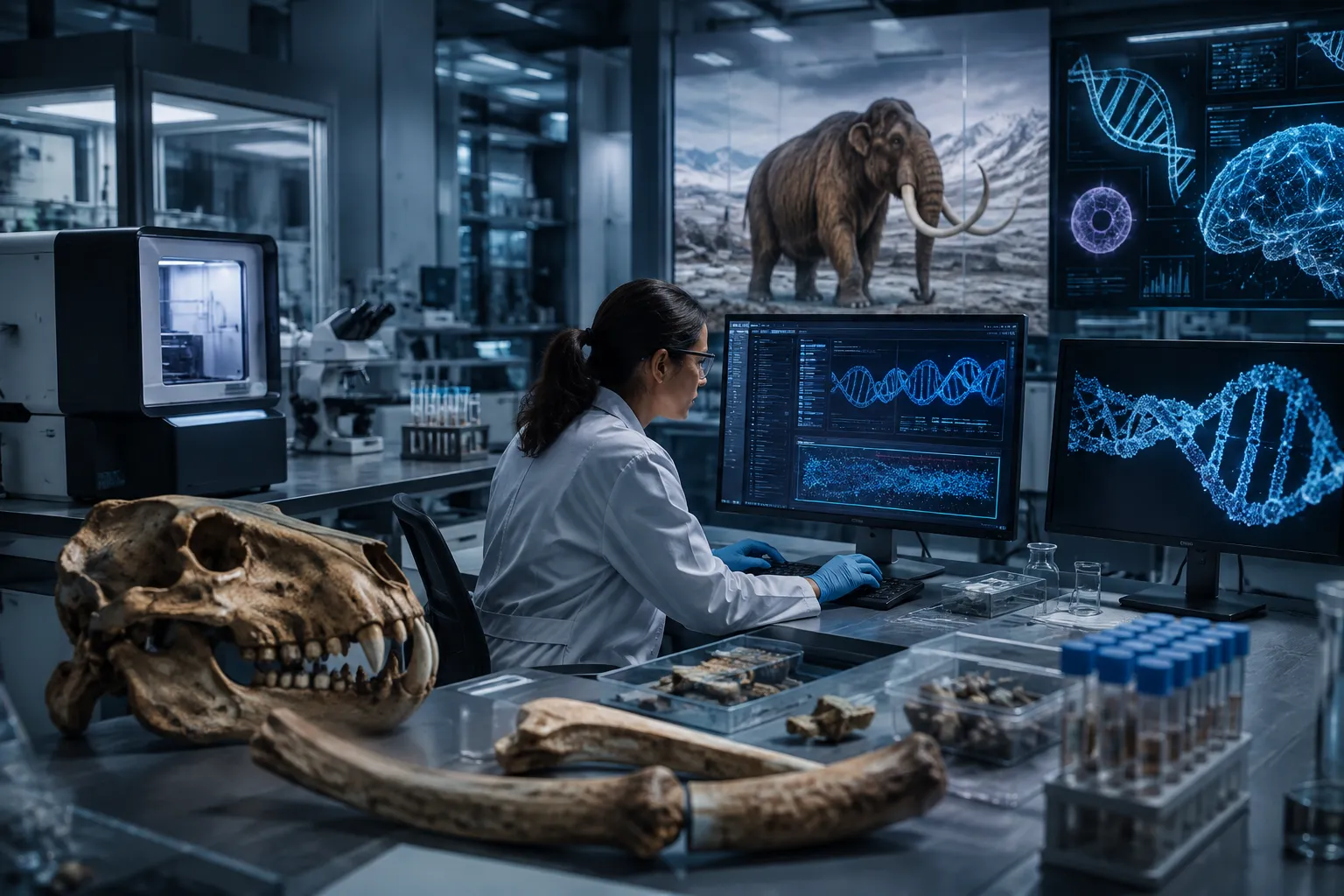
This field is known as de-extinction.
In 2026, de-extinction has moved beyond a purely theoretical concept. The most dramatic example is the work of Colossal Biosciences, which reported the birth of three genetically engineered animals designed to reproduce key traits of the extinct dire wolf. Colossal says the animals were created using 20 targeted edits across 14 genes in gray-wolf cells.
But there is an important scientific qualification.
These animals are not simply cloned from intact dire-wolf DNA.
Instead, scientists reconstructed genetic information from ancient remains and used a living relative as the biological starting point.
That distinction explains what de-extinction technology actually is—and where its limits remain.
For the wider technology landscape, this article is part of HNN24x7’s Future Technology 2026 pillar.
What Is De-Extinction Technology?
De-extinction technology refers to biotechnology techniques intended to recreate an extinct species or restore important genetic traits that disappeared with it.
The process can involve several technologies:
- ancient DNA sequencing,
- genome reconstruction,
- computational biology,
- CRISPR gene editing,
- stem-cell technologies,
- cloning,
- embryo development,
- reproductive biology,
- artificial or ex-utero development systems,
- AI-assisted genomic analysis.
The exact method depends on the extinct species.
A recently extinct animal with well-preserved DNA and a close living relative presents a very different scientific challenge from a species that disappeared millions of years ago.
Can Scientists Actually Bring Back an Extinct Animal?
Scientists can now create living animals carrying selected genetic characteristics associated with extinct species, but recreating a perfectly identical extinct species is a much harder—and in many cases impossible—goal.
Ancient DNA degrades over time.
Even when DNA fragments survive, scientists may not recover every part of the original genome.
A 2022 Nature Reviews Genetics analysis illustrated the problem: when researchers reconstructed the genome of the extinct Christmas Island rat and compared it with living relatives, nearly 5% of the genome could not be mapped even against a high-quality reference genome.
That missing information matters.
Genes do not work independently.
Regulatory sequences, developmental biology, epigenetics, microbiomes and environmental conditions can all influence an organism’s characteristics.
Therefore:
Reconstructing DNA is not necessarily the same as reconstructing an extinct species.
The Dire Wolf: The Biggest De-Extinction Story of the 2020s
The clearest example of modern de-extinction technology is the dire wolf.
The dire wolf (Aenocyon dirus) disappeared thousands of years ago.
In 2025, Colossal Biosciences announced the birth of three animals it described as the world’s first functionally de-extincted dire wolves.
The company says:
- Romulus and Remus were born in October 2024.
- Khaleesi was born in January 2025.
- Ancient DNA came from a 13,000-year-old tooth and a 72,000-year-old bone.
- Scientists identified genetic differences between dire wolves and modern gray wolves.
- 20 targeted genetic edits were made across 14 genes.
- The edited cells were used to create embryos.
- Surrogate dogs carried the embryos.
This is a remarkable biotechnology achievement.
But the terminology matters.
Are the New Dire Wolves Exact Copies of Ancient Dire Wolves?
No—not in the conventional cloning sense.
Colossal’s own description says it did not insert an entire ancient dire-wolf genome into a modern wolf.
Instead, researchers used the gray wolf as the starting point and edited selected genes associated with characteristics they wanted to reproduce.
The company describes this as functional de-extinction.
That means creating an organism that is genetically similar in important respects and expresses characteristic traits of the extinct species.
This is fundamentally different from finding a perfectly preserved extinct animal cell and making an exact clone.
There is currently no known method for doing that with an extinct species whose living cells have disappeared
How Does De-Extinction Work?
A simplified de-extinction pipeline looks like this:
Ancient remains
↓
DNA extraction
↓
Genome sequencing
↓
Computational reconstruction
↓
Comparison with living relatives
↓
Identify important genetic differences
↓
Genome editing
↓
Cell development
↓
Embryo creation
↓
Surrogate gestation or other reproductive system
↓
Birth and monitoring
The precise steps vary by species.
For the thylacine, for example, Colossal describes a process involving genome sequencing, computational biology, marsupial cell lines, CRISPR editing, somatic cell nuclear transfer and surrogate development.
Why Ancient DNA Is So Important
Ancient DNA is effectively the historical information source for de-extinction.
Scientists can extract DNA fragments from materials such as:
- bones,
- teeth,
- preserved tissues,
- hair,
- museum specimens,
- frozen remains.
But ancient DNA is fragmented and chemically damaged.
It can also be contaminated by modern DNA.
Scientists therefore need sophisticated sequencing and computational methods to determine:
Which genetic fragments actually belonged to the extinct animal?
Ancient DNA research has demonstrated that useful sequence information can sometimes survive for tens of thousands of years, although preservation conditions vary enormously.
AI Could Become the Missing Layer in De-Extinction
This is where AI-assisted research becomes particularly interesting.
Scientists may have enormous quantities of fragmented genomic data.
AI and computational biology can help researchers:
- compare genomes,
- identify mutations,
- predict gene functions,
- analyze regulatory sequences,
- identify candidate traits,
- reconstruct evolutionary relationships,
- model protein effects,
- prioritize genetic edits.
The goal is not simply:
“Ask AI to recreate a mammoth.”
It is much more complicated.
AI can help scientists decide:
Which genetic differences matter?
Which mutations are likely responsible for a particular trait?
Which edits should be tested experimentally?
Generative AI Could Change De-Extinction Research
A 2026 Trends in Biotechnology article examined a future-facing approach in which generative AI could potentially help design DNA sequences associated with desired traits. The authors discuss combining AI-generated genetic designs with artificial chromosomes, synthetic embryos and ex-utero development technologies.
This represents a possible next stage of the field.
Instead of only reconstructing what existed in the past, scientists could increasingly ask:
What genetic configuration could recreate a particular biological trait?
That could transform de-extinction from a purely reconstructive discipline into a form of biological design.
However, this remains a research direction—not a technology that can currently generate arbitrary extinct animals on demand.
What Role Does CRISPR Play?
CRISPR is one of the most important genome-editing technologies involved in modern de-extinction research.
It allows scientists to make targeted changes to DNA.
In simplified terms:
Ancient genome data → identify extinct-species variants → locate corresponding genes in living relative → edit those genes.
For the dire-wolf project, Colossal reports 20 precise edits across 14 genes.
Those edits were associated with traits including:
- coat characteristics,
- body size,
- skull structure,
- musculature,
- vocalization.
The larger scientific challenge is determining which genetic changes actually produce the desired biological outcome.
Why One Gene Is Not Enough
A common misconception is that one gene produces one visible characteristic.
Biology is usually more complicated.
A trait such as:
body size
may involve multiple genes and regulatory mechanisms.
Likewise:
fur thickness
can involve several biological pathways.
And:
behavior
can be influenced by genetics, development and environment.
That means de-extinction requires more than copying a few obvious genes.
Scientists need to understand the genetic architecture of the extinct animal.
Why a Living Relative Is Needed
Scientists cannot normally create a complex mammal from ancient DNA alone.
They need a biological framework.
That usually means using a closely related living species.
For the mammoth, the obvious candidate is the Asian elephant.
For the thylacine, researchers are studying marsupial relatives such as the fat-tailed dunnart.
For the dire wolf, gray wolves provide the cellular and genetic starting point.
The closer the living relative, the more genetic information can potentially be transferred or reconstructed.
But even closely related species can have meaningful differences.
The Mammoth Problem
The woolly mammoth remains perhaps the most famous target of de-extinction.
Unlike the dire wolf, however, the mammoth presents a much larger biological challenge.
Researchers have recovered substantial amounts of mammoth genetic information from ancient remains.
The Asian elephant is the closest living relative.
But recreating a mammoth-like animal would require far more than producing thick fur.
Scientists would need to consider characteristics including:
- body size,
- fat storage,
- cold adaptation,
- hair,
- ears,
- hemoglobin,
- metabolism,
- immune function,
- development.
Colossal’s mammoth program describes its objective more specifically as creating a cold-resistant elephant with core biological traits of the woolly mammoth, rather than simply cloning an ancient mammoth.
That distinction is crucial.
Why the Mammoth Is Harder Than the Dire Wolf
Elephants have:
- long pregnancies,
- large bodies,
- complex social behavior,
- long generation times,
- difficult reproductive biology.
Any attempt to create a mammoth-like elephant therefore faces major challenges.
There is also an ethical question:
What would happen to the animal after birth?
A mammoth would not simply need to survive.
It would need:
- appropriate social conditions,
- suitable habitat,
- veterinary care,
- food,
- environmental compatibility,
- potentially a population rather than one isolated individual.
Creating one animal is not the same as restoring a species.
What About the Thylacine?
The thylacine, or Tasmanian tiger, is another major de-extinction target.
The species disappeared from the wild in Tasmania during the 20th century.
Unlike ancient Ice Age species, the thylacine has relatively recent museum specimens.
Colossal says its thylacine work involves a 108-year-old specimen from which DNA was extracted and a genome sequence that was subsequently updated.
The proposed process involves:
- sequencing the thylacine genome,
- sequencing genomes of living relatives,
- computational comparison,
- identifying target genetic differences,
- editing marsupial cells,
- creating embryos,
- using reproductive technologies,
- developing offspring.
The thylacine is particularly interesting because it is a marsupial.
That creates reproductive challenges very different from those of mammals such as wolves or elephants.
Can AI Reconstruct a Complete Extinct Genome?
Not simply from incomplete DNA fragments.
AI can help predict and reconstruct missing information, but prediction is not equivalent to recovering historical fact.
If a DNA sequence is genuinely absent from the available evidence, scientists may have to infer it from:
- related species,
- evolutionary conservation,
- population genetics,
- gene function,
- comparative genomics.
That introduces uncertainty.
A predicted sequence could be biologically plausible without being identical to the sequence that actually existed in the extinct animal.
This is one of the most important limitations of AI-assisted de-extinction.
AI Does Not Have a Time Machine
AI can analyze genetic information.
It cannot recover information that was never preserved unless scientists infer it from other evidence.
That distinction should remain central in coverage of the field.
A good scientific description is:
AI can help reconstruct and interpret missing genetic information.
An inaccurate description would be:
AI can perfectly recreate extinct DNA.
The first is a research capability.
The second is an unsupported certainty.
De-Extinction Help Endangered Species?
Potentially, and this may ultimately be more important than resurrecting famous extinct animals.
The same tools being developed for de-extinction can potentially support genetic rescue.
For example:
- increasing genetic diversity,
- correcting harmful mutations,
- improving disease resistance,
- helping endangered populations reproduce,
- preserving genetic material,
- developing new conservation methods.
Colossal says its de-extinction research has already produced technologies it intends to apply to endangered species, including work involving red wolves and less invasive cell-sourcing methods.
This creates a more immediate conservation application.
Instead of asking:
“Can we bring back a species that disappeared?”
scientists can ask:
“Can we stop another species from disappearing?”
De-Extinction vs Genetic Rescue
These concepts should not be confused.
| Technology | Main Goal |
|---|---|
| De-extinction | Recreate extinct-species characteristics |
| Genetic rescue | Increase genetic health of an endangered population |
| Conservation breeding | Increase population numbers |
| Genome editing | Modify specific genetic sequences |
| Cloning | Produce genetically similar offspring from existing cells |
| Ancient DNA research | Recover genetic information from past organisms |
Genetic rescue may have a much clearer conservation case because the target species is still alive.
What Are the Ecological Risks?
Bringing back an extinct animal does not automatically restore an ecosystem.
The ecosystem may have changed dramatically since the animal disappeared.
There could be:
- new predators,
- different prey,
- altered vegetation,
- changed climate,
- human development,
- new diseases,
- invasive species.
A species that once played an ecological role thousands of years ago may not fit perfectly into the modern environment.
The International Union for Conservation of Nature has emphasized the need to consider opportunities, risks and uncertainties when evaluating de-extinction for conservation.
Could De-Extinction Harm Existing Species?
Potentially.
A reintroduced animal could:
- compete with existing species,
- alter food webs,
- introduce disease,
- change vegetation,
- disrupt predator-prey relationships.
This is why conservation scientists cannot evaluate de-extinction only at the level of genetics.
They also need ecological models.
A successful genome does not automatically produce a successful ecosystem.
What About Animal Welfare?
Animal welfare is another major concern.
Developing embryos through experimental reproductive technologies can involve:
- failed embryos,
- miscarriages,
- unsuccessful pregnancies,
- developmental abnormalities,
- surrogate-animal risks.
Even if the resulting animal is healthy, scientists need to consider:
What kind of life will it have?
For a species with no living population, researchers would need to create an appropriate social and environmental context.
This is particularly complicated for highly social species.
Is De-Extinction Ethical?
There is no universal answer.
Supporters argue that humans have contributed to many extinctions and that biotechnology could potentially help repair some of the damage.
Critics question whether resources should instead be directed toward species that are still alive.
The strongest ethical arguments depend on:
- the target species,
- the ecological purpose,
- animal welfare,
- conservation value,
- technological risk,
- cost,
- opportunity cost.
Therefore, de-extinction should not be presented as automatically good or automatically harmful.
It is a scientific and conservation decision with different risks for different species.
Could De-Extinction Reverse Extinction?
Only in a limited biological sense.
If an extinct species is recreated exactly, it would be reasonable to call that a reversal of extinction.
But many current approaches create an organism that is genetically engineered to resemble an extinct species.
That is closer to functional restoration than literal resurrection.
This distinction becomes particularly important as the technology advances.
The future may contain animals that look and behave like extinct species while having genomes that are partly derived from living relatives.
Why Computational Biology Matters
De-extinction is not just a laboratory exercise.
A huge part of the work happens inside computers.
Scientists must analyze:
- genome sequences,
- evolutionary relationships,
- gene variants,
- regulatory regions,
- protein functions,
- genetic differences,
- potential edits.
Computational biology turns millions or billions of DNA letters into biological hypotheses.
This is where AI could eventually provide enormous leverage.
The De-Extinction Technology Stack
The field can be viewed as a stack of technologies:
1. Ancient DNA
Provides genetic information from extinct organisms.
2. Genome Sequencing
Reads and organizes DNA fragments.
3. Computational Biology
Reconstructs genomes and compares species.
4. AI
Helps analyze complex genetic relationships and potentially design candidate sequences.
5. CRISPR
Makes targeted genetic modifications.
6. Stem Cells and Cell Reprogramming
Provide flexible biological material for reproduction and editing.
7. Cloning Technologies
Can transform edited cells into embryos.
8. Embryology
Allows embryos to develop.
9. Surrogate Biology
Provides the reproductive environment required for gestation.
10. Conservation Science
Determines whether and how the resulting animals could actually live in the environment.
This is why de-extinction is such a powerful example of converging future technologies.
Could Generative AI Design Extinct Animal Traits?
This is one of the most fascinating possibilities for the future.
Instead of attempting to reconstruct every detail of an extinct genome, scientists could focus on specific biological traits.
For example:
Cold tolerance
↓
Identify genes involved
↓
Model genetic variants
↓
Generate candidate sequences
↓
Edit cells
↓
Test biological function
↓
Select successful variants
This concept is being explored in the scientific literature as a potential future application of generative AI in de-extinction and trait design.
But this remains an emerging research direction.
It should not be confused with a mature ability to design complete animals.
Could Scientists Create New Species Instead?
This is where de-extinction starts becoming a much broader concept.
Once scientists can:
- edit genomes,
- predict traits,
- design sequences,
- create embryos,
- control development,
the technology could potentially be used not only to recreate historical traits but also to create new biological combinations.
That raises a fundamental question:
Where does conservation end and biological engineering begin?
A future animal could contain:
- extinct-species genes,
- modern-species genes,
- engineered adaptations.
Such an animal would not fit neatly into traditional categories.
Why De-Extinction Could Become a Major Future Technology
The significance of de-extinction extends beyond extinct animals.
The underlying technologies could contribute to:
- conservation genetics,
- veterinary medicine,
- reproductive biology,
- gene therapy research,
- synthetic biology,
- biodiversity preservation,
- disease resistance,
- endangered-species recovery.
In that sense, the extinct animal may be the demonstration project.
The more important technological legacy could be the tools developed along the way.
What Could Happen by 2030?
The most plausible near-term developments are not Jurassic Park-style ecosystems.
Instead, expect progress in:
- ancient-genome reconstruction,
- AI-assisted genomic analysis,
- precision gene editing,
- endangered-species genetic rescue,
- advanced reproductive technologies,
- cell reprogramming,
- embryo culture,
- conservation databases.
If those technologies mature, increasingly sophisticated attempts to recreate extinct-species traits could follow.
But the exact timeline remains uncertain.
Will We See Woolly Mammoths Walking Around Soon?
There is no scientifically established date for the return of a mammoth-like animal.
Companies working in the field have ambitious timelines, but creating a viable animal and establishing a healthy population are two different milestones.
The scientific challenges include:
- genome editing,
- elephant reproductive biology,
- embryo development,
- gestation,
- animal welfare,
- population establishment,
- ecological suitability.
Therefore, headlines predicting an imminent return of mammoths should be treated cautiously.
What Is the Biggest Limitation of De-Extinction?
The biggest limitation is not necessarily CRISPR.
It is missing biological information.
Ancient DNA is incomplete.
Even a nearly complete genome does not necessarily capture:
- epigenetics,
- developmental history,
- microbiome,
- learned behavior,
- environmental interactions.
An extinct species is an entire biological system.
DNA is the blueprint, but the final organism depends on much more than the sequence alone.
De-Extinction Could Change How We Think About Extinction
For centuries, extinction meant:
gone forever.
Biotechnology introduces a more complicated possibility:
genetic information can sometimes survive after the organism disappears.
That information can potentially be studied, reconstructed and used to restore selected biological traits.
But this does not mean extinction has become reversible.
It means humanity has acquired a new set of tools for interacting with the genetic consequences of extinction.
The Real Future May Be Conservation, Not Resurrection
The most valuable outcome of de-extinction technology may ultimately be preventing future extinctions.
Imagine a conservation system where scientists can:
- preserve genetic material before a species disappears,
- sequence endangered populations,
- identify harmful mutations,
- increase genetic diversity,
- improve disease resistance,
- support reproduction,
- store biological information digitally.
That could create a kind of genetic insurance policy for biodiversity.
In that scenario, de-extinction research becomes part of a larger mission:
preserve biological diversity before it is lost.
“Sources Used”
https://colossal.com/colossal-dire-wolves-brought-back-from-12000-year-extinction-through-revolutionary-gene-editing
https://www.nature.com/articles/s41576-022-00475-8
De-Extinction Technology in 2026: Where Things Stand
The field has reached an important transition.
It is no longer accurate to describe all de-extinction research as purely hypothetical.
The 2025 dire-wolf project demonstrated that researchers can use ancient genomic information, modern genome editing and reproductive biotechnology to produce living animals carrying selected extinct-species traits.
At the same time, it would be equally inaccurate to claim that scientists can simply clone any extinct animal.
They cannot.
The biggest barriers remain:
- incomplete ancient DNA,
- uncertain gene function,
- complex traits,
- reproductive biology,
- animal welfare,
- ecological compatibility,
- cost,
- regulatory oversight.
And AI is becoming another important layer.
Research published in 2026 points toward future AI systems that could assist not only with reconstructing extinct genomes but potentially with designing DNA associated with desired biological traits.
That could make the next phase of de-extinction much more ambitious.
The Future of De-Extinction Is Really the Future of Genetic Engineering
The most important story may not be whether a mammoth or dire wolf walks again.
The bigger story is that biotechnology is increasingly giving humans the ability to read, edit and potentially design biological information.
De-extinction brings all three capabilities together:
Read the past → edit the present → design the future.
Ancient DNA provides the historical record.
AI and computational biology interpret it.
CRISPR and genome engineering modify living cells.
Reproductive biotechnology turns those cells into organisms.
Conservation science determines whether those organisms have a meaningful place in the modern world.
That makes de-extinction technology one of the most extraordinary—and controversial—frontiers of future biotechnology in 2026.
And as the technology improves, the most important question may shift from:
“Can we bring extinct species back?”
to:
“What should we bring back, why should we do it, and how can we make sure the technology protects the species that are still here?”
For the wider emerging-technology ecosystem, readers can explore HNN24x7’s Future Technology 2026 pillar.
FAQ
What is de-extinction technology?
De-extinction technology uses tools such as ancient DNA sequencing, genome editing, computational biology and reproductive biotechnology to recreate extinct-species characteristics or, where possible, restore an extinct lineage.
Can extinct animals really be brought back?
Scientists can now create living animals carrying selected genetic traits associated with extinct species. However, creating an exact genetic copy of an extinct animal is much more difficult and may be impossible when complete genetic and biological information is unavailable.
Is the dire wolf really back?
In 2025, Colossal Biosciences reported producing three animals that it describes as functionally de-extincted dire wolves. The animals were created by editing gray-wolf cells at 20 sites across 14 genes rather than cloning an intact ancient dire-wolf cell.
How does CRISPR help de-extinction?
CRISPR can make targeted changes to the genome of a living relative. Researchers can use ancient DNA information to identify genetic variants associated with extinct-species traits and then investigate whether those variants can be recreated in living cells.
What role does AI play in de-extinction?
AI and computational biology can help analyze ancient genomes, compare living and extinct species, identify potentially important genetic variants and model candidate genetic changes. Researchers are also exploring future generative-AI approaches for designing DNA associated with biological traits.
Can scientists bring back the woolly mammoth?
Scientists have recovered substantial mammoth genetic information and are studying ways to create an elephant with important mammoth characteristics. A fully restored woolly mammoth species, however, remains an extremely challenging scientific goal.
Why is ancient DNA important?
Ancient DNA provides genetic information about extinct organisms. Researchers can use DNA from bones, teeth and preserved specimens to reconstruct parts of extinct genomes.
Could de-extinction help endangered animals?
Potentially. Technologies developed through de-extinction research may also support genetic rescue, conservation breeding, disease-resistance research and other methods of helping endangered populations.
Is de-extinction safe for ecosystems?
Not automatically. Reintroducing a species into a modern ecosystem could create ecological, disease, competition and animal-welfare risks. Each proposed restoration would need to be evaluated separately.
Is de-extinction the same as cloning?
No. Conventional cloning creates a genetically similar organism from an existing cell. Many de-extinction projects instead use ancient genetic information to edit cells from a living relative, meaning the resulting animal may resemble the extinct species without being an exact clone.