




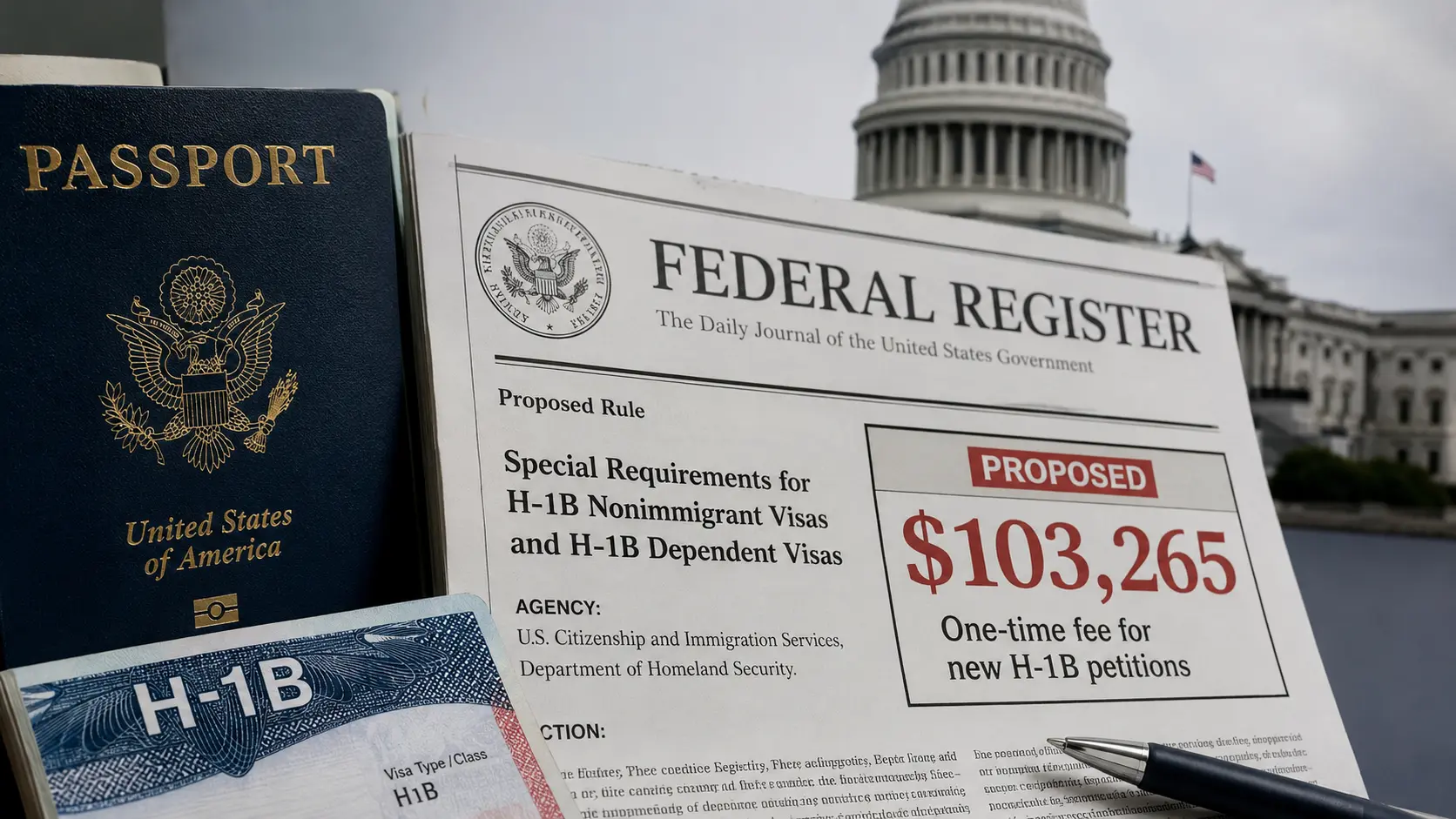
The U.S. Department of Homeland Security (DHS) has proposed a new $103,265 fee for H-1B cap-subject petitions, potentially creating a dramatic increase in the cost of hiring workers through the H-1B program.
But there is one crucial point readers need to understand:
The $103,265 H-1B fee is proposed, not final.
DHS published the proposal as a Notice of Proposed Rulemaking in the Federal Register on August 25, 2026. The proposed fee would be an additional charge on qualifying H-1B petitions, meaning it would come on top of other applicable H-1B fees or payments. The proposal is now subject to the federal rulemaking process and public comments.
That distinction is especially important for Indian professionals, international students and U.S. companies preparing for future H-1B filings.
What is the proposed $103,265 H-1B fee?
The $103,265 H-1B fee is a proposed additional fee for H-1B cap-subject petitions.
DHS proposes adding the fee as a separate charge rather than replacing the existing H-1B petition fee. It would therefore be payable in addition to other applicable fees or payments when the proposed rule applies.
DHS says the purpose of the proposed fee is to recover part of the federal government’s costs associated with administering the lawful immigration system.
Those costs include activities involving agencies such as DHS, the Department of Justice, the Department of State and the Department of Labor.
DHS estimates that applying the proposed fee to an assumed annual volume of 85,000 cap-subject petitions could generate approximately $8.8 billion per year.
Is the $103,265 H-1B fee final?
No. It is not final.
The Federal Register document is explicitly a proposed rule, not a final rule.
DHS has opened the proposal to public comments. The published deadline for submitting comments is September 24, 2026. After the comment period, DHS would need to consider the comments and determine whether and how to proceed with a final rule.
Therefore, employers and H-1B applicants should not treat $103,265 as a fee that every qualifying H-1B petition must pay today.
Who would have to pay the $103,265 H-1B fee?
Under the proposal, the fee would apply to H-1B cap-subject petitions.
That includes petitions subject to the regular annual H-1B numerical limit as well as petitions eligible for the 20,000 advanced-degree exemption for qualifying graduates of U.S. institutions.
DHS specifically proposes the fee for all H-1B cap-subject petitions, including those eligible for this advanced-degree exemption.
The proposal therefore covers two important parts of the annual H-1B allocation:
- The regular 65,000 H-1B numerical allocation.
- The additional 20,000 allocation for qualifying U.S. advanced-degree beneficiaries.
Together, these account for the annual 85,000 cap-subject allocation referenced by DHS in its revenue calculations.
Who would not pay the proposed $103,265 fee?
The proposed fee would not apply to all H-1B petitions.
DHS specifically limits the proposal to cap-subject H-1B petitions.
That means cap-exempt H-1B petitions would not be covered by this particular proposed fee.
Examples of organizations that can have cap-exempt H-1B petitions include certain:
- institutions of higher education;
- nonprofit research organizations;
- governmental research organizations.
USCIS says the proposed fee would not apply to H-1B petitions that are not subject to the statutory cap.
This distinction is one of the most important points in the proposal.
Cap-subject vs. cap-exempt H-1B
| H-1B category | Proposed $103,265 fee? |
|---|---|
| Regular cap-subject H-1B | Yes, if proposal becomes effective |
| U.S. master’s cap / advanced-degree exemption | Yes, if proposal becomes effective |
| Certain higher-education employers | No, if petition is cap-exempt |
| Certain nonprofit research organizations | No, if petition is cap-exempt |
| Certain governmental research organizations | No, if petition is cap-exempt |
| Existing H-1B status by itself | Not automatically |
| Every H-1B petition | No |
The exact applicability would depend on whether the petition is cap-subject under the final rules.
Does the $103,265 fee apply to H-1B applicants from India?
The proposal does not create a separate $103,265 charge specifically for Indians.
The proposed rule is structured around the type of H-1B petition, particularly whether it is cap-subject, rather than the applicant’s nationality.
However, the proposal is highly significant for Indian professionals because Indian nationals make up a large share of H-1B workers and beneficiaries.
For an Indian professional whose employer files a cap-subject H-1B petition, the proposed fee could therefore become a major factor in the employer’s hiring decision if the rule ultimately takes effect.
That is an economic and practical impact, not a nationality-specific fee.
Does the fee apply to the H-1B lottery?
Potentially, yes — if the petition selected through the cap process is ultimately subject to the proposed fee.
The proposed rule concerns H-1B cap-subject petitions rather than creating a fee simply for entering the registration process.
This distinction matters.
The H-1B process involves multiple stages, including electronic registration and, for selected beneficiaries, the subsequent petition process.
The proposed $103,265 charge is described by DHS as a fee payable at the time of filing of the qualifying petition.
Therefore, it should not be described as a $103,265 fee merely for submitting an H-1B lottery registration.
Would the employer or the worker pay the $103,265?
The proposal describes the fee as payable at the time the qualifying H-1B petition is filed.
In practical terms, the relevant party is the petitioning employer/petitioner, because the employer generally files the H-1B petition with USCIS.
The proposal does not describe the charge as a personal visa application fee imposed directly on every foreign worker.
This distinction is important when headlines say that an “H-1B applicant” would have to pay $103,265.
The financial burden would arise through the employer’s H-1B petition filing.
Does the $103,265 fee replace existing H-1B fees?
No.
DHS proposes the $103,265 amount as a separate additional fee.
The proposal says it would be imposed in addition to other applicable fees or payments.
That means the headline figure should not be interpreted as the complete cost of an H-1B petition.
If the proposal becomes effective, employers could face the $103,265 charge plus other applicable H-1B-related fees, depending on the circumstances of the petition.
This is one reason the proposal could represent such a substantial increase in the cost of cap-subject H-1B hiring.
What is the difference between the $103,265 proposal and the earlier $100,000 H-1B payment?
The two amounts are related to the broader H-1B fee debate, but they are not the same legal measure.
DHS’s proposed $103,265 fee is based on a different legal authority from the $100,000 payment associated with the 2025 presidential proclamation.
The Federal Register explains that the earlier $100,000 payment was imposed under Presidential Proclamation 10973 and related to restrictions on entry.
DHS says the new $103,265 proposal is instead being established as an additional H-1B fee under its statutory authorities.
This difference should be made clear in coverage.
$100,000: earlier proclamation-related payment.
$103,265: new DHS proposed additional fee.
They should not be presented as though DHS simply changed the previous $100,000 payment to $103,265.
Why is DHS proposing a $103,265 fee?
DHS says the proposed fee is intended to recover federal government costs associated with administering the lawful immigration system.
The department identifies costs related to areas including:
- immigration benefit adjudication;
- fraud detection;
- national-security vetting;
- immigration systems modernization;
- records and fee collection;
- immigration court operations;
- consular visa processing;
- labor standards enforcement;
- interagency coordination.
DHS estimates that the proposed fee would generate approximately $8.8 billion annually based on an assumed 85,000 cap-subject petitions.
The proposal therefore goes beyond the narrow cost of processing an individual H-1B petition. DHS says the revenue would help recover broader lawful-immigration-system costs.
Why is the proposed fee $103,265 instead of $100,000?
The Federal Register provides a specific calculation.
DHS estimated approximately $8.777 billion in costs to be recovered and divided that amount by a projected 85,000 fee-paying petitions.
The resulting calculation was approximately $103,264.57.
DHS then rounded the amount to $103,265.
So the figure is not simply an arbitrary headline number.
It is derived from the department’s proposed cost-recovery methodology.
Could the $103,265 fee make H-1B hiring more expensive?
Yes.
If implemented as proposed, a company sponsoring a qualifying cap-subject H-1B worker could face an additional six-figure federal fee on top of existing costs.
That could affect hiring decisions, particularly for:
- startups;
- smaller technology companies;
- consulting firms;
- employers recruiting entry-level international graduates;
- companies that frequently sponsor H-1B workers.
Large employers may be better positioned to absorb the cost, but a six-figure additional expense could still materially change the economics of sponsorship.
The proposal could therefore influence whether some companies sponsor workers, hire domestically, use alternative visa categories where available, or restructure international recruitment.
Those are potential business consequences, however, rather than guaranteed outcomes.
What could the proposal mean for international students?
The proposal could matter to international students who hope to transition from F-1 student status into H-1B employment.
A student who becomes eligible for an H-1B cap-subject petition could face an employer sponsorship decision influenced by the proposed additional cost.
However, the $103,265 proposal is not itself a $103,265 fee on every F-1 student or every OPT participant.
It is directed at qualifying H-1B cap-subject petitions.
This distinction is essential because headlines about a six-figure H-1B fee can otherwise create confusion among students who are not currently filing an H-1B petition.
When could the $103,265 H-1B fee take effect?
There is no final effective date yet for the proposed $103,265 fee.
The proposal was published in the Federal Register on August 25, 2026.
The public-comment period is scheduled to run through September 24, 2026.
The general process is:
Proposed rule published
↓
Public comment period
↓
DHS reviews comments
↓
DHS decides whether to issue a final rule
↓
Final rule and effective date, if adopted
Therefore, readers should not assume that the proposed fee automatically becomes payable when the proposal is published.
Can the proposal still change?
Yes.
A proposed rule is not necessarily the final version of a regulation.
During the public-comment period, individuals, businesses, universities, immigration organizations and other stakeholders can submit comments.
DHS can then modify, withdraw or finalize the proposal.
Even if a final rule is issued, it could potentially face legal challenges.
For that reason, the $103,265 figure should currently be described as “proposed” in news coverage.
What should H-1B applicants and employers do now?
The most important step is to distinguish current rules from proposed changes.
Employers planning H-1B filings should continue to check official USCIS guidance and the Federal Register for developments rather than assuming the $103,265 fee is already mandatory.
Applicants should also avoid making major immigration decisions based solely on headlines about the proposal.
The proposal is important, but its final form and effective date remain unresolved.
FAQ
1. Is the $103,265 H-1B fee final?
No. DHS has proposed the $103,265 fee through a Notice of Proposed Rulemaking. It is subject to public comments and further regulatory action.
2. Who would pay the $103,265 H-1B fee?
The proposal would apply to H-1B cap-subject petitions, including petitions eligible for the U.S. advanced-degree exemption.
3. Does the $103,265 fee apply to cap-exempt H-1B petitions?
No. DHS specifically proposes the additional fee for cap-subject petitions rather than all H-1B petitions.
4. Does the proposed fee apply specifically to Indian H-1B applicants?
No. The proposal is based on the type of H-1B petition, not the worker’s nationality.
5. Does the $103,265 fee replace existing H-1B fees?
No. DHS proposes it as a separate additional fee that would come on top of other applicable fees or payments.
6. When could the H-1B $103,265 fee take effect?
There is currently no final effective date. The proposal is open for public comments until September 24, 2026, after which DHS would need to decide whether and how to proceed.
7. Does the fee apply to the H-1B lottery registration?
The proposed fee is described as payable when the qualifying H-1B petition is filed. It is not described as a $103,265 charge merely for submitting an H-1B registration.
8. Why did DHS propose $103,265?
DHS calculated the fee from estimated federal immigration-related costs and a projected 85,000 cap-subject petitions. The calculation produced approximately $103,264.57, which DHS rounded to $103,265.
“Sources Used”
https://thefederalregister.org/documents/2026-17324/fee-for-certain-h-1b-petitions?
https://content.govdelivery.com/accounts/USDHSCIS/bulletins/42688fc
https://regulations.justia.com/regulations/fedreg/2026/08/25/2026-17324.html
https://www.justice.gov/eoir/federal-register-notices-2026
The bottom line
The DHS proposal would create a $103,265 additional fee for H-1B cap-subject petitions, including petitions eligible for the U.S. advanced-degree exemption.
It would not apply to every H-1B petition. Certain cap-exempt petitions, including qualifying petitions from higher-education and research organizations, would fall outside the proposal.
The fee is also not currently a final $103,265 H-1B requirement.
It is a proposed rule published in the Federal Register on August 25, 2026, with public comments due by September 24.
For Indian professionals and other international workers, the biggest potential impact would come indirectly: employers could face a dramatically higher cost when sponsoring a cap-subject H-1B worker.
For now, the most accurate headline is therefore:
H-1B $103,265 fee proposed — not final.
“Must Read”