




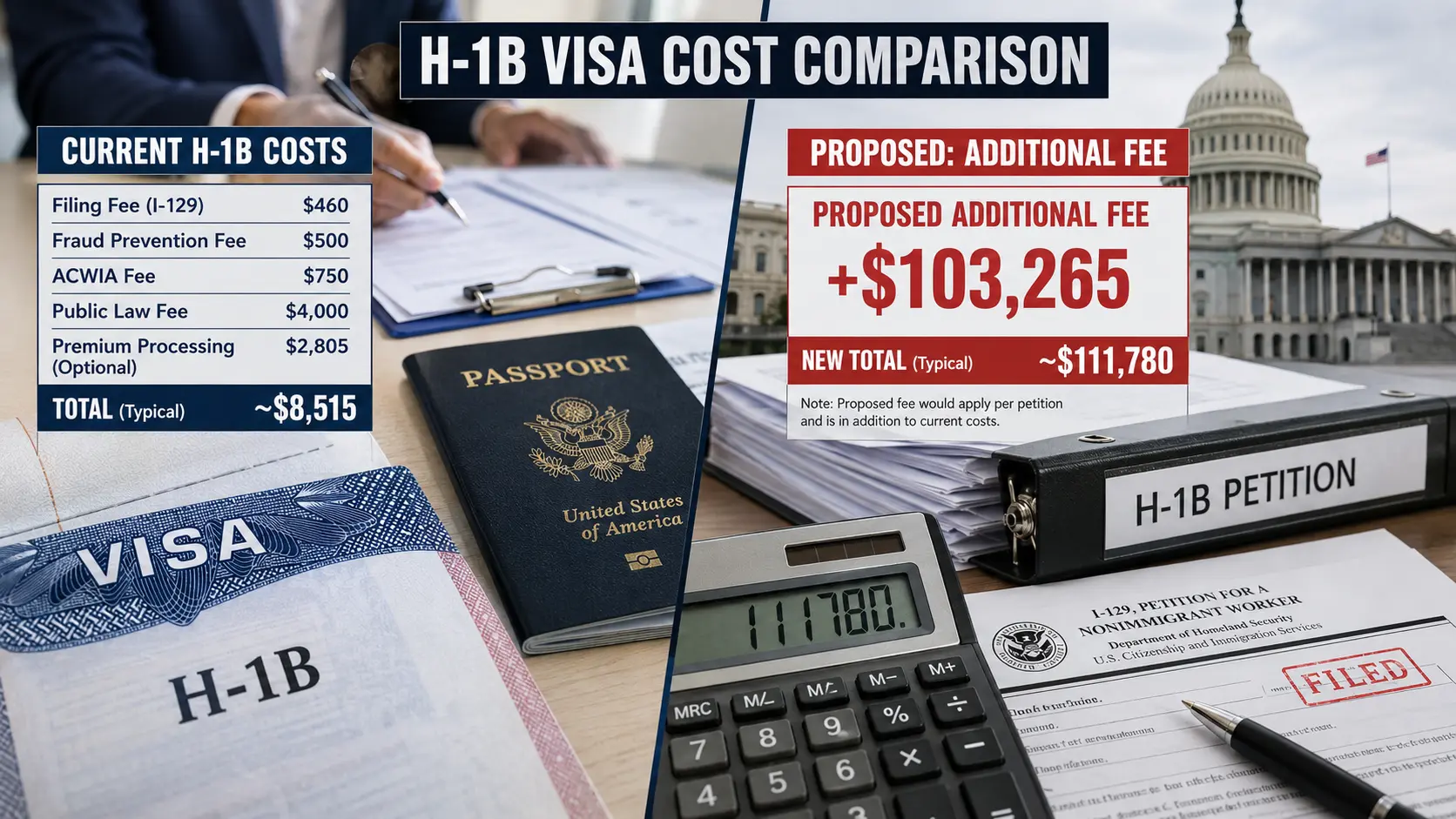
The proposed $103,265 H-1B fee would be dramatically larger than the standard government filing fees employers currently pay for an H-1B petition.
But the important comparison is not simply $103,265 versus a few hundred dollars.
An H-1B employer may already have to pay several separate government charges, depending on the type of employer and petition. USCIS’s current fee schedule lists a $780 paper Form I-129 filing fee for a standard H-1B petition, or $730 when filed online, with lower rules for certain small employers and nonprofits. Other charges can include the Asylum Program Fee, the $500 Fraud Prevention and Detection Fee and the ACWIA fee.
Against that existing structure, the Department of Homeland Security has proposed a separate $103,265 fee for each H-1B cap-subject petition. DHS says the proposed amount would be charged in addition to other required fees, not instead of them.
So how much could an employer actually pay?
H1B visa cost 2026 vs proposed $103,265 fee: What is the difference?
For a straightforward comparison, consider a regular employer filing a new cap-subject H-1B petition.
Under the current USCIS fee schedule, a standard petitioner can face:
- Form I-129 filing fee: $780 on paper or $730 online
- Asylum Program Fee: $600
- Fraud Prevention and Detection Fee: $500, when applicable
- ACWIA fee: generally $1,500 for qualifying employers, with a reduced $750 amount for employers with 25 or fewer full-time-equivalent U.S. employees
USCIS confirms the current I-129 H-1B filing amounts and additional fees in its fee schedule.
That means a large regular employer filing a qualifying initial H-1B petition could have $3,380 in government fees before optional premium processing or other case-specific expenses when using the $780 paper filing fee.
If the same petition became subject to the proposed $103,265 fee, the proposed charge would be added on top.
Simple comparison
| Cost component | Current example | If proposed fee takes effect |
|---|---|---|
| I-129 filing fee | $780 paper | $780 |
| Asylum Program Fee | $600 | $600 |
| Fraud Prevention Fee | $500 | $500 |
| ACWIA fee | $1,500 | $1,500 |
| Current mandatory example | $3,380 | $3,380 |
| Proposed H-1B fee | — | $103,265 |
| Combined government fees | $3,380 | $106,645 |
Important: This is an illustrative calculation for a qualifying regular employer and does not mean every H-1B petition currently costs $3,380 or would cost $106,645. Employer size, petition type, exemptions, filing method and optional services can change the total.
The key point is that the proposed $103,265 would be additional.
How much more would employers pay?
Using the illustrative $3,380 current government-fee example:
$106,645 proposed total − $3,380 current total = $103,265 additional.
In other words, the proposed rule would increase the government-fee portion of that example by exactly $103,265.
That represents more than a 30-fold increase compared with the illustrative current government-fee total.
But there is an important nuance: the proposed fee is not a replacement for the existing H-1B fee structure.
DHS specifically says the $103,265 charge would apply in addition to other required fees.
What are the current H-1B fees employers pay?
The H-1B process does not have one universal government fee.
Instead, employers may encounter multiple charges.
1. Form I-129 filing fee
The basic H-1B petition is filed through Form I-129.
USCIS’s current fee schedule lists:
- $780 for paper filing by a regular petitioner
- $730 for online filing by a regular petitioner
- $460 for qualifying small employers and nonprofits
The applicable amount depends on the filing category and eligibility.
2. Asylum Program Fee
The current USCIS schedule lists an additional:
- $600 for a regular petitioner
- $300 for a small employer
- $0 for a nonprofit
The exact applicability depends on the petition and the petitioner’s status.
3. Fraud Prevention and Detection Fee
A $500 Fraud Prevention and Detection Fee can apply to an H-1B petition seeking an initial approval or an employer change.
It does not apply to every type of H-1B filing. USCIS explains that the fee generally does not apply to certain extensions or amendments filed by the same employer.
4. ACWIA fee
The American Competitiveness and Workforce Improvement Act fee is generally:
- $1,500 for qualifying employers
- $750 for employers with no more than 25 full-time-equivalent employees in the United States
Certain organizations are exempt. USCIS describes these rules in its H-1B materials.
5. Premium processing
Premium processing is optional and is a separate service.
It should therefore not be mixed into the basic mandatory government-cost comparison unless the employer chooses it.
USCIS’s H-1B filing checklist specifically treats premium processing as an additional fee when requested.
Attorney fees, recruitment expenses and other employer costs are also separate from USCIS government filing fees.
Why the proposed $103,265 fee is different
The biggest difference is the scale and legal structure of the proposed charge.
Existing H-1B filing costs consist of several smaller government fees associated with processing the petition and administering the H-1B programme.
DHS’s new proposal would add a single $103,265 charge to each qualifying cap-subject petition.
DHS says it calculated the proposed amount to recover approximately $8.8 billion in annual lawful-immigration-system costs, using an estimated 85,000 H-1B cap-subject petitions per year.
The calculation is therefore not simply an increase to the existing I-129 filing fee.
It is a proposed separate fee.
Does the $103,265 replace the current H-1B fees?
No.
This is perhaps the most important point in the comparison.
DHS explicitly says the proposed $103,265 fee would be imposed in addition to other required fees.
So the comparison should be:
Current H-1B government fees
+
Proposed $103,265 fee
—not:
$103,265 instead of current H-1B fees.
That distinction can significantly change how employers calculate the potential impact.
Would every H-1B employer have to pay $103,265?
No.
The proposal is specifically aimed at H-1B cap-subject petitions.
DHS says it is proposing the additional fee for cap-subject H-1B petitions rather than all H-1B petitions or all I-129 petitions.
That means the proposed charge is not a universal fee on every H-1B filing.
Cap-subject example
A technology company files a new H-1B petition for a worker selected through the annual cap process.
If the proposal becomes effective as written, that petition could be subject to the $103,265 additional fee.
Cap-exempt example
An eligible higher-education institution files a cap-exempt H-1B petition.
The proposed $103,265 cap-subject fee would not apply merely because the petition is an H-1B petition.
The distinction between cap-subject and cap-exempt petitions is therefore essential.
What about the H-1B master’s cap?
The proposal also matters to petitions benefiting from the 20,000 advanced-degree exemption.
DHS’s calculation treats the annual H-1B cap-subject pool as 85,000 positions: 65,000 under the regular numerical limit plus 20,000 for qualifying U.S. advanced-degree beneficiaries.
The proposed fee is therefore not limited only to the regular 65,000 allocation.
If adopted as proposed, it would cover qualifying cap-subject petitions in the advanced-degree exemption category as well.
How much would a small employer pay?
A smaller employer can have lower existing H-1B government fees.
USCIS lists a $460 I-129 fee for qualifying small employers, compared with $780 for a regular paper filing. The Asylum Program Fee can also be $300 rather than $600, while the ACWIA fee can be $750 rather than $1,500.
Using an illustrative initial petition that also incurs the $500 Fraud Prevention and Detection Fee:
$460 + $300 + $750 + $500 = $2,010
If the proposed $103,265 fee were added:
$2,010 + $103,265 = $105,275
Again, this is an illustration, not a universal H-1B price.
The actual total depends on the petition and the employer’s eligibility for specific fees or exemptions.
What costs are not included in these numbers?
A real-world H-1B sponsorship budget can be considerably more complicated than the USCIS fee calculation.
The numbers above do not automatically include:
- immigration attorney fees;
- premium processing;
- employee relocation;
- recruitment expenses;
- document preparation;
- visa interview or consular expenses where applicable;
- travel;
- employer compliance costs;
- other case-specific expenses.
Therefore, government filing fees are not the same thing as the employer’s total H-1B sponsorship cost.
This distinction becomes especially important if the proposed $103,265 fee becomes effective.
Does the employee personally pay the $103,265?
The proposed charge is associated with the employer’s H-1B petition filing, rather than being a $103,265 personal visa application charge imposed on every foreign worker.
For an employee, the practical question is therefore usually:
Will the employer be willing and able to sponsor the H-1B petition if the additional fee becomes applicable?
That could be particularly important for international students, early-career workers and smaller companies.
A six-figure additional employer expense could influence sponsorship decisions even if the worker is not personally responsible for writing the check.
Why is this comparison important for Indian H-1B workers?
Indian professionals are among the largest groups affected by the H-1B programme, so a major increase in employer sponsorship costs could have significant practical consequences.
But it is important not to describe the proposed charge as a special fee on Indian nationals.
The proposal is based on the H-1B petition category, especially whether it is cap-subject.
Therefore:
Indian worker + cap-subject petition: potentially covered if the proposal becomes effective.
Indian worker + qualifying cap-exempt petition: not automatically covered by this proposed cap-subject fee.
The nationality does not determine whether the $103,265 proposal applies.
Is the $103,265 fee already payable?
No.
The $103,265 amount comes from a proposed DHS rule.
The Federal Register proposal was published in August 2026, and DHS has proposed the fee through a formal rulemaking process. It is therefore incorrect to present $103,265 as the current mandatory H-1B filing fee.
The existing USCIS fee schedule remains the basis for current filing-fee calculations unless and until a new requirement becomes effective.
This article should therefore use phrases such as:
- proposed $103,265 fee
- if the proposal takes effect
- under the proposed rule
- potential additional cost
rather than saying that employers currently have to pay $103,265.
What would the cost look like if the proposal becomes final?
For a regular employer using the illustrative current-fee combination:
Current example
$3,380 in applicable government fees.
Proposed additional fee
+$103,265
Potential combined government-fee total
$106,645
For a qualifying small employer under the illustrative combination:
Current example
$2,010
Proposed additional fee
+$103,265
Potential combined government-fee total
$105,275
These examples demonstrate the scale of the proposed change.
They should not be interpreted as fixed H-1B prices because individual petitions can have different fee requirements and exemptions.
What does the $103,265 proposal mean for employers?
For employers, the issue is not simply whether they can pay another government fee.
The larger question is whether the economics of H-1B sponsorship would change.
An additional six-figure charge could potentially affect:
- whether a company sponsors a candidate;
- which candidates receive sponsorship;
- whether startups can compete for international talent;
- hiring budgets;
- workforce planning;
- decisions involving international graduates;
- use of alternative immigration pathways where available.
These are potential effects rather than guaranteed outcomes.
The final impact would depend on whether DHS adopts the proposal, whether the amount changes, whether legal challenges affect implementation and how employers respond.
What does this mean for H-1B applicants?
For applicants, the most important takeaway is that the proposed fee does not mean every H-1B worker suddenly owes $103,265.
The proposed fee is aimed at qualifying cap-subject petitions and would be an additional employer-side government charge.
Applicants should therefore ask their prospective or current employer:
- Is the petition cap-subject?
- Is the employer eligible for any existing fee exemptions?
- Which current H-1B fees apply?
- Is premium processing being requested?
- Would the employer sponsor the petition if the proposed fee becomes effective?
These questions provide a much more realistic picture than simply asking whether “the H-1B visa now costs $103,265.”
H-1B current cost vs proposed fee: The quick answer
| Question | Current system | Proposed system |
| Basic I-129 fee | Applies according to filing category | Still applies |
| ACWIA fee | Applies where required | Still applies |
| Fraud Prevention Fee | Applies where required | Still applies |
| Asylum Program Fee | Applies where required | Still applies |
| Premium processing | Optional | Still optional |
| $103,265 fee | No | Additional fee for cap-subject petitions if adopted |
| Cap-exempt H-1B | Existing applicable fees | Proposed cap-subject fee would not apply merely because it is H-1B |
| Status | Current fee structure | Proposed, not final |
For a detailed explanation of who would be affected and why DHS proposed the amount, read our H-1B $103,265 fee explained guide.
The bottom line
The H1B visa cost 2026 is currently made up of multiple government fees rather than one single price.
For a qualifying regular employer filing an initial H-1B petition, an illustrative combination of current fees can total around $3,380 before optional premium processing and other expenses. A qualifying small employer can face a lower illustrative total of around $2,010. USCIS’s current fee schedule confirms that the applicable charges vary by employer and filing category.
The proposed DHS rule would add $103,265 to qualifying H-1B cap-subject petitions.
So if the proposal were adopted without changing the amount, an illustrative $3,380 current government-fee case could become approximately $106,645, before optional or non-government expenses.
But the most important word remains “proposed.”
The $103,265 fee is not the current universal H-1B filing fee. DHS has proposed it as an additional charge for cap-subject petitions, and the proposal must go through the federal rulemaking process.
For anyone trying to understand the practical impact, the key comparison is therefore:
Current H-1B fees → several thousand dollars in a typical initial-filing example
Proposed change → +$103,265 for a qualifying cap-subject petition
Potential result → more than $100,000 in government fees in some employer scenarios, if the proposal becomes effective as written.
“Sources Used”
https://www.uscis.gov/sites/default/files/document/forms/g-1055.pdf
https://public-inspection.federalregister.gov/2026-17324.pdf
FAQ
How much does an H-1B visa cost employers in 2026?
There is no single universal H-1B cost. For a qualifying regular employer, an illustrative initial petition can include the $780 paper I-129 fee, $600 Asylum Program Fee, $500 Fraud Prevention and Detection Fee and $1,500 ACWIA fee, totaling $3,380. Different employers and petition types can have different fees.
Is the $103,265 H-1B fee included in the current H-1B cost?
No. The $103,265 amount is a proposed additional fee, not part of the current standard H-1B fee schedule. DHS says the proposed amount would be imposed in addition to other required fees.
How much more would employers pay under the proposed rule?
If a qualifying employer currently pays an illustrative $3,380 in government fees, adding the proposed $103,265 charge would bring that example to $106,645 — an additional $103,265.
Would every H-1B petition have the $103,265 fee?
No. DHS proposes the fee specifically for cap-subject H-1B petitions, rather than all H-1B petitions.
Does the proposed fee replace the $780 H-1B filing fee?
No. The proposed $103,265 would be an additional fee. Existing applicable H-1B fees would remain payable.
What is the current H-1B I-129 filing fee?
USCIS currently lists $780 for paper filing by a regular petitioner and $730 for online filing. Qualifying small employers and nonprofits can have a $460 filing fee.
Does premium processing count toward the H-1B cost?
Yes, if an employer chooses it, but premium processing is an optional additional service and should be separated from mandatory filing fees. USCIS’s H-1B filing checklist treats it as an additional fee.
Does the $103,265 fee apply to Indian H-1B workers?
Not because they are Indian. The proposal is based on the type of H-1B petition, particularly whether it is cap-subject. A qualifying cap-subject petition for an Indian beneficiary could be affected if the proposal becomes effective.
Is the $103,265 H-1B fee final?
No. It is a DHS proposal. It should be described as proposed unless and until a final rule takes effect.