


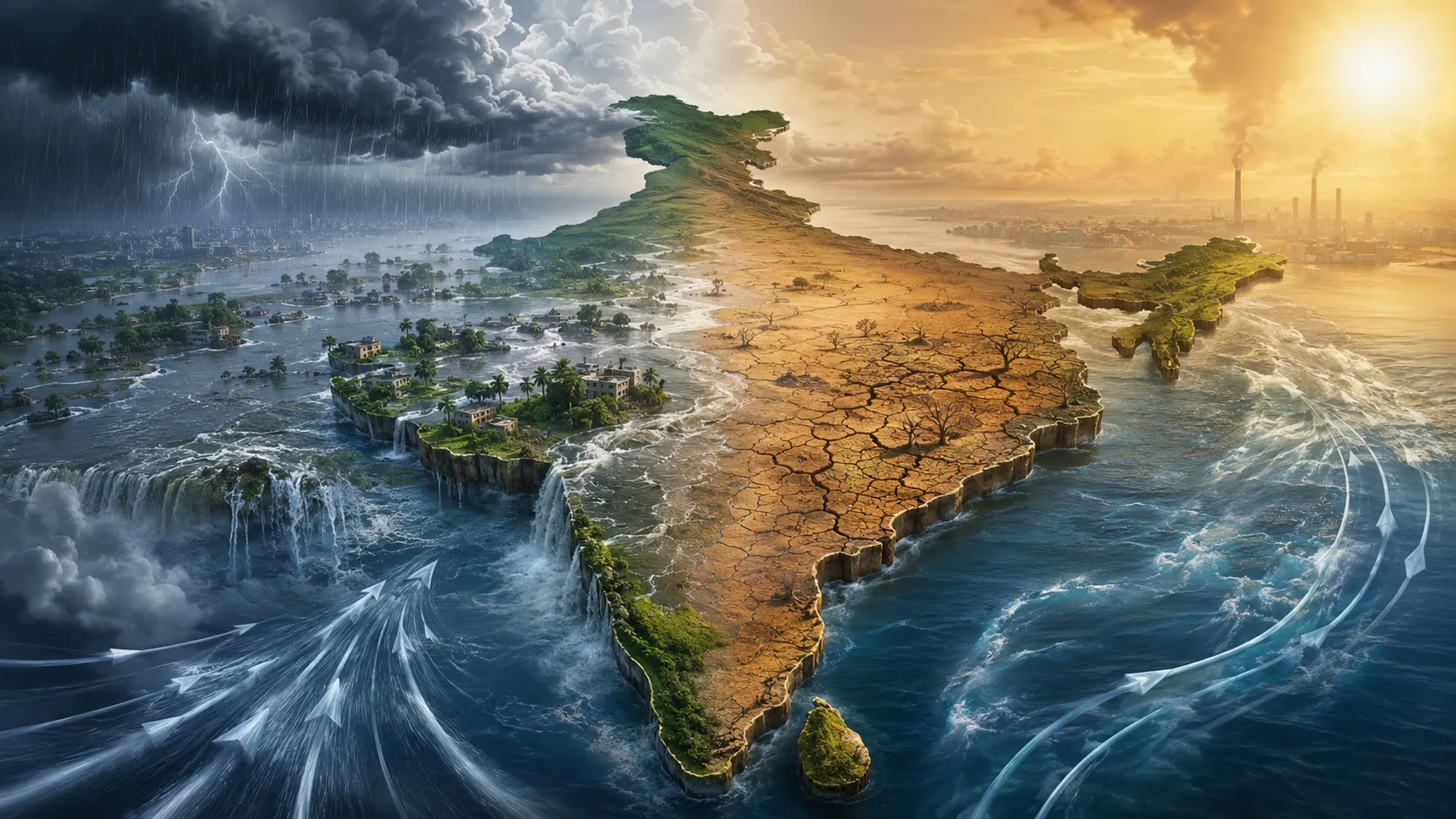
The climate change monsoon India connection is becoming increasingly important as the country faces a complicated rainfall pattern: intense downpours in some places, prolonged dry spells in others, and growing uncertainty about when and where rain will arrive.
India’s southwest monsoon is not simply becoming “more rainy” or “less rainy.” The bigger concern is changing rainfall patterns and greater variability. Scientific assessments show that climate change can increase the amount of moisture the atmosphere holds and intensify heavy rainfall, while warming can also increase evaporation and worsen dry conditions.
The result can be a paradox: more extreme rain and greater drought risk can exist within the same changing climate system.
Why is the Indian monsoon so important?
The Indian summer monsoon normally delivers about 80% of India’s annual rainfall between June and September, making it crucial for agriculture, water supplies, hydropower and the wider economy.
For millions of farmers, the timing and distribution of rainfall can be as important as the total amount of rain received.
A season with a near-normal national rainfall total can still create serious problems if:
- Rain arrives too late.
- Rainfall is concentrated into a few intense events.
- Long dry spells occur between rainy periods.
- Some regions receive floods while others face water shortages.
- Heavy rain runs off rapidly instead of replenishing soil and groundwater.
This is why understanding India monsoon climate change requires looking beyond the country’s seasonal rainfall total.
Is climate change changing India’s monsoon?
Yes, climate change is influencing the conditions in which India’s monsoon operates, but the changes are complex and vary by region and time period.
The IPCC finds high confidence in historical changes in South Asian rainfall, including decreases in summer monsoon precipitation across several areas during parts of the second half of the 20th century. At the same time, heavy precipitation has increased in South Asia, and future warming is projected to increase monsoon precipitation and its variability.
This apparent contradiction is important.
Climate change does not mean every location will receive more rain every year. Instead, warming can alter atmospheric circulation, moisture availability and the behaviour of extreme rainfall, while natural climate variability continues to influence individual monsoon seasons.
Why can climate change produce both heavy rain and drought?
A warmer atmosphere can hold more water vapour. When conditions are suitable, that additional moisture can contribute to more intense rainfall.
The IPCC reports that, globally, heavy precipitation generally intensifies as the climate warms, with atmospheric moisture increasing as temperature rises.
But warming can also increase evaporative demand. When rainfall stops for an extended period, higher temperatures can dry soils more quickly.
That creates an important climate paradox:
More atmospheric moisture + intense rainfall events + longer or hotter dry periods = greater swings between floods and drought stress.
This does not mean climate change directly causes every flood or drought. Individual events can result from several interacting factors, including natural variability, weather systems, land use and local geography.
Why is rainfall becoming more irregular in India?
One of the clearest concerns is not necessarily a simple change in annual rainfall, but a change in when, where and how quickly rainfall occurs.
Research on India’s monsoon has documented changes in wet and dry spells. A study of South Asian monsoon observations from 1951–2011 found increased daily rainfall variability, more frequent dry spells and more intense wet spells in the region.
An India Meteorological Department-linked study of Central India also found that very heavy and extreme rainfall events increased during the later decades of its 1971–2020 study period.
This helps explain why people can experience:
- Several days of little or no rain
- Followed by extremely heavy rainfall
- Localised flooding
- Soil erosion and crop damage
- Rapid runoff
- Then another dry period
For agriculture and water management, this distribution can be more damaging than a steady sequence of moderate rainfall events.
What role does El Niño play in India’s monsoon?
El Niño is one of the major natural climate factors affecting India’s monsoon, but it is not the same thing as climate change.
El Niño is associated with unusually warm sea-surface temperatures in the central and eastern tropical Pacific Ocean. These changes can influence atmospheric circulation far beyond the Pacific.
The India Meteorological Department says El Niño has historically often been associated with below-normal rainfall over India, while La Niña has generally been associated with above-normal rainfall. However, IMD also stresses that there is no one-to-one relationship between El Niño and India’s monsoon.
That distinction is essential.
An El Niño year does not automatically mean India will experience a drought. Other factors, including the Indian Ocean Dipole, ocean temperatures and atmospheric circulation, can modify the outcome.
El Niño vs climate change
| Factor | What it does |
|---|---|
| El Niño | Natural climate variability that can influence a particular monsoon season |
| La Niña | Natural variability that often favours stronger Indian monsoon rainfall |
| Climate change | Long-term change in the background climate caused primarily by human-driven greenhouse-gas emissions |
| Indian Ocean warming | Can influence moisture, circulation and monsoon behaviour |
| Aerosols | Can alter solar heating and atmospheric circulation, affecting rainfall patterns |
Therefore, blaming every weak monsoon on El Niño—or every flood on climate change—would oversimplify the science.
https://www.ipcc.ch/report/ar6/wg1/chapter/atlas/
How does global warming affect rainfall?
The basic physics is relatively straightforward: warmer air can contain more water vapour.
As the climate warms, increased evaporation from oceans and land can add moisture to the atmosphere. When that moisture is transported and atmospheric conditions trigger rainfall, there can be greater potential for intense precipitation.
The IPCC projects increasing summer monsoon precipitation across South Asia under continued warming, while also projecting increases in precipitation extremes.
However, rainfall is controlled by atmospheric circulation as well as moisture.
That means a warmer climate can produce complicated regional outcomes rather than a uniform increase in rainfall everywhere.
Are floods and droughts both becoming bigger risks?
Yes. Both can become serious risks in a warmer and more variable climate.
The World Bank describes India’s monsoon as increasingly erratic and unpredictable, with extreme rainfall and sudden drought presenting different sides of the same water-management challenge.
More recent World Bank analysis also notes that India’s rainfall is highly seasonal, with nearly 70% occurring in just three months, while the frequency of both floods and droughts is increasing with climate change.
This creates a difficult planning problem.
A region can have:
Too much water → flooding → runoff → infrastructure damage
and later:
Too little water → soil moisture loss → irrigation demand → drought stress
The challenge is therefore not simply “getting more rain.” It is managing increasingly variable water availability.
What does climate change mean for Indian agriculture?
Agriculture is particularly sensitive to monsoon variability.
Farmers need rainfall at different stages of crop growth. Heavy rain concentrated into a few days cannot always compensate for a long dry period.
Changing rainfall patterns can affect:
- Sowing dates
- Crop germination
- Soil moisture
- Irrigation requirements
- Crop yields
- Pest and disease conditions
- Harvest timing
- Groundwater demand
Research on India’s future climate has found that warming can increase the risk of flash droughts during the monsoon season, even under scenarios where overall monsoon precipitation increases.
This is one of the most important insights into the climate change rainfall relationship: total seasonal rainfall and agricultural water availability are not always the same thing.
Could India have more rain but still face water shortages?
Yes.
This may sound contradictory, but rainfall quantity and water availability are different measures.
Imagine an area receives its normal seasonal rainfall, but much of it falls during a handful of extreme storms. A large portion may flow rapidly into drains and rivers, causing flooding instead of slowly infiltrating soil.
Then several weeks of hot, dry weather follow.
The region can move from flood risk to water stress surprisingly quickly.
Climate adaptation therefore increasingly needs to focus on water storage, groundwater management, flood control, drainage, irrigation efficiency and reliable weather information—not simply annual rainfall totals.
Is the monsoon becoming weaker or stronger?
There is no single answer for all of India or every period.
Historical observations show complex trends, including weakening in some periods and regions, while climate models generally project increased monsoon precipitation under continued greenhouse-gas warming over the longer term.
The IPCC notes that observed South Asian summer monsoon precipitation declined across several areas during the mid-to-late 20th century, while future projections indicate an increase in monsoon precipitation accompanied by enhanced variability.
One reason for the historical complexity is the influence of anthropogenic aerosols.
IPCC assessments conclude that human-caused aerosols weakened South Asian monsoon circulation during the second half of the 20th century, offsetting some of the warming-driven increase in monsoon precipitation.
Future changes therefore cannot be understood through temperature alone.
What happens to India if monsoon variability increases?
Greater variability could affect several sectors simultaneously.
Agriculture
Farmers may face greater uncertainty around planting, irrigation and harvesting.
Water supply
Cities and rural communities could experience a more difficult balance between floodwater and water shortages.
Infrastructure
Roads, bridges, drainage systems and urban areas can be damaged by extreme rainfall.
Energy
Hydropower depends on reliable water availability, while heat and drought can increase electricity demand.
Public health
Floods can create sanitation and disease risks, while heat and water shortages create different health challenges.
The World Bank notes that monsoon variability affects agriculture, aviation, hydropower, urban infrastructure and tourism across South Asia.
What can India do to prepare for changing monsoon patterns?
Climate adaptation can reduce the damage from both extreme rainfall and drought.
Important measures include:
- Better rainfall forecasting
More localised and timely forecasts can help farmers and authorities make decisions. - Improved urban drainage
Cities need drainage systems designed for intense rainfall rather than historical averages alone. - Rainwater harvesting and storage
Capturing rainfall can reduce runoff and increase water availability during dry periods. - Groundwater management
Sustainable extraction becomes increasingly important when rainfall is unpredictable. - Climate-resilient agriculture
Crop choices, irrigation systems and planting strategies can be adapted to changing rainfall conditions. - Floodplain and wetland protection
Natural landscapes can absorb and temporarily store excess water. - Early-warning systems
Better warnings can reduce deaths and economic losses during extreme weather.
What does the future of India’s monsoon look like?
The future is unlikely to be a simple story of “more rain” or “less rain.”
Climate models indicate that South Asian summer monsoon precipitation is likely to increase over the long term as the planet warms, while extreme rainfall and rainfall variability can also increase.
At the same time, natural variability—including ENSO—and regional factors will continue to influence individual years.
This means India may increasingly need to prepare for a wider range of outcomes:
heavy rainfall → flooding → long dry spells → drought stress → another extreme rainfall event.
The precise timing and location of these events cannot be predicted decades in advance, but the broader risk from a warmer climate is becoming clearer.
FAQ
Is climate change changing India’s monsoon?
Yes. Climate change is altering the atmospheric and ocean conditions that influence India’s monsoon. The effects are complex, but scientific assessments indicate increasing risks from rainfall variability and extreme precipitation under continued warming.
Why does India sometimes experience heavy rain and drought in the same season?
Rainfall can become concentrated into intense wet spells separated by longer dry periods. Higher temperatures can also increase evaporation and soil-moisture loss during dry spells, increasing drought stress.
How does El Niño affect the Indian monsoon?
El Niño has historically often been associated with below-normal monsoon rainfall in India, while La Niña is generally associated with above-normal rainfall. However, the relationship is not perfect and other climate factors can alter the outcome.
Is India getting more rainfall because of climate change?
The answer depends on the location and period being examined. Long-term climate projections generally indicate increased South Asian summer monsoon precipitation with warming, but historical trends differ across regions and rainfall extremes can increase even where average rainfall changes are smaller.
Why is irregular rainfall dangerous for farmers?
Crops require water at specific growth stages. A season with intense rainfall followed by long dry periods can cause flooding, soil erosion, crop stress and increased irrigation demand even when total seasonal rainfall appears adequate.
Can climate change cause both floods and droughts?
Yes. A warmer climate can intensify heavy rainfall while also increasing evaporative demand and drying during prolonged rain-free periods. This can increase the risk of both flooding and drought.
Is El Niño the same as climate change?
No. El Niño is a naturally occurring climate pattern associated with tropical Pacific Ocean temperatures. Climate change refers to long-term changes in the Earth’s climate, primarily driven by human greenhouse-gas emissions. El Niño can temporarily influence the effects of a changing climate.
Will India’s monsoon become stronger in the future?
Climate projections generally indicate increasing summer monsoon precipitation over South Asia as global temperatures rise, but regional changes and individual monsoon seasons remain uncertain. Extreme rainfall and variability are also important parts of the projected risk.
The bottom line
Climate change is changing the background conditions that shape India’s monsoon, but it does not mean every year will simply become wetter or drier.
The major concern is increasingly rainfall variability and extremes. A warmer atmosphere can hold more moisture, increasing the potential for intense rainfall, while higher temperatures can increase evaporation and worsen dry conditions during rainfall breaks.
El Niño remains an important driver of year-to-year monsoon variability, but it should not be confused with long-term human-caused climate change.
For India, the challenge is therefore not just predicting how much rain will fall. It is preparing for when the rain comes, how intensely it falls, where it falls, and how long the next dry period lasts.
For broader background on the science behind global warming and climate change, readers can also explore HNN24x7’s related coverage: Climate Change and Global Warming