




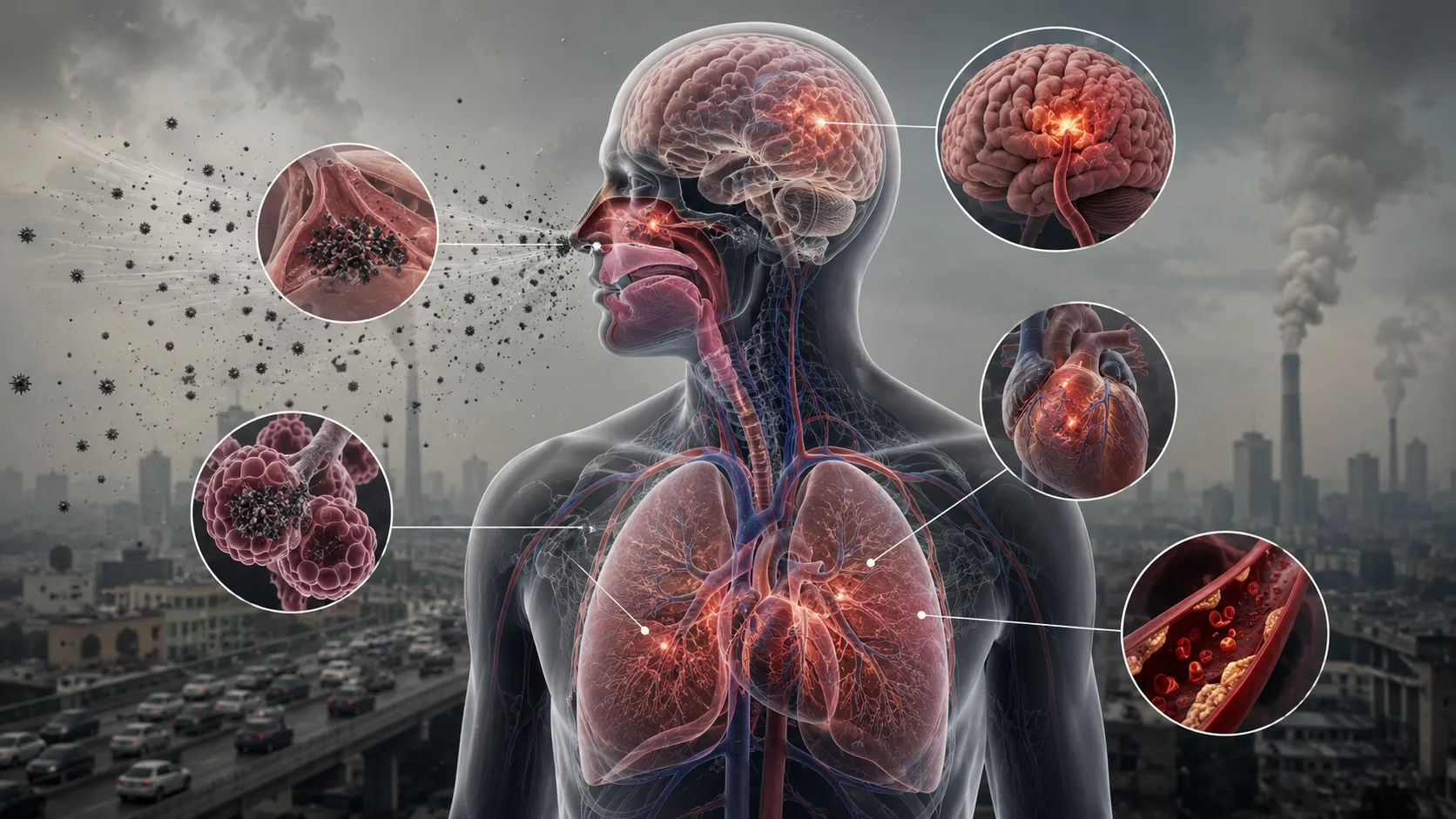
Air pollution is often discussed as a lung problem, but the air pollution health effects can extend throughout the body. Fine particles such as PM2.5 can penetrate deep into the lungs, trigger inflammation and oxidative stress, and contribute to effects involving the cardiovascular and nervous systems.
The World Health Organization (WHO) says air pollution can affect almost every organ in the body. The strongest established disease links include ischemic heart disease and stroke, while growing evidence also points to cognitive impairment and neurological conditions.
That means polluted air is not simply an issue of coughing, breathing difficulty or lung irritation. For people exposed repeatedly over months or years, the potential consequences may involve the heart, blood vessels, brain and other systems.
What are the main air pollution health effects?
Air pollution can cause both short-term and long-term health effects. The severity depends on the pollutant, concentration, duration of exposure and individual vulnerability.
The most important pollutants include:
- PM2.5: Fine particulate matter small enough to penetrate deep into the lungs.
- PM10: Larger particulate matter that can still enter the respiratory system.
- Nitrogen dioxide (NO2): Commonly associated with traffic and combustion.
- Ozone (O3): A major component of smog formed through chemical reactions in the atmosphere.
- Sulfur dioxide (SO2): Often associated with combustion of sulfur-containing fuels.
- Carbon monoxide (CO): A toxic gas produced by incomplete combustion.
WHO notes that PM2.5 is particularly important because these particles can penetrate deep into the lungs and, through biological pathways, contribute to cardiovascular and cerebrovascular effects.
Short-term exposure can worsen respiratory symptoms and, particularly among susceptible people, contribute to cardiovascular events. Long-term exposure is associated with a broader range of chronic health risks.
How does air pollution affect the human body?
One reason pollution can affect organs beyond the lungs is that inhaled pollutants can initiate biological responses throughout the body.
According to WHO, exposure can produce inflammation, oxidative stress and immune-system effects. Some very small particles can also move from the lungs into the bloodstream, allowing pollution-related effects to reach distant organs and tissues.
In simple terms, the pathway can look like this:
Polluted air → inhalation → lung irritation/inflammation → systemic biological response → effects on blood vessels, heart and potentially brain
This does not mean every person exposed to pollution will develop a particular disease. Rather, repeated exposure can increase risk, especially when combined with other factors such as age, existing cardiovascular disease, smoking, diabetes or high blood pressure.
How does air pollution affect the heart?
The pollution effects on heart health are among the best-established consequences beyond the respiratory system.
The American Heart Association says both short- and long-term air pollution exposure are linked with cardiovascular problems. Short-term exposure can increase the risk of heart attack, stroke, abnormal heart rhythms and heart failure in susceptible individuals, while long-term exposure is associated with the development and progression of atherosclerosis.
Why can polluted air damage the cardiovascular system?
PM2.5 and other pollutants can contribute to several processes:
- Systemic inflammation
- Oxidative stress
- Blood-vessel dysfunction
- Changes in blood pressure
- Activation of clotting pathways
- Atherosclerosis
- Abnormal heart rhythms
Research reviews describe oxidative stress and inflammation as important mechanisms linking particulate pollution with cardiovascular disease. PM2.5 exposure has also been associated with vascular injury, thrombosis and increased blood pressure.
Another review found strong evidence connecting higher ambient air pollution exposure with cardiovascular mortality, stroke and ischemic heart disease. Short-term exposure to particulate matter has also been associated with increased risks of myocardial infarction and stroke.
Can air pollution increase the risk of heart attack and stroke?
Yes. Scientific evidence supports an association between air pollution exposure and increased cardiovascular risk, including heart attack and stroke.
WHO identifies ischemic heart disease and stroke among the diseases most strongly linked to air pollution.
The risk is particularly important for older adults and people who already have cardiovascular disease or other chronic conditions.
How does air pollution affect the brain?
The relationship between air pollution and brain health is an active area of scientific research.
Evidence suggests that exposure to air pollution may be associated with changes in cognitive function and an increased risk of some neurological conditions. WHO describes cognitive impairment and neurological diseases as areas where evidence is emerging.
A systematic review examining air pollution, brain structure and cognition found associations between pollution exposure and changes involving certain brain structures and functional connectivity. The review also reported associations with cognitive outcomes, although the strength of findings varied across studies.
A separate systematic review and meta-analysis covering 86 studies found moderate-certainty evidence supporting detrimental associations between PM2.5 exposure and general cognition in adults aged 40 and older, as well as between particulate pollution and executive function in children.
These findings do not mean that pollution alone causes dementia or cognitive decline in every exposed person. Researchers continue to investigate the biological mechanisms and the degree to which pollution contributes independently of other risk factors.
Can air pollution affect memory and cognitive function?
Research increasingly suggests that long-term exposure to certain pollutants may be associated with poorer cognitive performance.
Studies have examined areas such as:
- Memory
- Attention
- Executive function
- Reasoning
- Processing speed
- Learning
- Overall cognitive performance
A recent global meta-analysis involving more than 700,000 participants reported an association between particulate pollution and cognitive impairment. However, the authors also reported substantial variation among studies, meaning the findings should be interpreted as evidence of an association rather than proof that pollution is the sole cause of cognitive decline.
What are the PM2.5 health effects?
PM2.5 refers to fine particles with an aerodynamic diameter of 2.5 micrometres or less.
Because of their extremely small size, these particles can travel deep into the respiratory system. WHO identifies particulate matter as one of the pollutants for which health risks are especially well documented.
The potential PM2.5 health effects include:
- Respiratory inflammation
- Increased cardiovascular risk
- Blood-vessel dysfunction
- Increased risk of stroke
- Increased risk of ischemic heart disease
- Possible effects on cognitive function
- Increased risk of some neurological conditions
- Increased risk of premature death from pollution-related diseases
The cardiovascular effects are particularly well established. Reviews describe pathways involving inflammation, oxidative stress, endothelial dysfunction and blood clotting.
Can air pollution affect mental and neurological health?
The answer is more complicated than simply saying that polluted air causes mental illness.
Researchers are investigating possible links between pollution exposure and neurological or neuropsychiatric outcomes. WHO describes emerging evidence involving neurological conditions and cognitive impairment.
Potential mechanisms being studied include:
- Neuroinflammation
- Oxidative stress
- Vascular damage
- Changes in brain connectivity
- Effects on the blood-brain barrier
- Systemic inflammation
However, mental health is influenced by many factors, including genetics, socioeconomic conditions, stress, sleep, lifestyle and physical health. Therefore, pollution should be considered one possible environmental risk factor rather than a single explanation for mental-health conditions.
For readers interested specifically in this connection, HNN24x7 has previously examined the relationship between pollution, brain function and mental health: Air Pollution, Brain Health and Mental Health
Who is most vulnerable to air pollution?
Air pollution does not affect everyone equally.
WHO identifies several groups that may face greater risks, including:
- Children
- Older adults
- Pregnant women
- People with chronic diseases
- People with existing heart or lung conditions
- People living in areas with high pollution
- People exposed to pollution for long periods
Children may be particularly important because their organs and immune systems are still developing, while older adults and people with chronic diseases may have less physiological reserve.
WHO also notes that socioeconomic conditions can influence vulnerability and exposure.
Does short-term exposure matter, or only long-term pollution?
Both can matter.
Short-term spikes in pollution can aggravate existing respiratory and cardiovascular conditions and may trigger acute cardiovascular events in susceptible people. Long-term exposure is associated with chronic disease development and increased mortality risk.
This is why an individual should not assume that pollution is harmless simply because exposure occurs for only a few hours on a particular day.
At the same time, health risk depends on the concentration and duration of exposure. A single exposure should not automatically be interpreted as causing permanent organ damage.
How can people reduce exposure to polluted air?
Completely avoiding air pollution is difficult, particularly in large cities and areas affected by traffic, industrial emissions, wildfires or seasonal pollution.
However, exposure can often be reduced by:
- Checking local air-quality information before prolonged outdoor activity.
- Limiting strenuous outdoor exercise during severe pollution episodes.
- Keeping indoor spaces adequately ventilated when outdoor air quality is acceptable.
- Using appropriate indoor air filtration when pollution levels are high.
- Avoiding indoor sources of pollution such as tobacco smoke.
- Reducing exposure to traffic-heavy areas when practical.
- Following local public-health guidance during severe air-pollution events.
The American Heart Association specifically recommends precautions during low-air-quality periods and notes that air filtration systems can improve indoor air quality.
Why air pollution should be viewed as a whole-body health issue
The biggest change in scientific understanding is that air pollution can no longer be viewed only as a lung problem.
The lungs are the first major point of contact, but pollution-related inflammation, oxidative stress and vascular effects can influence other systems. WHO now describes evidence of impacts involving respiratory, cardiovascular, cerebrovascular, reproductive and metabolic systems, alongside emerging evidence concerning neurological health.
The air pollution human body relationship is therefore broader than symptoms such as coughing or shortness of breath.
For public health, this matters because preventing exposure could potentially reduce risks across several major disease categories rather than only respiratory illness.
The bottom line
Air pollution can affect much more than the lungs. Strong evidence links polluted air, particularly fine particulate matter such as PM2.5, with cardiovascular diseases including ischemic heart disease and stroke. Research also increasingly associates long-term exposure with cognitive and neurological effects, although some brain-health relationships remain an active area of study.
The safest approach is to treat air quality as an important part of overall health—especially for children, older adults and people with existing heart, lung or other chronic conditions.
Reducing exposure does not eliminate every health risk, but cleaner air can be an important part of protecting lung, heart and brain health over the long term.