


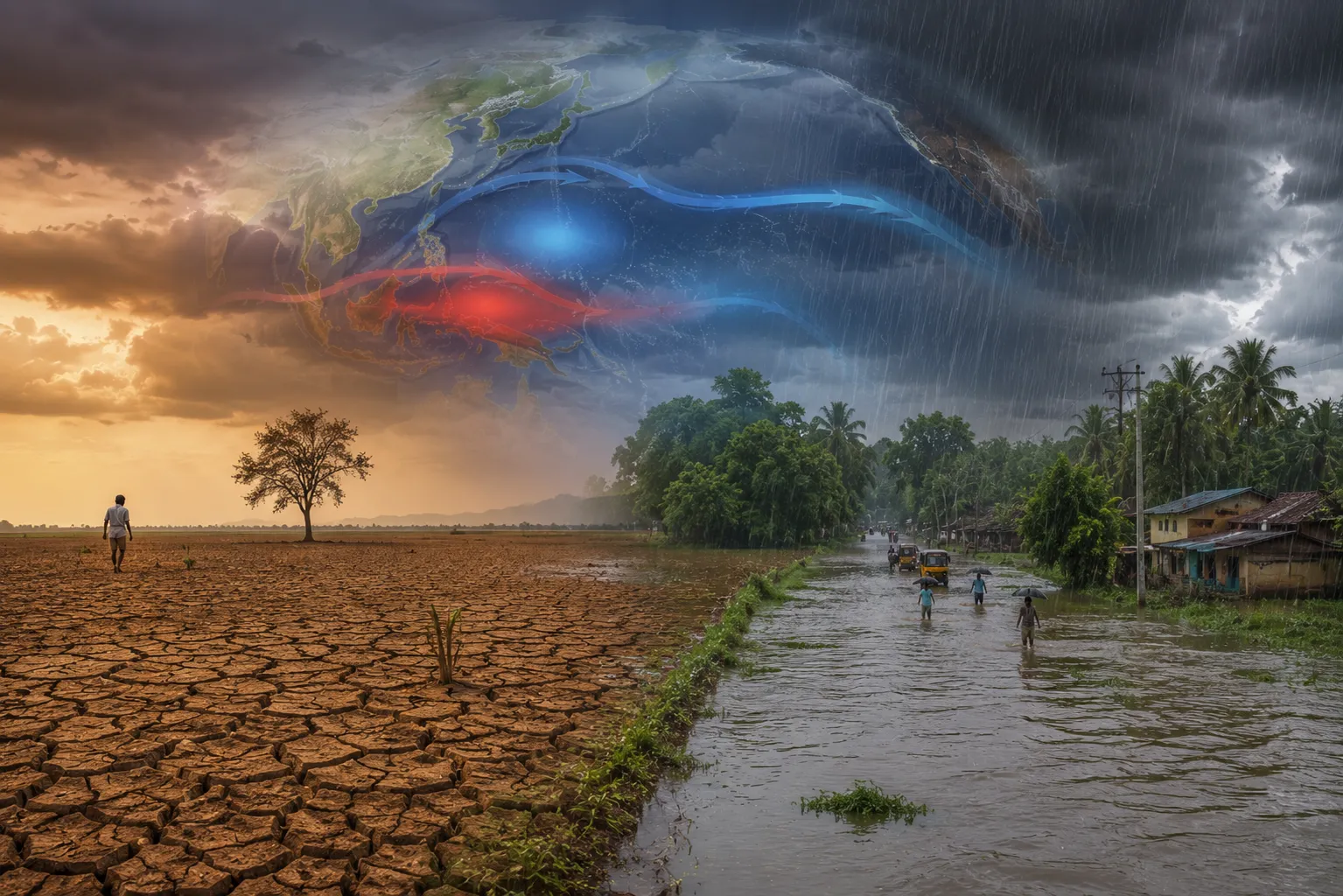
El Niño is often associated with below-normal monsoon rainfall in India, but the relationship is more complicated than simply saying “El Niño means drought.” Historical observations from the India Meteorological Department (IMD) show that rainfall during El Niño years has varied considerably, with some years recording below-normal rainfall and others experiencing normal or even above-normal rainfall.
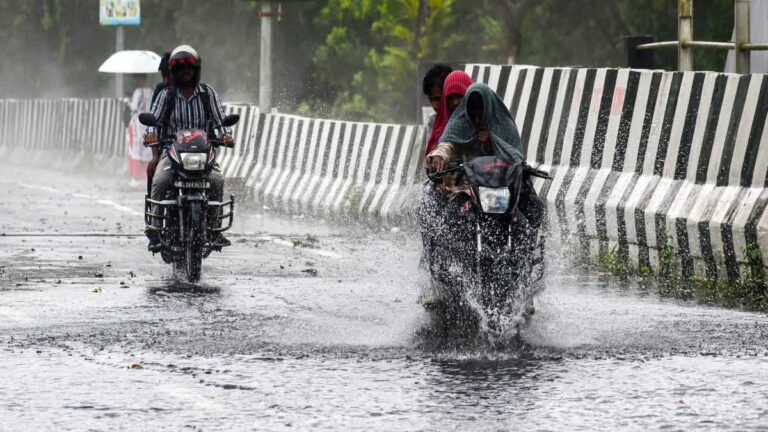
At the same time, India can experience intense rainfall events, floods and long dry spells within the same monsoon season.
So, can El Niño cause both less rain and sudden heavy rain in India? The short answer is yes, but not because El Niño directly produces both outcomes everywhere. El Niño changes large-scale atmospheric circulation and can tilt the odds toward weaker monsoon rainfall, while regional weather systems, the Indian Ocean Dipole (IOD), monsoon depressions, atmospheric moisture and climate change can determine where and when extreme rainfall occurs.
https://mausam.imd.gov.in/responsive/el_nino_ismr.php
What Is El Niño?
El Niño is the warm phase of the El Niño-Southern Oscillation (ENSO), a recurring climate pattern involving changes in sea-surface temperatures and atmospheric circulation over the tropical Pacific Ocean.
During El Niño, unusually warm waters develop across parts of the central and eastern equatorial Pacific. This changes tropical atmospheric circulation and can influence weather patterns thousands of kilometres away, including the Indian summer monsoon.
The Indian monsoon is particularly sensitive to large-scale circulation changes because it depends on the movement of moisture from the surrounding oceans toward the Indian subcontinent.
El Niño is therefore considered one of the major global climate drivers influencing Indian monsoon rainfall.
How Does El Niño Affect the Indian Monsoon?
The typical El Niño effect on India is a tendency toward weaker Southwest Monsoon rainfall.
Changes associated with El Niño can alter the Walker circulation and other atmospheric circulation patterns in ways that suppress some of the conditions normally supporting India’s summer monsoon.
Research published in Nature Communications in 2026 explains that El Niño events typically produce a deficit in Indian summer monsoon rainfall through interactions involving the Walker circulation and regional atmospheric circulation.
However, “typical” does not mean “guaranteed.”
IMD’s historical El Niño dataset shows that rainfall outcomes have varied substantially. For example, some El Niño years recorded large deficits, while others had near-normal or above-normal seasonal rainfall. The 1994 El Niño year recorded a 13.9% positive June-September rainfall departure, while 2002 recorded a 20.9% deficit and 2015 recorded a 12.7% deficit.
This variation is central to understanding El Nino India rainfall.
Does El Niño Always Cause Drought in India?
No. El Niño increases the risk of deficient monsoon rainfall, but it does not guarantee drought across India.
IMD has explicitly noted that the relationship between ENSO and Indian monsoon rainfall is not a simple one-to-one relationship. Other climate influences—including the Indian Ocean Dipole, Eurasian snow conditions and regional atmospheric circulation—can modify the outcome.
Historical research published through IMD’s MAUSAM journal similarly found that strong associations exist between warm ENSO events and droughts, but droughts can occur without El Niño and floods can occur even during El Niño events.
This means El Niño should be viewed as a climate influence, not a standalone weather forecast.
Then How Can Heavy Rain Occur During El Niño?
This is where India’s highly variable monsoon becomes important.
El Niño affects large-scale conditions, but rainfall in individual regions and on individual days is controlled by additional weather systems.
A season can therefore contain:
- Long periods with below-normal rainfall
- Short bursts of extremely heavy rain
- Extended dry spells
- Localized flooding
- Different rainfall patterns in different states
A weak seasonal rainfall total does not mean every day or every region will be dry.
For example, research on Indian rainfall has found that widespread extreme rainfall events can increase even while average rainfall declines. A Nature Communications study found a threefold rise in widespread extreme rain events over central India between 1950 and 2015 despite a decline in seasonal rainfall in the region.
This is an important distinction: average rainfall and rainfall intensity are not the same thing.
What Is the Difference Between El Niño Drought and Heavy Rain?
Drought generally develops when rainfall remains substantially below normal over an extended period.
Heavy rainfall, on the other hand, can occur over a few hours or days when large amounts of atmospheric moisture converge and strong weather systems produce intense precipitation.
Therefore, a season can have:
Lower overall rainfall + more intense individual rain events.
This apparent contradiction is becoming increasingly important in discussions about Indian monsoon variability.
Researchers have found that monsoon rainfall can become more unevenly distributed, with longer dry periods occurring alongside intense rainfall episodes.
What Does El Niño Do to Rainfall Patterns Across India?
The El Nino effect on India is not uniform.
Some regions may experience larger rainfall deficits than others, while individual weather systems can produce heavy rainfall in particular areas.
IMD’s historical El Niño data demonstrates substantial month-to-month and year-to-year variation. During the 2023 El Niño, for instance, July rainfall was 12.8% above the long-period average, while August rainfall was 36.1% below normal and September rainfall was 13.1% above normal. The overall June-September rainfall departure was -5.3%.
This example shows why looking only at the word “El Niño” is insufficient.
The El Nino monsoon India relationship needs to be analysed across the entire season and in combination with other climate drivers.
Can El Niño Increase the Risk of Drought?
Yes.
Studies have consistently identified El Niño as an important driver associated with Indian monsoon drought risk.
Research published in Scientific Reports found that El Niño can reduce Indian summer rainfall and that elevated aerosol loading can further amplify rainfall deficits over central India.
Another study found that hot and dry monsoon extremes tend to occur during El Niño years in the observed record from 1951–2018.
That combination can create serious consequences for:
- Agriculture
- Reservoir levels
- Groundwater recharge
- Hydropower
- Drinking-water availability
- Food production
However, El Niño is only one part of the risk equation.
Can El Niño Cause Heavy Rainfall?
El Niño itself is generally associated with weaker Indian monsoon rainfall, so it should not be described as a direct cause of widespread heavy rainfall across India.
However, heavy rainfall can still occur during an El Niño year because regional atmospheric systems can temporarily overcome or interact with the broader seasonal influence of El Niño.
IMD research has found that ENSO can modify regional circulation patterns and influence whether extreme events occur, but other atmospheric and geographical factors also matter.
In other words:
El Niño can increase the probability of a weaker monsoon overall while individual weather systems still produce very heavy rainfall.
This is why a flood in one part of India does not automatically disprove an El Niño-related seasonal rainfall deficit.
What Role Does Climate Change Play?
This is where climate change monsoon research becomes particularly important.
Climate change and El Niño are not the same phenomenon.
- El Niño is a natural climate variability pattern associated with the tropical Pacific.
- Climate change refers to long-term changes in Earth’s climate, primarily driven today by human-caused greenhouse-gas emissions.
The two can interact.
A warmer atmosphere can hold more moisture, while changes in ocean temperatures and atmospheric circulation can influence the behaviour of the monsoon.
Recent research published in Nature Communications in 2026 found that greenhouse warming can intensify El Niño-induced Indian monsoon droughts and increase risks associated with hydrological extremes and food security.
This does not mean climate change causes every heavy rainfall event. Rather, warming can change the background conditions in which El Niño and monsoon systems operate.
Why Is India Seeing Both Dry Spells and Extreme Rainfall?
India’s rainfall pattern is influenced by several interacting processes.
These include:
El Niño and ENSO
El Niño can weaken the large-scale monsoon circulation and increase the risk of seasonal rainfall deficits.
Indian Ocean Dipole
The IOD can strengthen or weaken the effect of ENSO on India’s monsoon. IMD notes that positive IOD conditions can sometimes offset the rainfall-deficient influence associated with El Niño.
Monsoon depressions
Low-pressure systems and monsoon depressions can concentrate moisture and produce heavy rainfall over specific regions.
Atmospheric moisture
A warmer atmosphere can hold more water vapour, potentially increasing the amount of rainfall released when suitable weather systems develop.
Climate change
Long-term warming can influence rainfall intensity, variability and the frequency or severity of some extremes.
Together, these factors help explain why Indian rainfall cannot be predicted simply by looking at whether an El Niño event is present.
Can One Monsoon Season Have Both Drought and Floods?
Yes.
A season can experience a prolonged rainfall deficit followed by a few days of extremely heavy precipitation.
This can create a particularly dangerous situation.
Suppose a region receives little rain for several weeks. Soil moisture declines and water availability becomes stressed. If a strong weather system subsequently brings very heavy rainfall, the ground and drainage systems may be unable to absorb all the water quickly enough.
The result can be a combination of:
dry spell → rainfall deficit → sudden extreme rain → flooding
This is one reason seasonal rainfall totals alone cannot fully describe India’s monsoon risk.
Is Extreme Rainfall Increasing Because of El Niño?
Not necessarily.
It would be scientifically inaccurate to attribute India’s long-term increase in extreme rainfall directly to El Niño.
Research has identified multiple causes behind changes in India’s rainfall extremes, including warming oceans, atmospheric circulation changes, moisture availability and regional climate variability.
A 2024 Scientific Reports study projected increases in the area and intensity of long-duration extreme rainfall events over India under future warming scenarios.
Meanwhile, a study of central India found a substantial rise in widespread extreme rainfall events despite declining mean rainfall.
Therefore, El Niño can influence a particular monsoon season, while climate change can alter the longer-term background risk.
Why Does This Matter for Farmers?
For Indian agriculture, rainfall distribution can be as important as seasonal rainfall totals.
A farmer may need steady rainfall during particular stages of crop growth. If rainfall is absent for several weeks and then arrives in an intense burst, the seasonal total may appear reasonable while agricultural damage still occurs.
Dry spells can affect crop growth, while intense rainfall can cause:
- Waterlogging
- Soil erosion
- Crop lodging
- Nutrient loss
- Flood damage
- Harvest disruptions
This is why agricultural planning increasingly requires information about when and how rainfall occurs, rather than only how much rain falls during June-September.
What Should People Remember About El Niño and Indian Rainfall?
The most important point is that El Niño is a probability-changing climate signal, not a guarantee of a specific weather outcome.
Historically, El Niño has often been associated with weaker Indian monsoon rainfall, but there have been important exceptions. IMD’s historical records show that some El Niño years experienced near-normal or above-normal rainfall.
At the same time, individual regions can experience heavy rainfall even during an overall deficient monsoon season.
For readers who want to understand why India’s rainfall is becoming increasingly uneven and why climate change matters for monsoon behaviour, HNN24x7’s related explainer provides useful background:
Climate Change and India’s Monsoon: Why Rainfall Is Becoming More Irregular
Bottom Line
Yes, India can experience both rainfall deficits and sudden heavy rainfall during an El Niño year—but El Niño does not directly cause both outcomes everywhere.
The typical El Nino effect on India is a tendency toward weaker Indian summer monsoon rainfall and greater drought risk. But individual weather systems, the Indian Ocean Dipole, atmospheric moisture and regional circulation can still produce intense rainfall and flooding during an El Niño season.
The bigger picture becomes even more complicated when climate change is considered. Long-term warming can influence rainfall variability and extreme precipitation, while recent research indicates that greenhouse warming can exacerbate El Niño-related monsoon drought risk.
So, the right way to understand El Nino India rainfall is not “El Niño means less rain everywhere.” It is better described as a major climate signal that can tilt the odds toward a weaker monsoon while interacting with other factors that determine where, when and how intensely rain actually falls.