



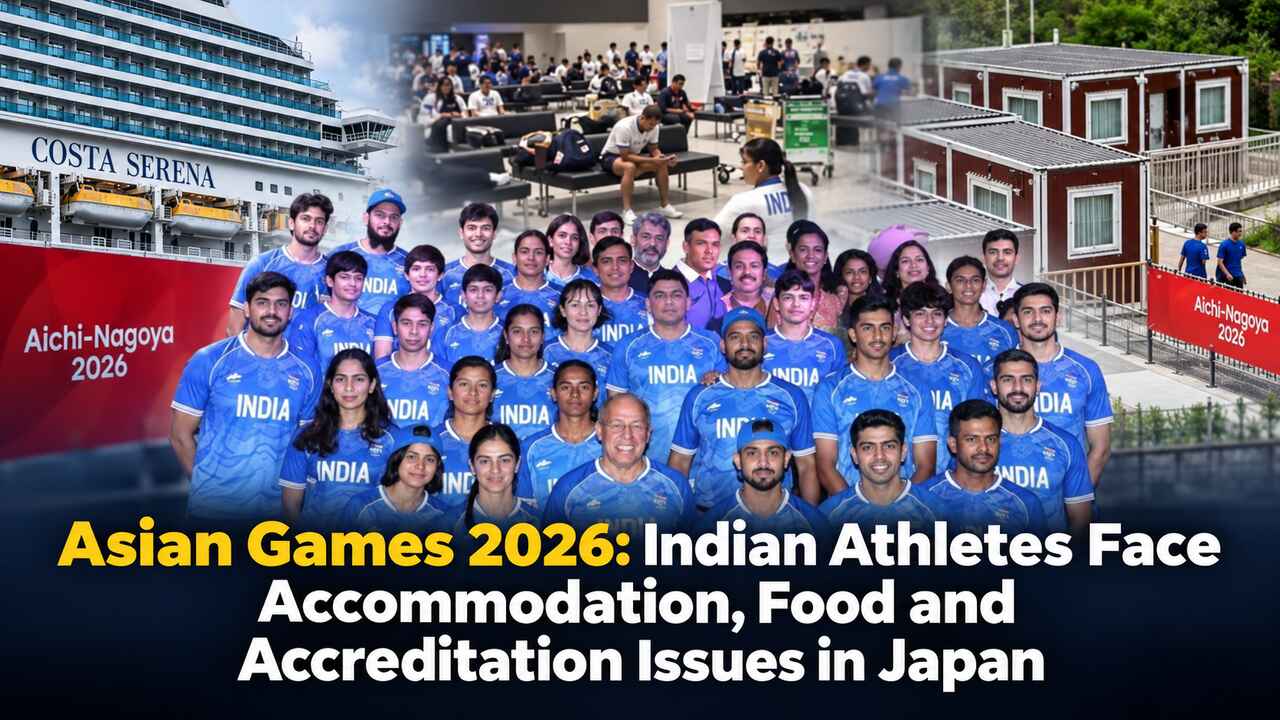
Asian Games 2026 – In any major multi-sport event, athletes can be expected to compete for medals only when they receive basic support from accommodation and food to transport, equipment handling and accreditation without unnecessary disruption. The early experience of Indian athletes arriving in Japan ahead of the Asian Games 2026 has therefore raised serious questions about planning and coordination. According to the Olympic Council of Asia calendar, the 20th Asian Games will officially be held in Aichi-Nagoya from September 19 to October 4. However, members of India’s rowing and shooting contingents reportedly encountered significant logistical problems even before the opening ceremony.
accommodation was listed for only three of the 22 male rowers. Three of the five female rowers Poonam, Aleena Anto and Anshika Bharati were reportedly missing from the host registration system despite holding valid accreditation. The rowing team’s difficulties began before departure when a group travelling from Mumbai was not allowed to check in its oars. The equipment had to be sent to Delhi and was expected to reach Nagoya shortly before the first official practice session. India’s shooting contingent also faced a difficult arrival. After landing at Nagoya airport at around 9 pm, the team reportedly waited nearly three hours for transport. Food outlets were closed, the welcome centre could not provide clear information and the athletes reached their hotel at approximately 4 am. Pistol shooting head coach Samaresh Jung was issued accreditation that did not permit access to the athletes’ area or the field of play, although officials were reportedly working to replace it.
Indian equestrian riders faced a different concern: they were asked to pay for hay, bedding, fodder and other stable requirements and claim reimbursement later. These problems are not merely inconvenient. Poor sleep, delayed meals, interrupted practice, missing equipment and restricted coach access can affect an athlete’s recovery, focus and competition readiness. The practical solution is rapid coordination: a pre-arrival accreditation audit, a verified rooming list, airport assistance, emergency food and transport, confirmed equipment-handling arrangements and an accessible contingency fund. Quick corrective action could help the Indian contingent move beyond the difficult arrival and return its attention to performance.
What Went Wrong With the Welcome for Indian Athletes?
The difficulties were not limited to one delayed bus or a single missing booking. Problems were reported across room allocation, equipment handling, airport transfers, food, accreditation and funding. This suggests that coordination may have failed at several levels. Immediately before a major competition, even a seemingly minor operational mistake can disrupt rest, training schedules and an athlete’s mental readiness.
- Accommodation was reportedly missing for several rowers.
- Three female rowers were absent from the host registration system.
- The rowing team’s oars were not accepted on the scheduled flight.
- Shooters reportedly waited nearly three hours for airport transport.
- Problems were also reported with coach accreditation and equestrian funding.
Why Were the Rowing and Shooting Contingents Directly Affected?
Accommodation and equipment were the most urgent concerns for the rowing team. According to the report, room details appeared in the system for only three of the 22 male athletes, while three female rowers were missing from the host registration records. The failure to check in the team’s oars also created a serious risk because rowing practice cannot be completed effectively without the correct equipment. The shooting contingent faced a similarly exhausting arrival. After landing at Nagoya airport at 9 pm, the group reportedly waited around three hours for a bus, found the food outlets closed and reached its hotel at approximately 4 am. Incorrect accreditation for head coach Samaresh Jung created further concern over coaching access, especially because several Indian 10m air pistol shooters train under him. These issues affect more than comfort; they can disturb recovery, technical preparation and established pre-competition routines at the most important stage of an athlete’s campaign.
- The women’s coach and team manager were reportedly asked to manage their own accommodation.
- The airport welcome centre could not provide clear information to the shooters.
- Samaresh Jung’s accreditation did not allow access to the field of play.
- A corrected accreditation was reportedly being arranged.
Expected Support vs Reported Reality: Where Was the Gap?
The gap becomes clearer when the support athletes should normally receive is compared with their reported experience. The problems extended beyond an underwhelming welcome and affected accommodation, mobility, equipment, coaching access and athlete welfare—areas that form an essential part of competition preparation. Arrival-day management can directly influence performance on competition day.
| Area | What Should Have Happened? | What Was Reported? | Possible Impact |
|---|---|---|---|
| Accommodation | A verified rooming list before arrival | Rooms listed for only three of 22 male rowers | Rest and recovery could be affected |
| Registration | All accredited athletes listed in the host system | Three female rowers reportedly missing | Delays in check-in and event access |
| Equipment | Oars transported on the scheduled flight | Oars were not checked in and had to be rerouted | Official practice placed at risk |
| Airport support | Transport and food arranged in advance | Nearly three-hour wait and no available food | Fatigue and disrupted sleep |
| Coach accreditation | Full access to athletes and competition areas | Samaresh Jung received incorrect access | Technical coaching could be affected |
| Equestrian funding | Feed and stable expenses paid in advance | Riders asked to pay and claim reimbursement | Financial and mental pressure |
Why Is the Horse-Feed Funding Issue Serious?
In equestrian sport, the care of the horse is as important as the preparation of the rider. According to the source report, Indian riders were asked to purchase hay, bedding, fodder and other stable requirements in Japan and claim reimbursement later. Communication linked to the Indian Olympic Association-appointed ad-hoc panel reportedly cited a shortage of government funds and said the amount available was insufficient even to clear a transporter’s bill. Riders also said they had personally paid for food, travel, accommodation and fees during the horses’ mandatory quarantine in Germany. Reimbursements connected with pre-quarantine tests, blood and swab tests, horse transportation, and accommodation for athletes and grooms were reportedly still pending. Such uncertainty can create financial and mental pressure when riders should be concentrating on horse health, training rhythm and competition strategy. Immediate advance payments, local procurement support and a written reimbursement timeline would reduce this burden and allow the contingent to focus on performance.
- Emergency advances should be released for horse feed and bedding.
- Riders should receive a written reimbursement timeline.
- A dedicated procurement coordinator should be available in Japan.
- Pending rider and groom accommodation payments should be verified immediately.
Can the Indian Contingent Recover From These Problems?
The difficult arrival of Indian athletes in Japan ahead of the Asian Games 2026 is a reminder that medal preparation does not happen only on the training ground. Confirmed rooms, timely meals, reliable transport, valid accreditation, secure equipment movement and clearly released funds are all parts of a high-performance system. The reported problems faced by rowers, shooters and equestrian riders may appear different, but they point to the same need: real-time coordination and accountability. Organisers, the IOA, national federations and support agencies should create a joint control desk to review unresolved accommodation, accreditation, transport and payment issues each day. Athletes should receive one verified point of contact instead of having to approach several officials. With the Games beginning on September 19, the immediate priority should be resolving these problems quickly and restoring normal team routines. If corrective action is taken in time, this poor start does not have to define India’s campaign. Fans should also rely on official updates and verified reports rather than unconfirmed social-media claims.
READ MORE,
Frequently Asked Questions
1. When and where will the Asian Games 2026 be held?
The 20th Asian Games will be held in the Aichi-Nagoya region of Japan from September 19 to October 4, 2026.
2. What problems did the Indian rowing team face?
Several rowers reportedly did not have confirmed accommodation, three female athletes were missing from the host registration system and the team encountered problems transporting its oars.
3. How long did the Indian shooters wait at the airport?
The shooting contingent reportedly waited nearly three hours for transport and reached its hotel at approximately 4 am.
4. What was wrong with Samaresh Jung’s accreditation?
His accreditation reportedly did not permit entry to the athletes’ area or field of play. Officials were said to be arranging a corrected accreditation.
5. Why were equestrian riders asked to purchase horse feed themselves?
The report cited a shortage of funds. Riders were asked to purchase hay, bedding, fodder and other requirements before claiming reimbursement.