



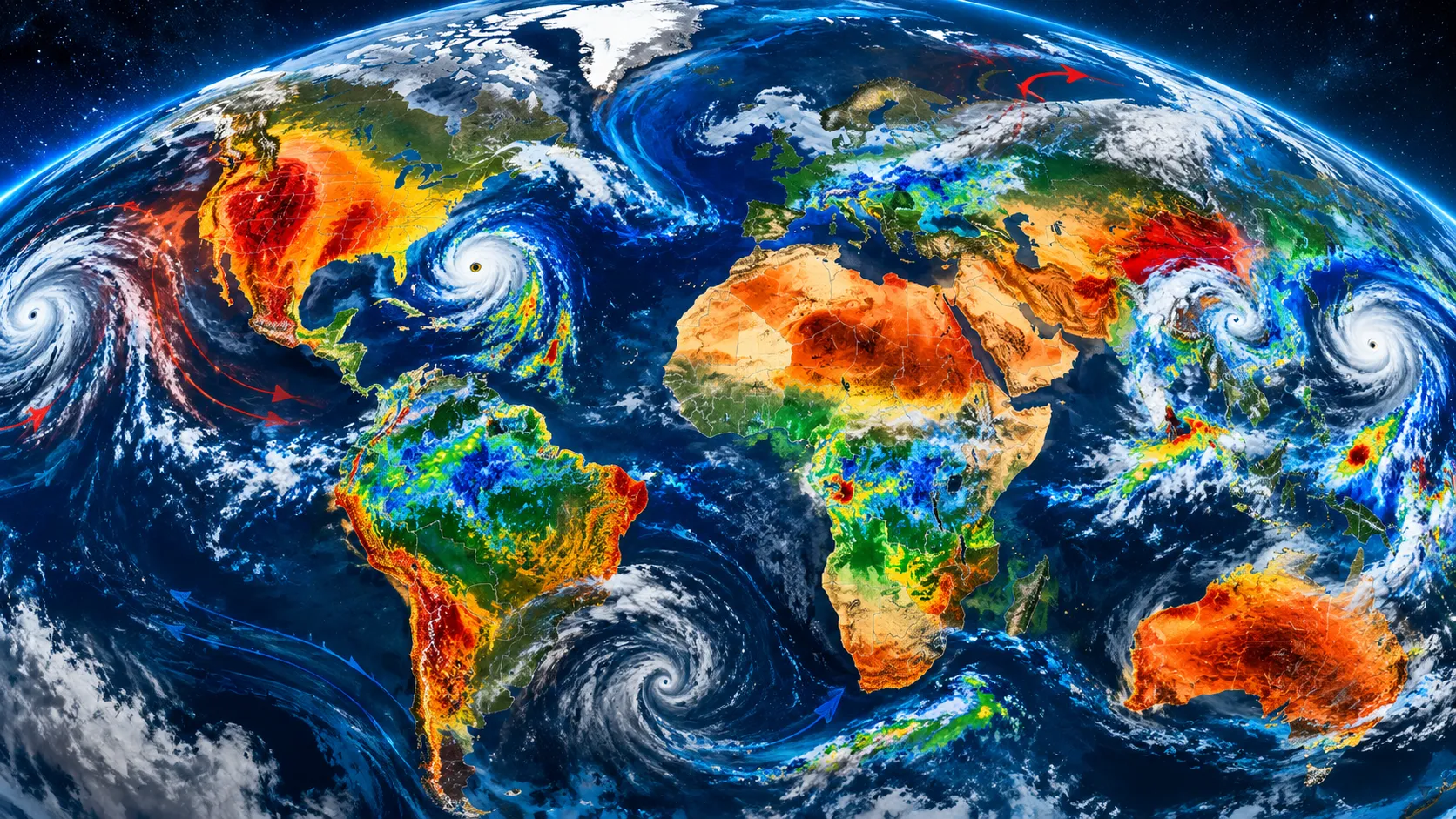
Weather today is not following one single global pattern. While some parts of the world are dealing with heavy rain, thunderstorms or flooding, others are experiencing unusual heat, drought or wildfire conditions.
That contrast is one of the defining features of the current global weather picture.
In September 2026, the developing El Niño is an important factor influencing temperature and rainfall patterns. At the same time, the background influence of long-term global warming is contributing to unusually high temperatures and increasing the likelihood of some climate extremes.
The World Meteorological Organization (WMO) says a strong El Niño is developing and is expected to influence global temperature and rainfall patterns during the coming months. Its seasonal outlook for August–October 2026 projects above-normal temperatures across much of the world, while rainfall patterns are expected to vary significantly between regions.
What Is the Weather Today Around the World?
There is no single “global weather” condition because weather is highly regional.
On September 17, different parts of the world are experiencing very different conditions.
In parts of North America, the U.S. Weather Prediction Center is monitoring areas at risk of excessive rainfall, including portions of Arizona and New Mexico. Its latest forecast identifies a moderate risk of excessive rainfall in parts of the Southwest for September 17.
In parts of Europe, weather is also changing rapidly as the continent moves away from an exceptionally hot summer. Forecasters have warned that parts of Europe could experience periods of intense rainfall and flash flooding following the summer heat.
Across South Asia, India’s weather agency is forecasting widespread rainfall, thunderstorms and gusty winds across several regions between September 17 and September 22, with some locations facing heavy to very heavy rainfall.
The result is a global picture in which heat, rain, storms and relatively dry conditions can occur simultaneously.
Why Is Weather Changing So Much?
Several different processes are responsible.
1. El Niño Is Changing Global Weather Patterns
One of the biggest current influences is El Niño, a warming of the tropical Pacific Ocean that changes atmospheric circulation and can affect weather far beyond the Pacific region.
The WMO says El Niño conditions are developing strongly in 2026 and are expected to influence global temperature and rainfall patterns.
Its seasonal forecast indicates that above-normal temperatures are likely across much of the world, while rainfall conditions will vary. Some areas are expected to become wetter, while others face increased drought risk.
This is important because El Niño does not simply mean “warmer weather everywhere.”
Its effects depend on geography and season.
One region may experience increased rainfall while another experiences reduced precipitation. Some countries may see increased heat, while others experience changes in storm activity.
2. Global Temperatures Remain Exceptionally High
The broader climate background is also important.
The WMO reported that August 2026 was the hottest August on record, based on monthly assessments from the Copernicus Climate Change Service, NOAA and NASA.
The organization also reported that the Northern Hemisphere experienced its warmest summer on record during June–August 2026, while the Southern Hemisphere experienced a near-record warm winter.
That does not mean every location experienced record heat every day.
Global temperature records are calculated from observations across large areas and over defined time periods. Individual cities can therefore experience cooler-than-average days even while the global average remains exceptionally high.
What Does This Mean for Temperature Today?
For people searching “temperature today,” the most important point is that local conditions can differ dramatically from the global climate trend.
A city could be experiencing:
- Cooler-than-normal temperatures
- A heatwave
- Heavy cloud cover
- Thunderstorms
- High humidity
- Dry and dusty conditions
All of these can occur at the same time in different parts of the world.
Global temperature data therefore should not be confused with a forecast for a particular city.
For an individual location, national meteorological agencies and local forecasts remain the most useful sources for today’s temperature and rainfall.
Why Are Some Places Getting Heavy Rain While Others Face Drought?
Rainfall is strongly affected by atmospheric circulation and ocean temperatures.
When major climate patterns such as El Niño alter the movement of heat and moisture through the atmosphere, rainfall can shift geographically.
The WMO’s current seasonal outlook specifically highlights this contrast: some regions may experience wetter-than-normal conditions while others face increased drought risk.
This means the global water cycle can become increasingly uneven.
One area may receive intense rainfall over a short period, increasing flood risks, while another region experiences prolonged dry conditions.
That distinction is important when discussing “global rainfall.”
More rainfall globally does not necessarily mean that water is being distributed evenly.
Extreme Weather Is Also Making Headlines
Extreme weather remains a major part of the current global picture.
The WMO reported in August that record-breaking heat, drought, wildfires, heavy rainfall and flooding were affecting different parts of the world during July and early August 2026.
It described the period as being marked by record land and sea surface temperatures as well as multiple high-impact weather and climate events.
The organization’s warnings highlight why early-warning systems and reliable weather forecasting are increasingly important.
Heatwaves
Heatwaves can become dangerous when high temperatures combine with humidity, especially for older people, outdoor workers and people with certain health vulnerabilities.
Urban areas can also experience higher temperatures because buildings and roads retain heat.
Heavy Rainfall
Heavy rainfall can cause flash floods even when a location has not experienced unusually wet conditions for an entire season.
Short-duration rainfall intensity can therefore be more important than the total seasonal rainfall when assessing immediate flood risk.
Drought
Drought develops over longer periods and can affect agriculture, reservoirs, groundwater and ecosystems.
El Niño can increase drought risks in some regions while increasing rainfall in others.
Wildfires
Hot and dry conditions can increase fire risk by drying vegetation and soils.
The combination of heat, drought and strong winds can make wildfire conditions particularly dangerous.
What Is Happening With Global Water Resources?
The global weather story is also connected to longer-term water availability.
A WMO report released on September 17 found that more than one-third of the world’s river basins recorded below-normal flows in 2025, making it one of the driest years in the organization’s 35-year monitoring record.
The report also highlighted continued glacier losses and declining terrestrial water storage, although conditions differed considerably between regions.
This shows why rainfall alone is not enough to understand global water security.
A region can experience intense rainfall and flooding during one period while still facing longer-term water-management challenges.
How Is El Niño Affecting the Weather in 2026?
El Niño is currently one of the most important climate signals to watch.
The WMO expects the event to strengthen through late 2026, with impacts on global temperature and rainfall potentially continuing into 2027.
Possible effects include changes in:
- Regional rainfall
- Drought risk
- Heat conditions
- Storm patterns
- Agricultural weather
- Water availability
- Marine conditions
However, El Niño does not determine the weather of every location by itself.
Local weather systems, seasonal cycles, geography and other ocean-atmosphere patterns also influence individual forecasts.
Does Climate Change Cause Every Extreme Weather Event?
No single extreme weather event should automatically be attributed entirely to climate change.
Weather events usually have multiple contributing factors.
However, climate science can determine whether human-caused warming has changed the probability or intensity of particular types of events.
For example, a recent scientific assessment of the catastrophic August 2026 glacier and rock collapse in the Himalayas concluded that rapid warming, glacier thinning and permafrost changes increased the instability of the affected environment. The analysis did not identify climate change as the sole cause of the disaster.
This distinction matters.
Climate change can influence the conditions in which an event occurs without being the only factor responsible for that event.
Why Can the Weather Change So Quickly?
Weather systems operate across different time scales.
A location can move from sunshine to thunderstorms within hours because of changes in atmospheric instability, moisture and wind.
Over several days, larger weather systems can shift temperatures and rainfall.
Over months, seasonal patterns and phenomena such as El Niño can influence regional climate conditions.
Over decades, long-term warming changes the background climate in which weather events occur.
That is why a single day’s weather should not be used by itself to describe the global climate.
Weather Today vs Global Climate: What Is the Difference?
The terms weather and climate are often used interchangeably, but they describe different things.
Weather refers to atmospheric conditions over short periods—such as today’s temperature, rainfall, wind or thunderstorms.
Climate describes long-term patterns and averages, generally measured over decades.
For example, one unusually cool day does not disprove global warming.
Similarly, one extremely hot day does not by itself prove a long-term climate trend.
Scientists examine long records and large datasets to identify persistent changes.
What Should People Watch in the Coming Weeks?
Several indicators will be important as September progresses.
Global temperatures
The evolution of global land and ocean temperatures will help determine whether the recent exceptional warmth continues.
El Niño strength
The strength and location of Pacific Ocean warming will influence how strongly the event affects regional weather.
Rainfall distribution
Meteorologists will continue watching areas experiencing excessive rainfall as well as regions where precipitation remains below normal.
Drought conditions
Agricultural and water-management agencies will monitor soil moisture, reservoirs, river flows and groundwater.
Extreme weather warnings
Short-term weather forecasts remain essential for thunderstorms, floods, heatwaves, tropical storms and other hazards.
What Is the Global Weather Outlook?
The current global outlook points toward continued above-normal temperatures in many parts of the world, combined with highly variable rainfall patterns.
The WMO’s August–October 2026 outlook identifies strong El Niño development and forecasts above-normal temperatures worldwide, while rainfall patterns show a mixture of wetter and drier conditions depending on region.
This does not mean every country will be hotter or wetter than normal every day.
Instead, the broader signal is one of elevated temperatures and significant regional differences.
Bottom Line: What Does Weather Today Tell Us?
The global weather picture on September 17, 2026 is best understood as a patchwork of regional conditions rather than one worldwide weather event.
Some areas are experiencing heavy rainfall and thunderstorms, while others are dealing with heat, drought or changing seasonal conditions.
At the global level, temperatures remain exceptionally high, with August 2026 reported as the hottest August on record. El Niño is developing strongly and is expected to influence temperature and rainfall patterns over the coming months.
For readers checking “weather today,” the key distinction is between the weather at a particular location and the larger global climate pattern.
The best approach is to use local meteorological forecasts for immediate decisions while using global climate assessments to understand the broader trends shaping weather around the world.
FAQ
What is the global weather today?
There is no single global weather condition. On September 17, 2026, different regions are experiencing heat, rainfall, thunderstorms, drought and changing seasonal conditions.
Why is global temperature so high?
Global temperatures remain elevated because of long-term human-caused warming, while natural climate variability—including the developing El Niño—can temporarily raise or redistribute temperatures.
Is El Niño affecting weather in 2026?
Yes. The WMO says a strong El Niño is developing and is expected to influence global temperature and rainfall patterns during the coming months.
Is extreme weather becoming more common?
Many types of climate extremes are being influenced by a warmer climate, but the trend differs by event type and region. Scientists assess individual events and long-term datasets rather than treating every extreme event as having the same cause.
Why can one country have floods while another has drought?
Large-scale atmospheric and ocean patterns can redistribute heat and moisture. El Niño is one example of a climate pattern that can increase rainfall in some regions while increasing drought risk elsewhere.
Is August 2026 the hottest August on record?
According to the WMO’s September 11 report, August 2026 was the hottest August on record based on monthly assessments from Copernicus, NOAA and NASA.
Does hot weather today mean climate change caused it?
Not necessarily. A single day’s weather cannot establish the cause of a long-term climate trend. Climate scientists examine long-term observations and event-specific attribution studies.
Where can I check today’s local weather?
For immediate local conditions, readers should use their national meteorological agency or a reliable local forecast service. Global climate reports are useful for broader trends but are not substitutes for city-level forecasts.
“Must Read” – Climate Change & Global Warming: What Is Happening to the Planet in 2026?