



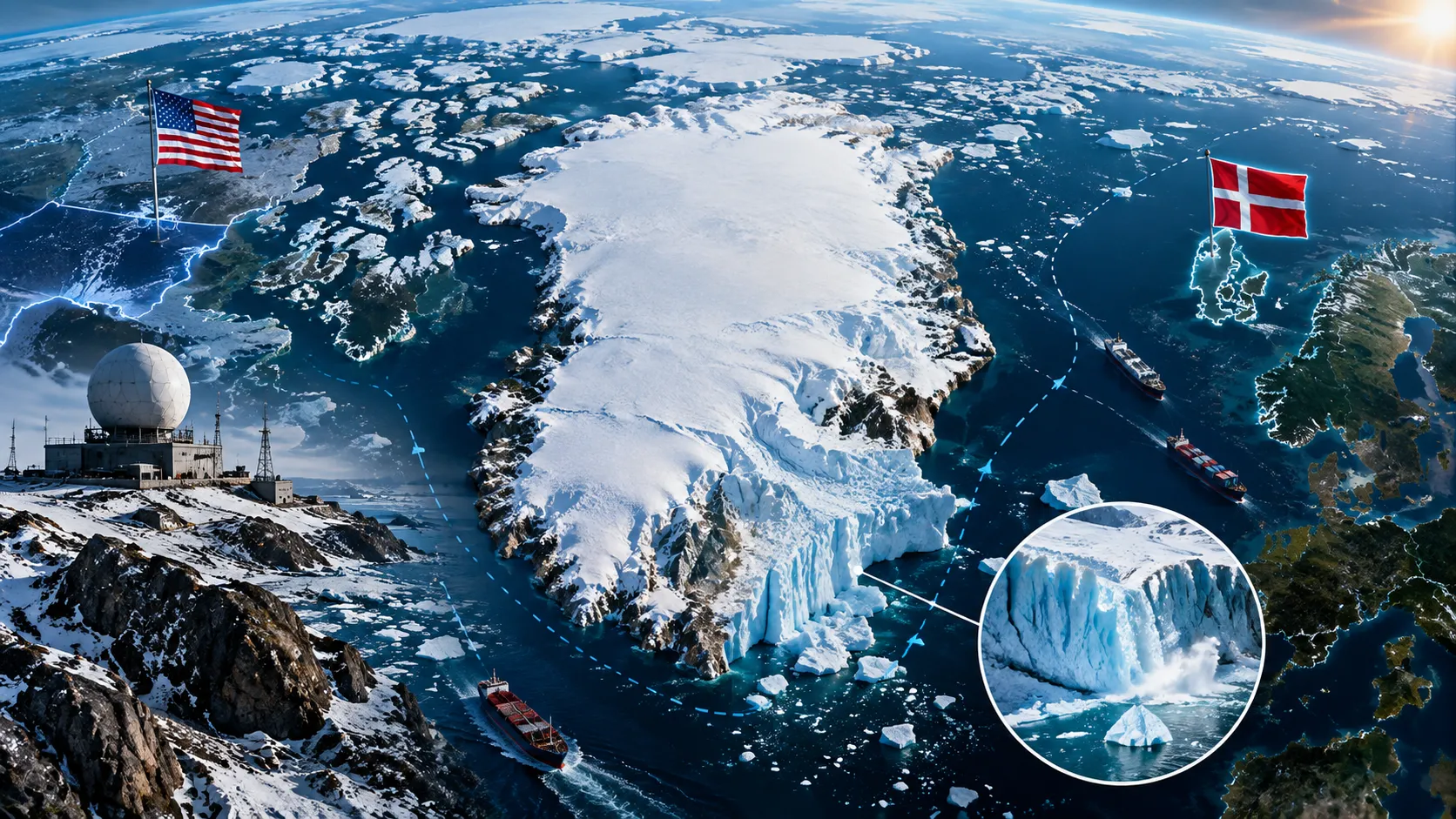
Greenland is back at the center of global attention after the United States, Denmark and Greenland announced a new agreement aimed at strengthening security in the Arctic and North Atlantic.
U.S. President Donald Trump said the agreement gives Washington permanent control over security and other defense-related needs in Greenland. However, the arrangement does not transfer Greenland’s sovereignty to the United States. Denmark and Greenland have said their sovereignty and Greenlanders’ right to self-determination remain recognized. The agreement is expected to be signed at the United Nations General Assembly and will still require the necessary parliamentary procedures.
That development has once again put a spotlight on a place that is often described simply as a remote, frozen island.
But Greenland is far more important than its population or appearance on a map might suggest.
Its position between North America and Europe, its proximity to the Arctic Ocean, its existing U.S. military infrastructure, its mineral potential and its enormous ice sheet make it one of the most strategically significant territories in the Arctic.
Why Is Greenland Trending Right Now?
The immediate reason is the newly announced U.S.-Denmark-Greenland security agreement.
According to Reuters, the agreement significantly expands the long-term U.S. military presence and access in Greenland while preventing non-NATO adversaries from establishing military bases or making sensitive investments there. The agreement builds on existing U.S.-Danish defense arrangements and is intended to address long-term Arctic security concerns.
The development follows months of tension over Trump’s repeated push for greater U.S. control over Greenland.
The latest arrangement is different from an outright takeover. Greenland remains within the Kingdom of Denmark, while the agreement is designed to give the United States broader and lasting security access.
Denmark’s government has emphasized that the deal recognizes the sovereignty and territorial integrity of the Kingdom of Denmark as well as the Greenlandic people’s right to self-determination.
That distinction is important because security control, military access and territorial sovereignty are not the same thing.
Where Is Greenland Located?
Greenland is located in the Arctic region between the North Atlantic and Arctic oceans.
Geographically, it sits northeast of Canada and relatively close to Iceland and Europe. Although Greenland is politically associated with Denmark, its physical location places it firmly at the heart of the Arctic.
The island covers more than 2.1 million square kilometres, making it the world’s largest island. Around 56,600 people lived there in 2024, according to the European Commission.
Its capital and largest city is Nuuk.
Greenland is an autonomous territory within the Kingdom of Denmark under the 2009 Self-Government Act. It is not part of Denmark in the same administrative sense as a Danish region, and Greenland has extensive responsibility for its own domestic affairs.
Why Is Greenland Strategically Important?
Greenland’s strategic value comes primarily from geography.
The island sits in a critical part of the Arctic-North Atlantic region, connecting the broader security space between North America and Europe.
That makes it important for:
- Military surveillance
- Missile warning systems
- Arctic defense
- Air and maritime monitoring
- North Atlantic security
- Space-related infrastructure
- Potential future Arctic shipping
- Access to natural resources
The U.S. already operates Pituffik Space Base, formerly known as Thule Air Base, in northwestern Greenland.
The U.S. Space Force says the installation supports force projection, space superiority and scientific research in the Arctic and is the northernmost U.S. military installation. Its history also includes ballistic missile early-warning operations dating back to the Cold War era.
This existing infrastructure helps explain why Greenland has such an important place in U.S. Arctic strategy.
What Is the U.S. Interested in Greenland?
The United States has several strategic interests in Greenland.
1. Arctic Defense
As the Arctic becomes increasingly important to global security, Greenland provides a geographically valuable location for monitoring activity across the northern Atlantic and Arctic regions.
The existing Pituffik facility gives the United States an established military and space infrastructure in a strategically remote location.
The new agreement is expected to provide Washington with expanded access and greater ability to operate in Greenland.
2. Russia and China
The Arctic is increasingly viewed as an area of competition among major powers.
The new agreement specifically seeks to prevent non-NATO adversaries from establishing military bases or making sensitive investments in Greenland.
That makes Greenland part of the broader strategic competition involving the United States, Russia, China, NATO and European countries.
3. Missile and Space Defense
Greenland’s northern position is particularly valuable for early-warning and surveillance systems.
Pituffik’s history as a ballistic missile early-warning location demonstrates why the island has mattered to U.S. defense planning for decades.
Greenland’s Natural Resources Are Another Major Factor
Greenland is not only strategically located; it also has significant mineral potential.
The European Union says Greenland has 25 of the 34 critical raw materials identified by the EU as important for the green and digital transition.
These resources are potentially important for industries involving:
- Electric vehicles
- Batteries
- Wind turbines
- Electronics
- Defense technology
- Renewable energy
- Advanced manufacturing
The EU and Greenland have therefore developed a strategic partnership focused partly on sustainable raw-material supply chains.
In September 2026, the European Commission announced a new €200 million Global Gateway Partnership Package for Greenland, covering areas including connectivity, sustainable energy and critical raw materials.
This illustrates another reason Greenland matters beyond military strategy: resource security.
Why Are Rare Earth Minerals Important?
Rare earth elements are used in many modern technologies, including electric motors, wind turbines, smartphones, LEDs and other advanced products.
The European Commission notes that the EU currently depends heavily on imports for rare earth materials, making alternative sources strategically valuable.
Greenland’s mineral potential therefore attracts interest from Europe and other major economies.
However, mineral potential does not automatically mean large-scale mining.
Greenland’s extreme climate, limited infrastructure, environmental concerns, remote geography and high development costs can make resource extraction challenging.
Greenland’s Ice Sheet Makes It Globally Important
Greenland is also central to the global climate story.
Approximately 80% of Greenland is covered by an enormous ice sheet. NASA describes it as the largest ice sheet on Earth outside Antarctica.
The ice sheet contains a huge amount of freshwater stored as ice.
Its continued mass loss contributes to global sea-level rise.
NASA estimates that Greenland has been losing hundreds of billions of tonnes of ice annually over the satellite-observation era.
That means what happens in Greenland does not remain a local issue.
Changes to the Greenland ice sheet can influence sea levels and contribute to wider changes in the Arctic environment.
Could Melting Ice Make Greenland More Strategically Important?
Potentially, yes.
Climate change is changing the physical and economic conditions of the Arctic.
As sea ice patterns change, some Arctic maritime routes can become more accessible for longer periods. At the same time, previously difficult-to-reach resources may become more economically interesting.
But this does not mean the Arctic will suddenly become an easy shipping or mining region.
Harsh weather, limited infrastructure, environmental risks and difficult operating conditions remain major obstacles.
The strategic importance of Greenland therefore comes from a combination of geography, security, resources and environmental change, rather than from any single factor.
Who Controls Greenland?
Greenland is an autonomous territory within the Kingdom of Denmark.
It has its own government and parliament and exercises extensive self-government.
Denmark retains responsibility for certain areas, including foreign affairs and defense.
The latest U.S.-Denmark-Greenland agreement does not change that basic sovereignty arrangement. Denmark’s government explicitly said the agreement recognizes the sovereignty and territorial integrity of the Kingdom of Denmark and Greenlanders’ right to self-determination.
The agreement is instead focused on security and military cooperation.
Is Greenland Part of the United States?
No.
Greenland is not a U.S. territory and has not become part of the United States under the latest agreement.
The new arrangement concerns U.S. security responsibilities, military access and strategic cooperation while Greenland remains under Danish sovereignty. Reuters and other reports describe the deal as an expansion of U.S. strategic and military access rather than a transfer of sovereignty.
The distinction is particularly important because earlier U.S. discussions had included the possibility of acquiring Greenland.
The current agreement falls short of territorial acquisition.
Why Does Greenland Matter to Europe?
Greenland has become increasingly important to Europe’s Arctic strategy.
For Denmark, Greenland is directly connected to national sovereignty and Arctic security.
For the European Union, Greenland is important because of:
- Critical raw materials
- Arctic environmental policy
- Fisheries
- Energy
- Connectivity
- Security and geopolitical cooperation
The EU describes Greenland as an increasingly important part of Europe’s Arctic engagement and has expanded its partnership with Nuuk.
Greenland and the Future of Arctic Geopolitics
Greenland’s importance is likely to remain high because several global trends are converging in the Arctic.
Security
NATO members are paying greater attention to Arctic and North Atlantic defense.
Resources
Critical minerals are becoming increasingly important to economic security and advanced technology.
Climate
Rapid environmental changes are transforming the Arctic.
Shipping
Changes in sea ice could affect future maritime activity.
Great-power competition
The United States, Russia, China and European states all have strategic interests in the wider Arctic region.
These factors make Greenland much more than a remote frozen territory.
Greenland Explained in 5 Key Facts
| Question | Answer |
|---|---|
| Where is Greenland? | In the Arctic, northeast of Canada and between North America and Europe |
| Who controls Greenland? | Greenland is an autonomous territory within the Kingdom of Denmark |
| Capital | Nuuk |
| Why is it strategically important? | Its Arctic location, military infrastructure, surveillance value and resource potential |
| How much of Greenland is covered by ice? | About 80% |
What Happens Next?
The next major step is the formal signing and implementation process for the new Arctic security agreement.
Denmark and Greenland have said the agreement is expected to be signed at the United Nations General Assembly. It will then be subject to the necessary national parliamentary procedures.
The practical impact will depend on how the agreement is implemented, including the extent of expanded U.S. military access and infrastructure.
At the same time, Greenland’s own political priorities will remain important, particularly its autonomy, economic development and long-term discussion over self-determination.
Bottom Line
Greenland is trending because a new security agreement has placed the Arctic island at the center of U.S., Danish and Greenlandic strategic discussions.
But the bigger story goes beyond the latest diplomatic deal.
Greenland sits at a critical Arctic crossroads, hosts important U.S. military infrastructure, contains significant critical-mineral potential and holds one of the world’s largest ice sheets.
That combination makes Greenland important simultaneously for global security, resource supply chains, climate change and the future of Arctic geopolitics.
The latest agreement strengthens the U.S. security role without transferring Greenland’s sovereignty to Washington.
For a relatively small population living across one of the world’s most remote landscapes, Greenland has an unusually large role in the future of global affairs.
FAQ
Why is Greenland in the news right now?
Greenland is in the news because the United States, Denmark and Greenland announced a new agreement intended to strengthen security in the Arctic and North Atlantic while expanding the U.S. military role in Greenland.
Where is Greenland located?
Greenland is located in the Arctic between the North Atlantic and Arctic oceans, northeast of Canada and relatively close to Iceland and Europe.
Who owns Greenland?
Greenland is an autonomous territory within the Kingdom of Denmark. Greenland has extensive self-government, while Denmark retains responsibility for areas including defense and foreign affairs.
Why does the United States care about Greenland?
The United States considers Greenland strategically important because of its Arctic location, existing military infrastructure, surveillance capabilities and potential role in defending North America and the North Atlantic.
Does the new agreement make Greenland part of the United States?
No. The announced agreement does not transfer Greenland’s sovereignty to the United States. Greenland remains within the Kingdom of Denmark.
What is the Greenland ice sheet?
The Greenland ice sheet is a massive layer of ice covering roughly 80% of the island. It is the largest ice sheet outside Antarctica and is an important contributor to global sea-level change as it loses mass.
Does Greenland have valuable minerals?
Yes. The European Commission says Greenland contains 25 of the 34 critical raw materials identified by the EU, making its mineral potential strategically important.
Why is Greenland important for Europe?
Greenland is important to Europe because of its Arctic location, critical minerals, fisheries, environmental significance, energy potential and growing role in Arctic security.
“MUST READ” – What Is Critical Minerals Weaponization? Why India Warned the World at BRICS 2026