


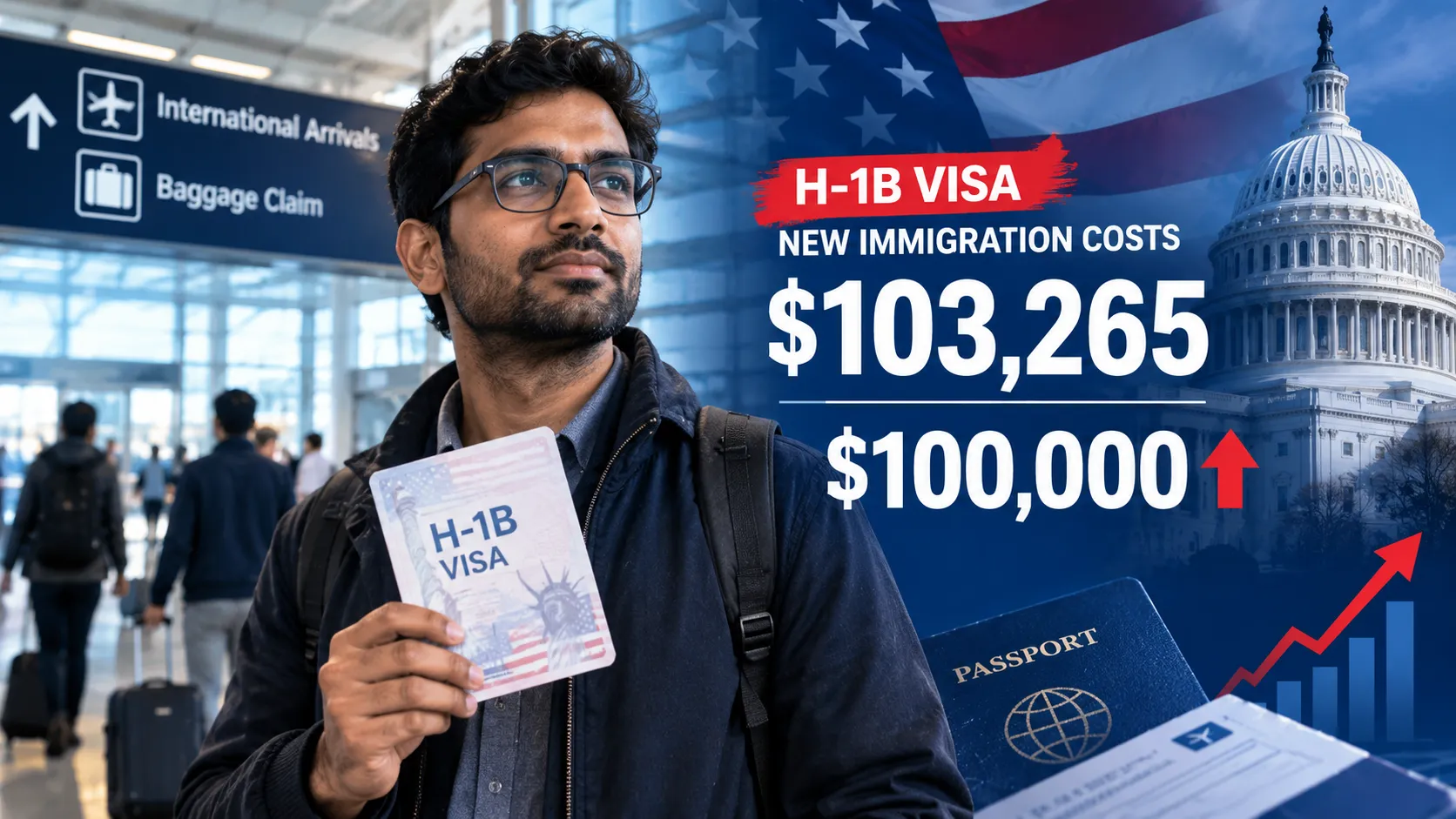
The cost of sponsoring an H-1B worker in the United States could become dramatically higher if two separate fee mechanisms ultimately apply to the same petition. The US Department of Homeland Security (DHS) has proposed a new $103,265 fee for H-1B cap-subject petitions, while an earlier $100,000 payment introduced under a 2025 presidential proclamation remains tied up in litigation.
On paper, adding the two figures produces $203,265, before ordinary H-1B filing and other applicable costs. But this does not mean that Indian workers or their employers are currently being charged $203,265. The $103,265 amount is still a proposal, while the earlier $100,000 payment was struck down by a federal district court and remains part of an ongoing legal dispute.
For readers following the latest H1B fee 2026 developments, the distinction between a proposed fee, an existing fee and a court-challenged payment is crucial.
For a detailed breakdown of the proposed charge, readers can also see HNN24x7’s explainer on H-1B $103,265 Fee 2026.
What is the new $103,265 H-1B fee?
DHS has proposed creating a $103,265 fee for every H-1B cap-subject petition, including petitions eligible for the advanced-degree exemption.
The proposal was published in August 2026 and is separate from the normal H-1B filing fees. DHS says the money would help recover federal government costs associated with administering the immigration system across agencies including DHS, the Department of Labor, the Department of Justice and the Department of State.
Importantly, this is a proposed rule, not a final rule.
That means employers are not currently required to pay the $103,265 charge simply because they are filing an H-1B petition.
The proposal also specifically targets cap-subject H-1B petitions. Cap-exempt H-1B petitions, such as qualifying petitions involving certain universities and research organizations, would not be subject to this particular proposed fee.
Why is everyone talking about $200,000?
The $200,000-plus figure comes from adding two different six-figure charges:
| Potential charge | Amount | Current status |
|---|---|---|
| Earlier Trump H-1B payment | $100,000 | Court challenge; not currently being collected under the vacated implementation |
| New DHS proposed fee | $103,265 | Proposed, not final |
| Combined theoretical amount | $203,265 | Not currently an active combined fee |
The DHS proposal explicitly says the $103,265 fee would be in addition to other applicable fees or payments, including a separate payment required under a presidential proclamation.
DHS therefore acknowledged that if an H-1B petitioner were subject to both mechanisms, both payments could potentially be required.
That is the basis for the H1B $200000 headline.
However, it would be misleading to say that the US has already introduced a $203,265 H-1B visa fee.
It has not.
The $203,265 figure is a potential scenario based on two separate measures that do not currently operate together.
What happened to Trump’s earlier $100,000 H-1B fee?
Donald Trump introduced the $100,000 payment through a presidential proclamation in September 2025.
The White House said the measure was designed to restrict entry of certain H-1B workers unless the petition was accompanied by a $100,000 payment, with exemptions possible in cases determined to be in the national interest.
But the policy faced a major legal setback in June 2026.
A federal judge ruled that the $100,000 payment was unlawful, finding that the administration had exceeded its authority. The government appealed the decision, leaving the legal status of the measure uncertain.
The Federal Register notice for the new $103,265 proposal also acknowledges that the earlier payment was challenged in court and that the government’s appeal remains pending. It says that if the earlier order is lifted, DHS could collect the payment consistent with the presidential proclamation and any extension or renewal.
This is why the old $100,000 fee and new $103,265 proposal should not be treated as one already-active charge.
Is the $103,265 H-1B fee final?
No.
This is one of the most important points for applicants and employers.
The DHS measure is a Notice of Proposed Rulemaking. It must go through the federal rulemaking process before it can become a final requirement.
The proposal was scheduled for publication in the Federal Register on August 25, 2026, with a public-comment period.
As of September 8, 2026, the $103,265 charge therefore remains a proposal.
Employers should not assume that every new H-1B petition automatically requires this payment.
Will Indian H-1B workers be affected?
Potentially, yes — but not because the applicants are Indian.
The proposed fee is linked to the type of H-1B petition rather than nationality. A qualifying cap-subject petition for an Indian beneficiary could be affected if the proposal becomes final.
India’s large share of the H-1B programme makes the issue particularly important for Indian professionals.
According to U.S. Citizenship and Immigration Services data, beneficiaries born in India accounted for 71% of approved H-1B petitions in FY2024. That represented roughly 283,400 approved petitions. China was the next-largest country of birth at about 12%.
More recent USCIS data has continued to show India’s overwhelming presence in the programme, making changes to H-1B sponsorship especially relevant to Indian IT professionals.
Does the worker actually pay the $103,265?
The proposed fee is structured as a petition fee payable by the employer/petitioner, rather than a normal personal visa fee that an Indian worker simply pays at a US consulate.
That distinction matters.
If an employer faces a six-figure additional cost, the economic consequences can nevertheless reach the worker indirectly.
Companies could reconsider whether to sponsor an overseas candidate, delay recruitment, shift a role to another country, increase offshore work, or prioritize candidates already authorized to work in the United States.
In other words, the biggest effect may be on employer hiring decisions, rather than an Indian worker receiving a $103,265 bill personally.
Why could this be especially important for Indian IT professionals?
Indian technology companies and US-based employers have historically relied heavily on the H-1B programme to move skilled professionals into US-based roles.
Reuters reported that India accounted for 71% of approved H-1B beneficiaries and noted concerns that higher costs could encourage companies to rely more heavily on offshore and nearshore delivery models.
A six-figure sponsorship cost could therefore affect:
- New Indian graduates seeking US employment
- IT professionals moving from India to the US
- Consulting and technology companies
- Employers recruiting specialized foreign talent
- International students transitioning from F-1 to H-1B
- Companies using the annual H-1B lottery
The impact would not necessarily be uniform. Large companies may be better positioned to absorb additional costs than smaller businesses or organizations with tighter hiring budgets.
Could the total H-1B cost be even higher than $203,265?
Yes, in a hypothetical situation.
The $203,265 calculation only adds the two six-figure charges.
The DHS proposal says the $103,265 fee would be additional to other applicable H-1B fees. That means ordinary petition-related fees could theoretically sit on top of the two large payments if a particular case were subject to both.
Premium processing, where applicable and selected, would also be a separate expense.
Therefore, $203,265 should be understood as a theoretical combined figure for the two headline charges, not the complete cost of every H-1B case.
Does the $103,265 fee apply to every H-1B visa?
No.
The proposal is specifically aimed at H-1B cap-subject petitions, including petitions eligible for the advanced-degree exemption.
It is not designed as a blanket $103,265 charge for every H-1B petition.
This distinction is particularly important because H-1B filings can involve different categories, including cap-subject cases, cap-exempt cases and continuing employment petitions.
What should Indian H-1B applicants do now?
Applicants should avoid making decisions based only on the $200,000 headline.
The more important questions are:
- Is the petition cap-subject?
- Has the $103,265 proposal become final?
- What is the legal status of the earlier $100,000 payment?
- What fees apply to the specific employer and petition?
- Is the employer prepared to absorb potential additional costs?
- Are there any new USCIS or Department of Labor requirements affecting the case?
For people already holding H-1B status, a proposed fee on future cap-subject petitions should not automatically be interpreted as a new $103,265 charge on an existing visa.
H-1B Fee 2026: What happens next?
The next major development will be the federal rulemaking process for the $103,265 proposal and the continuing litigation surrounding the earlier $100,000 payment.
The legal question is especially important because the two measures come from different authorities.
The earlier $100,000 payment was created through a presidential proclamation, while DHS is attempting to establish the $103,265 charge through formal rulemaking. The proposed rule itself says the two mechanisms are legally distinct.
That means the final cost structure for future H-1B sponsorship remains uncertain.
FAQ
Q1. Is the $103,265 H-1B fee final?
No. As of September 8, 2026, it is a DHS proposal and has not become a final fee requirement.
Q2. Can H-1B costs reach $203,265?
Theoretically, yes. If both the $100,000 payment and $103,265 proposed fee became applicable to the same petition, their combined amount would be $203,265. This is not currently an active combined fee.
Q3. Does the $103,265 fee apply specifically to Indians?
No. The proposal is based on the type of H-1B petition, particularly cap-subject petitions, rather than the applicant’s nationality.
Q4. Why is the H-1B fee especially important for India?
Indian-born beneficiaries represented 71% of approved H-1B petitions in FY2024, making India the largest beneficiary group by a substantial margin.
Q5. Who would pay the proposed $103,265 fee?
It is structured as a petition fee payable by the H-1B petitioner/employer rather than a standard personal visa fee paid directly by the worker.
Q6. Does the $103,265 fee apply to cap-exempt H-1B petitions?
The proposal specifically applies to cap-subject petitions and does not establish the fee for cap-exempt H-1B filings.
Q7. What happened to Trump’s $100,000 H-1B fee?
A federal judge struck down the implementation in June 2026, and the administration appealed. The legal dispute remains important to the future fee structure.
Bottom line
Can H-1B costs theoretically cross $200,000? Yes.
If the proposed $103,265 DHS fee becomes final and the earlier $100,000 payment is restored or otherwise becomes applicable to the same petition, the two could total $203,265, before ordinary H-1B-related expenses.
Is every Indian H-1B worker currently facing a $203,265 fee? No.
As of September 8, 2026, the $103,265 amount is still a proposal, while the earlier $100,000 measure remains entangled in litigation. The final impact on Indian workers will depend on how the rulemaking and court proceedings develop.