



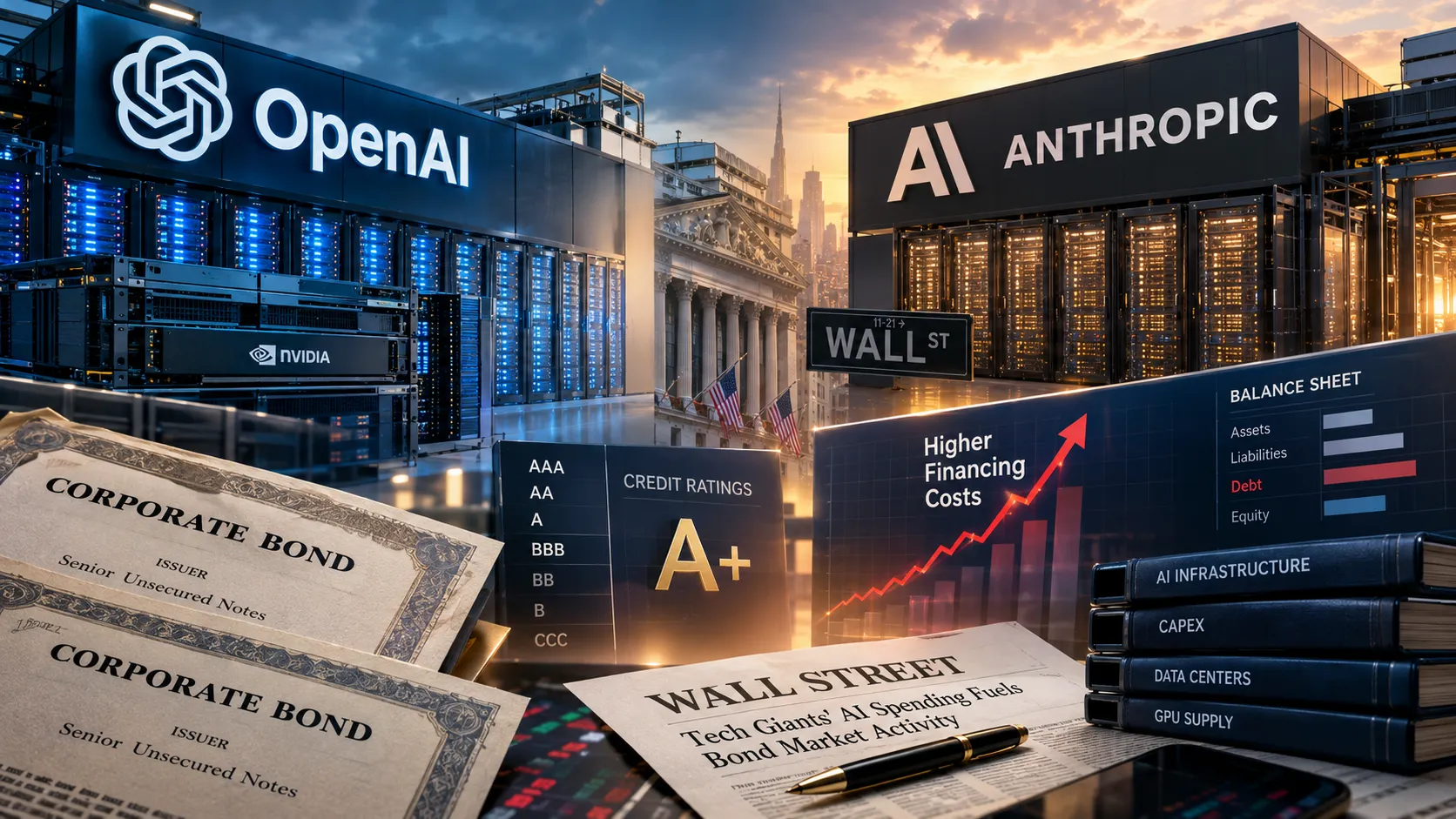
The artificial intelligence boom is entering a new financial phase. OpenAI and Anthropic are seeking investment-grade credit ratings ahead of their expected public-market debuts, as the two AI companies face enormous costs for computing power, data centers and long-term infrastructure.
The reason is straightforward: a stronger credit rating can mean cheaper borrowing, access to a much larger pool of institutional investors and greater flexibility to finance infrastructure with debt.
Bankers working with the companies are reportedly talking to credit-rating agencies about securing investment-grade status following their planned IPOs. Morgan Stanley is working with Anthropic, while Goldman Sachs is involved with OpenAI, according to the Financial Times. The target is access to the roughly $11.7 trillion US corporate bond market.
But there is a bigger question behind the OpenAI debt story: why do some of the world’s most valuable AI companies need so much financing in the first place?
Why do OpenAI and Anthropic need investment-grade ratings?
The main reason is the extraordinary amount of capital required to build and operate AI infrastructure.
Training frontier AI models requires huge quantities of GPUs, electricity, data-center capacity and networking equipment. Running those models for millions of users requires another layer of infrastructure.
OpenAI has already committed to massive computing and data-center projects, while Anthropic is rapidly expanding its own compute capacity to support Claude.
That creates a financing challenge.
Equity investment can provide enormous amounts of capital, but debt offers companies another way to fund expansion without continuously issuing new shares.
The problem is that debt comes with interest costs and repayment obligations.
An investment-grade rating can reduce the interest rate investors demand because the borrower is considered comparatively less risky.
For companies planning to spend tens or hundreds of billions of dollars on infrastructure, even a relatively small difference in borrowing costs can translate into enormous savings over time.
What exactly is an investment-grade rating?
An investment-grade credit rating is essentially an assessment that a company has a relatively strong ability to meet its financial obligations.
Ratings agencies such as S&P Global Ratings, Moody’s and Fitch classify corporate debt according to perceived credit risk.
Investment-grade debt generally attracts a broader investor base than speculative-grade or “junk” debt.
That distinction matters because many institutional investors, including pension funds and insurance companies, have restrictions on how much lower-rated corporate debt they can hold.
Therefore, a higher rating can create two advantages:
- Lower borrowing costs
- A larger pool of potential investors
For OpenAI and Anthropic, both could become increasingly important as AI infrastructure spending accelerates.
Why is OpenAI’s debt becoming an important issue?
OpenAI is moving from being primarily an AI model developer toward becoming a major infrastructure customer and operator.
In March 2026, OpenAI announced that it had closed a funding round involving $122 billion in committed capital at an $852 billion post-money valuation. The company said the funding would support research, products and infrastructure, with access to compute described as a strategic advantage.
But equity financing is only one part of the capital structure.
OpenAI has increasingly become connected to financing arrangements involving data-center developers, chip companies and cloud providers.
One of the clearest examples is its Ohio infrastructure expansion.
Nvidia has committed to provide a guarantee of up to $105 billion connected to OpenAI’s lease of a major data-center project in Ohio developed by SB Energy. The facility is planned to ultimately provide as much as 8 gigawatts of power capacity.
This does not mean OpenAI has simply borrowed $105 billion in cash.
Rather, the guarantee is part of a complex infrastructure financing structure involving leases, power payments and other commitments.
That distinction is important when discussing OpenAI debt. AI companies can have enormous financial obligations without all of those obligations appearing as conventional corporate loans on the balance sheet.
OpenAI is already using traditional credit
OpenAI’s relationship with banks is also expanding.
In July, Bank of America extended a $520 million credit line to OpenAI, according to Reuters. The loan came as OpenAI prepared for a potential IPO and was described as the bank’s first loan to the AI company.
This is significant because it shows how OpenAI is increasingly becoming part of the traditional corporate-finance system.
The transition is notable.
For years, frontier AI companies were financed primarily through venture capital and strategic technology investors. As their infrastructure requirements grow, they increasingly need access to the much larger debt markets used by established corporations.
What is happening with Anthropic debt?
Anthropic is facing a similar financing challenge.
The company has rapidly expanded its AI infrastructure commitments as demand for Claude has increased.
Reuters reported in September that Anthropic has moved from being cautious about very large infrastructure agreements to securing major long-term compute arrangements. These include large commitments involving Microsoft, Nvidia, Nscale and SpaceX.
Anthropic is also preparing for a potential IPO.
Reuters reported that the company expects to begin marketing its IPO in mid-October 2026, with its public filing process expected to move forward in late September. Anthropic is also finalizing a $15 billion revolving credit facility involving major banks including Morgan Stanley, Goldman Sachs, JPMorgan and Citi.
That credit facility is especially important in understanding the Anthropic debt story.
A revolving credit facility is not the same as taking the entire amount as a loan immediately. It gives the company access to financing when needed, subject to the terms of the facility.
For an AI company spending heavily on infrastructure, that can function as an important liquidity buffer.
Anthropic has also attracted enormous equity investment
Anthropic’s financing story is not exclusively about debt.
In February, the company announced a $30 billion Series G funding round at a $380 billion post-money valuation.
In May, Anthropic completed another massive financing round.
Qatar Investment Authority said Anthropic’s $65 billion Series H financing valued the company at $965 billion post-money. The funding was intended to support safety and interpretability research, expanded compute capacity and product development.
The combination of enormous equity funding and expanding debt facilities illustrates the central financial challenge facing frontier AI companies:
AI development is becoming a capital-intensive infrastructure business.
Why can’t they simply keep raising equity?
They can — and they are.
But relying entirely on equity financing has drawbacks.
When a company issues additional shares, existing shareholders can experience dilution. Debt does not create the same direct ownership dilution.
Debt also becomes attractive when a company believes its future cash flows will be strong enough to service the borrowing.
For AI companies, however, there is a major complication: future revenue is still difficult to predict while infrastructure spending is enormous.
That is why the credit-rating question matters so much.
If rating agencies believe OpenAI and Anthropic deserve investment-grade status, the companies could potentially borrow at more favorable rates.
If agencies remain skeptical, the companies could face higher financing costs.
Why are rating agencies cautious?
The biggest problem is that both companies operate in a highly unusual financial environment.
They have extraordinary valuations and rapidly growing businesses, but they also require enormous ongoing investment.
The Financial Times reported that both companies remain unprofitable and that rating agencies are cautious about their financial transparency and cash burn.
That creates a difficult question for credit analysts:
Can future AI revenue reliably cover the infrastructure spending and debt obligations required to achieve that revenue?
The answer is not yet obvious.
AI demand has grown rapidly, but the economics of frontier models remain tied to expensive computing infrastructure.
A company can have rapidly increasing revenue and still require enormous external capital if its expansion costs grow even faster.
AI companies financing: Why debt is suddenly everywhere
OpenAI and Anthropic are not alone.
The broader technology sector has been borrowing heavily to fund the AI buildout.
Reuters reported in August that AI-related corporate debt issuance had reached $220 billion in 2026, compared with $12.5 billion over the same period the previous year. Even highly rated technology companies were beginning to encounter investor resistance as the volume of AI-related borrowing increased.
That means the question is no longer simply whether AI companies can raise money.
The bigger question is:
How much capital can the market absorb, and at what price?
As borrowing increases, investors may demand higher yields. That can make each additional dollar of debt more expensive.
This is precisely why an investment-grade rating could become strategically valuable.
What would a strong credit rating change for OpenAI and Anthropic?
There are at least four major benefits.
1. Lower borrowing costs
A stronger rating can reduce the risk premium investors demand.
For companies borrowing billions of dollars, even a modest reduction in interest rates can produce significant savings.
2. Access to institutional investors
Investment-grade status could allow the companies to reach investors that avoid speculative-grade debt.
That could substantially increase the potential buyer base for future bonds.
3. Easier infrastructure financing
Data centers require enormous upfront investment and generate financial obligations over many years.
A strong credit profile could make it easier to structure long-term financing for those projects.
4. Less dependence on equity funding
Debt can supplement equity financing.
That could allow AI companies to continue expanding without relying entirely on fresh share issuance.
Could an IPO improve their creditworthiness?
Potentially.
This is one of the central arguments being presented to rating agencies.
An IPO could provide:
- greater liquidity,
- a transparent public-market valuation,
- a stronger equity base,
- access to public capital markets,
- and potentially a larger balance sheet.
According to the Financial Times, bankers are arguing that post-IPO liquidity and stronger balance sheets could support investment-grade ratings.
But an IPO does not automatically guarantee a high credit rating.
A company can be extremely valuable in the stock market and still have a weak credit profile.
Credit investors care about cash flow, debt service, liquidity, business stability and the ability to repay obligations — not simply the company’s valuation.
What makes this different from traditional tech companies?
The scale and speed are unusual.
Meta and Tesla, for example, did not immediately receive investment-grade ratings simply because they became public companies. The AI companies are attempting to compress that transition much more quickly.
SpaceX has provided an important precedent after receiving an investment-grade rating shortly after its IPO, according to the Financial Times.
OpenAI and Anthropic are effectively asking the bond market to view them not merely as speculative AI startups, but as emerging infrastructure companies with enormous future revenue potential.
That is a major shift in how the AI industry is financed.
What does this mean for investors?
For investors, the credit-rating debate is a warning that AI’s next phase may depend as much on financial engineering as on better models.
The first phase of the AI boom was dominated by venture capital and strategic investments.
The next phase could involve:
Equity + corporate bonds + bank loans + infrastructure financing + long-term compute contracts.
That creates both opportunities and risks.
If AI revenue grows fast enough, debt can accelerate expansion.
If revenue growth slows while infrastructure obligations remain high, debt can become a major financial burden.
Anthropic and OpenAI bankers push for top-tier credit ratings post-IPO
The bigger question: Is AI becoming too capital-intensive?
This may ultimately be the most important question behind the OpenAI and Anthropic financing story.
The AI industry is increasingly resembling an infrastructure sector.
Data centers, electricity, chips, networking equipment and long-term computing contracts require massive amounts of capital.
Anthropic’s planned credit facility and OpenAI’s expanding financing relationships show how quickly this transformation is happening. At the same time, the wider market is already showing signs that investors are becoming more selective about the amount of AI-related debt they are willing to absorb.
For OpenAI and Anthropic, obtaining an investment-grade rating would therefore be more than a financial badge.
It could become a competitive advantage.
“Must Read” – Claude vs ChatGPT vs Gemini: 2026 में कौन सा AI सबसे बेहतर है?
FAQ
Q1. Why does OpenAI want an investment-grade credit rating?
OpenAI wants access to cheaper debt and a broader pool of institutional investors as its spending on AI infrastructure and computing capacity increases.
Q2. Why is Anthropic seeking an investment-grade rating?
Anthropic is rapidly expanding its compute infrastructure and is preparing for a potential IPO. A stronger credit rating could lower financing costs and make future borrowing easier.
Q3. Does investment-grade mean OpenAI has no financial risk?
No. A credit rating is an assessment of creditworthiness, not a guarantee that a company is financially risk-free.
Q4. How much is the US corporate bond market worth?
SIFMA reported approximately $11.7 trillion in outstanding US corporate bonds as of Q1 2026.
Q5. Is OpenAI already borrowing money?
Yes. Bank of America extended a reported $520 million credit line to OpenAI in July 2026, while the company is also involved in complex infrastructure financing arrangements.
Q6. Is Anthropic taking on debt?
Anthropic is arranging significant financing facilities, including a reported $15 billion revolving credit facility, alongside major long-term infrastructure commitments.
Q7. Why do AI companies need so much money?
Training and operating frontier AI models requires expensive GPUs, data centers, electricity, networking infrastructure and long-term computing capacity.
Q8. Could debt become a problem for AI companies?
Yes. If AI revenue grows slower than infrastructure spending, companies could face higher interest costs, refinancing pressure and weaker cash flows.
Bottom Line
The OpenAI debt and Anthropic debt story is ultimately about the changing economics of artificial intelligence.
Both companies need enormous amounts of computing infrastructure to support their ambitions. Equity funding has provided unprecedented capital, but debt offers another way to finance expansion without relying entirely on new shareholders.
An investment-grade rating could give OpenAI and Anthropic cheaper borrowing, broader access to institutional investors and greater flexibility to finance data centers and compute capacity.
But rating agencies still face a difficult decision.
Both companies are operating at extraordinary scale, yet their businesses require huge continuing investment and remain exposed to questions around profitability, cash burn and the long-term economics of AI.
If OpenAI and Anthropic successfully become investment-grade borrowers, it could mark a major transition: AI companies moving from venture-funded technology startups toward globally significant infrastructure businesses.