



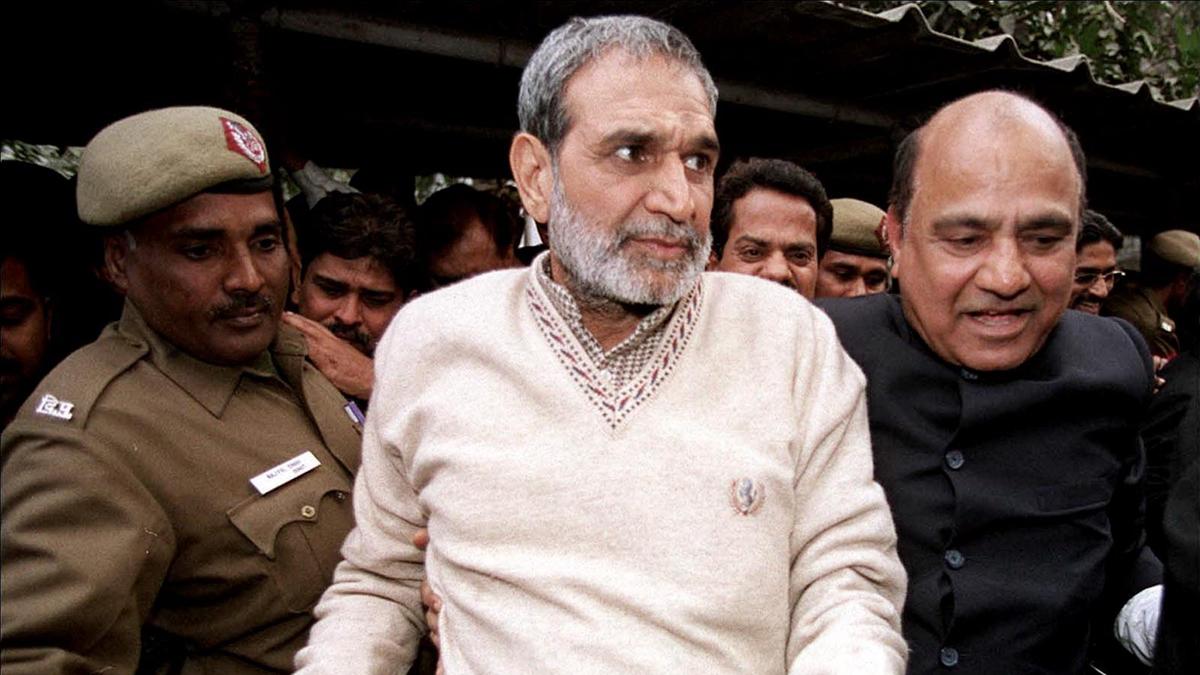
Former Congress MP Sajjan Kumar, who was serving life imprisonment in connection with cases arising from the 1984 anti-Sikh riots in Delhi, died at the age of 80 on Thursday, August 20, 2026. He was declared dead at Safdarjung Hospital in New Delhi, according to reports citing hospital sources.
Kumar had been lodged in Tihar Jail since December 2018 after the Delhi High Court sentenced him to life imprisonment in a case involving the killing of five members of a Sikh family and the burning of a gurdwara during the violence that followed the assassination of former Prime Minister Indira Gandhi.
His death brings to an end the life of one of the most controversial political figures associated with the decades-long legal proceedings arising from the 1984 violence.
What happened to Sajjan Kumar?
Sajjan Kumar died on August 20, 2026, at the age of 80. He had been serving a life sentence in Tihar Jail when he was taken to Safdarjung Hospital, where he was declared dead, according to reports citing hospital sources.
Reports available so far identify the hospital as Safdarjung Hospital in New Delhi. Further official details about the circumstances surrounding his death were not immediately available in the initial reports.
Kumar’s death comes after more than three decades of criminal investigations, trials, acquittals, convictions and appeals connected with the 1984 anti-Sikh violence.
Who was Sajjan Kumar?
Sajjan Kumar was a prominent Delhi politician of the Indian National Congress and served multiple terms as a Lok Sabha member from Outer Delhi.
He entered electoral politics through the Municipal Corporation of Delhi in 1977 and later became a Congress parliamentarian. He represented Outer Delhi in the Lok Sabha in multiple terms, including from 1980–84, 1991–96 and 2004–09.
His political career was ultimately overshadowed by allegations and criminal proceedings concerning the 1984 anti-Sikh riots.
Following his conviction by the Delhi High Court in December 2018 and his life sentence, Kumar resigned from the Congress.
What were the 1984 anti-Sikh riots?
The violence erupted in Delhi and other parts of India after Prime Minister Indira Gandhi was assassinated by two of her Sikh bodyguards on October 31, 1984.
Thousands of Sikhs were killed across the country, with Delhi experiencing some of the worst violence.
The events became the subject of numerous investigations, commissions, criminal cases and court proceedings over subsequent decades.
Kumar was one of several Congress-linked political figures whose alleged role in the violence became the subject of prolonged legal scrutiny.
Why was Sajjan Kumar sentenced to life imprisonment in 2018?
The most significant early conviction came in December 2018, when the Delhi High Court overturned Kumar’s earlier acquittal and sentenced him to life imprisonment.
The case concerned the killings of five members of a Sikh family in Raj Nagar, Delhi Cantonment, during the violence on November 1, 1984. The court found Kumar guilty of offences including murder and promoting enmity between groups.
The five victims identified in reporting on the case were Kehar Singh, Gurpreet Singh, Raghuvender Singh, Narender Pal Singh and Kuldeep Singh.
Kumar had previously been acquitted by a trial court, but the CBI challenged that decision. The Delhi High Court subsequently reversed the acquittal and imposed the life sentence.
He surrendered and entered prison in December 2018.
Sajjan Kumar received a second life sentence in 2025
Kumar’s legal troubles did not end with the 2018 conviction.
On February 12, 2025, a Delhi court convicted him in another 1984 riots case concerning the deaths of Jaswant Singh and his son, Tarundeep Singh, in the Saraswati Vihar area of Delhi on November 1, 1984.
The prosecution alleged that Kumar had instigated a mob involved in the killings.
The court found him guilty of murder and other offences based on the evidence presented during the trial.
On February 25, 2025, Special Judge Kaveri Baweja sentenced Kumar to another life term. The court rejected a request for the death penalty. Reporting on the sentencing said the court took into account factors including Kumar’s age and health when determining the punishment.
Thus, by the time of his death, Kumar was serving life imprisonment in connection with the 1984 violence.
Was Sajjan Kumar convicted in every 1984 riots case against him?
No. Kumar faced several separate cases, and the outcomes were not identical.
This distinction is important because he was convicted in some cases but acquitted in others.
In January 2026, a Delhi court acquitted Kumar in a case concerning allegations of inciting violence in the Janakpuri and Vikaspuri areas during the 1984 riots. Special Judge Dig Vinay Singh ruled that the prosecution had failed to prove the charges beyond reasonable doubt.
The case included allegations concerning the deaths of Sohan Singh and his son-in-law Avtar Singh in Janakpuri and the alleged killing of Gurcharan Singh in Vikaspuri.
The acquittal illustrates why individual criminal cases arising from the 1984 violence need to be distinguished from one another.
A conviction in one case did not automatically establish guilt in every other case.
Sajjan Kumar’s final years were spent in prison
Kumar remained in custody for years after his 2018 conviction.
He had sought bail on medical grounds on multiple occasions. The Supreme Court rejected earlier pleas, while he remained imprisoned because of his conviction in the Raj Nagar case.
Even when Kumar obtained relief in another riot-related proceeding, his release was prevented by the life sentence he was already serving.
His health and age also became relevant during later court proceedings, particularly when the prosecution sought the death penalty following his 2025 conviction.
What was Sajjan Kumar’s political career?
Kumar began his political career in Delhi’s municipal politics and won his first Lok Sabha election from Outer Delhi in 1980.
He later returned to Parliament in 1991 and again in 2004. He was therefore a three-time Lok Sabha MP from Outer Delhi.
His political influence in Delhi was substantial before the 1984 riots cases transformed his public legacy.
After the Delhi High Court’s 2018 conviction, Kumar resigned from the Congress party.
What happens to Sajjan Kumar’s pending legal cases after his death?
The immediate legal consequences depend on the status and nature of each proceeding.
Because Kumar has died, criminal proceedings against him personally cannot continue in the ordinary manner as they would against a living accused. Appeals or connected proceedings can have different legal implications depending on their status and the relief being sought.
At the time of his death, his legal history included convictions as well as acquittals in separate cases. Reporting in earlier proceedings had also noted pending appeals connected to some of those cases.
Any specific legal effect on pending appeals or connected proceedings would ultimately depend on the relevant court orders and legal procedure.
Why Sajjan Kumar’s death is significant
Sajjan Kumar’s death is significant not simply because he was a former parliamentarian.
His name became closely associated with one of the most painful chapters in India’s post-Independence history.
The 1984 anti-Sikh violence generated decades of demands from survivors and families for accountability. Kumar’s 2018 conviction was one of the highest-profile convictions involving a political figure accused in the violence.
His second life sentence in 2025 further reinforced the judicial significance of the cases against him.
At the same time, his acquittals in other proceedings demonstrate the importance of examining each case on its own evidence rather than treating all allegations as established facts.
Sajjan Kumar case timeline
| Year | Development |
|---|---|
| 1977 | Kumar entered Delhi municipal politics and became a councillor. |
| 1980 | He was elected to the Lok Sabha from Outer Delhi. |
| 1984 | Anti-Sikh violence followed Indira Gandhi’s assassination. |
| 2013 | Kumar was acquitted by a Delhi trial court in one major 1984 riots case. |
| December 2018 | Delhi High Court overturned the acquittal and sentenced Kumar to life imprisonment. |
| December 2018 | Kumar resigned from the Congress after the conviction. |
| February 12, 2025 | Delhi court convicted him in the Saraswati Vihar father-son murder case. |
| February 25, 2025 | He received a second life sentence. |
| January 22, 2026 | Delhi court acquitted him in the Janakpuri-Vikaspuri violence case. |
| August 20, 2026 | Sajjan Kumar died at age 80 after being taken to Safdarjung Hospital. |
What is known about Sajjan Kumar’s death?
As of the initial reports on August 20, 2026, Sajjan Kumar was reported dead at Safdarjung Hospital in New Delhi at the age of 80. He had been serving a life sentence in Tihar Jail.
The first reports cited hospital sources. More details about his medical condition immediately before his death may emerge through official statements or subsequent reporting.
Bottom line
Former Congress MP Sajjan Kumar, one of the most prominent political figures convicted in cases arising from the 1984 anti-Sikh riots, died at 80 on August 20, 2026.
He had been serving a life sentence after the Delhi High Court convicted him in 2018 in the Raj Nagar case involving the killing of five Sikhs. He received another life sentence in 2025 after being convicted in the killing of Jaswant Singh and his son Tarundeep Singh.
His legal record was not uniformly one of conviction: a Delhi court acquitted him in January 2026 in a separate Janakpuri-Vikaspuri case.
His death closes the chapter on Kumar himself, but the broader historical and legal legacy of the 1984 anti-Sikh violence remains a deeply significant part of India’s political and judicial history.
FAQ
Who was Sajjan Kumar?
Sajjan Kumar was a former Congress politician and three-time Lok Sabha MP from Delhi’s Outer Delhi constituency. He was later convicted in cases connected with the 1984 anti-Sikh riots.
When did Sajjan Kumar die?
Sajjan Kumar died on August 20, 2026, at the age of 80.
Where did Sajjan Kumar die?
He was taken to Safdarjung Hospital in New Delhi, where he was declared dead, according to reports citing hospital sources.
Why was Sajjan Kumar in jail?
He was serving life imprisonment following his conviction in a 1984 anti-Sikh riots case involving the killing of five members of a Sikh family in Raj Nagar, Delhi Cantonment.
Did Sajjan Kumar receive more than one life sentence?
Yes. In February 2025, a Delhi court sentenced him to life imprisonment in another 1984 riots murder case involving Jaswant Singh and his son Tarundeep Singh.
Was Sajjan Kumar acquitted in any cases?
Yes. In January 2026, a Delhi court acquitted him in a case concerning alleged violence in Janakpuri and Vikaspuri during the 1984 riots.
Did Sajjan Kumar remain a Congress member until his death?
No. He resigned from the Congress after the Delhi High Court convicted him and sentenced him to life imprisonment in December 2018.
How old was Sajjan Kumar when he died?
He was 80 years old.
“Must Read”
Dehradun TB Campaign: 189 क्षेत्रों की 100% स्क्रीनिंग
CJI सूर्यकांत विवाद: क्यों लॉ स्टूडेंट्स नहीं चाहते अपने कॉन्वोकेशन में चीफ जस्टिस को बुलाना?