




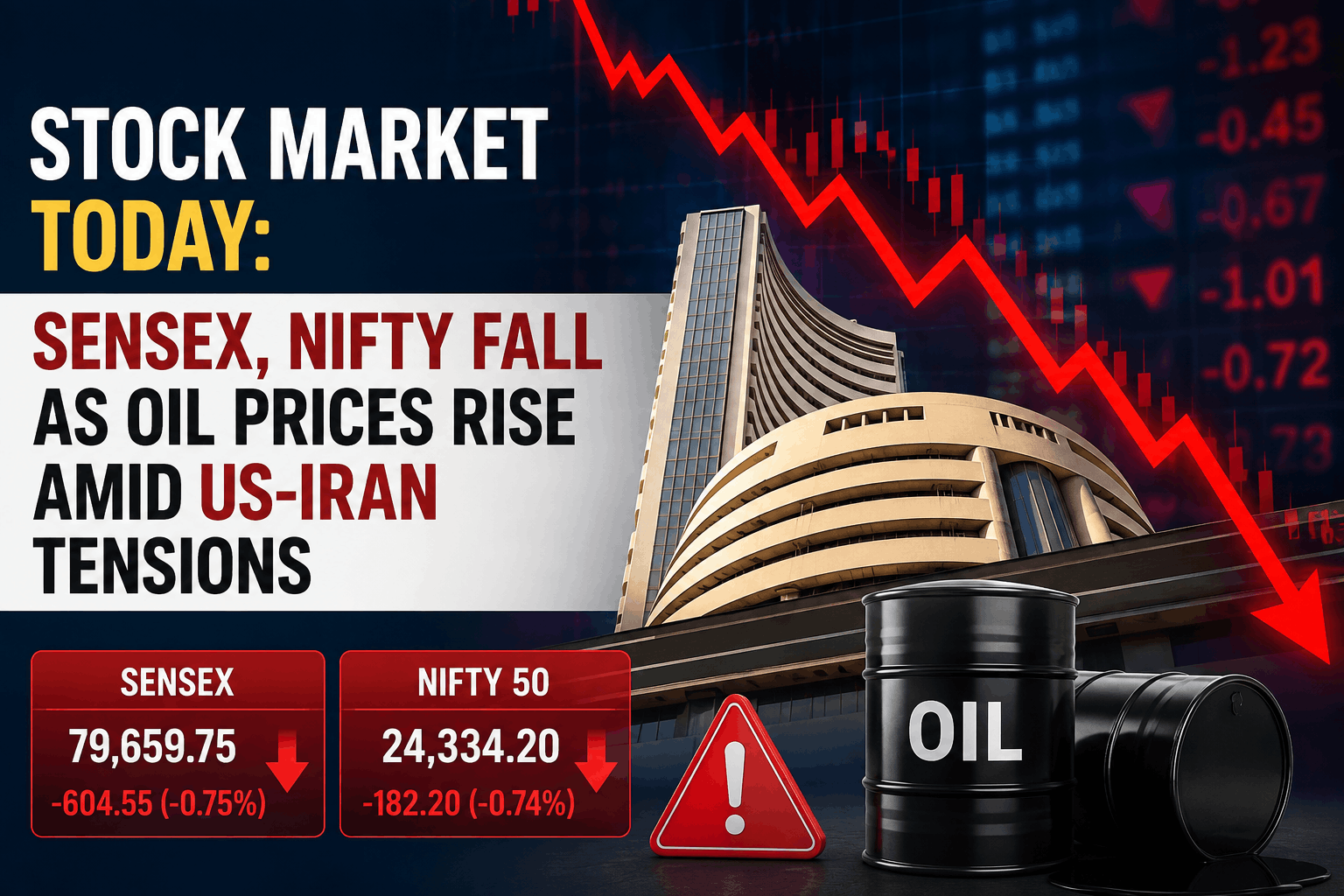
Stock Market Today: Indian equity markets closed lower on Wednesday, September 2, as renewed US-Iran tensions, rising crude oil prices and higher global bond yields weighed on investor sentiment. The Sensex fell 373.93 points, or 0.49%, to 76,570.35, while the Nifty 50 declined 141.35 points, or 0.59%, to 23,914.45.
What happened to the stock market today?

Indian stock markets ended their session in the red territory and extended the trend seen initially at the beginning of the month of September. The Sensex closed at 76,570.35, whereas the Nifty 50 index closed at 23,914.45.
The reason behind the market downturn was the risk-off mood prevailing in the international markets, as the crude oil prices were rising, and concerns had emerged related to the inflationary environment and imports bills for India, along with higher bond yield.
As per Reuters, out of 16 sectors, 11 sectors declined.
Stock market today: key numbers
| Indicator | September 2, 2026 close |
| BSE Sensex | 76,570.35 |
| Sensex change | -373.93 points |
| Sensex percentage change | -0.49% |
| Nifty 50 | 23,914.45 |
| Nifty percentage change | -0.59% |
| Brent crude | Around $97 per barrel during the session |
| Indian rupee | Around ₹94.97 per US dollar at the close |
The rupee remained relatively stable despite external pressure, with Reuters reporting a September 2 close of ₹94.97 per US dollar.
Why are Sensex and Nifty falling today?

The main reasons were renewed geopolitical tensions involving the United States and Iran, higher crude oil prices, rising bond yields and concerns that persistent inflation could keep global interest rates higher for longer.
For Indian equities, these factors matter because they can affect corporate costs, the country’s import bill, inflation expectations, currency movements and investor flows.
1. US-Iran tensions pushed oil prices higher
Military tensions that have resurfaced between the US and Iran have raised fears of any supply disruption to crude oil.
The price of Brent crude was approaching the area of $97 per barrel in Wednesday’s trading sessions, while WTI crude was also moving up. The traders are paying special attention to the risks associated with the Strait of Hormuz.
For India, an increase in crude oil prices could be a matter of macro-economic importance since the country is very dependent on imported crude oil.
2. Higher crude oil can increase inflation pressure
Rising crude prices can affect transportation, manufacturing, logistics and other energy-intensive parts of the economy.
An RBI research paper examining India’s oil-price relationship estimated that a 10% increase in global crude prices could raise inflation by around 20 basis points, although the actual impact can vary depending on government intervention and other economic conditions.
This is why investors watch crude prices closely whenever geopolitical tensions escalate.
3. Higher bond yields pressured equities
Moreover, bond yields around the world also increased as market players reviewed their views on inflation and interest rates.
With rising bond yields, equities may appear less attractive to investors since higher yields could be achieved in fixed income securities. Increased costs of borrowing would also affect the financing cost and price-to-earnings ratios of firms.
According to Reuters, the US 10-year Treasury yield had reached 5%.
4. Global risk-off sentiment affected Indian equities
This was not a problem that was only prevalent in India.
US stocks were also under pressure due to the increase in the price of oil and the rise in yields from treasury securities, while Asia was facing similar problems. It is because of these reasons that investors began to reduce their risks.
How did different sectors perform today?
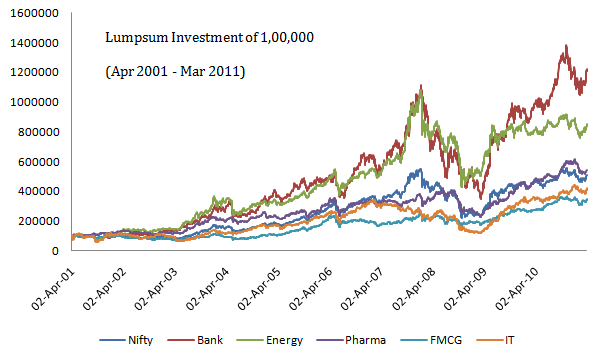
The market decline was broad-based, although individual stocks and sectors behaved differently.
Auto stocks were among the weaker areas of the market, while several other sectors also came under selling pressure. Reuters reported that 11 of 16 sectors declined during the session.
Sectors under pressure
- Automobiles: Higher fuel and input-cost concerns can weigh on the sector, while individual companies can also be affected by sales and market-share trends.
- Information technology: IT stocks remain sensitive to global risk appetite, currency movements and overseas economic conditions.
- Financials: Banks and financial companies can react negatively when higher yields and risk aversion affect broader market valuations.
- FMCG: Rising input and energy costs can create margin concerns for consumer companies.
- Pharmaceuticals: The sector can have different drivers from the broader market, including export revenue and currency movements.
Sector performance should therefore be evaluated company by company rather than assuming that every stock within a sector will respond identically.
Which stocks stood out today?

Even with the broad-based market fall, some stocks saw gains.
Among the notable gainers was Coal India, whose shares appreciated 4.1% on the basis of reports in Reuters, besides others moving independently of the benchmark indices.
Gains in Coal India were further spurred on by reports of the firm filing draft papers for an IPO of 10% in its wholly owned subsidiary Mahanadi Coalfields. Brokers cited strong demand for thermal coal, low inventory levels and the prospect of premium e-auctions as the other reasons for the gains.
By contrast, there were heavy losses in automobile stocks. Hero MotoCorp lost almost 4.6%, and Eicher Motors was one of the biggest falling stocks in the Nifty 50 index, losing about 3.2%. The drop in Hero MotoCorp came after it released August sales results showing an increase in sales on a year-on-year basis.
Swiggy dropped about 2.7% due to fears of the impact of foreign ownership restrictions and potential fund outflows.
How did the broader market perform?
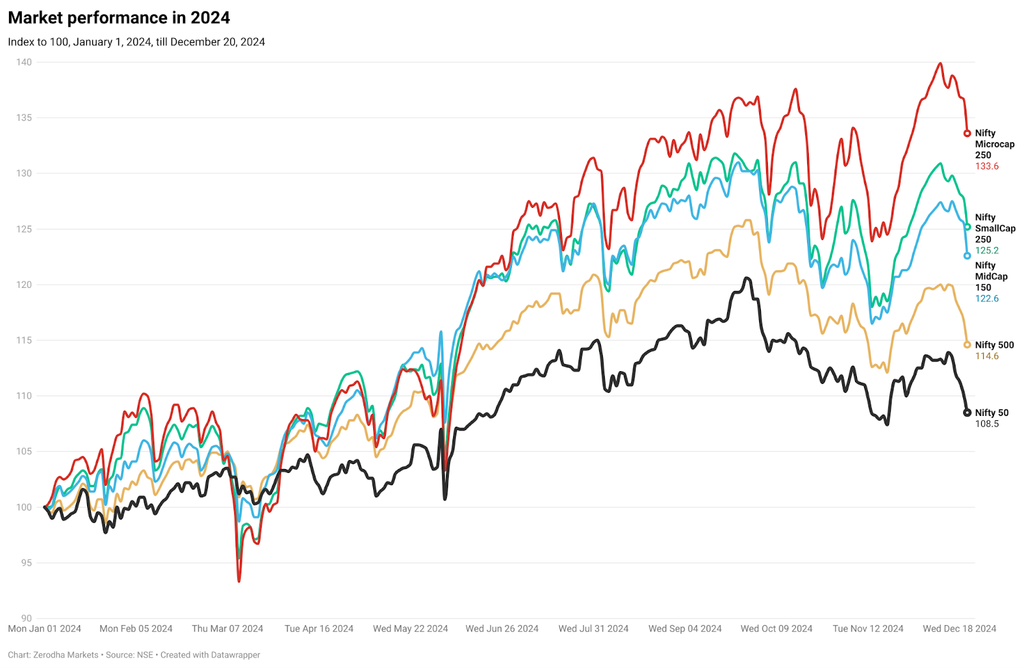
However, the weakness wasn’t only limited to the big cap indices. Small caps and mid-caps also felt the pain as investors scaled down on their risk exposure.
As per Reuters, out of 16 sectorial indices in India, 11 ended lower for the day. Auto, IT and media stocks were some of the weakest performers, whereas the Energy and Oil & Gas sector stocks were among the few stocks that could make gains.
Here, one can see the contrasting market reaction to the oil shock as firms who can benefit from higher energy prices might get support, whereas those with higher cost of fuels, transport or raw materials may come under pressure.
What happened to crude oil prices?

Crude oil continued to be among the major factors causing the market volatility throughout the trading day.
Brent crude showed significant increase in price during the session and reached $97.04 per barrel temporarily. Then the price dropped slightly to stand at $94 per barrel. The West Texas Intermediate (WTI) crude also saw significant increase and reached $92.29 per barrel before pulling back.
The primary fear is the effect that another oil shipping lane disruption in the Strait of Hormuz may have on the markets.
Should the tensions increase and prices continue to be high for a long period of time, India’s import costs will be increased. This, in turn, will lead to increased inflation, current account deficit and depreciation of the Indian rupee.
Why did the rupee remain stable?

Even with the increase in price of crude oil and the strength of the US dollar, the Indian Rupee remained stable.
The Indian Rupee traded around ₹94.97 to a US dollar on September 2. The stability of the Rupee was aided by the intervention of the Reserve Bank of India, according to Reuters.
Stability of the Indian Rupee is vital for the performance of stocks in India since a sudden decline in the Rupee would increase the cost of imported goods, especially crude oil.
For the time being, the stability of the Rupee has acted as buffer for the stock market amidst external pressure.
What are the key levels for Nifty?
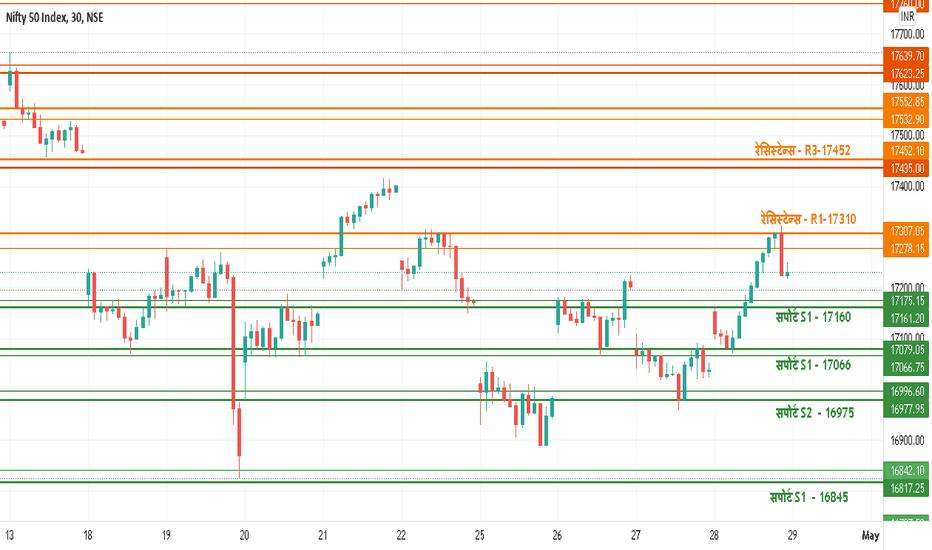
To begin with, the Nifty 50 is still important from the technical perspective.
The current price of the index as of Wednesday is 23,914.45, therefore, being in the mentioned range of support. If the index falls below 23,900, then this may cause selling pressure, which could push the index down towards 23,800 and further to 23,600.
In terms of resistance, 24,200 is the initial level, while 24,400 will be the second one to watch out for. Crossing over 24,400 may mean that the sentiment has improved short-term.
Taking into account all the above information, the coming days may be critical for the Nifty 50.
What could drive the stock market next?
Investors are expected to keep their eye on the following major variables: crude oil prices, US-Iran conflict developments and interest rates outlook across the globe.
Further oil price increases can cause worries about inflation and the import bill of India. In addition, the rise in yields on US Treasuries can make the equity market less attractive and increase the cost of capital for firms.
Global stock markets have already indicated some level of caution. According to Reuters, Asian equities dropped dramatically, with a fall of nearly 4% for South Korean KOSPI and of 2.9% for Japanese Nikkei 225. European stocks also declined due to assessment of geopolitics and inflation risks.
Furthermore, the outlook on the interest rates by the US Federal Reserve Bank will still play its role. Oil prices and rising inflation expectations pushed up market expectations of a possible interest rate increase in September.
Stock Market Outlook: What should investors watch?
The immediate forecast for Indian equities is still negative, as geopolitical uncertainty and commodity prices will keep shaping the global markets.
The key factor will be the price of crude oil. If the price of Brent stays under the psychologically important level of $100 per barrel and geopolitical tensions start to decline, there may be some respite from the risk-off trend. On the other hand, a breakout of the $100 barrier would raise further concerns of inflation and India’s external imbalances.
In addition, it will be worth following whether foreign institutional investors start de-risking or whether domestic institutions will help to prop up the market.
From the trading perspective, the behaviour of the Nifty at 23,900 will be significant. In terms of long-term investment, the emphasis should be placed on fundamentals, such as company results, valuations, balance sheets, and the effect of high energy costs.
Bottom line
The Indian stock market was down on September 2 because of a risk-off mood as the result of US-Iran situation, rise in the price of crude oil and bond yield increase globally.
The Sensex Index dropped by 373.93 points and closed at 76,570.35 points, whereas the Nifty 50 index was down by 141.35 points and closed at 23,914.45 points. The stocks from the energy segment such as Coal India and ONGC performed well, while automobile stocks and others were weak.