


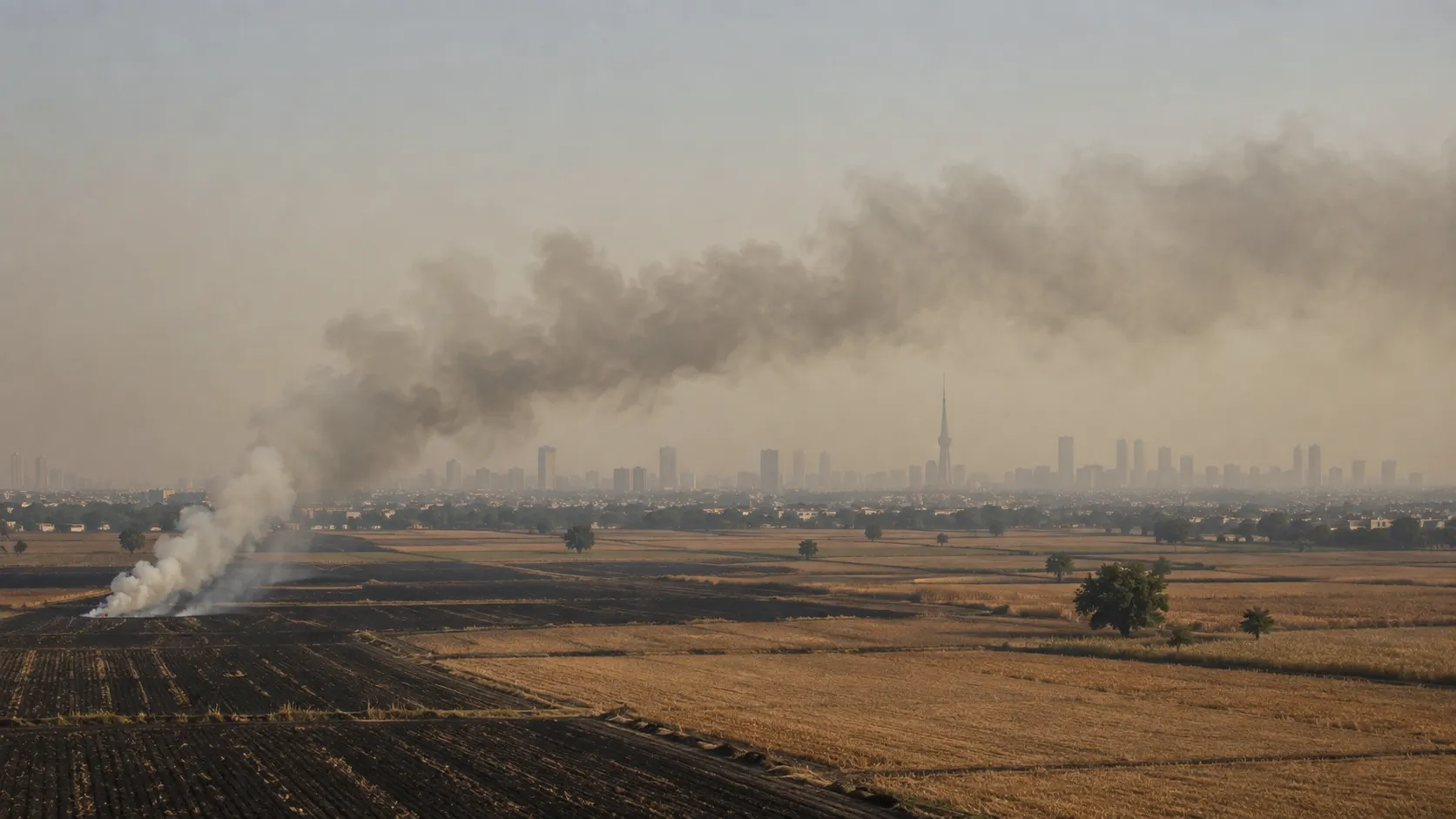
Every autumn, the burning of crop residue in parts of Punjab and Haryana becomes part of a much larger air-pollution story across northern India. Smoke from agricultural fires can be transported by air masses toward Delhi, where it can add to already high levels of fine particulate pollution.
So, does stubble-burning smoke reach Delhi and harm our health? Yes—but the scale of its contribution changes from day to day. Scientific studies show that crop-residue burning can significantly increase Delhi’s PM2.5 during certain pollution episodes, but it is only one part of a complex pollution mix that also includes vehicles, industry, dust, construction, waste burning and weather conditions.
The health concern is particularly serious because the smoke contains fine particles such as PM2.5 as well as other combustion-related pollutants.
Does Stubble-Burning Smoke Actually Reach Delhi?
Yes. Smoke from crop-residue fires in Punjab and Haryana can reach Delhi when atmospheric circulation transports the polluted air mass toward the National Capital Region.
A study examining crop-residue burning in Haryana found evidence of air-mass movement from Haryana, Punjab and Pakistan toward Delhi and concluded that pollutants from agricultural burning can reach the capital and deteriorate its air quality.
The Central Pollution Control Board has also documented the role of north-westerly winds in transporting pollutants from Punjab and Haryana toward Delhi during the stubble-burning season.
However, smoke does not travel toward Delhi at the same intensity every day. Wind direction, wind speed, temperature, atmospheric stability and the height of the pollution plume all influence how much pollution reaches the city.
How Does Punjab-Haryana Pollution Reach Delhi?
The process is essentially atmospheric transport.
After crop residue is burned, the resulting smoke and pollutants enter the atmosphere. When winds move from the northwest toward the Delhi-NCR region, some of that pollution can be transported downwind.
During October and November, meteorological conditions can make the situation worse. Cooler temperatures and a relatively shallow atmospheric boundary layer can limit dispersion, allowing pollutants to accumulate near the surface.
This means the same number of fires can produce very different impacts on Delhi on different days.
A scientific study of Haryana crop-residue burning found that meteorological conditions strongly influenced pollutant concentrations and the movement of polluted air masses toward Delhi.
How Much Does Stubble Burning Contribute to Delhi’s PM2.5?
There is no single fixed percentage because the contribution changes with location, weather, fire activity and the specific pollution episode being studied.
One modelling study estimated that non-local fire emissions contributed about 20% of Delhi’s PM2.5 on average during the post-monsoon October-November period, while individual pollution episodes showed contributions as high as 50–75%.
Another study analysing 2021 fire activity estimated a maximum daily mean contribution of around 30–35% to Delhi’s air pollution during October-November.
CPCB documentation based on SAFAR estimates reported an average biomass-burning contribution of about 13% during specified portions of the 2020 and 2021 stubble-burning seasons, with maximum estimated contributions of 42% in 2020 and 48% in 2021.
These numbers are not contradictory. They reflect different years, models, time windows and methods of calculating the contribution.
The important point is that stubble burning can become a major contributor during particular Delhi pollution episodes, but it should not be treated as the sole cause of Delhi’s air pollution.
What Pollutants Come From Crop Burning?
Crop-residue burning releases a mixture of pollutants into the atmosphere.
Among the most important are:
- PM2.5
- PM10
- Carbon monoxide
- Nitrogen oxides
- Organic carbon
- Black carbon
- Volatile organic compounds
- Other combustion-related chemicals
A high-resolution emissions study of northern Indian crop-residue burning identified PM2.5, PM10, carbon monoxide, nitrogen oxides, black carbon, organic carbon and polycyclic aromatic hydrocarbons among the pollutants released during burning.
The composition of the smoke also depends on what is being burned and how efficiently the material combusts.
Why Is Stubble Burning PM2.5 Dangerous?
PM2.5 is one of the most important health concerns associated with stubble-burning smoke.
These particles are small enough to penetrate deep into the respiratory system. WHO notes that particulate matter can penetrate deep into the lungs, while PM2.5 can enter the bloodstream and contribute to cardiovascular and respiratory effects.
When people breathe polluted air containing high concentrations of PM2.5, the particles can trigger inflammation and oxidative stress.
Repeated or high exposure is associated with increased risks of respiratory and cardiovascular disease.
This is why a rise in stubble burning PM2.5 is not simply an environmental issue—it is also a public-health concern.
What Are the Stubble Burning Health Effects?
The stubble burning health effects can range from short-term irritation to increased risks associated with respiratory and cardiovascular disease.
1. Coughing and throat irritation
People exposed to high concentrations of smoke may experience:
- Coughing
- Sore or irritated throat
- Burning eyes
- Increased mucus
- Wheezing
- Shortness of breath
These effects can be especially noticeable when pollution levels rise sharply.
2. Asthma and breathing problems
People with asthma or other respiratory conditions can be particularly vulnerable.
Fine particulate pollution can irritate the airways and worsen respiratory symptoms. Evidence from studies of biomass-burning pollution consistently links exposure with respiratory morbidity. A review of outdoor biomass-burning emissions found positive associations between PM exposure and respiratory admissions or emergency visits.
3. COPD and existing lung disease
People with chronic obstructive pulmonary disease (COPD) may be more sensitive to high pollution levels.
Smoke exposure can aggravate existing respiratory symptoms and make breathing more difficult.
This is especially relevant for older adults and people who already have chronic lung disease.
4. Cardiovascular effects
The health impact does not stop at the lungs.
WHO states that PM2.5 can enter the bloodstream and contribute to cardiovascular effects, including ischaemic heart disease and stroke.
Research on biomass-burning pollution has also found associations with cardiovascular mortality and morbidity, although the strength of evidence varies across individual outcomes.
What Are the Black Carbon Health Effects?
Black carbon, often called soot, is a component of fine particulate pollution produced by incomplete combustion.
Crop-residue burning can emit black carbon along with other particles and gases. WHO identifies black carbon as a component of PM2.5 and notes that it comes from incomplete combustion of fuels and biomass.
The black carbon health effects are important because exposure has been associated with cardiovascular health effects and premature mortality.
WHO’s review of the evidence found sufficient evidence of associations between black carbon exposure and cardiopulmonary morbidity and mortality. It also cautions that black carbon can be emitted together with other harmful components of combustion-related particulate matter, making it difficult to separate the effect of black carbon from the broader pollution mixture.
So, it would be misleading to describe black carbon as the only dangerous component of crop-burning smoke. The entire pollution mixture matters.
Does Stubble Burning Affect Only People in Delhi?
No.
The pollution can affect communities across the wider Indo-Gangetic Plain, including areas closer to the burning fields and cities downwind.
Recent research covering the Indo-Gangetic Plain found substantial seasonal PM2.5 pollution associated with crop-residue burning and identified regional transport as an important factor in pollution across multiple cities.
Another 2025 study examining Delhi and Kanpur found that transported agricultural-fire emissions from northwest India contributed significantly to organic aerosol during the post-monsoon rice-harvest period.
This highlights why crop burning is better understood as a regional air-quality problem, rather than an issue affecting only individual farms.
Is Stubble Burning the Only Reason Delhi Has Severe Pollution?
No. This is an important distinction.
Delhi’s air pollution comes from multiple sources. Crop-residue burning can significantly increase pollution during certain periods, but local emissions and meteorological conditions also play major roles.
These sources can include:
- Vehicle emissions
- Industrial activity
- Construction and road dust
- Waste burning
- Household and commercial combustion
- Secondary formation of particulate matter
- Regional pollution transported from surrounding areas
The relative contribution of each source changes over time.
For example, modelling research has shown that crop burning can account for a large share of PM2.5 during some specific episodes, while its average seasonal contribution can be substantially lower.
Therefore, saying “Delhi pollution is caused only by stubble burning” is scientifically inaccurate.
Why Does the Problem Become Worse in October and November?
The post-monsoon period creates a combination of agricultural and meteorological conditions that can favour pollution episodes.
Rice harvesting leaves large quantities of residue in parts of northwestern India. Farmers may burn some of this residue to quickly clear fields for the next crop.
At the same time, changing wind patterns and cooler atmospheric conditions can reduce dispersion and help pollutants accumulate.
Research has repeatedly identified October-November as a major period for crop-residue burning and regional air pollution in northern India.
Can Stubble-Burning Smoke Cause Long-Term Health Problems?
The risk depends on how much pollution a person inhales, how often they are exposed, the duration of exposure and their underlying health.
Air pollution research has established strong links between PM2.5 exposure and cardiovascular and respiratory disease. WHO also identifies children, pregnant women, older adults and people with chronic diseases as particularly vulnerable to air pollution.
However, it is important not to claim that every individual episode of stubble smoke will automatically cause permanent disease.
The more scientifically accurate conclusion is that repeated exposure to elevated particulate pollution adds to overall health risk, particularly for vulnerable people.
Who Is Most Vulnerable to Crop-Burning Smoke?
Certain groups should take extra precautions when regional air quality deteriorates.
They include:
- Children
- Older adults
- Pregnant people
- People with asthma
- People with COPD
- People with cardiovascular disease
- Outdoor workers
- People who spend long periods outdoors
WHO’s latest evidence summary identifies children, pregnant women, older people and those with chronic diseases among groups at greater risk from air pollution.
How Can People Reduce Exposure During Stubble-Burning Episodes?
Individuals cannot control regional crop burning, but they can reduce their own exposure.
Check air quality
Monitor the local Air Quality Index (AQI) and PM2.5 levels, particularly during October-November.
Reduce outdoor exertion
When air quality is poor, avoid unnecessary strenuous outdoor exercise because heavier breathing can increase the amount of polluted air entering the lungs.
Improve indoor air
Keep windows and doors closed during periods of heavy outdoor pollution where practical and use suitable air filtration if available.
Protect vulnerable family members
Children, older adults and people with asthma, COPD or heart disease may need to reduce exposure more aggressively.
Follow official advisories
Local health and pollution-control authorities may issue recommendations during severe pollution episodes. These should take priority over informal claims circulating on social media.
What Can Reduce the Health Impact of Stubble Burning?
The most effective long-term solution is not simply asking people to tolerate smoke—it is reducing the need for open-field burning while making residue management practical for farmers.
Potential approaches include:
- In-situ residue management
- Crop-residue machinery
- Better access to straw-management equipment
- Economic incentives
- Alternative uses for agricultural residue
- Improved biomass collection and supply chains
- Regional air-quality coordination
Research on India’s crop-residue burning has found that targeted interventions in high-impact agricultural districts could potentially produce substantial health benefits.
The challenge is therefore both environmental and economic: farmers need workable alternatives that are affordable, timely and suitable for local agricultural conditions.
What Does the Evidence Tell Us?
The evidence supports three conclusions.
First, stubble-burning smoke can reach Delhi. Atmospheric transport from Punjab and Haryana has been demonstrated in observational and modelling studies.
Second, its contribution to Delhi’s PM2.5 can become substantial during particular episodes. Estimates vary considerably depending on the period and methodology, with studies reporting average seasonal contributions around 20% and much higher contributions during some severe episodes.
Third, the health concern is real because crop-burning smoke contains PM2.5 and other combustion pollutants. Fine particles are associated with respiratory and cardiovascular harm, while black carbon is also associated with cardiopulmonary health effects.
FAQ
Does stubble-burning smoke reach Delhi?
Yes. Research and official assessments show that air masses can transport pollutants from Punjab and Haryana toward Delhi, particularly under favourable north-westerly wind conditions.
How much does stubble burning contribute to Delhi pollution?
There is no fixed percentage. Studies have reported average contributions around 20% during parts of the post-monsoon season, while individual pollution episodes can show substantially higher contributions.
What is the biggest health risk from stubble burning?
Fine particulate matter, particularly PM2.5, is a major concern because it can penetrate deep into the lungs and contribute to respiratory and cardiovascular health effects.
What are the main stubble burning health effects?
Exposure can cause coughing, throat and eye irritation, breathing difficulties and worsening of respiratory conditions. Fine-particle exposure is also associated with cardiovascular health risks.
What is black carbon and why is it dangerous?
Black carbon is a soot-like component of fine particulate pollution produced by incomplete combustion. WHO reports associations between black carbon exposure and cardiopulmonary morbidity and mortality.
Is stubble burning the only cause of Delhi’s air pollution?
No. Delhi’s pollution is influenced by multiple local and regional sources, including vehicles, industry, dust, waste burning, secondary pollutants, weather and transported agricultural emissions.
Why is stubble burning particularly associated with October and November pollution?
Rice harvesting and residue burning occur during the post-monsoon period, while changing meteorological conditions can make pollution dispersion more difficult.
https://pubmed.ncbi.nlm.nih.gov/38670421/
Bottom Line
Yes, smoke from stubble burning in Punjab and Haryana can reach Delhi and worsen air pollution, particularly during favourable wind and weather conditions. During some pollution episodes, crop burning can make a substantial contribution to Delhi’s PM2.5, although it is not the city’s only pollution source.
The biggest health concern is exposure to fine particulate matter such as PM2.5. It can penetrate deep into the lungs and is associated with respiratory and cardiovascular health risks. Black carbon and other combustion pollutants add to the complexity of the smoke mixture.
For Delhi-NCR residents, the practical lesson is simple: during severe post-monsoon pollution episodes, check actual air-quality conditions rather than assuming the pollution source is only local or only agricultural. Regional transport, local emissions and weather can all combine to determine the air people breathe.