



The world’s growing appetite for artificial intelligence is creating a problem that has little to do with algorithms: where and how to build the enormous infrastructure needed to run them.
Modern data centers require huge amounts of electricity, sophisticated cooling systems, reliable networks and large physical sites. As AI models become more computationally demanding, those requirements are increasing.
That has revived interest in an unusual idea: putting data centers underwater.
The concept has already been tested outside the laboratory. Microsoft’s Project Natick deployed a subsea data center off the coast of Orkney, Scotland, in 2018. The 12-rack prototype consumed 240 kW and was powered entirely by locally produced renewable electricity during the experiment.
But underwater data centers are not simply “servers sitting in the sea.”
They involve sealed pressure vessels, cooling systems, power connections, networking infrastructure and specialized maintenance strategies. And while the technology demonstrated that subsea computing is technically possible, it has not yet become a mainstream replacement for land-based data centers.
The question in 2026 is therefore more interesting:
Could underwater data centers become a useful part of the infrastructure supporting AI and cloud computing?
What Are Underwater Data Centers?
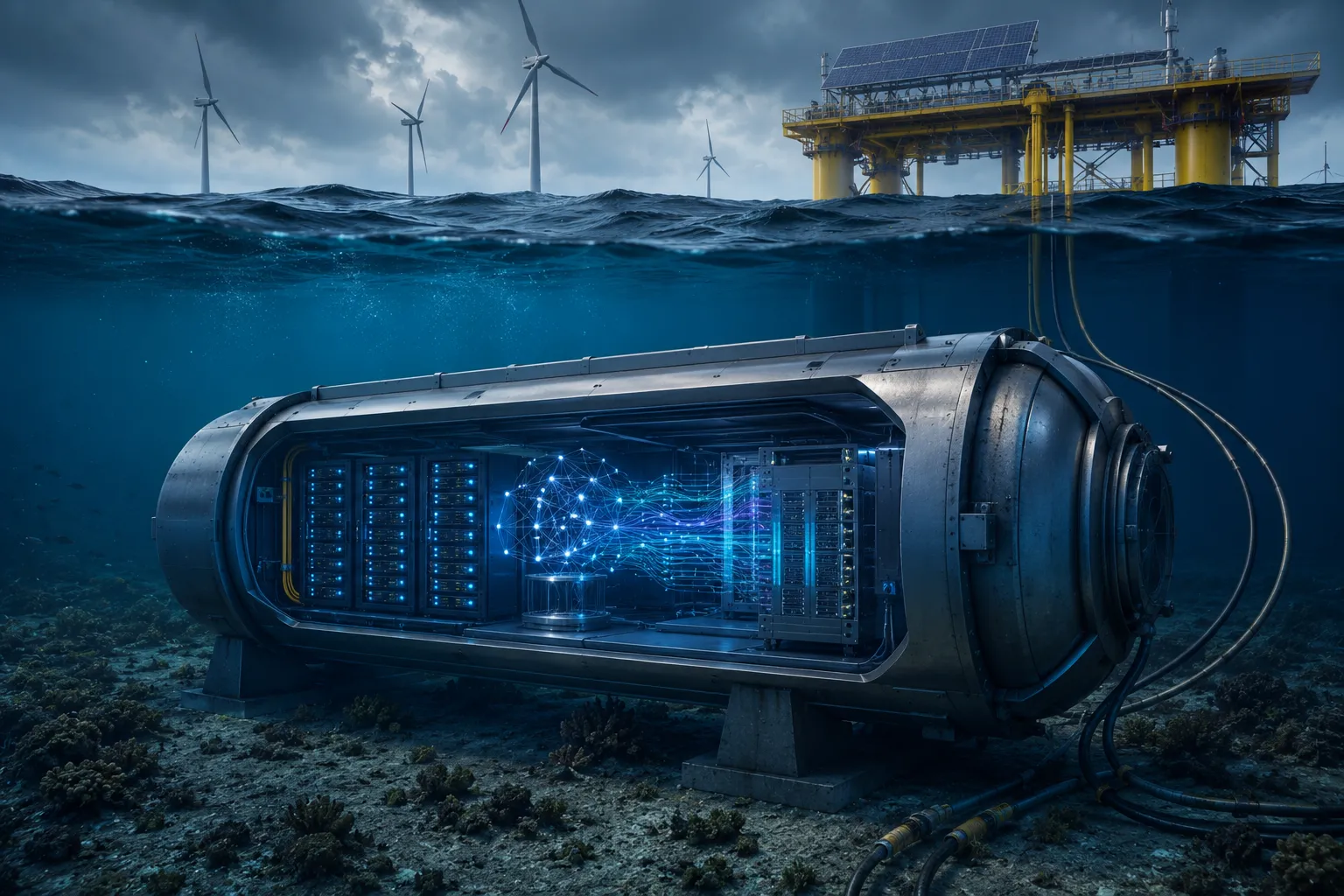
An underwater data center is a computing facility in which servers and related equipment are housed inside a sealed module deployed beneath the surface of a body of water.
Instead of placing conventional server racks inside a large building on land, the computing equipment is enclosed in a controlled environment and submerged.
The basic concept involves:
- Server equipment inside a sealed module
- Power infrastructure supplying electricity
- Network connections carrying data to and from the facility
- Heat-transfer systems that move heat away from the servers
- Monitoring equipment that tracks the underwater environment
- A subsea structure capable of operating under water pressure
Microsoft’s Project Natick used a cylindrical pressure vessel containing server racks and electronics. Its Phase 2 vessel was approximately 12.2 metres long and 2.8 metres in diameter.
The concept is similar to placing a compact data center inside a highly controlled underwater container.
Why Put a Data Center Underwater?
The strongest argument is cooling.
Servers generate heat whenever they operate. The more computing power a data center contains, the more heat engineers must remove.
Traditional facilities use a combination of air conditioning, cooling towers, chillers, liquid cooling and other systems depending on the design.
The IEA estimates that cooling can account for roughly 7% of electricity consumption in efficient hyperscale data centers and more than 30% in less-efficient enterprise data centers.
That makes cooling an important part of data-center energy efficiency.
Water provides a potentially attractive thermal environment because the surrounding ocean can absorb heat from a properly designed system.
Microsoft’s Natick experiment was specifically designed to investigate whether the subsea environment could provide practical cooling and other operational advantages.
But there is an important distinction:
Underwater does not automatically mean low-energy.
The servers still consume electricity. Cooling is only one component of total data-center energy consumption.
How Do Underwater Data Centers Work?
An underwater data center generally separates the computing environment from the surrounding ocean.
Step 1: Servers Are Installed Inside a Sealed Module
The computing hardware is placed inside a pressure-resistant enclosure.
The goal is to protect sensitive electronics from:
- seawater
- corrosion
- pressure
- humidity
- biological growth
- physical disturbance
Microsoft’s Natick Phase 2 system used a dry nitrogen atmosphere inside its pressure vessel rather than ordinary humid air.
Step 2: The Module Is Deployed Underwater
The completed unit can be transported to its intended location and connected to subsea infrastructure.
One of the attractions of the Natick design was rapid deployment. Microsoft reported that its Phase 2 module could be deployed in less than 90 days from the decision to proceed to powering it on.
Step 3: Electricity Powers the Servers
Electricity reaches the underwater module through an appropriate power connection.
That electricity could theoretically come from the conventional grid, offshore wind, tidal power or another local source.
In the Natick experiment, Microsoft reported that its electricity came from locally produced renewable sources, including onshore wind and solar as well as offshore tidal and wave power.
Step 4: Heat Is Transferred Away
The computing equipment produces heat.
Rather than relying entirely on conventional air-conditioning infrastructure, the subsea environment can act as a heat sink through engineered heat exchangers.
The surrounding water absorbs heat from the system.
Step 5: Data Moves Through Subsea Networks
The servers need high-capacity network connections to communicate with users, cloud services and other data centers.
This makes location important.
An underwater facility may have excellent cooling conditions but still be unsuitable if its network connection is too expensive or its latency is unacceptable.
Microsoft Project Natick: The Best-Known Underwater Data Center Experiment
When discussing underwater data centers, Microsoft Project Natick is the key real-world experiment.
Microsoft began researching subsea data centers in 2014 after the idea was proposed within the company. Phase 1 was deployed off the California coast in 2015. Phase 2 followed in 2018 at the European Marine Energy Centre in Orkney, Scotland.
The second-generation module contained:
- 864 servers
- 12 server racks
- 27.6 petabytes of storage
- 240 kW electrical power consumption
- a pressure vessel about 12.2 metres long
- a deployment period of less than 90 days
The project was designed to investigate whether subsea data centers could be manufactured, deployed and operated economically.
One particularly interesting finding concerned reliability.
Microsoft reported that the servers in the Northern Isles system had a failure rate one-eighth that of its land-based control group. Microsoft attributed the possible difference partly to the controlled nitrogen atmosphere and the absence of people physically interacting with the equipment.
However, that result should not be interpreted as proof that all underwater data centers will automatically be more reliable.
Natick was a specific experimental design under specific conditions. Large commercial facilities could face very different maintenance, networking, environmental and economic challenges.
Did Microsoft Commercialize Underwater Data Centers?
Project Natick demonstrated technical feasibility, but it did not turn underwater data centers into a mainstream commercial data-center architecture.
Microsoft’s current Project Natick material describes the initiative as research into the feasibility and potential benefits and difficulties of subsea data centers.
That distinction is important.
The experiment answered several questions:
- Can servers operate underwater? Yes.
- Can a sealed underwater module be deployed? Yes.
- Can the underwater environment support cooling? Yes, in the tested design.
- Can the equipment operate reliably? The experiment produced encouraging results.
- Does that mean underwater data centers are ready to replace land-based hyperscale facilities? No.
The commercial question is much harder than the engineering demonstration.
Why Underwater Data Centers Are Interesting for AI Infrastructure
AI is changing the economics of data centers.
Training and deploying large AI models requires high-performance processors, often operating in large clusters. Those systems consume significant amounts of electricity and generate substantial heat.
The International Energy Agency’s 2026 analysis estimates that data centers consumed around 415 TWh of electricity globally in 2024 and projects consumption to reach around 945 TWh by 2030 in its base case. AI is identified as the most important driver of this growth alongside other digital services.
The IEA also notes that a typical AI-focused data center can consume as much electricity as around 100,000 households, while the largest facilities under construction could require roughly 20 times as much.
This creates several infrastructure challenges.
More AI Computing Means More Heat
AI accelerators can operate at very high power densities.
That puts pressure on cooling systems.
More Computing Means More Electricity
Servers are only one part of the energy equation. Cooling, networking, storage and power-management equipment also consume electricity.
More Data Centers Mean More Local Grid Pressure
The IEA says data-center electricity demand is geographically concentrated, meaning the local effects can be much more significant than the global percentage suggests.
This is where underwater data centers become interesting.
They could potentially offer an alternative location for some computing workloads while using the surrounding water as part of the thermal-management system.
Can Underwater Data Centers Reduce AI Energy Consumption?
Potentially, but the answer is more complicated than simply saying “yes.”
The largest potential energy advantage comes from reducing the electricity needed for cooling.
The IEA’s data-center analysis shows that cooling can represent a meaningful share of facility electricity consumption, particularly in less-efficient facilities.
If an underwater system can transfer heat efficiently without relying on the same conventional cooling infrastructure, its total facility energy requirement could potentially be lower.
But the electricity consumed by the AI processors themselves does not disappear.
A simplified energy equation looks like this:
Total data-center electricity = computing + storage + networking + cooling + power infrastructure + other systems
Submerging the facility primarily changes the cooling and infrastructure side of that equation.
It does not make AI computation free.
That distinction is crucial when discussing the future of underwater data centers.
Could Underwater Data Centers Be Powered by Renewable Energy?
This is one of the more interesting possibilities.
Offshore data centers could potentially be located near renewable-energy resources such as:
- offshore wind
- tidal power
- wave energy
- coastal solar infrastructure
Microsoft’s Natick experiment specifically tested a renewable-energy-powered subsea data center. Its Phase 2 system used locally produced renewable electricity, including wind, solar, tidal and wave sources.
In a future scenario, an underwater computing facility could theoretically combine:
Offshore renewable energy
↓
Subsea data center
↓
Natural water-based heat rejection
↓
AI/cloud computing
That is attractive conceptually.
But renewable power generation and data-center computing still have to match in terms of reliability, transmission capacity and economics.
AI infrastructure cannot simply shut down every time offshore wind output falls.
“Sources Used”
https://natick.research.microsoft.com/
Underwater Data Centers vs Land-Based Data Centers
| Feature | Land-Based Data Center | Underwater Data Center |
|---|---|---|
| Cooling | Mechanical/liquid/air systems | Surrounding water + engineered heat transfer |
| Maintenance | Relatively accessible | Difficult once deployed |
| Physical access | Easy | Highly restricted |
| Environmental exposure | Weather and local climate | Seawater, pressure and marine conditions |
| Construction | Established industry | Specialized subsea engineering |
| Network infrastructure | Mature | Requires subsea connectivity |
| Renewable integration | Grid/onsite renewable options | Potential offshore renewable integration |
| Scaling | Proven at very large scale | Commercial scaling remains uncertain |
| Hardware replacement | Relatively straightforward | Major operational challenge |
| Water exposure | Indirect | Direct external environment |
| Commercial maturity | Highly mature | Experimental/emerging |
The comparison reveals why underwater data centers are not an obvious replacement.
They may solve one problem while creating another.
The Biggest Challenge: Maintenance
Imagine a server fails in a conventional data center.
A technician can walk into the building, remove the faulty component and install a replacement.
Now imagine the same failure in a sealed underwater module.
Getting access to the hardware could require:
- identifying the problem remotely,
- retrieving the module,
- transporting it to a maintenance facility,
- opening the enclosure,
- replacing the hardware,
- testing the system,
- redeploying the module.
That changes the economics of maintenance dramatically.
Microsoft designed Natick around long periods of operation without human intervention. Its Phase 2 design was intended to operate for up to five years without maintenance.
That approach works best when hardware is highly reliable.
But AI infrastructure evolves quickly.
A five-year-old AI server can become technologically outdated long before it physically fails.
That creates a major question:
Would an underwater data center be able to upgrade its AI hardware quickly enough to remain economically competitive?
This could be one of the biggest obstacles to large-scale adoption.
What About the Environmental Impact?
Calling underwater data centers “green” without qualification would be misleading.
There are potential advantages.
Potential Benefits
- reduced dependence on conventional cooling systems
- potential integration with offshore renewable energy
- compact deployment
- potentially lower land requirements
- potentially lower local freshwater requirements for cooling
But there are also environmental questions.
Potential Concerns
- heat released into marine environments
- underwater construction impacts
- cables and seabed infrastructure
- marine ecosystem disturbance
- manufacturing and transportation emissions
- equipment recovery and end-of-life management
- effects of large-scale deployment
The environmental impact would therefore depend heavily on the specific design and location.
Microsoft reported that the Natick seabed was restored to its previous condition after the experiment and that the components were intended for recycling.
That is useful evidence from the experiment, but it should not be generalized into a claim that all subsea data centers will have negligible environmental impact.
Does Putting Data Centers Underwater Save Water?
This is a particularly interesting distinction.
Traditional data centers can use water directly or indirectly in cooling systems, depending on their design.
An underwater data center has a huge water source surrounding it, but that does not necessarily mean the seawater is pumped through the server equipment.
Instead, the system can use heat exchangers to transfer heat from the controlled internal environment to the surrounding water.
That could reduce reliance on freshwater-based cooling approaches.
However, the overall water footprint still depends on:
- electricity generation
- manufacturing
- cooling design
- supply chains
- maintenance
- local environmental conditions
So “underwater” should not automatically be equated with “zero-water data center.”
Could Underwater Data Centers Support AI Factories?
The concept becomes more interesting as AI data centers become larger.
The IEA says AI-focused data-center capacity has expanded rapidly and that capital expenditure by five major technology companies exceeded $400 billion in 2025, with another substantial increase expected in 2026.
At the same time, the IEA projects global data-center electricity consumption to roughly double between 2025 and 2030, reaching around 950 TWh in its updated base case.
This means future AI infrastructure will need solutions across several dimensions:
- electricity supply
- cooling
- land
- networking
- chip availability
- construction speed
- grid access
- reliability
Underwater data centers potentially address some of those problems.
They do not solve all of them.
An underwater facility still needs enormous amounts of electricity if it is running thousands of AI accelerators.
The bigger opportunity may therefore be specialized subsea infrastructure rather than replacing every hyperscale AI campus.
Where Could Underwater Data Centers Make the Most Sense?
The technology could be particularly interesting in locations where several conditions overlap.
Coastal Cities
Large populations are concentrated near coastlines.
Microsoft’s Natick research highlighted the possibility of placing computing resources closer to users in coastal regions.
That could potentially reduce some network latency, although actual latency depends on the full network architecture rather than simply geographic distance.
Offshore Renewable Energy Zones
Subsea computing could theoretically be integrated with offshore wind, tidal or wave-energy projects.
Areas With Limited Land
A coastal or offshore deployment could reduce competition for valuable urban land.
High-Density Computing
Facilities requiring substantial cooling could potentially benefit more from a subsea thermal environment.
But each of these applications would need to be evaluated economically.
Why Underwater Data Centers Are Still Not Mainstream
Several barriers stand between experimental success and mass deployment.
1. Maintenance
Accessing hardware underwater is much more difficult.
2. Hardware Obsolescence
AI processors evolve rapidly, making long maintenance intervals potentially problematic.
3. Subsea Networking
High-capacity and reliable network connections are essential.
4. Power Infrastructure
Large AI facilities need dependable electricity regardless of where they are located.
5. Environmental Regulation
Large-scale marine infrastructure would face environmental assessment and regulatory requirements.
6. Capital Costs
Specialized pressure vessels, subsea power systems and deployment equipment are expensive.
7. Scaling
A successful prototype is not the same as an economically competitive multi-gigawatt AI infrastructure platform.
8. Cooling Alternatives Are Improving
Land-based data centers are not standing still.
Liquid cooling and other advanced thermal-management systems are developing rapidly, particularly for high-density AI computing.
That means underwater data centers are competing against a rapidly evolving land-based technology ecosystem.
What Is the Future of Underwater Data Centers?
The most realistic future may be specialization rather than universal adoption.
Instead of replacing conventional data centers, underwater facilities could potentially become one part of a larger infrastructure mix.
A future architecture could include:
Land-based data centers
→ general cloud computing
AI hyperscale campuses
→ large model training and inference
Edge data centers
→ low-latency applications
Underwater/subsea facilities
→ specialized coastal or offshore computing
Renewable-powered computing
→ locations with abundant low-carbon electricity
This diversified model would make more sense than assuming one data-center design will dominate the future.
Underwater Data Centers and the Future of AI Infrastructure
The most important reason to watch underwater data centers is not that computers are moving beneath the ocean.
It is that AI is forcing engineers to rethink the physical infrastructure behind computing.
The AI revolution requires more than increasingly powerful chips.
It requires:
- electricity
- cooling
- buildings
- networks
- storage
- water
- land
- power generation
- increasingly sophisticated thermal management
The IEA’s latest analysis makes the scale of the challenge clear: global data-center electricity consumption is projected to rise substantially through 2030, with AI as a major driver.
Underwater data centers offer one possible response.
Their biggest advantage is potentially straightforward: the ocean is an enormous heat sink.
Their biggest disadvantage is equally straightforward: the ocean is a very difficult place to maintain sophisticated computing equipment.
That trade-off will determine whether subsea computing becomes a niche technology or an important part of future AI infrastructure.
For a wider look at technologies that could reshape computing, energy and infrastructure, read HNN24x7’s Future Technology 2026: 15 Emerging Technologies That Could Change How We Live.
FAQ
What are underwater data centers?
Underwater data centers are computing facilities in sealed modules deployed beneath the ocean or another body of water. The servers operate inside a controlled enclosure while the surrounding water can help remove heat.
How do underwater data centers stay cool?
The computing equipment generates heat that can be transferred through engineered heat exchangers to the surrounding water. This can reduce reliance on conventional mechanical cooling systems.
Does Microsoft have an underwater data center?
Microsoft conducted Project Natick, a research program that tested subsea data centers. Its second-phase prototype was deployed off Orkney, Scotland, in 2018 and contained 864 servers across 12 racks.
Did Project Natick prove underwater data centers work?
It demonstrated that subsea data centers can be deployed and operated successfully. Microsoft also reported lower server failure rates than its land-based control group. However, that does not establish that underwater data centers are commercially superior for every application.
Can underwater data centers reduce energy consumption?
They may reduce some cooling-related energy requirements, but the servers and AI processors still consume substantial electricity. Cooling is only one part of total data-center energy consumption.
Can underwater data centers power AI?
Technically, yes. An underwater data center can house computing equipment capable of running AI workloads. The bigger question is whether subsea facilities can provide the scale, upgradeability, networking and economics required by modern AI infrastructure.
Are underwater data centers better for the environment?
They could offer environmental advantages in specific designs, particularly through reduced cooling requirements and potential integration with renewable energy. However, marine construction, heat discharge, cables and ecosystem impacts must also be considered.
Why aren’t all data centers underwater?
Maintenance, deployment costs, networking, power infrastructure, environmental regulation and hardware upgrades make underwater facilities more complicated than conventional data centers.
Will underwater data centers become mainstream?
There is not enough evidence to say they will. The technology has demonstrated feasibility, but commercial-scale adoption remains uncertain. More likely, subsea data centers could become a specialized option for particular coastal, offshore or high-density computing applications.
How much electricity do data centers use?
The IEA estimates global data-center electricity consumption was about 415 TWh in 2024 and projects around 945 TWh by 2030 in its base case.