



Weather forecasting is entering a new technological phase.
For decades, meteorologists have relied primarily on numerical weather prediction, where powerful computers solve equations describing the atmosphere, oceans and land. Today, artificial intelligence is adding another approach: machine-learning systems trained on huge volumes of historical weather and Earth-system data can learn patterns and generate forecasts at remarkable speed.
The change is already moving beyond laboratory experiments.
The European Centre for Medium-Range Weather Forecasts (ECMWF) has operated its Artificial Intelligence Forecasting System (AIFS) since February 2025, alongside its physics-based Integrated Forecasting System. In May 2026, ECMWF upgraded AIFS to version 2.
The World Meteorological Organization (WMO) now describes AI as increasingly important across weather, climate, water and environmental services, while stressing that AI should complement established scientific forecasting systems rather than simply replace them.
So what exactly is AI weather forecasting, how does it work, and what role do satellites play?
What Is AI Weather Forecasting?
AI weather forecasting is the use of artificial intelligence and machine learning to analyse atmospheric data and produce predictions about future weather conditions.
Traditional weather models are based primarily on physics. They take observations of the current atmosphere and use mathematical equations to calculate how that system is likely to evolve.
AI weather models take a different approach.
They are trained using large historical datasets containing information about variables such as:
- temperature
- atmospheric pressure
- humidity
- wind
- precipitation
- ocean conditions
- cloud patterns
- satellite observations
- radar measurements
- previous model forecasts
The AI learns statistical and spatial relationships within those datasets.
That does not mean the system “understands” weather in the same way a meteorologist does. It means the model has learned patterns that can be used to estimate what atmospheric conditions are likely to occur next.
Modern AI forecasting can therefore work alongside traditional numerical weather prediction rather than necessarily replacing it.
How Does AI Weather Forecasting Work?
The process can be simplified into four stages.
1. Collect Weather and Earth Data
The first requirement is data.
Weather agencies collect information from satellites, weather stations, aircraft, ocean instruments, weather balloons, radar systems and other observation networks.
Satellites are particularly important because they provide observations over huge areas that cannot be covered by ground instruments alone.
For example, NOAA says its low-Earth-orbit satellite data provide roughly 85% of the data used in numerical weather prediction models, while its geostationary satellites provide near-real-time observations useful for monitoring severe weather.
EUMETSAT similarly describes its Meteosat and Metop satellite systems as critical sources of information for weather forecasting and climate monitoring.
2. Train the AI Model
The historical observations are then used to train machine-learning models.
One of the most important datasets in this field is ERA5, ECMWF’s global atmospheric reanalysis dataset.
ECMWF says ERA5 covers the period from 1940 to the present and has become a major training source for leading AI weather models because of its global coverage, long historical record and physical consistency.
The model effectively learns relationships between previous atmospheric states and what happened afterward.
3. Generate a Forecast
Once trained, the model receives the latest atmospheric information and predicts a future state.
Depending on the system, this can involve forecasts for:
- temperature
- wind
- pressure
- precipitation
- humidity
- ocean conditions
- waves
- snow cover
Some AI systems can generate forecasts dramatically faster than traditional physics-based systems.
ECMWF says AI systems can generate skilful global forecasts in minutes and highlights speed as one of the major advantages of machine-learning forecasting.
4. Verify the Forecast
Speed alone is not enough.
A weather forecast is useful only if it is accurate, reliable and robust across different locations and weather conditions.
This is why meteorological organisations compare AI forecasts against established numerical models and real observations.
ECMWF describes its operational AIFS as running alongside its conventional forecasting system so that the two approaches can be evaluated and their strengths and limitations understood.
Why Are AI Weather Models So Fast?
One of the biggest differences between AI forecasting and traditional numerical weather prediction is computational cost.
Traditional models repeatedly solve complex physical equations across a three-dimensional representation of the atmosphere. This requires significant computing infrastructure.
Once an AI model has been trained, generating a new forecast can require substantially less computation.
ECMWF reported when AIFS became operational in 2025 that its machine-learning approach could reduce the energy required to generate a forecast by approximately 1,000 times compared with its traditional forecasting approach, while showing strong performance across several measures.
That does not mean AI weather models require no computing power. Training them can itself be computationally intensive.
The important difference is between training the model and running the trained model repeatedly.
If forecasts can be generated more efficiently, meteorological organisations could potentially produce larger ensembles, more frequent updates or more localised information within available computing budgets.
ECMWF has highlighted the possibility of generating large ensembles more rapidly as one of the potential advantages of machine-learning forecasting.
What Role Do Satellites Play in AI Weather Forecasting?
Satellites are one of the foundations of modern AI weather forecasting.
AI models need observations, and satellites provide some of the most valuable observations available.
A weather satellite does not simply take ordinary photographs of clouds. Different instruments measure different properties of the atmosphere, land and oceans.
Depending on the instrument, satellite observations can provide information related to:
- temperature
- humidity
- cloud properties
- atmospheric composition
- ocean conditions
- surface temperature
- wind
- precipitation
- atmospheric motion
EUMETSAT explains that satellite measurements are important inputs to numerical weather prediction and include microwave and infrared observations, scatterometer winds, radio-occultation measurements and atmospheric-motion vectors.
This creates a powerful relationship:
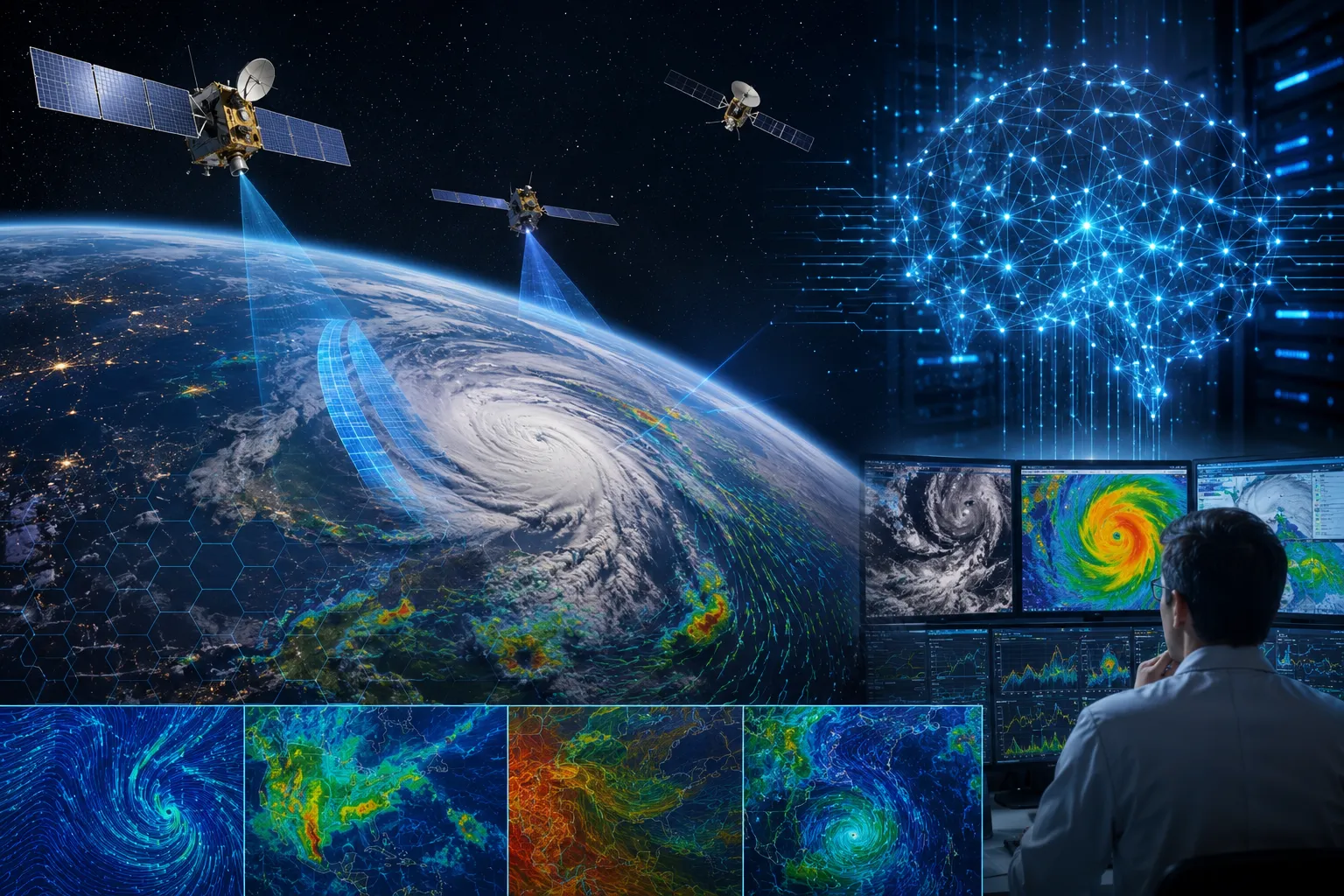
Satellites collect observations → data is processed → AI and physics-based models analyse the atmosphere → forecasts are produced → warnings and decisions are generated.
That relationship is likely to become even more important as AI models move toward higher-resolution forecasting.
Geostationary Satellites vs Low-Earth-Orbit Satellites
Different satellite orbits provide different kinds of information.
Geostationary satellites
Geostationary satellites remain over approximately the same region of Earth and can repeatedly observe developing weather systems.
EUMETSAT’s Meteosat satellites operate around 36,000 km above the equator and provide frequent observations useful for detecting rapidly developing storms and supporting nowcasting.
Low-Earth-orbit satellites
Low-Earth-orbit satellites move around the planet and provide detailed global measurements.
NOAA’s Joint Polar Satellite System satellites orbit from pole to pole and provide global observations used in weather forecasting.
The two systems therefore complement each other.
Geostationary satellites are particularly useful for frequent monitoring of rapidly changing weather, while polar-orbiting satellites provide detailed global observations that feed broader forecasting systems.
AI Weather Forecasting vs Traditional Weather Forecasting
It is tempting to describe AI as a replacement for traditional meteorology.
That would be misleading.
Traditional numerical weather prediction remains fundamental to operational forecasting. ECMWF’s Integrated Forecasting System continues to be its core physics-based system, while AIFS operates as an additional machine-learning forecasting approach.
The difference can be simplified like this:
| Feature | Traditional Forecasting | AI Weather Forecasting |
|---|---|---|
| Main approach | Physics-based equations | Data-driven machine learning |
| Training | Physical model development and observations | Large historical datasets |
| Forecast generation | Computationally intensive simulations | Very fast inference after training |
| Data requirement | Observations + physical models | Large training datasets + observations |
| Strength | Physical consistency and established science | Speed and pattern recognition |
| Main challenge | High computing requirements | Reliability, robustness and generalisation |
| Future direction | Continues evolving | Increasing integration with conventional systems |
The emerging model is therefore not necessarily AI versus meteorologists.
It is increasingly AI + physics + observations + human expertise.
WMO explicitly supports this complementary approach and says rigorous verification is essential before AI systems are used operationally.
Can AI Predict Extreme Weather?
Yes, AI can contribute to extreme-weather prediction, but it does not mean every extreme event can now be predicted perfectly.
Extreme weather creates some of the most difficult forecasting problems because conditions can change rapidly and events can occur at very small geographic scales.
AI is being explored for:
- heavy rainfall
- thunderstorms
- tropical cyclones
- flash floods
- extreme heat
- strong winds
- hail
- lightning
- severe storms
WMO says AI-based nowcasting can combine radar, satellite observations and local meteorological and hydrological records to improve predictions of hazards such as hail, wind gusts, lightning and precipitation.
This is particularly important because nowcasting focuses on the next few minutes to several hours, when rapidly developing storms can have immediate consequences.
For communities, a slightly better warning delivered earlier can be more valuable than a highly sophisticated forecast that arrives too late.
What Is AI Nowcasting?
AI nowcasting focuses on very short-term predictions.
Instead of asking:
What will the weather look like next week?
a nowcasting system may ask:
Where will this storm move during the next hour?
Traditional nowcasting can use radar imagery, satellite imagery and other observations to track weather systems.
AI can analyse sequences of these observations and learn how weather patterns tend to evolve.
WMO identifies nowcasting as one of the areas where AI could have particularly important benefits for early warnings.
This could be especially valuable for:
- urban flooding
- thunderstorms
- intense rainfall
- lightning
- aviation hazards
- renewable-energy forecasting
- emergency management
How AI Weather Forecasting Could Improve Everyday Life
The benefits of better forecasting extend far beyond checking whether it will rain tomorrow.
Agriculture
Farmers need information about rainfall, temperature, heat and soil conditions.
More localised forecasting could help with irrigation, planting, harvesting and protection against extreme weather.
Aviation
Airlines and airports depend on accurate information about thunderstorms, wind, icing, turbulence, visibility and other atmospheric conditions.
Better short-term predictions could support safer and more efficient operations.
Renewable Energy
Solar and wind power are weather-dependent.
Forecasting cloud cover, sunlight and wind conditions can help electricity operators anticipate changes in renewable generation.
AI therefore has a potential connection between weather technology and clean-energy infrastructure.
Disaster Preparedness
Earlier warnings for floods, cyclones, extreme rainfall and other hazards can help governments and emergency services prepare resources before an event develops.
Everyday Consumers
Weather forecasts influence travel, outdoor activities, construction, deliveries, events and countless other decisions.
The technology may be invisible to most people, but better forecasts can affect many parts of daily life.
AI Weather Forecasting and Climate Technology
Weather and climate are related, but they are not the same thing.
Weather forecasting focuses on atmospheric conditions over relatively short periods, from minutes to days or weeks.
Climate science looks at longer-term patterns, trends and changes across months, years and decades.
AI is increasingly being explored across both areas.
WMO says AI is being applied across the weather-to-climate spectrum, from nowcasting and medium-range forecasting to subseasonal-to-seasonal prediction and longer-term climate applications.
NASA and IBM have also developed the Prithvi-weather-climate foundation model using NASA’s MERRA-2 dataset, with the aim of improving the resolution and usefulness of regional and local weather and climate modelling.
This creates an important future technology connection:
AI + satellites + climate datasets + computing = increasingly sophisticated Earth-system intelligence.
AI will not eliminate the complexity of climate science, but it may help researchers process datasets and explore scenarios that would otherwise be extremely difficult or expensive.
What Are the Biggest Challenges for AI Weather Forecasting?
The technology has significant potential, but several problems remain.
1. Data Quality
AI models depend heavily on their training data.
If observations contain gaps, biases or errors, those limitations can affect model performance.
This is one reason why long-running, carefully maintained datasets such as ERA5 are so valuable.
2. Extreme Events Are Difficult
A model may perform well on common weather patterns but struggle with rare events.
That is particularly important because the rare events often have the greatest consequences.
3. Regional Generalisation
A model trained using one set of geographical conditions may not perform equally well everywhere.
WMO has specifically highlighted questions around the observational requirements needed for high-resolution local AI forecasting and whether models trained in one region can transfer reliably to another.
4. Explainability
Traditional physics-based models have an interpretable scientific foundation.
AI models can be more difficult to interpret.
When a forecast affects evacuation decisions or public warnings, meteorologists and authorities need to understand not only the prediction but also its reliability.
5. Operational Reliability
A research model that performs impressively in a paper is not automatically ready for public forecasting.
Operational systems must run consistently, handle unusual conditions, integrate new observations and meet strict reliability requirements.
6. Unequal Access
Advanced AI forecasting can require significant data, computing infrastructure and technical expertise.
WMO has therefore emphasised equitable access so that AI does not create a situation in which only wealthy countries can benefit from the newest forecasting capabilities.
Will AI Replace Meteorologists?
No — at least not in the foreseeable future.
AI can automate parts of forecasting, but weather services do much more than generate a numerical prediction.
Meteorologists interpret forecasts, compare different models, examine observations, communicate uncertainty and make decisions about warnings.
WMO continues to emphasise the authoritative role of National Meteorological and Hydrological Services in weather, climate and water-related warnings.
The likely future is therefore a hybrid system.
AI can provide:
- faster predictions
- additional forecast guidance
- high-resolution products
- large ensembles
- rapid processing of observations
Meteorologists provide:
- scientific interpretation
- verification
- contextual knowledge
- risk communication
- human judgment
The strongest systems are likely to combine both.
What Is Happening With AI Weather Forecasting in 2026?
AI forecasting has moved significantly beyond the experimental stage.
ECMWF’s AIFS has been operational since 2025 and received its AIFS v2 upgrade in May 2026. ECMWF says the updated system introduced, among other capabilities, data-driven wave and snow-cover forecasts.
ECMWF is also developing shared infrastructure such as Anemoi, a framework intended to support the development, training and operation of large-scale AI models for weather and climate across European meteorological services.
In the United States, NOAA’s HRRR-Cast is an experimental AI-powered regional forecasting system designed to produce rapid mesoscale forecasts at a fraction of current computing costs.
At the international level, WMO has moved toward integrating AI into the broader global weather, climate and environmental forecasting ecosystem, while maintaining requirements for verification, transparency and scientific oversight.
This makes 2026 an important transition period: AI weather forecasting is increasingly becoming an operational technology, but its integration with established forecasting infrastructure is still developing.
The Future of AI Weather Forecasting
The next phase may not simply involve making AI forecasts faster.
It may involve making them more local, probabilistic and useful for decisions.
A future forecasting system could combine:
Satellite observations
↓
Radar and ground observations
↓
AI models + physics-based models
↓
High-resolution forecasts
↓
Risk and impact analysis
↓
Early warnings and local decisions
This could allow forecasts to become increasingly tailored to specific needs.
A farmer may need rainfall and soil information.
An airport may need visibility and turbulence.
A power operator may need wind and solar generation forecasts.
A city may need flood-risk information.
The underlying weather data could be similar, but AI may help transform it into more specialised products.
WMO’s current AI work reflects this broader vision, with AI being explored across weather, climate, water and environmental services rather than simply as another weather app technology.
Why AI Weather Forecasting Matters for Future Technology
AI weather forecasting is a good example of how several emerging technologies can converge.
It combines:
- AI technology for pattern recognition and prediction
- satellites for global Earth observation
- cloud and high-performance computing for processing
- climate technology for understanding environmental change
- radar and sensor networks for real-time observations
- data science for turning observations into useful information
That makes weather forecasting an important part of the broader future-technology ecosystem.
It is also a reminder that the most important technological breakthroughs may not always be consumer products.
A better forecast can help an energy company manage renewable electricity, help a city prepare for flooding, help farmers respond to changing conditions and help emergency agencies issue warnings.
The technology may operate largely behind the scenes, but its consequences can be very real.
For a broader look at the emerging technologies shaping the next decade, see HNN24x7’s Future Technology 2026: 15 Emerging Technologies That Could Change How We Live.