


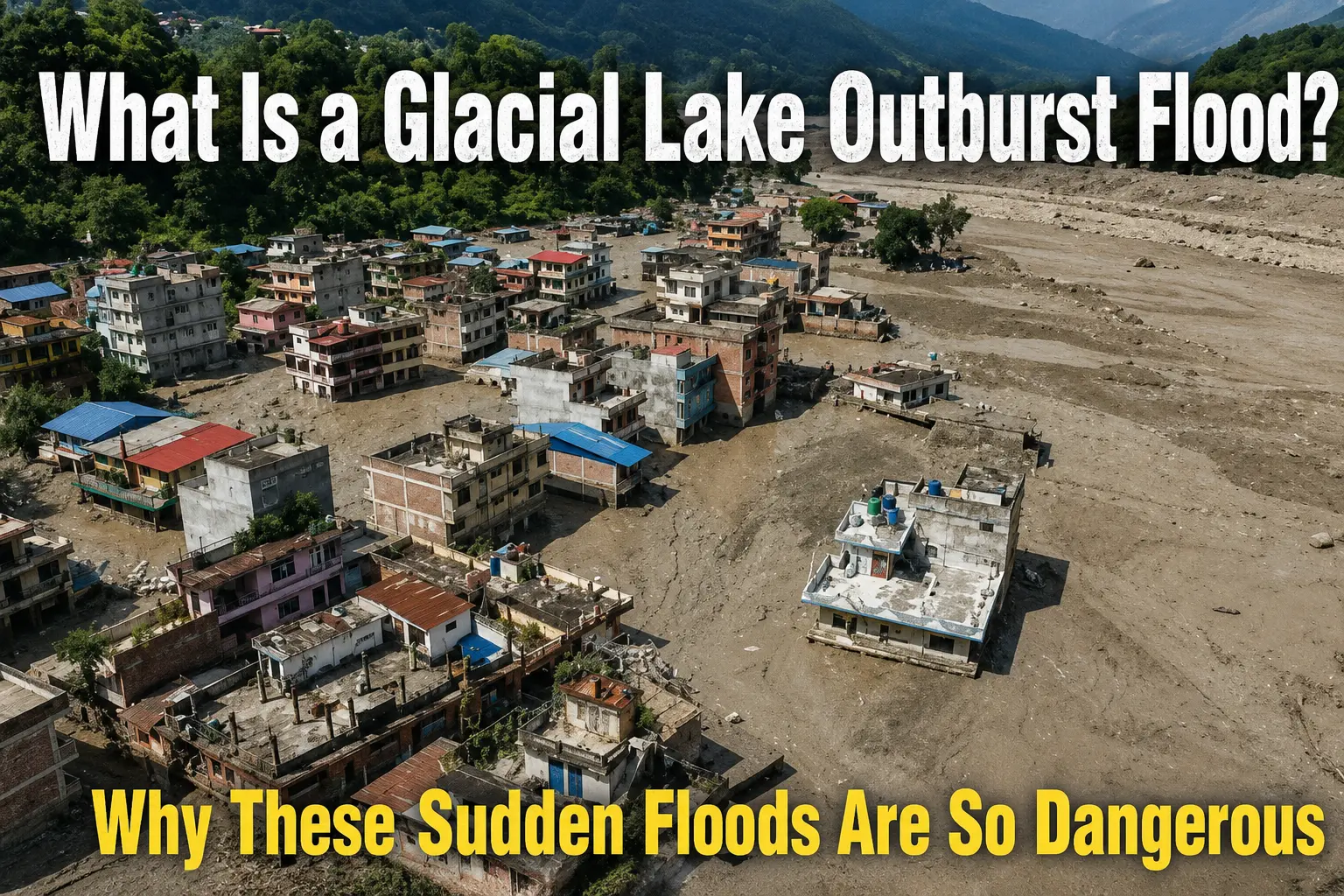
A glacial lake outburst flood (GLOF) is a sudden release of water from a lake associated with a glacier. When the natural dam holding that water fails, enormous quantities of water can rush downstream in a short time, carrying mud, rocks, trees and other debris with it.
These floods are particularly dangerous in the Himalayas, where steep terrain can turn a sudden release of glacial water into a destructive flood wave capable of travelling rapidly through narrow valleys.
The risk is becoming increasingly important as glaciers retreat and new glacial lakes form or existing lakes expand. However, not every glacier-related flood is a GLOF. The precise mechanism matters.
What is a glacial lake outburst flood?
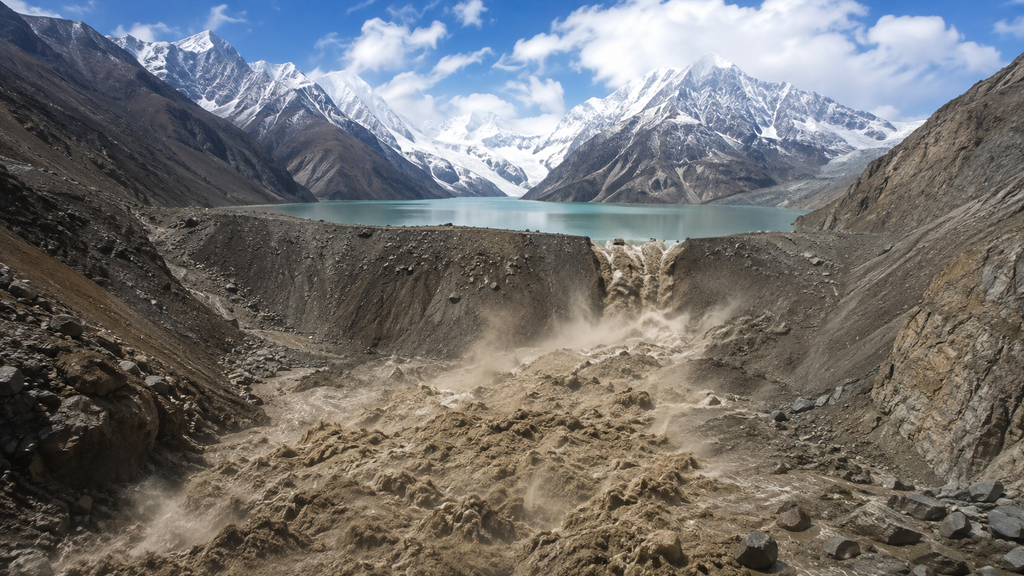
A glacial lake outburst flood is a sudden drainage of water from a glacial lake after the natural barrier containing it fails or is breached.
The lake may be held back by:
- a moraine made of rocks and sediment;
- glacial ice;
- a combination of ice and sediment;
- or, in some cases, other natural barriers.
USGS explains that glacier-related water bodies can drain suddenly when glacier dams, moraine dams or ice-jam systems fail.
ICIMOD similarly describes GLOFs in the Hindu Kush Himalaya as catastrophic events that can occur when glacial lakes held behind moraine complexes, ice or other barriers suddenly breach or fail.
In simple words
Think of a glacial lake as a large natural reservoir in the mountains.
Instead of a concrete dam, the reservoir may be held back by a pile of loose rocks and sediment left behind by a retreating glacier.
If that natural dam becomes unstable and breaks, the stored water can escape suddenly.
That sudden release is a glacial lake outburst flood.
How does a glacial lake outburst flood happen?
A GLOF generally develops through a sequence of events rather than a single process.
Step 1: A glacier retreats
As a glacier loses ice, space can develop between the retreating glacier and the sediment deposited around it.
Meltwater collects in this depression.
Step 2: A glacial lake grows
Over time, the lake can become larger and deeper as additional meltwater accumulates.
ICIMOD notes that retreating glaciers can create moraine-dammed lakes, with meltwater accumulating between the retreating glacier and the moraine.
Step 3: The natural dam becomes vulnerable
The moraine dam may contain loose, poorly sorted sediment and sometimes buried ice.
That makes it fundamentally different from an engineered concrete dam.
USGS notes that moraine dams can be vulnerable to overtopping and erosion, while melting ice within the dam and internal water flow can also contribute to failure.
Step 4: A trigger destabilizes the lake or dam
Several things can initiate a GLOF.
A trigger may include:
- an ice avalanche;
- a landslide;
- intense rainfall;
- rapidly increasing water pressure;
- melting within the moraine;
- erosion of the dam;
- an earthquake or other strong ground disturbance.
An avalanche or landslide falling into a lake can generate a large displacement wave. That wave may overtop the natural dam, beginning a breach that grows rapidly.
Step 5: The dam breaches
Once water begins cutting through the natural barrier, the opening can expand.
The lake may then drain extremely quickly.
Step 6: A flood wave moves downstream
The released water accelerates down the mountain valley.
Because the flow can pick up enormous amounts of sediment and rock, the resulting hazard can become much more destructive than a simple rise in river level.
Why are glacial lake outburst floods so dangerous?
The danger comes from a combination of large water volume, sudden onset, steep terrain and debris.
A GLOF can affect communities downstream even when they are many kilometres away from the original lake.
USGS notes that glacier-related outburst floods can cause severe downstream consequences and that the peak discharge can increase rapidly during an outburst.
1. They can happen suddenly
People living downstream may have very little time to react.
This is particularly dangerous in remote mountain valleys where communications and roads may already be limited.
2. Water moves rapidly downhill
Himalayan valleys can be extremely steep.
Gravity therefore gives the released water and debris enormous energy as they move downstream.
3. The flood can carry huge debris
A GLOF is not necessarily a clear-water flood.
The moving water can erode riverbanks and carry:
- boulders;
- rocks;
- mud;
- sand;
- trees;
- bridge fragments;
- other infrastructure debris.
This can dramatically increase the destructive force.
4. Infrastructure is concentrated along rivers
Roads, bridges, hydropower facilities, settlements and tourism infrastructure are frequently located near river valleys.
A sudden flood therefore has the potential to damage several critical systems simultaneously.
5. The effects can travel far downstream
A flood generated high in the mountains does not necessarily remain a local event.
The flood wave and sediment can travel downstream through connected river systems, potentially affecting communities far from the original glacial lake.
What is a moraine dam?
A moraine dam is a natural barrier made primarily of rock, sediment and other material deposited by a glacier.
When a glacier advances or retreats, it can push and leave behind large quantities of debris.
A moraine can form at the front or sides of the glacier.
If meltwater accumulates behind the moraine, a glacial lake can develop.
The problem is that a moraine is not engineered to contain water.
Its stability depends on its shape, composition, internal ice, drainage and surrounding conditions.
USGS notes that many moraine dams are steep and relatively narrow and can consist of poorly sorted sediment, sometimes containing ice. These characteristics can make them susceptible to failure.
What can trigger a GLOF?
There is no single trigger for every glacial lake outburst flood.
Ice avalanche
A large chunk of glacier ice can fall into the lake.
The resulting displacement wave can overtop the moraine dam.
Landslide or rock avalanche
A landslide entering a lake can displace a huge amount of water.
If the resulting wave overtops the dam, erosion can rapidly enlarge the breach.
Heavy rainfall
Intense rainfall can increase water entering a glacial lake and contribute to erosion or instability around the natural dam.
Internal seepage
Water can gradually move through weaknesses inside a moraine dam.
This can weaken the structure and eventually create a pathway through which more water escapes.
Melting of buried ice
Some moraine dams contain buried ice.
If that ice melts, voids and weaknesses can develop inside the dam.
Earthquake
An earthquake can destabilize slopes surrounding a glacial lake or trigger a landslide or avalanche into the lake.
But an earthquake does not automatically produce a GLOF. It is one possible trigger among several.
What is the difference between a GLOF and a normal glacier-related flood?
This distinction is important.
A GLOF specifically involves the sudden release of water stored in a glacial lake or glacier-dammed water body.
A glacier-related flood can have other causes.
For example, an ice-rock avalanche can enter a river and cause a sudden flood or debris surge without the event being a classic GLOF.
Similarly, intense rainfall can produce a flash flood in a glacier-fed valley without any glacial lake bursting.
So the terms should not be used interchangeably.
Quick comparison
| Hazard | Main mechanism |
|---|---|
| GLOF | Sudden drainage of a glacial lake |
| Flash flood | Rapid flooding, often caused by intense rainfall or sudden water release |
| Ice avalanche | Large mass of glacier ice collapses downslope |
| Landslide flood | Landslide blocks/displaces a river and causes flooding |
| Debris flow | Rapid mixture of water, mud, rocks and sediment |
Some disasters can involve several of these mechanisms at the same time.
That is why Himalayan flood events can become complex chains of cascading hazards.
Why are GLOFs a major concern in Nepal?
Nepal is highly exposed because it contains thousands of glaciers and glacial lakes in high mountain environments.
A 2025 UNDP framework for Nepal’s GLOF-risk programme states that Nepal has approximately 3,800 glaciers and about 2,000 glacial lakes, with 47 identified as potentially dangerous in that assessment.
Earlier ICIMOD and UNDP research identified 47 potentially dangerous glacial lakes across the Koshi, Gandaki and Karnali river basins in Nepal, the Tibet Autonomous Region of China and India.
These figures illustrate why GLOFs are not simply a theoretical hazard for Nepal.
They are an ongoing disaster-risk management issue.
Nepal has experienced GLOFs before
Nepal has a long history of glacier-related floods.
ICIMOD’s regional inventory notes that 26 GLOF events have been recorded in Nepal since 1977, with 11 having transboundary impacts.
One of the best-known recent examples is the Imja Glacial Lake in the Everest region.
Nepal and international partners have worked to reduce risk around Imja, including lowering the lake’s water level and installing early-warning measures. UNDP reported that the water level was lowered by 3.4 metres through risk-reduction work, helping protect downstream communities.
What happened in Nepal’s 2024 Thame flood?
The 2024 flood in Nepal’s Thame Valley provides an especially useful modern case study because scientists were able to reconstruct a complicated chain of events.
On August 16, 2024, a major rock avalanche above a glacial lake triggered a displacement wave.
According to an ICIMOD study published in 2025, the avalanche struck a glacial lake at about 4,900 metres, causing the lake to breach and releasing approximately 156,000 cubic metres of water. A second lake was subsequently involved in the chain reaction, with the total estimated water release reaching about 459,000 cubic metres.
The flood destroyed homes and other infrastructure in Thame and transported debris roughly 80 kilometres downstream.
This is an important lesson:
A GLOF does not necessarily begin with the lake simply “bursting.”
An avalanche or landslide can first hit the lake, generate a displacement wave, breach the natural dam and then create a much larger downstream disaster.
How does climate change affect GLOF risk?
Climate change is one of the major factors researchers are watching in the Himalayas.
As temperatures rise, glaciers can retreat and lose mass.
That can contribute to the formation of new glacial lakes and the expansion of existing ones.
ICIMOD says warming can increase the number and size of glacial lakes and therefore increase the potential flood volumes associated with GLOFs.
USGS similarly notes that as glaciers retreat and thin, new lakes can form and existing lakes can become larger, potentially increasing GLOF hazards.
However, climate change does not mean every GLOF is directly caused by warming.
A particular event may depend on local geology, lake geometry, rainfall, slope stability, glacier dynamics and the specific trigger.
The scientifically safer conclusion is that climate change can increase the conditions and exposure that contribute to GLOF risk, while the immediate trigger varies from event to event.
How are dangerous glacial lakes monitored?
Scientists and authorities use several technologies to identify and monitor potentially dangerous lakes.
Satellite imagery
Satellites can track changes in:
- lake area;
- glacier position;
- surrounding slopes;
- moraine structures;
- water extent.
This is especially important in remote Himalayan terrain where regular ground surveys are difficult.
UNDP and ICIMOD have used remote-sensing methods to inventory and classify potentially dangerous glacial lakes across major river basins.
Field surveys
Experts can visit high-risk lakes to measure:
- lake depth;
- water volume;
- dam structure;
- ice conditions;
- drainage channels;
- surrounding slopes.
Water-level monitoring
Sudden changes in lake level can provide important warning information.
Early-warning systems
Sensors and communication systems can alert downstream communities when dangerous changes are detected.
Nepal has already implemented early-warning measures around high-risk locations, including the Imja area.
Can GLOFs be prevented?
A GLOF cannot always be prevented, but its risk can be reduced.
Possible measures include:
- lowering the water level of a dangerous lake;
- strengthening or stabilizing vulnerable sections of a natural dam;
- improving drainage;
- installing early-warning systems;
- monitoring lake and glacier changes;
- creating evacuation routes;
- conducting community preparedness exercises;
- restricting high-risk infrastructure in vulnerable flood corridors.
Nepal’s GLOF-risk programmes include both structural and non-structural measures, including early-warning systems and institutional capacity building.
The goal is not necessarily to eliminate every glacial lake.
The goal is to reduce the probability of catastrophic failure and give downstream communities enough warning to move to safety.
What should people do if a GLOF warning is issued?
For communities downstream of a potentially dangerous glacial lake, a warning should be treated seriously.
The safest response depends on the local emergency plan, but the basic principles are:
- Move away from river channels and low-lying valley floors.
- Follow official evacuation routes.
- Move toward designated higher ground.
- Do not wait to see the flood.
- Avoid bridges and river crossings.
- Follow instructions from local authorities and emergency services.
- Keep communication systems available where possible.
A GLOF can arrive rapidly, so evacuation planning before an event is much more valuable than trying to improvise during the flood.
Why the recent Nepal flood matters
The recent Nepal disaster has renewed attention on the difference between several kinds of Himalayan hazards.
The earlier article in this series explains how glacier collapse triggered the flood and why the event was initially confused with an earthquake.
For readers who want to understand the broader science behind glacial-lake hazards, this article provides the necessary background: what a GLOF is, how natural dams fail, how avalanches and landslides can trigger lake outbursts, and why Himalayan communities remain vulnerable.
For the Nepal case study, see how glacier collapse triggered the flood.
The two stories should therefore complement rather than duplicate each other:
Nepal case → what happened
This explainer → how GLOFs work and why they are dangerous
FAQ
What is a glacial lake outburst flood?
A glacial lake outburst flood, or GLOF, is a sudden release of water from a glacial lake after the natural dam holding it back fails or is breached. The resulting flood can carry large amounts of sediment and debris downstream.
How does a GLOF happen?
A glacier retreats and creates a lake, often behind a moraine or ice dam. A landslide, avalanche, rainfall, erosion, rising water pressure or another process can destabilize the dam, allowing the lake to drain suddenly.
Why are GLOFs dangerous?
GLOFs can release large volumes of water very quickly. In steep Himalayan valleys, the flood can travel rapidly and carry boulders, mud and other debris, damaging settlements and infrastructure downstream.
Is every glacier-related flood a GLOF?
No. A GLOF specifically involves the sudden drainage of a glacial lake or glacier-dammed water body. Glacier collapses, ice avalanches and landslide-generated floods can occur without a glacial lake actually bursting.
Can an earthquake trigger a GLOF?
Yes, an earthquake can potentially destabilize a glacier, moraine dam or surrounding slope and trigger an avalanche or landslide into a glacial lake. But earthquakes are only one possible trigger.
Does climate change increase GLOF risk?
Warming can contribute to glacier retreat and the formation or expansion of glacial lakes, potentially increasing GLOF risk. However, climate change should not automatically be identified as the direct trigger of an individual flood.
Why is Nepal vulnerable to GLOFs?
Nepal has extensive glaciers and glacial lakes in steep Himalayan terrain. Research by ICIMOD and UNDP has identified potentially dangerous lakes across major Nepalese river basins, while historical GLOF events have caused significant downstream damage.
Can a GLOF be prevented?
The flood itself cannot always be prevented, but authorities can reduce risk by lowering lake levels, improving drainage, monitoring dangerous lakes, strengthening vulnerable areas and installing early-warning systems.
What is a moraine dam?
A moraine dam is a natural barrier made largely from rock and sediment deposited by a glacier. Glacial lakes can form behind these barriers, but their stability can vary significantly.
What is the difference between a GLOF and a flash flood?
A flash flood is a broader term for flooding that develops rapidly. A GLOF is a specific type of sudden flood caused by the release of water from a glacial lake or glacier-dammed water body.
“Sources Used”
https://www.usgs.gov/publications/glacier-related-outburst-floods
https://www.icimod.org/mountain/glacial-lake-outburst-flood/
https://www.undp.org/nepal/publications/protecting-livelihoods-and-assets-risk-glacial-lake-outburst-floods-glofs-and-climate-change-induced-flooding-glacial-river-basins
The bottom line
A glacial lake outburst flood is a sudden release of water from a glacial lake after its natural dam fails or is breached.
The failure can be triggered by an avalanche, landslide, rainfall, rising water pressure, internal erosion, melting ice within the dam or other destabilizing processes.
The danger is amplified in the Himalayas because steep valleys allow floodwater and debris to travel rapidly downstream.
Climate change is making the situation more important to monitor because glacier retreat can create new lakes and enlarge existing ones. But the exact trigger of any individual GLOF must be established from evidence rather than automatically attributed to climate change.
Nepal’s experience—from Imja to the 2024 Thame disaster—shows why satellite monitoring, scientific assessment, early-warning systems and community preparedness are increasingly important for Himalayan disaster risk reduction.
A glacial lake may look calm and harmless from a distance. The real danger is the enormous volume of water that can be stored behind an unstable natural dam and how quickly that water can turn into a destructive flood.
“Must Read”