



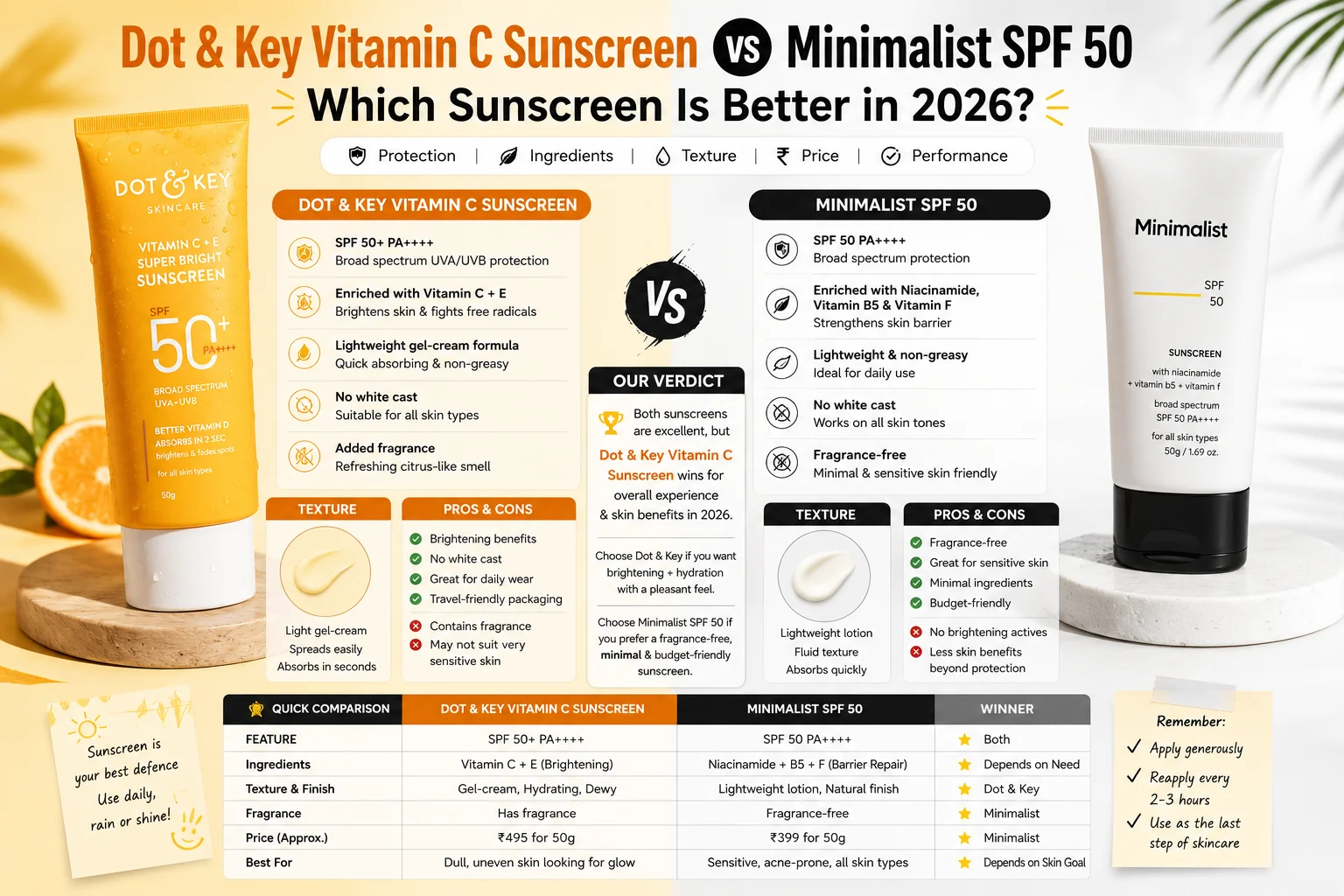
Dot & Key Vitamin C Sunscreen vs Minimalist SPF 50: Choosing a daily sunscreen in India is no longer simply about finding the highest SPF number. Texture, UVA protection, finish, white cast, skin type, climate, and how well a sunscreen fits into a daily routine can all influence whether people actually use it consistently.
Two popular options in the Indian skincare market are Dot & Key Vitamin C + E Super Bright Sunscreen SPF 50+ PA++++ and Minimalist SPF 50 PA++++ Multi-Vitamin Sunscreen. Both offer high sun protection, but their formulas are positioned somewhat differently.
So, in the Dot & Key Vitamin C Sunscreen vs Minimalist SPF 50 comparison, which one is better in 2026?
The answer depends on what you want from your sunscreen. Dot & Key focuses on a lightweight, glow-oriented formula with vitamin C and vitamin E, while Minimalist emphasizes broad-spectrum SPF 50 PA++++ protection with a lightweight, moisturising, non-shiny finish. Dot & Key currently lists its Vitamin C + E sunscreen as SPF 50+ PA++++ with newer UV filters, while Minimalist’s official product page lists SPF 50 and PA++++ protection.
What Is Dot & Key Vitamin C Sunscreen?
The Dot & Key Vitamin C + E Super Bright Sunscreen SPF 50+ PA++++ is positioned as a lightweight daily sunscreen that combines UV protection with antioxidant-focused skincare.
Dot & Key’s current sunscreen collection describes the product as containing vitamin C and vitamin E and offering protection against UVA and UVB rays. The brand also promotes a lightweight, non-sticky texture.
Retail listings describe the sunscreen as SPF 50+ PA++++ and highlight its no-white-cast positioning.
The product is therefore aimed at people who want their sunscreen to do more than simply sit on the skin as a protective layer. Its branding combines sun protection with a brighter, more radiant-looking complexion.
What makes Dot & Key appealing?
The biggest attraction is the combination of:
- SPF 50+ protection
- PA++++ UVA protection
- Vitamin C and vitamin E
- Lightweight texture
- Glow-oriented finish
- No-white-cast positioning
That combination can make it appealing for someone who dislikes the heavier or chalkier feel associated with some traditional sunscreens.
However, vitamin C in a sunscreen should not be interpreted as meaning the product replaces a dedicated vitamin C treatment. Its primary role is still sun protection.
What Is Minimalist SPF 50 Sunscreen?
Minimalist’s Multi-Vitamin SPF 50 PA++++ Sunscreen takes a somewhat different approach.
The official Minimalist listing describes it as a broad-spectrum SPF 50 sunscreen with PA++++ protection. The brand says the texture is very light, spreads easily, and leaves a natural, moisturised,d and non-shiny finish.
The formula is positioned around multiple vitamins and everyday photoprotection rather than a specifically glow-focused experience.
That distinction becomes important when comparing the two products.
If you want your sunscreen to leave a visibly fresh or radiant appearance, Dot & Key may be more appealing. If you prefer your sunscreen to disappear into your routine with a relatively understated finish, Minimalist has a strong proposition.
Dot & Key Vitamin C Sunscreen vs Minimalist SPF 50: Which Has Better Protection?
On the headline numbers, both products offer high protection.
Dot & Key currently lists SPF 50+ PA++++, while Minimalist lists SPF 50 PA++++.
That means both products are designed to provide strong UVB protection and high UVA protection.
But SPF alone shouldn’t determine the winner.
A sunscreen can only provide the protection claimed on its packaging when it is applied adequately and used according to its directions. In real life, under-application is a common reason people receive less protection than the label suggests.
Therefore, it would be misleading to say that one is automatically “better” simply because its SPF is written as 50+ instead of 50.
For the protection rating itself, this comparison is essentially a tie.
The more meaningful difference is likely to be how comfortable each sunscreen feels and whether you are willing to apply enough of it every day.
Which Sunscreen Has a Better Finish?
This is one of the clearest differences between the two.
Dot & Key’s Vitamin C + E sunscreen is marketed around a bright, glowing complexion, making it attractive to people who prefer a radiant finish. The brand describes the product as lightweight and non-sticky.
Minimalist, on the other hand, specifically describes its SPF 50 sunscreen as leaving a natural, moisturised, non-shiny look.
So:
For glow: Dot & Key has the stronger appeal.
For a natural, less shiny appearance: Minimalist has the advantage.
This doesn’t necessarily mean Dot & Key is unsuitable for oily skin or Minimalist is unsuitable for dry skin. Your moisturizer, cleanser, climate, and application amount can all change the final appearance.
Which Is Better for Oily Skin?
For oily or combination skin, finish can matter almost as much as protection.
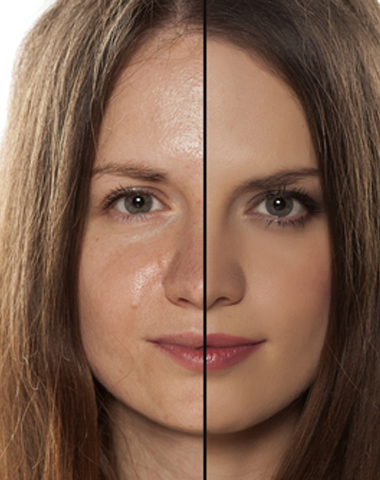
Minimalist has an advantage here because its official description specifically emphasizes a non-shiny finish.
That makes it an attractive option for people who don’t want additional shine during the day.
Dot & Key may still work for oily skin, particularly if you like a more radiant appearance. But if your biggest sunscreen complaint is looking greasy after application, a glow-focused formula may not be your first choice.
Best starting point for oily skin: Minimalist.
Still, individual skin chemistry matters. A sunscreen that looks matte on one person can become shiny on another after several hours.
Which Is Better for Dry Skin?
Dry skin often benefits from products that don’t leave the complexion feeling tight or overly matte.
Minimalist describes its sunscreen as leaving the skin moisturised, while Dot & Key emphasizes lightweight application and a bright, glowing finish.
For someone with dry skin who wants a healthy-looking glow, Dot & Key may be the more appealing choice.
For someone who prefers a neutral finish and already uses a rich moisturizer underneath, Minimalist may be more appropriate.
The important point is that neither sunscreen should be judged independently of the rest of your skincare routine.
Which Is Better for Indian Skin?

Both are designed for the Indian skincare market, but “Indian skin” covers a very broad range of skin tones and types.
For deeper skin tones, one of the most important practical questions is whether a sunscreen leaves a visible cast. Dot & Key and Minimalist both market their relevant products around a no-white-cast experience.
However, a no-white-cast claim does not guarantee an identical result on every complexion.
The best test is to apply the sunscreen generously along the face and jawline and check it in natural daylight after it settles.
Climate is another consideration.
In India’s hot and humid conditions, a sunscreen that feels comfortable enough to apply generously every morning can be more useful than one that looks perfect but feels unpleasant after application.
Dot & Key vs Minimalist for Hot and Humid Weather
India’s climate makes sunscreen texture particularly important.
Dot & Key describes its Vitamin C + E sunscreen as lightweight and non-sticky, while Minimalist describes its formula as very light and non-shiny. D
For someone commuting outdoors in hot weather, both therefore have reasonable everyday-use propositions.
The choice comes down to finish preference:
- Want a fresh, brighter-looking complexion? Dot & Key.
- Want a more restrained, non-shiny appearance? Minimalist.
Neither product should be assumed to be completely sweat-proof simply because it is lightweight. If you spend substantial time outdoors, follow the product’s directions for reapplication and use additional sun-protection measures such as shade, clothing, and a hat where practical.
Which Has the Better Ingredients?
Ingredients can tell you what a formula is designed to do, but they don’t automatically determine which sunscreen is better.
Dot & Key
Its Vitamin C + E sunscreen highlights:
- Vitamin C
- Vitamin E
- UV filters
- Antioxidant-focused skincare positioning
Dot & Key markets the combination around protection and brighter-looking skin.
Minimalist
Minimalist’s Multi-Vitamin sunscreen emphasizes:
- Broad-spectrum SPF 50
- PA++++
- Multiple vitamins
- Lightweight texture
- Moisturised, non-shiny finish
The official listing specifically positions it as a sunscreen designed to help protect against UV-related damage. M
Rather than asking which ingredient list “wins,” the better question is:
Which formula fits your skin and routine well enough that you will use the correct amount consistently?
That is ultimately more important than choosing a product because one ingredient sounds more impressive.
Dot & Key Vitamin C Sunscreen Reviews: What Should You Look For?
When reading Dot & Key Vitamin C sunscreen reviews, don’t rely exclusively on star ratings.
Look for comments about:
- White cast
- Texture
- Pilling
- Shine after several hours
- Makeup compatibility
- Eye irritation
- Sweat and humidity
- How the sunscreen behaves after reapplication
Retailer ratings can provide useful signals about customer experience. For example, an Amazon listing currently shows thousands of ratings for the Dot & Key Vitamin C + E sunscreen.
But customer ratings are not the same as controlled sunscreen testing. Individual experiences can vary substantially depending on skin type and application.
Minimalist SPF 50 Reviews: What Do Users Say?
Minimalist’s SPF 50 sunscreen is also widely reviewed by Indian shoppers.
One current retailer listing shows a large number of customer ratings and reviews, with users commenting on characteristics such as lightweight feel and white-cast performance.
At the same time, marketplace feedback can be mixed. Some users may find the finish comfortable, while others may experience more shine or a different texture than expected.
That isn’t unusual for sunscreen.
The same product can behave differently depending on:
- Skin oil production
- Humidity
- Amount applied
- Moisturizer underneath
- Makeup layered on top
- Reapplication frequency
So reviews are most useful when the reviewer has a skin type and climate similar to yours.
Which Sunscreen Is Better Under Makeup?
If sunscreen is part of your morning makeup routine, texture becomes crucial.
A sunscreen that pills underneath foundation can make an otherwise excellent makeup routine frustrating.
Dot & Key’s lightweight positioning and glow-focused finish may work particularly well for people who like a luminous makeup base. Minimalist’s natural, non-shiny positioning may be more appealing to someone who prefers a less radiant canvas.
Whichever you choose, allow skincare layers to settle before applying makeup and avoid excessive rubbing during application.
Price and Value in 2026
Price is another area where shoppers should check current listings rather than relying on old articles.
Dot & Key currently lists its Vitamin C + E sunscreen at an MRP of ₹595 on its website, although promotions and pack sizes can change.
Minimalist’s current official listing is available online, while major Indian retailers list the SPF 50 product around the ₹399 level for a 50 g pack at the time of checking.
Because discounts are frequent in Indian skincare, cost per gram is a more useful comparison than a temporary sale price.
If you use sunscreen every day and reapply when appropriate, even a relatively small price difference can become meaningful over the course of a year.
Dot & Key Vitamin C Sunscreen vs Minimalist SPF 50: Pros and Cons
Dot & Key Vitamin C + E Sunscreen
Pros
- SPF 50+ and PA++++
- Vitamin C and vitamin E
- Lightweight positioning
- Glow-focused finish
- No-white-cast positioning
- Attractive option for people who like radiant skin
Cons
- Glow may not appeal to people who dislike shine
- Vitamin C shouldn’t be treated as a replacement for a dedicated antioxidant treatment.
- Actual finish can vary by skin type
Minimalist SPF 50 PA++++
Pros
- SPF 50 and PA++++
- Very lightweight positioning
- Natural, moisturised, non-shiny finish
- Strong everyday-use proposition
- Attractive for people who dislike overly glossy sunscreen
Cons
- The less-glowy finish may not suit people who want a luminous look
- Individual experiences with shine and texture can vary
- Product versions and formulations should be checked before purchasing
Final Verdict: Which Sunscreen Is Better in 2026?
So, Dot & Key Vitamin C Sunscreen vs Minimalist SPF 50—which sunscreen should you buy?
There isn’t a single winner for everyone.
Choose Dot & Key Vitamin C + E Sunscreen if you want:
- A radiant, bright-looking finish
- Vitamin C and vitamin E in your sunscreen
- Lightweight daily wear
- SPF 50+ PA++++ protection
- A sunscreen that can complement a glow-focused skincare routine
Choose Minimalist SPF 50 if you want:
- SPF 50 PA++++ protection
- A natural, moisturised finish
- Less visible shine
- A simple everyday sunscreen
- A lightweight formula that fits easily into a minimal skincare routine
“Must Read”