



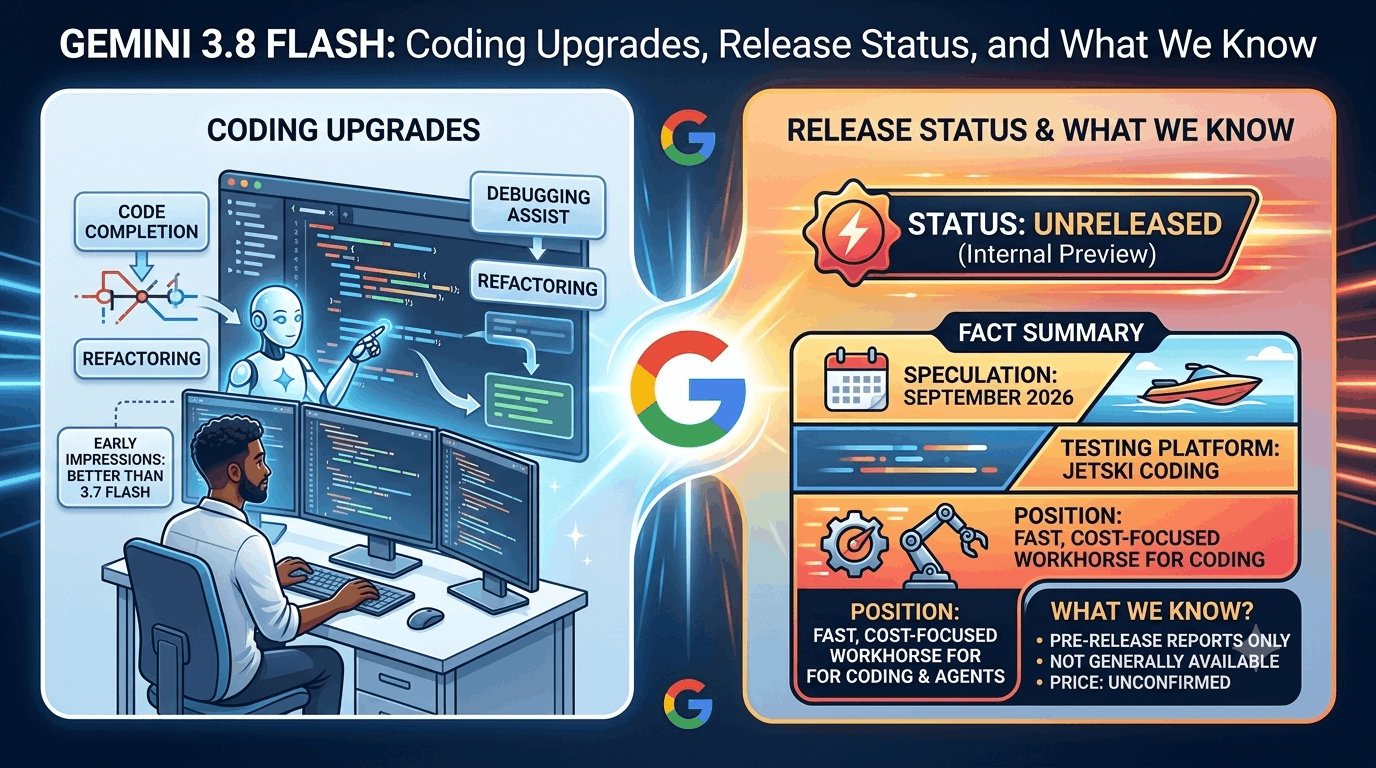
Google is reportedly preparing Gemini 3.8 Flash, a new Flash-series AI model focused heavily on software engineering and coding. According to reporting from The Wall Street Journal, the model is internally known as “Skimaki” and has reportedly performed strongly against Anthropic’s Opus in internal coding tests. However, Google has not yet published a full public benchmark or model card for Gemini 3.8 Flash, so several performance claims should be treated as reported rather than independently verified.
What is Gemini 3.8 Flash?
Gemini 3.8 Flash is reportedly the next iteration of Google’s fast, efficiency-focused Gemini Flash model family, with a particular emphasis on coding and agentic software-engineering workflows.
Google’s existing Flash models are positioned as fast “workhorse” models for tasks that require a combination of intelligence, speed, and scalability. Google describes Gemini 3.7 Flash as its most intelligent workhorse model for coding and agents, while its published evaluations cover software engineering, web development, terminal-based coding, and other agentic tasks.
Important: As of September 2, 2026, detailed official specifications and independent benchmark results for Gemini 3.8 Flash should not be assumed unless Google publishes them.
Is Gemini 3.8 Flash officially released?
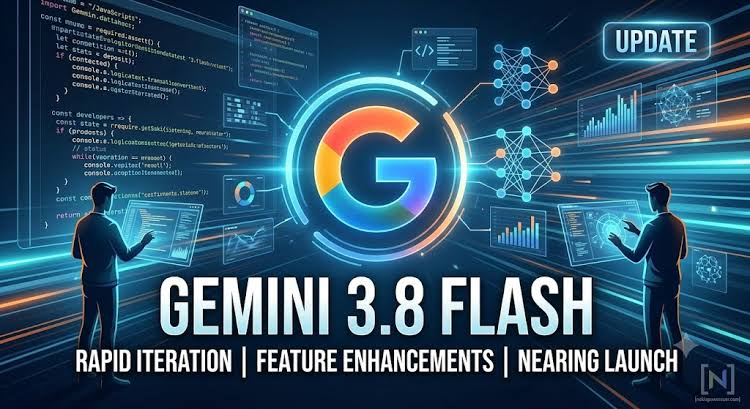
Gemini 3.8 Flash is being reported as an imminent release, but the most important specifications should be verified against Google’s official documentation once the model is publicly announced. The WSJ reported that the model could be released as soon as Wednesday, September 2, while describing internal testing and performance claims from people familiar with Google’s work.
For comparison, Google officially announced Gemini 3.7 Flash on August 13, 2026, describing it as a major improvement for coding and agentic workflows.
This creates an unusually short iteration cycle: Gemini 3.8 Flash is being reported only weeks after Gemini 3.7 Flash.
What is confirmed vs. reported?
| Information | Status |
| Gemini 3.8 Flash name | Reported |
| Internal codename “Skimaki” | Reported by WSJ |
| Stronger coding capability | Reported |
| Testing inside Google’s Jetski coding environment | Reported |
| Google engineers preferred it to Anthropic’s Opus in internal testing | Reported |
| Exact public coding benchmark scores | Not officially established in the sources reviewed |
| Official 3.8 Flash pricing | Not established |
| Official model card | Not established in the sources reviewed |
| Official context window | Should be verified after release |
This distinction matters because an internal evaluation is not equivalent to an independently reproducible benchmark.
Why is Gemini 3.8 Flash important for AI coding?
Coding has become one of the most commercially important applications for generative AI.
Modern coding models are increasingly expected to do more than autocomplete a few lines. Developers want AI systems that can understand an existing repository, modify multiple files, execute commands, diagnose failures, write tests, and iterate toward a working solution.
Google’s own research illustrates this shift. Its AlphaEvolve system combines Gemini models with automated evaluators to generate, test, score, and evolve programs, demonstrating how AI coding is moving from simple code generation toward automated software and algorithm development.
Gemini 3.8 Flash is therefore significant not simply because it may “write better code,” but because stronger coding performance could improve the economics of agentic software development.
What coding improvements are being reported for Gemini 3.8 Flash?
The strongest publicly reported claim is that Google engineers preferred Gemini 3.8 Flash over Anthropic’s Opus model in head-to-head testing performed through Jetski, Google’s internal coding tool.
The WSJ describes the model as having significantly upgraded coding capabilities and says the internal tests suggest Google is narrowing a gap with OpenAI and Anthropic in this area.
However, there is an important limitation:
A preference in an internal coding environment does not establish that Gemini 3.8 Flash is universally better than Claude or OpenAI’s models.
The result could depend on the tasks selected, prompts, tools, model versions, inference settings, evaluation criteria, and the particular coding workflow.
For developers, the most useful comparison will ultimately be based on public, reproducible evaluations.
What is Google’s Jetski coding tool?

Jetski is described in reporting as an internal Google coding environment used by engineers to work with and evaluate AI models on software-development tasks.
The reported Gemini 3.8 Flash testing is particularly interesting because it represents a form of internal “dogfooding”: Google engineers are apparently testing the model in a real development environment rather than relying only on academic benchmarks.
That type of testing can reveal problems that standardized benchmarks may miss, including:
- How often an AI agent gets stuck
- Whether generated code is unnecessarily verbose
- How well the model handles multi-file changes
- Whether it follows repository-specific instructions
- How effectively it responds to compiler and test failures
- How much human intervention is required
- How quickly the model completes an end-to-end task
These factors matter enormously when evaluating an AI coding assistant.
Gemini 3.8 Flash vs. Gemini 3.7 Flash
The clearest verified baseline is Gemini 3.7 Flash.
Google’s published August 2026 evaluation data shows Gemini 3.7 Flash scoring 85.8% on Terminal-Bench 2.1, compared with 78.0% for Gemini 3.6 Flash. On SWE-oriented long-horizon software engineering evaluation, Gemini 3.7 Flash scored 65.3% on DeepSWE v1.1.
| Category | Gemini 3.7 Flash | Gemini 3.8 Flash |
| Public coding benchmarks | Available | Awaiting official data |
| Terminal-Bench 2.1 | 85.8% | Not officially established |
| DeepSWE v1.1 | 65.3% | Not officially established |
| Coding positioning | Workhorse coding/agent model | Reportedly stronger coding focus |
| Internal Jetski testing | — | Reportedly preferred over Opus |
| Official pricing | Published | Verify after launch |
The safest conclusion is that Gemini 3.7 Flash provides the verified performance baseline, while Gemini 3.8 Flash represents a reported next step rather than a benchmark-proven generational leap.
How does Gemini 3.8 Flash compare with Claude Opus?
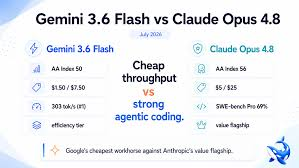
According to the WSJ report, Google engineers preferred Gemini 3.8 Flash to Anthropic’s Opus during internal head-to-head testing on Jetski.
That is potentially significant because Anthropic’s Opus family has been positioned as a high-end model for complex reasoning and coding.
But there are three reasons not to interpret the report as proof that Gemini 3.8 Flash is better overall:
- The testing was internal. The methodology has not been publicly released.
- The evaluation was coding-focused. A coding advantage does not automatically mean an advantage in reasoning, writing, mathematics, multimodal tasks, or general knowledge.
- The comparison may involve specific model versions and configurations. AI models change rapidly, so comparisons need a clearly defined test date and configuration.
A useful independent comparison should measure at least coding accuracy, repository-level software engineering, tool use, latency, cost, context handling, and task completion rate.
Why is Google focusing so heavily on coding?

AI-assisted software development has evolved from autocomplete into agentic coding.
Instead of asking:
“Write this function.”
developers increasingly ask AI agents to:
- Understand a codebase.
- Identify the source of a bug.
- Modify several files.
- Run tests.
- Analyze failures.
- Implement corrections.
- Repeat the process.
- Produce a final working change.
This explains why Google’s current Gemini messaging emphasizes both coding and agents. Google describes Gemini 3.7 Flash as a workhorse model for complex agentic tasks, while its model evaluations increasingly measure terminal interaction, software engineering, and tool use.
The competitive advantage is therefore not necessarily “who generates the most code.”
It is increasingly who can complete the most useful engineering work with the fewest human interventions.
What could Gemini 3.8 Flash mean for developers?
If the reported coding improvements are confirmed through public testing, Gemini 3.8 Flash could be particularly relevant to developers who prioritize:
- Fast coding assistance
- Repository-level development
- Agentic programming
- Automated debugging
- Test generation
- Code refactoring
- High-volume AI inference
- Developer tools that need low latency
The Flash architecture is particularly interesting for production applications because speed and cost can be just as important as raw benchmark intelligence.
A model that is slightly less capable but substantially faster or cheaper can sometimes deliver more practical value than a slower flagship model.
Should developers switch to Gemini 3.8 Flash immediately?

Not solely because of the reported internal coding results. Developers should wait for public documentation and test Gemini 3.8 Flash against their own workloads before replacing a production coding model.
A practical evaluation should use your real repository and measure:
- Successful task completion rate
- Number of human corrections
- Test pass rate
- Compilation/build success
- Latency
- Token consumption
- API cost
- Regression rate
- Security issues
- Quality of generated tests
- Performance on unfamiliar codebases
Your own workload is often more informative than a single leaderboard.
What should you look for when Gemini 3.8 Flash launches?

When Google publishes the official model information, check these specifications first:
1. Coding benchmarks
Look for standardized evaluations such as SWE-Bench, Terminal-Bench, or comparable software-engineering tests.
2. Context window
A large context window can be valuable for understanding entire repositories, although context length alone does not guarantee better coding performance.
3. Tool use
Check whether the model can reliably interact with terminals, search, files, APIs, and other development tools.
4. Pricing
For coding agents, output-token costs can become significant because a single task may involve many rounds of reasoning and tool calls.
5. Latency
A fast model can dramatically improve interactive coding workflows.
6. Reliability
Benchmark scores matter, but developers also need models that behave consistently across many tasks.
Gemini’s broader coding strategy
Gemini’s coding push is part of a larger Google strategy around AI agents and automated software engineering.
Google’s AlphaEvolve research demonstrates the direction particularly well. Rather than simply generating a candidate program, the system can generate programs, evaluate them automatically, retain promising solutions, and iteratively improve them. Google says the system has been used for algorithm discovery and optimization across areas including computing infrastructure and mathematics.
That suggests the long-term competition is moving beyond “AI that writes code” toward AI systems that can autonomously solve measurable engineering problems.
Frequently Asked Questions
What is Gemini 3.8 Flash?
Gemini 3.8 Flash is a reportedly upcoming Google Gemini Flash model focused on improved coding and agentic software-development capabilities. The Wall Street Journal reported that Google internally refers to the model as “Skimaki” and that engineers have tested it against Anthropic’s Opus.
When will Gemini 3.8 Flash be released?
The WSJ reported that Gemini 3.8 Flash could be released as soon as Wednesday, September 2, 2026. That timing was based on people familiar with Google’s plans rather than a public Google announcement
What is the codename for Gemini 3.8 Flash?
According to the WSJ, Gemini 3.8 Flash is internally known as “Skimaki.”
Is Gemini 3.8 Flash better than Claude Opus?
Not yet in a way that can be established from public, independent benchmarks. The WSJ reported that Google engineers preferred Gemini 3.8 Flash to Anthropic’s Opus during internal coding tests, but the methodology and full results have not been publicly disclosed.
Is Gemini 3.8 Flash better than Gemini 3.7 Flash?
The reported purpose of Gemini 3.8 Flash is to improve upon Google’s existing Flash models, particularly for coding. However, a definitive performance comparison should wait for official Gemini 3.8 Flash benchmarks and model documentation.
What is Gemini Flash used for?
Gemini Flash models are designed for fast, scalable AI workloads. Google’s current Gemini 3.7 Flash is positioned for coding, agents, multimodal understanding, and complex workflows.
Should I use Gemini for coding?
Gemini can be a strong option for coding, particularly when speed, tool use, and agentic workflows are important. Developers should evaluate the specific model against their own repositories and engineering tasks rather than relying on a single benchmark.
Bottom Line
Gemini 3.8 Flash could be an important upgrade for AI-assisted coding, but the strongest claims about its performance are still based on internal testing and reporting rather than a complete public benchmark suite.
The most notable claim is that Google engineers reportedly preferred the new model over Anthropic’s Opus in coding tests conducted through Jetski. If Google confirms that advantage through independent, reproducible evaluations, Gemini could become significantly more competitive in the rapidly growing market for agentic software development.