



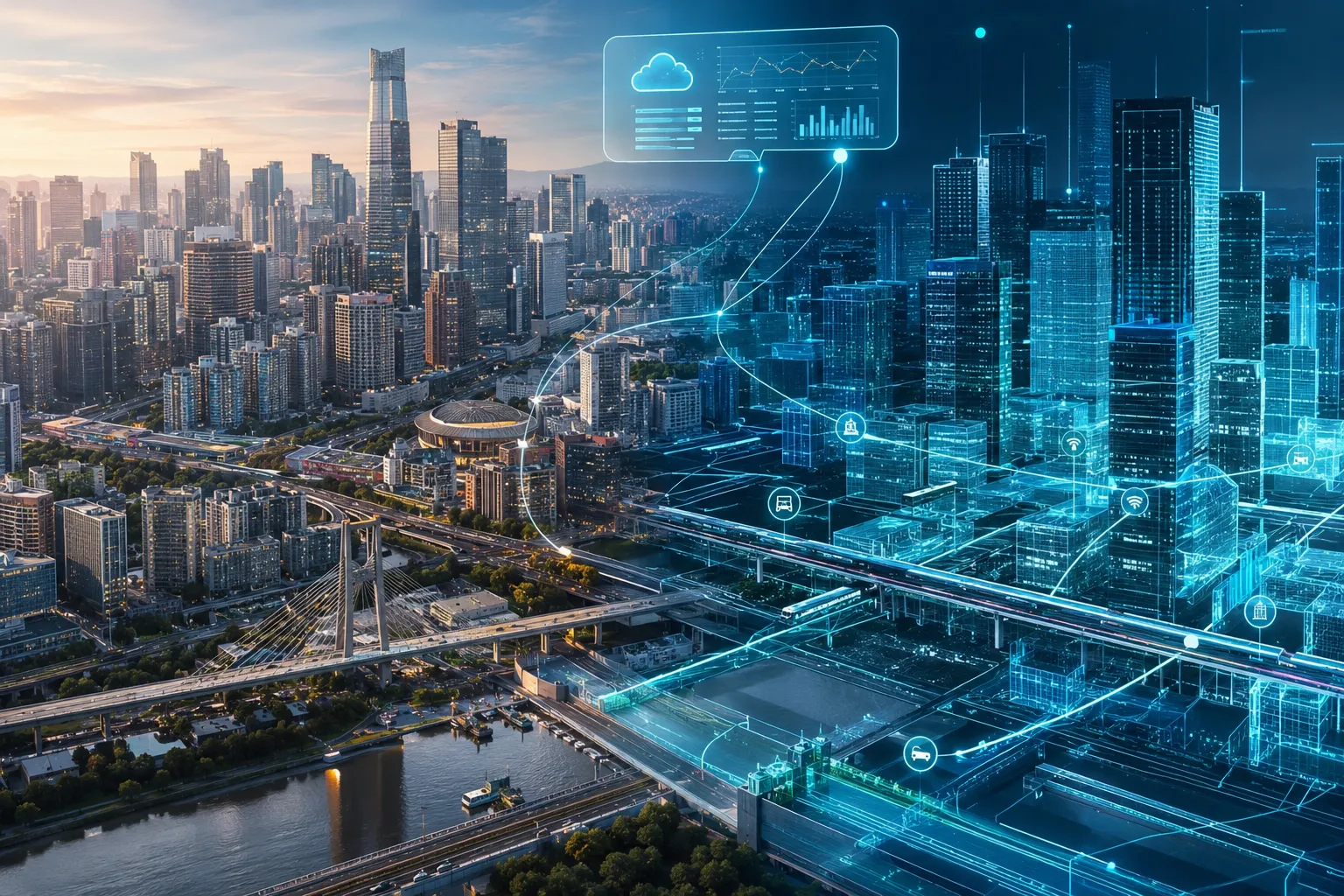
Imagine a city where engineers can test a new traffic system before changing a single traffic light, where authorities can simulate the effect of a flood before it happens, and where a bridge can be monitored through a continuously updated digital model.
That is the promise of digital twins.
A digital twin creates a digital representation of a physical object, system or environment and connects that representation to information about its real-world counterpart. The concept can apply to something as small as a machine component or as complex as an entire city.
The technology is becoming increasingly important because AI, IoT sensors, cloud computing, simulation and real-time data are converging.
The U.S. National Institute of Standards and Technology (NIST) describes a digital twin as a virtual representation of a physical or perceived real-world entity. NIST also emphasizes that digital twins can support monitoring, prediction, simulation, optimization and decision-making.
For smart cities, that means a digital twin could become something much bigger than a 3D map.
It could become a living digital model of how a city works.
For the wider technology ecosystem, read HNN24x7’s Future Technology 2026 pillar.
What Are Digital Twins?
A digital twin is a digital representation of a real-world object, system or environment that can be used to understand, monitor, simulate or predict aspects of its physical counterpart.
The important distinction is between a digital model and a digital twin.
A normal 3D model of a building might show:
- walls,
- floors,
- windows,
- doors,
- electrical systems.
But it may remain essentially static.
A digital twin can incorporate information from the physical building, such as:
- temperature,
- energy consumption,
- occupancy,
- equipment condition,
- air quality,
- maintenance status.
When those data streams are continuously connected to the digital representation, the model becomes much more useful for operational decisions.
NIST’s recent work emphasizes that an effective digital twin is not simply a static computer model; it depends on connections, synchronization, data and predictive capabilities.
How Do Digital Twins Work?
A simplified digital-twin system can be understood as a continuous loop:
Physical system
↓
Sensors and data
↓
Connectivity
↓
Digital model
↓
AI + simulation + analytics
↓
Prediction and decision
↓
Action in the physical world
↓
New data
The cycle then repeats.
For example, consider a smart bridge.
Sensors could monitor:
- vibration,
- structural movement,
- temperature,
- traffic load,
- material conditions.
That information can feed into the bridge’s digital twin.
AI and simulation systems could then identify unusual patterns.
Instead of waiting for visible damage, engineers could potentially investigate an emerging problem earlier.
NIST describes digital twins as systems capable of dynamically representing, diagnosing, predicting, optimizing and controlling their real-world counterparts.
That predictive element is what makes digital twins particularly powerful.
Digital Twin vs Digital Model: What’s the Difference?
This is one of the most important concepts to understand.
Digital Model
A digital model represents something in software.
It may be static or updated manually.
Digital Shadow
A digital shadow generally involves information flowing from the physical system into a digital representation.
Digital Twin
A digital twin goes further by maintaining an operational relationship between the digital and physical systems, potentially supporting analysis, prediction, optimization and feedback.
Terminology is not completely standardized.
NIST notes that there is still no single universally accepted definition of digital twins, which creates challenges when comparing systems and establishing standards.
Therefore, not every “digital twin” advertised by a technology company necessarily provides the same capabilities.
What Technologies Power Digital Twins?
Digital twins are not one technology.
They are an ecosystem.
Internet of Things
IoT sensors provide information from the physical environment.
Examples include:
- temperature sensors,
- cameras,
- GPS systems,
- pressure sensors,
- vibration sensors,
- electricity meters,
- air-quality sensors.
Artificial Intelligence
AI can analyze large volumes of sensor and operational data.
It can help identify patterns, anomalies and potential future conditions.
Machine Learning
Machine-learning models can learn from historical and real-time information to support forecasting and prediction.
Simulation
Simulation allows engineers and planners to test scenarios without immediately changing the real system.
Cloud Computing
Cloud infrastructure can provide the computing and storage capacity required by large digital-twin systems.
Edge Computing
Some decisions need to happen close to the physical system rather than waiting for a distant cloud server.
Edge computing can therefore reduce latency.
3D Visualization
Three-dimensional models make complex infrastructure easier for humans to understand and interact with.
Together, these technologies turn a digital twin into an operational system rather than simply a visual model
How AI Changes Digital Twins
AI may be one of the most important technologies accelerating digital twins.
A digital twin can collect enormous amounts of information.
But data alone does not automatically produce useful decisions.
AI can help transform that data into predictions and recommendations.
For example, an AI-enabled digital twin could potentially answer:
- Why is this building consuming more energy?
- Which road is likely to experience congestion?
- Which machine component is showing unusual behavior?
- What happens if a bridge is closed?
- How would a heatwave affect electricity demand?
- Where could flooding occur during extreme rainfall?
- What happens if a new transit route is introduced?
NIST research specifically examines opportunities created by combining AI with simulation and digital twins, including predictive analysis and decision-support applications.
This is where AI changes the role of a digital twin.
Instead of simply showing what is happening, it can help explore:
what could happen next.
What Is an AI Digital Twin?
An AI digital twin is essentially a digital-twin system enhanced with AI or machine-learning techniques for analysis, prediction, optimization or decision support.
The combination can create a powerful workflow:
Sensors → Digital Twin → AI → Prediction → Decision
Consider an urban water network.
The system could monitor:
- water pressure,
- flow rates,
- pump performance,
- reservoir levels,
- demand.
AI could analyze the data and identify unusual patterns.
The digital twin could then simulate different responses.
Operators could evaluate potential actions before implementing them.
This can reduce the need to experiment directly on critical physical infrastructure.
Digital Twins and Smart Cities
Smart cities generate enormous quantities of data.
Traffic systems generate information.
Public transport generates information.
Buildings generate information.
Electricity networks generate information.
Water systems generate information.
Weather stations generate information.
Emergency services generate information.
The challenge is connecting these systems.
That is where urban digital twins come in.
An urban digital twin can bring multiple infrastructure systems into a shared digital environment.
A 2025 review of digital twins in smart cities identified applications across energy, transportation, public safety and environmental management and highlighted the role of IoT, AI, big-data analytics and edge-cloud architectures.
This makes digital twins potentially useful as a coordination layer for smart-city infrastructure.
What Is an Urban Digital Twin?
An urban digital twin is a digital representation of a city, district or urban system that combines physical infrastructure data with models, simulations and analytics.
It can potentially represent:
- roads,
- buildings,
- public transport,
- power networks,
- water systems,
- drainage,
- telecommunications,
- parks,
- environmental conditions,
- population-related activity,
- construction projects.
The goal is not necessarily to digitally reproduce every person or object.
Instead, the objective is to create a useful operational representation of the systems that city authorities need to understand and manage.
How Digital Twins Could Make Cities Smarter
1. Traffic Management
Traffic is one of the most obvious applications.
A city digital twin could combine:
- traffic-camera data,
- GPS information,
- road sensors,
- public-transport data,
- weather information.
AI could identify congestion patterns.
The digital twin could simulate potential interventions.
For example:
What happens if this intersection’s signal timing changes?
Instead of implementing a change immediately, planners could first test it virtually.
2. Public Transportation
Digital twins could help cities model transport networks.
A system could simulate:
- new bus routes,
- metro extensions,
- station closures,
- road construction,
- traffic disruptions,
- changes in passenger demand.
The objective would be to understand how a change in one part of the network affects other parts.
That becomes increasingly important as cities grow more interconnected.
3. Smart Energy Management
Buildings and energy infrastructure are major components of urban systems.
A digital twin could model:
- electricity demand,
- solar generation,
- battery storage,
- building efficiency,
- heating and cooling,
- grid conditions.
AI could forecast demand and help identify inefficiencies.
A 2025 review specifically identified digital twins’ potential for real-time monitoring, predictive maintenance and energy forecasting in smart cities.
4. Water Management
Water infrastructure is another promising application.
Digital twins could potentially monitor:
- pipelines,
- pumps,
- reservoirs,
- water pressure,
- consumption,
- leakage indicators.
If unusual pressure patterns appear, the system could flag an area for inspection.
The digital twin could then help model possible causes and consequences.
This is particularly useful because much urban water infrastructure is hidden underground.
5. Flood and Climate Resilience
Climate-related risks are becoming increasingly important for cities.
A digital twin could combine:
- rainfall data,
- elevation models,
- drainage information,
- river levels,
- soil conditions,
- infrastructure maps.
AI and simulation could then model possible flooding scenarios.
Research published in 2026 has specifically examined digital twins for urban heat monitoring and climate-resilience planning.
This could help cities move from simply responding to disasters toward better preparation.
6. Buildings and Construction
A building can have its own digital twin.
The system could incorporate information about:
- structural components,
- HVAC systems,
- elevators,
- energy use,
- occupancy,
- maintenance.
During construction, a digital twin can also help compare planned designs with actual conditions.
After construction, it can become an operational tool.
That creates a connection between:
design → construction → operation → maintenance
across the building’s lifecycle.
7. Bridges, Roads and Other Infrastructure
Infrastructure maintenance is expensive.
Waiting for visible failure is even more expensive.
Digital twins could support condition monitoring of:
- bridges,
- tunnels,
- highways,
- railways,
- dams,
- power infrastructure.
Sensors can provide information about physical conditions.
AI can search for anomalies.
The digital twin can simulate possible scenarios.
Engineers can then prioritize inspections and maintenance.
This is one of the clearest ways digital twins can create economic value
Digital Twins Could Change Infrastructure Maintenance
Traditional infrastructure maintenance often follows one of several approaches:
Reactive Maintenance
Fix something after it breaks.
Preventive Maintenance
Perform maintenance according to a schedule.
Predictive Maintenance
Use data to estimate when maintenance may be needed.
Digital twins can support the third approach.
For example, if a pump normally produces a particular vibration pattern but the digital twin detects a gradual deviation, an AI system could flag the change.
The goal is not to allow AI to independently declare that an asset will fail.
Rather, it can provide engineers with an additional source of evidence for investigation and maintenance planning.
Digital Twins for Future Infrastructure Planning
One of the most interesting applications is building the future before physically building it.
Suppose a city plans a new highway.
Instead of evaluating the project only through static engineering drawings, planners could potentially build a digital representation of the proposed infrastructure and examine interactions with existing systems.
They could model:
- traffic,
- emissions,
- noise,
- land use,
- public transport,
- energy consumption,
- construction impacts.
The same principle could apply to:
- airports,
- ports,
- rail systems,
- hospitals,
- power plants,
- industrial parks,
- new residential districts.
A 2026 research framework describes digital twins as a way to transform heterogeneous infrastructure data into actionable decisions for real-time operations and long-term management.
Digital Twins and Smart-City Planning
The biggest advantage may be the ability to test scenarios before making expensive real-world changes.
Consider a city considering a new bus corridor.
A digital twin could potentially model:
Current city
↓
New bus route
↓
Traffic changes
↓
Passenger movement
↓
Emissions
↓
Energy demand
↓
Potential outcomes
This doesn’t mean the model will perfectly predict reality.
Cities are complex systems.
Human behavior can change.
Unexpected events occur.
Data can be incomplete.
But even an imperfect simulation can provide useful information if its limitations are understood.
Digital Twins Could Become a “City Simulator”
The long-term vision is much bigger than monitoring infrastructure.
A sufficiently advanced urban digital twin could become a city-scale simulation environment.
Authorities could test scenarios such as:
- What if population increases?
- What if temperatures rise?
- What if rainfall becomes more intense?
- What if a major bridge closes?
- What if electricity demand doubles?
- What if a new metro line opens?
- What if a neighborhood is redeveloped?
- What if a major road becomes pedestrian-only?
This could transform urban planning from:
design → build → discover problems
toward:
model → simulate → compare → optimize → build
The real-world outcome would still depend on implementation.
But the decision-making process could become more evidence-based
Digital Twins and AI-Powered Infrastructure
The relationship between AI and digital twins is particularly important.
A digital twin provides:
context + physical-system data + simulation
AI provides:
pattern recognition + prediction + optimization
Together they can create:
AI-assisted infrastructure decision-making
A 2025 study of AI-IoT-digital-twin integration in smart cities similarly identified the combination as a way to support predictive and adaptive infrastructure management.
This is why digital twins are increasingly appearing alongside discussions about AI infrastructure.
What Could a Fully AI-Enabled Smart City Look Like?
Imagine a future city where multiple systems are digitally connected.
Morning
AI forecasts increased traffic because of rain.
The transportation digital twin simulates congestion.
Traffic systems adjust signals.
Public transport receives additional capacity.
Afternoon
Solar generation rises.
The energy digital twin forecasts excess electricity.
Battery systems absorb part of the surplus.
Buildings adjust certain energy loads.
Evening
Electricity demand increases.
The digital twin forecasts a peak.
AI-assisted systems coordinate storage and flexible loads.
Overnight
A water-pressure sensor detects an anomaly.
The digital twin compares the reading against historical patterns.
An inspection alert is generated.
The city does not need to wait for a pipe to fail visibly.
This is the larger promise:
A city that can increasingly sense, simulate, predict and respond
Digital Twins Are Not the Same as the Metaverse
These concepts are sometimes confused.
Digital Twin
Designed to represent a real-world system and support understanding, simulation or operation.
Metaverse
Generally refers to persistent or immersive digital environments, although the term has broad and contested definitions.
A digital twin can use 3D visualization or virtual reality.
But it does not need to be immersive.
Its primary purpose is generally real-world system understanding and management.
What Are the Biggest Challenges?
Digital twins sound straightforward until they are deployed at scale.
A city is an enormous system.
Creating a useful digital representation involves serious technical and organizational challenges.
1. Data Quality
If sensor data is wrong, incomplete or outdated, the digital twin can produce misleading results.
A sophisticated AI model cannot automatically solve bad input data.
2. Interoperability
Different departments and infrastructure operators may use different software and data formats.
A citywide digital twin requires systems to communicate.
NIST identifies standards and interoperability as important unresolved areas in the development of digital-twin technology.
3. Cybersecurity
A digital twin can contain detailed information about physical infrastructure.
That makes security critical.
Imagine an attacker gaining access to data describing:
- power systems,
- water infrastructure,
- transport networks,
- buildings,
- industrial facilities.
A compromised digital twin could potentially become a serious security risk.
NIST’s 2025 digital-twin guidance specifically addresses cybersecurity and trust considerations.
4. Privacy
Urban digital twins may process data associated with people and their movements.
That creates privacy questions.
Cities need to distinguish between:
infrastructure intelligence
and
unnecessary individual surveillance.
Privacy-preserving architectures, data minimization and strong governance are therefore essential.
5. Cost
Sensors, connectivity, computing infrastructure, software and maintenance all cost money.
A digital twin that looks impressive but does not improve actual decisions can become an expensive visualization project.
6. Model Accuracy
A digital twin is not reality.
It is a representation.
Every model has assumptions.
If those assumptions are wrong, predictions can be wrong.
This is why validation and continuous calibration matter.
7. Organizational Complexity
A city digital twin may involve:
- government agencies,
- utility companies,
- transport authorities,
- construction companies,
- technology vendors,
- telecommunications providers.
Getting these organizations to share data and standards can be as difficult as building the technology itself
Are Digital Twins Already Being Used?
Yes.
Digital twins are already used in manufacturing, engineering, buildings, infrastructure and other domains.
The technology is not merely theoretical.
NIST notes that digital twins can already support simulation, monitoring, optimization, diagnosis and operational decision-making across physical systems.
The bigger question is how far the technology can scale.
A digital twin of a machine is one thing.
A digital twin of a complex city containing millions of interacting systems is much harder
What Is Changing in 2026?
The digital-twin field is moving beyond visualization.
Three developments are particularly important.
1. Real-Time Data
More sensors and connected infrastructure allow digital models to be updated more frequently.
2. AI and Generative AI
AI can help analyze complex systems and provide more accessible interfaces to digital-twin data.
A 2026 urban digital-twin prototype demonstrated a conversational interface using large language models to query an urban digital twin containing traffic, weather, air-quality and other data streams.
3. City-Scale Integration
Researchers are increasingly looking at digital twins that connect multiple urban systems rather than modeling only one asset.
That is the step from:
digital twin of a building
to:
digital twin of a neighborhood
to:
digital twin of a city.
Could You Talk to a City’s Digital Twin?
This may become one of the most interesting AI applications.
Instead of navigating dozens of dashboards, a city official could potentially ask:
“Which neighborhoods are most vulnerable to flooding tonight?”
The AI interface could query the digital twin.
Another question:
“What would happen to traffic if this road were closed for six hours?”
The system could run a simulation.
Or:
“Which municipal buildings have unusually high energy consumption?”
The digital twin could identify anomalies.
Research published in 2026 has already explored conversational interfaces connected to urban digital twins and large language models.
But there is an important limitation.
A conversational AI should not automatically be treated as an authoritative decision-maker.
For critical infrastructure, human oversight, validation and clear uncertainty information remain essential.
Digital Twins and Future Infrastructure Resilience
Infrastructure is becoming more interconnected.
A power outage can affect:
- transport,
- telecommunications,
- water systems,
- hospitals,
- data centers.
A flood can affect:
- roads,
- electricity,
- buildings,
- emergency services.
A heatwave can increase:
- electricity demand,
- cooling requirements,
- health risks,
- infrastructure stress.
Digital twins could help model these interconnected effects.
That is potentially more valuable than analyzing each infrastructure system separately.
The future of infrastructure management may therefore shift toward system-level simulation.
Digital Twins and Climate Resilience
Climate change adds another reason to model infrastructure before problems occur.
Urban digital twins could help simulate:
- extreme heat,
- flooding,
- storms,
- water shortages,
- energy-demand spikes.
For example, a city could model how a heatwave affects building temperatures and electricity demand.
AI could forecast which areas are likely to experience the greatest stress.
Officials could then test possible interventions.
The technology does not prevent climate events.
Its value lies in improving preparedness and decision-making.
Will Every City Have a Digital Twin?
Probably not in exactly the same form.
Some cities may build highly detailed city-scale systems.
Others may focus on specific infrastructure.
For example:
- transport digital twin,
- energy digital twin,
- water digital twin,
- flood-management digital twin,
- construction digital twin.
A modular approach may be more practical than attempting to digitally reproduce everything simultaneously.
The 2025 research literature highlights scalability, interoperability and organizational readiness as major challenges for city-scale digital twins.
What Is the Future of Digital Twins?
The long-term evolution could look something like this:
Stage 1 — Visualization
Create a digital representation.
Stage 2 — Monitoring
Connect real-world data.
Stage 3 — Simulation
Test different scenarios.
Stage 4 — Prediction
Use AI and analytics to forecast outcomes.
Stage 5 — Optimization
Compare potential decisions.
Stage 6 — Assisted Control
Allow software to recommend or execute selected actions under defined safeguards.
The final stage requires the greatest trust.
A digital twin controlling a traffic simulation is relatively low risk.
A system influencing a real power grid or water network requires much stronger safety, security and governance.
Digital Twins Could Become the Operating Layer of Smart Cities
The most interesting possibility is that digital twins may eventually become a kind of operating layer for physical infrastructure.
Today, cities often have separate systems:
- traffic dashboard,
- electricity dashboard,
- water-management system,
- building-management platform,
- emergency-management software.
Digital twins could help connect these systems.
Instead of asking:
“What does the traffic system say?”
city planners could ask:
“How does this transportation change affect energy use, emissions, congestion and emergency response?”
That is a much more powerful question
Digital Twins vs AI: Which Technology Is More Important?
This is the wrong comparison.
They serve different functions.
AI is a method for extracting patterns, making predictions and supporting decisions.
Digital twins provide a structured representation of the physical system in which those predictions matter.
A useful way to think about the relationship is:
Digital Twin = virtual representation of the system
AI = intelligence applied to the system’s data and behavior
IoT = connection to the physical world
Together:
IoT + Digital Twin + AI = intelligent physical-system management
That combination could become one of the defining technology architectures of the next decade.
The Future of Digital Twins in Smart Cities
Digital twins are moving from a niche engineering concept toward a broader infrastructure technology.
NIST’s 2026 work continues to focus on definitions, essential elements, standards, validation and practical deployment — a sign that the field is still developing rather than being a finished technology.
At the same time, recent research is expanding digital twins into:
- urban management,
- climate resilience,
- transportation,
- energy,
- infrastructure maintenance,
- conversational AI.
The direction is clear:
digital twins are becoming increasingly connected, predictive and AI-assisted.
But the technology will only deliver real value if cities solve the less glamorous problems too:
data quality, interoperability, cybersecurity, privacy, standards, cost and governance.
Why Digital Twins Matter for Future Technology
Digital twins sit at the intersection of several major technology trends.
AI provides prediction and decision support.
IoT connects physical infrastructure to digital systems.
Cloud and edge computing provide processing power.
5G and other networks improve connectivity.
Simulation allows cities to test scenarios.
Smart infrastructure provides the physical systems being monitored.
The result is a new type of infrastructure:
physical systems that can increasingly be represented, analyzed and simulated digitally.
That could change how cities are designed and operated.
Instead of building infrastructure and learning from its problems afterward, future cities could increasingly use digital environments to test, predict and optimize decisions before making expensive physical changes.
The real significance of digital twins is therefore not the 3D model.
It is the possibility of creating a continuous connection between:
the physical world → data → AI → simulation → decisions → the physical world.
That feedback loop could become one of the foundations of future smart infrastructure.
FAQ
What are digital twins?
Digital twins are digital representations of physical objects, systems or environments that can use real-world data for monitoring, simulation, prediction, optimization and decision support.
How do digital twins use AI?
AI can analyze data from sensors and other sources to identify patterns, detect anomalies, forecast future conditions and support decision-making within a digital-twin environment.
What is an urban digital twin?
An urban digital twin is a digital representation of a city, district or urban system that combines infrastructure models with real-world data, analytics and potentially AI-driven simulation.
How can digital twins help smart cities?
They can help cities simulate traffic, monitor infrastructure, forecast energy demand, manage water systems, support maintenance and evaluate possible infrastructure changes before implementing them.
Can digital twins predict infrastructure failures?
They can support predictive maintenance by combining sensor data, historical information, simulations and analytics to identify unusual patterns or conditions associated with potential problems. They do not guarantee that a failure will be predicted.
Are digital twins the same as 3D city models?
No. A 3D model can simply represent how something looks. A digital twin can connect the representation with real-world data and analytical or predictive capabilities. NIST distinguishes digital twins from static models through their relationship with physical systems and operational use.
How could digital twins help climate resilience?
They can help cities simulate hazards such as flooding and extreme heat, combine environmental and infrastructure data, and evaluate possible resilience measures before implementing them.
What are the biggest digital-twin challenges?
Major challenges include data quality, interoperability, cybersecurity, privacy, scalability, cost, standards and organizational coordination. NIST specifically identifies trust, security and standards as important considerations.
Can you use ChatGPT or other AI with a digital twin?
Potentially, yes. Research in 2026 has explored conversational interfaces using large language models to query urban digital-twin data. Such interfaces can make complex systems easier to interact with, but critical decisions still require appropriate validation and human oversight.
Will every future city have a digital twin?
Not necessarily. Some cities may develop city-scale twins, while others may deploy separate digital twins for transportation, energy, water, buildings or climate resilience. The appropriate architecture will depend on local needs, data availability, cost and governance.