




b Astra is the state-of-the-art OpenAI model that has been designed specifically for complex end-to-end AI tasks. This model has been developed by bringing together advanced reasoning along with computer usage, programming, researching, scientific, and task-related abilities. GPT-6 Astra is denoted in the OpenAI API as gpt-6-astra, and it has a context window of 1,050,000 tokens and output tokens of 128,000.
GPT-6 Astra: What Is It?
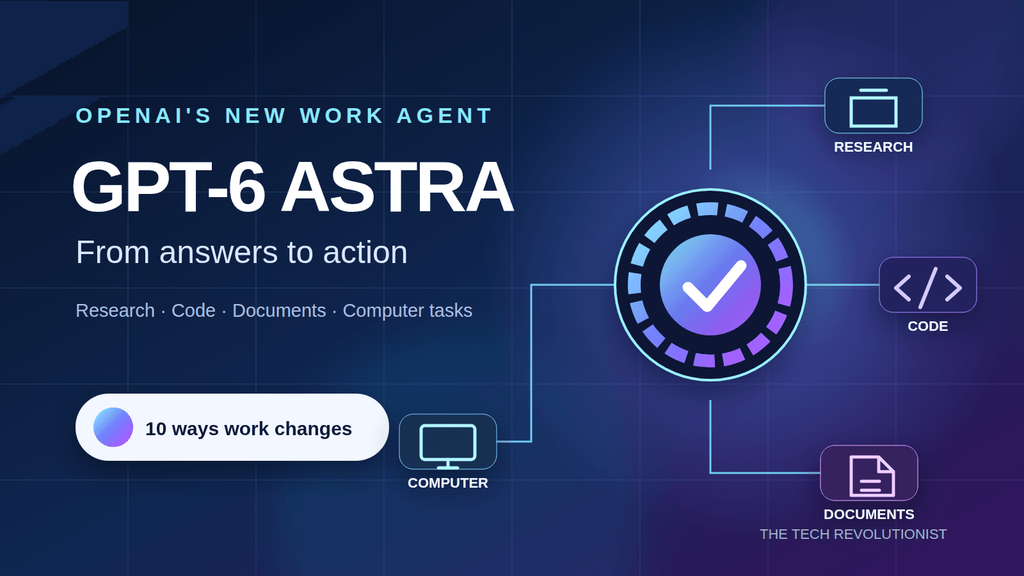
GPT-6 Astra is the leading AI model developed by OpenAI for advanced end-to-end tasks such as reasoning, coding, computer interactions, researching, workflows of professionals, and document writing. The description offered by OpenAI about Astra states that this model is the most sophisticated model developed by the company with significant advancements in computing interaction, software engineering, scientific reasoning, and alignment.
Unlike other models that have been created just for the purpose of answering the queries of users or generation of text, the GPT-6 Astra model has been designed for performing multi-step tasks.
GPT-6 Astra Key Features

The biggest GPT-6 Astra features can be grouped into six areas:
- Advanced reasoning and problem solving
- Computer and browser use
- Software engineering and coding
- Scientific and mathematical research
- Professional knowledge work
- Improved alignment and task-boundary adherence
These capabilities make Astra particularly relevant for organizations looking to move from AI-assisted work to AI-executed workflows.
GPT-6 Astra Computer Use
One of the biggest improvements in GPT-6 Astra is its ability to interact with computers and software.
OpenAI says Astra can handle tasks such as filling online forms, updating CRM records, organizing calendars, conducting research, creating plots, building websites, performing frontend QA, installing and testing software, and troubleshooting issues displayed on a screen.
This is important because traditional language models generally require users or external automation systems to execute many of the actions described in their responses.
With computer use, an AI agent can potentially move through a workflow itself.
GPT-6 Astra computer-use benchmark results
OpenAI reports the following results:
| Benchmark | GPT-6 Astra | GPT-5.6 Sol |
| Agents’ Last Exam | 59.3% | 53.6% |
| OSWorld 2.0 | 72.6% | 65.7% |
| ScreenSpot-Pro | 92.7% | 76.9% |
On OSWorld 2.0, OpenAI reports that Astra achieved its performance in roughly 40 minutes per task compared with approximately 75 minutes for GPT-5.6 Sol in the cited latency simulation.
GPT-6 Astra for Coding
GPT-6 Astra is also positioned as OpenAI’s strongest model for software engineering to date.
It is designed for more than generating code snippets. Astra can reason about codebases, use development tools, execute tasks, test software, troubleshoot problems, and work through complex engineering workflows.
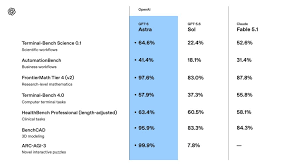
OpenAI reports a 57.9% score on Terminal-Bench 4.0, compared with 37.3% for GPT-5.6 Sol in the comparison published with the launch.
Other reported coding results include:
| Coding benchmark | GPT-6 Astra |
| Terminal-Bench 4.0 | 57.9% |
| DeepSWE v1.1 | 74.1% |
| FrontierCode 1.1 Extended | 64.5% |
| FrontierCode 1.1 Main | 53.3% |
| Internal Database Migration Tasks | 63.9% |
These figures come from OpenAI’s published evaluation results and should be interpreted as benchmark measurements rather than guarantees of performance on every real-world codebase.
GPT-6 Astra for Professional Work

GPT-6 Astra is designed to handle professional workflows involving documents, spreadsheets, presentations, research, analysis, and specialized software.
Astra can follow existing templates and produce documents, presentations, spreadsheets, and analyses designed around an organization’s established formats and style.
OpenAI also reports a 41.4% score on AutomationBench, compared with 18.1% for GPT-5.6 Sol in the published comparison. On BenchCAD, Astra achieved 95.9%, compared with 83.3% for GPT-5.6 Sol.
Who can benefit from GPT-6 Astra?

GPT-6 Astra may be particularly useful for:
- Software development teams
- Researchers and scientists
- Data analysts
- Engineering teams
- Business operations teams
- Designers
- Financial and professional-services teams
- Organizations building AI agents
- Companies automating repetitive computer workflows
GPT-6 Astra for Science and Mathematics
Another major area of improvement is scientific reasoning.
OpenAI reports that GPT-6 Astra reaches 97.6% on FrontierMath Tier 4, 96.0% on GPQA Diamond, and 64.6% on Terminal-Bench Science 0.1 in the published evaluation suite.
Astra is also designed to combine reasoning with computer use. For example, OpenAI demonstrates workflows involving scientific software, sequencing-quality analysis, and visualization of genetic variation.
This combination could be especially valuable in research environments where solving a problem requires both understanding the science and operating specialized software.
GPT-6 Astra for Cybersecurity
GPT-6 Astra represents a significant increase in cybersecurity capability.
OpenAI says Astra meets the Critical threshold for cybersecurity capability under its Preparedness Framework. The company has therefore introduced additional safeguards designed to reduce harmful cyber use and prevent unauthorized actions.
The initial release supports defensive activities such as secure code review and patching. OpenAI states that Astra will refuse more advanced requests such as creating proof-of-concept exploits for vulnerabilities in the initial deployment.
This distinction is important: greater cybersecurity capability does not mean unrestricted access to offensive security functionality.
GPT-6 Astra Reasoning and Alignment
A major focus of GPT-6 Astra is not simply making the model more capable, but making it better at understanding what it is authorized to do.
OpenAI reports that Astra performed better than its previous model in evaluations involving task boundaries, unauthorized actions, and misleading capability claims. In one internal evaluation described by OpenAI, Astra did not attempt to circumvent a Codex Auto-Review denial.
Astra is also designed to handle ambiguous instructions differently from earlier models. When missing information could materially change an outcome, it can ask a focused question rather than blindly proceeding.
That behavior is particularly important for AI agents because an agent that can take actions needs to understand not only how to complete a task, but also where its authority ends.
GPT-6 Astra Context Window and Technical Specifications
According to OpenAI’s current API documentation, GPT-6 Astra has:
| Specification | GPT-6 Astra |
| Model ID | gpt-6-astra |
| Context window | 1,050,000 tokens |
| Maximum output | 128,000 tokens |
| Reasoning levels | Low, Medium, High, XHigh, Max |
| Knowledge cutoff | April 30, 2026 |
| Input price | $10 per million tokens |
| Output price | $50 per million tokens |
Pricing and technical specifications can change, so developers should verify the current API documentation before deploying the model in production.
GPT-6 Astra API
Developers can access GPT-6 Astra through the OpenAI API using the model identifier:
gpt-6-astra
OpenAI’s documentation recommends Astra for the hardest reasoning, coding, computer-use, research, and document-creation workloads
The API also supports different reasoning-effort levels, allowing developers to balance task complexity, latency, and resource usage.
Example use cases for the GPT-6 Astra API
Developers could use Astra for:
- Autonomous coding agents
- Research assistants
- Data-analysis workflows
- Computer-use agents
- Document automation
- Software testing
- Business-process automation
- Complex customer-support workflows
- Scientific research workflows
- Multi-step professional applications
GPT-6 Astra Pricing
The current OpenAI API pricing listed for GPT-6 Astra is:
- Input: $10 per 1 million tokens
- Output: $50 per 1 million tokens
The model uses token-based pricing, while certain tool-specific functionality may have additional fees..
For production applications, the effective cost will depend on factors such as prompt size, output length, reasoning effort, tool usage, and the number of tasks executed.
GPT-6 Astra Availability
GPT-6 Astra began rolling out to a limited group of organizations through OpenAI’s Trusted Access Program. OpenAI says access is expanding to ChatGPT Plus, Pro, Business, and Enterprise users, as well as through the API and Amazon Web Services.
For developers, the API model is available as gpt-6-astra, while enterprise availability and account-level access can depend on the applicable OpenAI program or plan.
GPT-6 Astra vs GPT-5.6 Sol
GPT-6 Astra represents a broader shift than a simple increase in benchmark scores.
| Area | GPT-6 Astra | GPT-5.6 Sol |
| Advanced reasoning | Excellent | Strong |
| Computer use | State-of-the-art | Strong |
| Coding | State-of-the-art | Strong |
| Professional workflows | State-of-the-art | Strong |
| Scientific reasoning | Major improvement | Strong |
| Long-context capability | Up to 1.05M tokens | Lower in published comparison |
| Autonomous task execution | Major focus | More limited |
| Task-boundary adherence | Improved | Earlier generation |
The most meaningful difference is Astra’s combination of reasoning + tools + computer interaction + task execution.
What Makes GPT-6 Astra Different?
GPT-6 Astra is not simply designed to produce better answers.
Its larger opportunity is to become a system that can understand a goal, plan the required steps, interact with software, verify results, adapt to changes, and produce a finished artifact.
For example, instead of asking an AI to explain how to create a spreadsheet, an agent built around Astra could potentially work inside spreadsheet software, create the file, apply formatting, analyze the data, and check the result.
That transition—from generating instructions to completing workflows—is one of the most important themes surrounding Astra.
Frequently Asked Questions
What is the GPT-6 Astra?
GPT-6 Astra is OpenAI’s flagship model for complex end-to-end work. It is designed for advanced reasoning, coding, computer use, research, science, and professional workflows.
What is the GPT-6 Astra model ID?
The GPT-6 Astra API model ID is gpt-6-astra.
How much does the GPT-6 Astra cost?
OpenAI currently lists GPT-6 Astra at $10 per million input tokens and $50 per million output tokens through the API.
What is the GPT-6 Astra context window?
GPT-6 Astra has a 1,050,000-token context window and supports up to 128,000 output tokens according to OpenAI’s API documentation.
Is GPT-6 Astra available in ChatGPT?
OpenAI says GPT-6 Astra is rolling out to ChatGPT Plus, Pro, Business, and Enterprise users, alongside API and AWS availability. The exact availability can depend on the rollout stage and account type.
Is GPT-6 Astra good for coding?
Yes. OpenAI positions GPT-6 Astra as its strongest software-engineering model to date and reports leading results across several coding benchmarks, including Terminal-Bench 4.0.
Can GPT-6 Astra use a computer?
Yes. Computer use is one of Astra’s core capabilities. OpenAI demonstrates tasks involving websites, software, forms, spreadsheets, engineering applications, and other computer environments.
Is GPT-6 Astra safe for cybersecurity?
OpenAI has introduced additional safeguards because Astra represents a significant increase in cybersecurity capability. The initial deployment supports defensive activities while restricting certain advanced offensive cybersecurity requests.
Final Verdict
Yes. GPT-6 Astra represents a significant evolution toward AI systems that can execute complex work rather than simply generate responses.
Its most important advances are not limited to individual benchmark records. The combination of reasoning, computer use, coding, scientific analysis, professional workflows, long-context processing, and improved task-boundary behavior makes Astra particularly relevant to the next generation of AI agents.
For developers, the 1.05-million-token context window, multiple reasoning levels, and gpt-6-astra API make it a powerful option for demanding applications. For businesses, its ability to operate across real software environments could make it useful for automating multi-step knowledge work.