




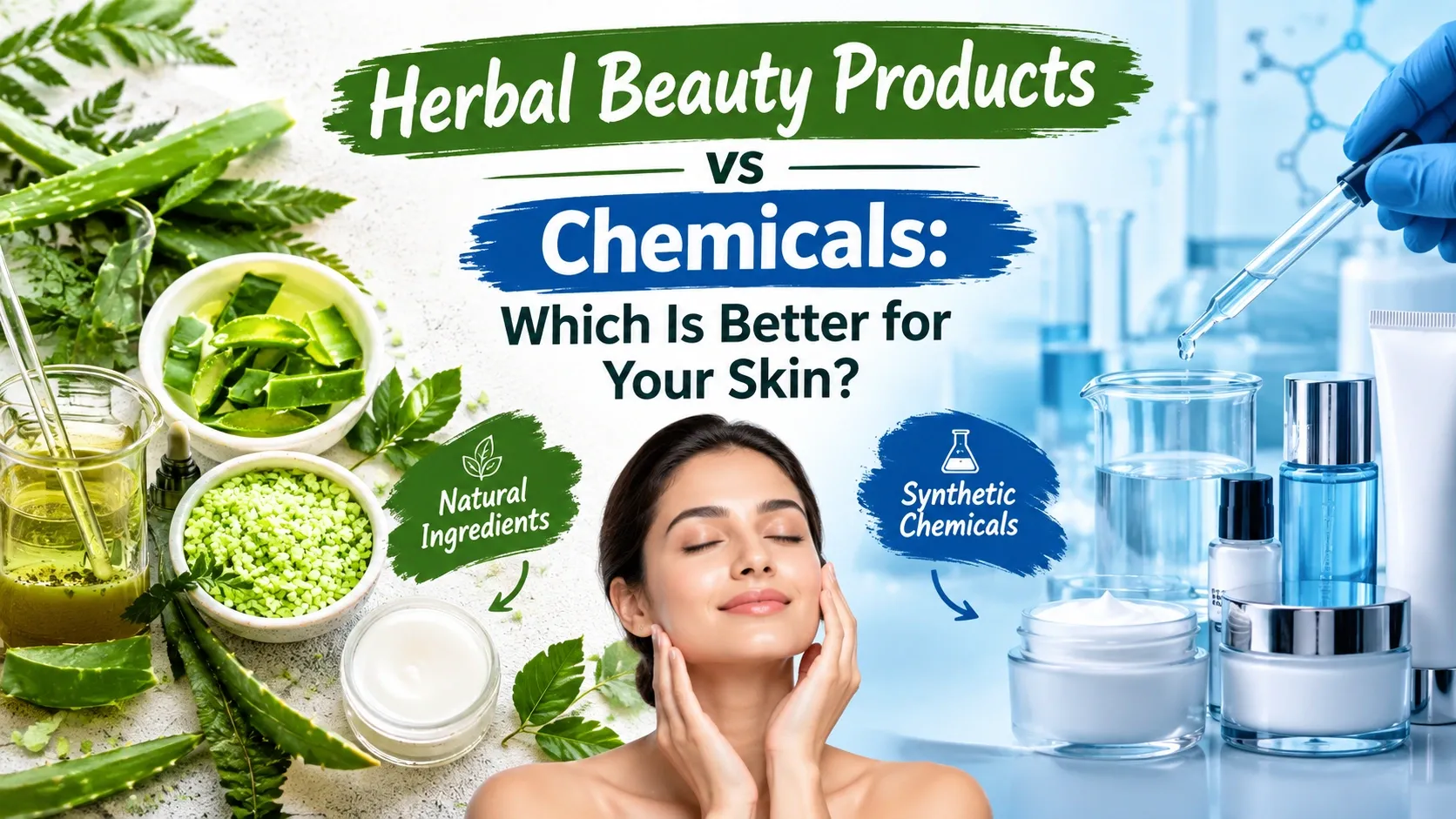
Herbal Beauty Products vs Chemicals: When choosing skincare and beauty products, the biggest question is often whether herbal beauty products are better than chemical-based products. Herbal products are commonly associated with natural ingredients, traditional remedies, and gentle skincare, while “chemical” products are sometimes viewed as harsh or unsafe.
However, this comparison is not as simple as it sounds. Scientifically, herbal ingredients are also made up of chemicals. Water, aloe vera, turmeric and vitamin C are all chemicals. Therefore, the more useful comparison is between plant-derived and synthetic ingredients, while also considering the safety, formulation, and effectiveness of the finished product.
Understanding Herbal and Chemical Beauty Products
Herbal and chemical-based beauty products differ mainly in the types of ingredients used, their formulation and how they are processed. However, the distinction between “natural” and “chemical” is often misunderstood because every cosmetic product contains chemical substances. What matters most is the safety, concentration, quality and purpose of each ingredient.
What Are Herbal Beauty Products?
Herbal beauty products contain ingredients derived from plants, herbs, flowers, roots, seeds or botanical extracts. Common examples include aloe vera, turmeric, neem, green tea, rose, chamomile, coconut oil and sandalwood.
Herbal skincare has a particularly strong connection with traditional beauty practices in India. Ayurvedic and other traditional approaches have used botanical ingredients for generations, while modern cosmetic brands now combine plant extracts with contemporary formulations.
Many botanical ingredients contain antioxidants, fatty acids and other compounds that may provide moisturizing, soothing or protective properties. However, “natural” does not automatically mean that an ingredient is suitable for everyone.
The U.S. Food and Drug Administration (FDA) notes that natural or organic cosmetic ingredients are not automatically safer than ingredients obtained from other sources.
What Are Chemical-Based Beauty Products?
The term “chemical beauty products” is commonly used to describe products containing synthetic or laboratory-produced ingredients. However, the term can be misleading because every cosmetic product contains chemicals.
Synthetic ingredients may be used as preservatives, emulsifiers, cleansing agents, fragrances, pigments or active skincare ingredients. Some are specifically developed to improve product stability, texture, absorption and performance.
For example, preservatives can help prevent microbial contamination in water-based skincare products. Without appropriate preservation, products such as creams and lotions could become contaminated and potentially unsafe.
Therefore, the presence of synthetic ingredients does not automatically mean that a beauty product is harmful.
Source to be Used:
Herbal Beauty Products vs Chemicals: Benefits and Safety
Both herbal and synthetic ingredients can have a place in modern skincare. The right choice depends on the skin concern, formulation and individual sensitivity rather than simply whether a product is labelled natural or chemical.
Are Herbal Beauty Products Safer?
The simple answer is not necessarily.
A herbal ingredient can cause irritation or an allergic reaction, while a synthetic ingredient may be well tolerated by the skin. The opposite can also occur.
Essential oils and botanical extracts, for example, contain naturally occurring compounds that may trigger sensitivity in some individuals. Fragrance is also a common cause of contact dermatitis.
This is why skincare safety should be judged according to the individual ingredient, concentration, formulation and person’s skin sensitivity rather than simply the word “natural.”
For sensitive skin, fragrance-free and properly formulated products may be more appropriate than products containing numerous botanical extracts or essential oils.
Benefits of Herbal Beauty Products
Herbal beauty products can offer several advantages when they are properly formulated.
Ingredients such as aloe vera, green tea and chamomile are commonly used in skincare because of their soothing and antioxidant properties. Plant oils can also act as emollients and help improve the feel of dry skin.
Another advantage is the connection with traditional beauty practices. In India, ingredients such as turmeric, neem, aloe vera and coconut oil have long been associated with personal care.
However, the amount and quality of a botanical extract matter. A product containing a plant ingredient does not automatically provide the same benefits demonstrated in laboratory or clinical research.
Benefits of Synthetic Ingredients
Synthetic ingredients also have an important role in modern skincare.
Cosmetic chemistry allows manufacturers to develop ingredients with specific properties and predictable performance. Synthetic ingredients may improve texture, stability, preservation, cleansing and product consistency.
Some widely used skincare ingredients are also produced through controlled chemical processes. Their effectiveness depends on their formulation and concentration rather than simply on whether they are natural or synthetic.
This means that a well-formulated product containing synthetic ingredients can be just as appropriate for skincare as a product containing botanical ingredients.
Herbal vs Chemical Skincare for Sensitive Skin
Sensitive skin needs extra attention when selecting beauty products.
Choosing a product because it is labelled “herbal” does not guarantee that it will be gentle. Botanical extracts, essential oils and fragrances can cause irritation in sensitive individuals.
A better approach is to check the complete ingredient list and introduce new products gradually.
Patch testing can also help identify potential reactions before applying a new product to larger areas of the skin. The American Academy of Dermatology recommends testing skincare products on a small area and monitoring the skin for signs such as redness, itching or swelling.
Anyone experiencing persistent or severe irritation should stop using the suspected product and seek professional dermatological advice.
Which Is Better: Herbal or Chemical Beauty Products?
There is no universal winner in the herbal beauty products vs chemicals debate.
A properly formulated herbal product can be a good choice for some people. A product containing synthetic ingredients can also be safe and effective.
The better choice depends on the specific skincare goal, ingredient profile, concentration, formulation and individual skin sensitivity.
Instead of asking whether a product is herbal or chemical, a more useful question is:
Are the ingredients safe, effective and suitable for the skin?
This approach avoids the common misconception that everything natural is automatically safe and everything synthetic is automatically harmful.
Ultimately, the best beauty product is not necessarily the most natural or the most synthetic. It is the product that is appropriately formulated, supported by reliable evidence and suitable for the individual’s skin needs.
Read More.