



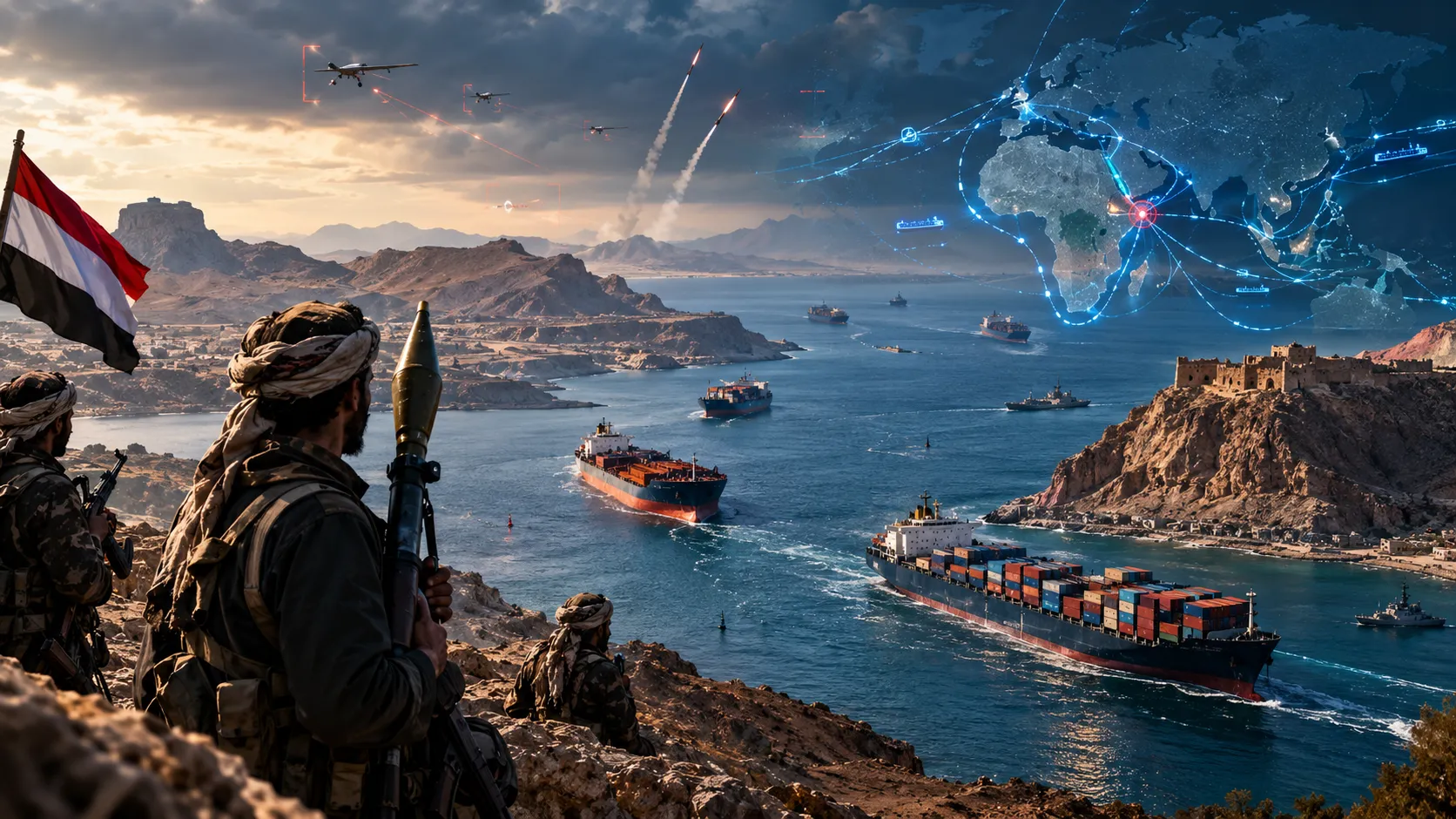
The Houthi Red Sea crisis has entered a potentially more dangerous phase after Houthi forces made significant advances along Yemen’s western coastline, including the reported capture of the strategic port of Mocha and movement toward islands near the Bab el-Mandeb Strait.
The development matters far beyond Yemen.
Bab el-Mandeb is one of the world’s most important maritime chokepoints, connecting the Red Sea and Gulf of Aden. Ships using the route can then reach the Suez Canal and continue between Europe and Asia.
The latest Houthi advances therefore raise a major global question: Could the group gain enough influence over the Red Sea corridor to seriously disrupt international shipping, oil supplies and global trade?
The answer is not certain, but the risk has increased.
Recent reporting says Houthi forces have moved closer to the Bab el-Mandeb after capturing Mocha and advancing toward strategic islands. Reuters reported that the development could threaten shipping and Saudi oil-export routes.
What Is Happening in the Red Sea?
Fighting in Yemen has sharply intensified after years of relative calm following the 2022 ceasefire.
The Iran-aligned Houthi movement has expanded its position along Yemen’s Red Sea coast, while Saudi-backed Yemeni forces are attempting to stop the advance.
The Houthis have reportedly captured Mocha and made gains toward strategic islands in and around the southern Red Sea. Reuters reported that the advances bring the group closer to the Bab el-Mandeb, the narrow maritime gateway connecting the Red Sea with the Gulf of Aden.
The development comes amid a wider Middle East conflict that has already disrupted other major shipping routes.
That makes the Red Sea particularly important.
If maritime traffic through the Red Sea becomes unsafe, shipping companies may have to choose between accepting higher security risks or taking much longer routes around Africa.
Why Is Bab el-Mandeb So Important?
Bab el-Mandeb is a strategic chokepoint for international shipping.
It sits between Yemen on the Arabian Peninsula and Djibouti and Eritrea in the Horn of Africa.
For ships traveling between Asia and Europe, the normal route is:
Indian Ocean → Gulf of Aden → Bab el-Mandeb → Red Sea → Suez Canal → Mediterranean Sea → Europe
This route is considerably shorter than sailing around the southern tip of Africa.
That makes the strait economically valuable.
The International Maritime Organization has repeatedly described the Red Sea as a critical maritime corridor for international trade and warned that attacks threaten global supply chains.
What Do Houthi Attacks Mean for Global Shipping?
The immediate concern is security.
If shipping companies believe vessels could be targeted by missiles, drones or other attacks, operators may avoid the Red Sea altogether.
That has happened before.
During earlier phases of the Red Sea crisis, major shipping companies diverted vessels around the Cape of Good Hope rather than passing through the Suez Canal route.
That alternative adds thousands of nautical miles to some journeys.
The consequences can include:
- Longer delivery times
- Higher fuel consumption
- Higher insurance costs
- Increased freight rates
- Delays in container deliveries
- Higher inventory costs for businesses
- Pressure on consumer prices
- Greater volatility in energy markets
The IMO has warned that continued attacks could further disrupt commercial routes and undermine freedom of navigation.
Could the Red Sea Crisis Affect the Suez Canal?
Yes, indirectly.
The Houthis do not control the Suez Canal itself.
The canal is in Egypt, far north of Yemen.
But the two waterways are commercially connected.
A ship traveling from Asia to Europe through the Suez Canal normally has to pass through the Red Sea and Bab el-Mandeb first.
If the southern Red Sea becomes too dangerous, a shipping company may decide that using the Suez route is no longer commercially viable.
The vessel can instead travel around Africa.
That means a crisis near Yemen can reduce traffic through the Suez Canal even though the Houthis have no control over the canal itself.
This is one of the most important connections between Houthi attacks and global trade.
How Much Longer Is the Route Around Africa?
The exact additional distance depends on the origin and destination.
But rerouting around the Cape of Good Hope can add substantial sailing time compared with the Suez route.
For some Asia-Europe voyages, the difference can amount to weeks rather than days once additional congestion, fuel requirements and scheduling changes are included.
Recent reporting has warned that escalating Red Sea tensions could add roughly a month to some Asia-bound oil shipments if tankers avoid the region.
That additional time has a direct economic cost.
A ship that takes longer to complete a round trip is effectively unavailable for another voyage.
As a result, global shipping capacity can tighten even if the number of ships has not changed.
What About Oil Prices?
The Red Sea crisis is also an energy-market problem.
Oil tankers use maritime routes to transport crude and petroleum products between producing regions and major consumers.
The strategic importance of the Red Sea has increased because other regional shipping routes have simultaneously faced disruption.
Recent reports said oil prices had already moved above $100 per barrel amid fears that the fighting could further threaten energy routes.
The potential chain reaction is straightforward:
Houthi attacks → higher maritime risk → rerouting → longer voyages → higher shipping costs → tighter supply → potential pressure on oil prices
That does not mean every Houthi attack automatically causes a global oil shock.
The actual impact depends on how long disruptions last, how much cargo is rerouted and whether alternative export routes remain available.
Why Has Houthi Power Increased?
The latest advances are occurring against the background of Yemen’s long-running civil war and wider regional rivalries.
The Houthis have developed significant military capabilities, including missiles and drones.
Iran has provided political and military support to the group, although Tehran has repeatedly denied directly controlling Houthi operations.
The current Houthi advance is strategically important because controlling more territory along Yemen’s western coast could give the group greater leverage over maritime routes.
Reuters reported that the Houthi advance toward the southern Red Sea has significantly shifted the regional balance and increased pressure on Saudi Arabia and other Gulf states.
Are Houthi Forces Trying to Control Global Shipping?
The Houthis have said their maritime operations are linked to the broader regional conflict and have previously framed attacks around political and military objectives.
Their current position is more complicated than simply attempting to “control global shipping.”
Houthi officials have said certain commercial vessels would not be targeted, while Saudi-linked shipping remains a particular focus of their declared blockade.
That means the immediate threat is better understood as selective disruption and increased insecurity, rather than a complete attempt to shut down every vessel in the Red Sea.
However, shipping companies do not necessarily need to believe that every vessel will be attacked.
If the perceived risk becomes high enough, companies may voluntarily reroute.
That alone can disrupt global trade.
What Makes the Current Crisis Different?
The latest development is significant because the Houthis are not merely launching attacks from isolated positions.
Their reported territorial advances along the Red Sea coast could put them closer to the geography surrounding the Bab el-Mandeb.
Reuters reported that the group has captured Mocha and advanced toward strategically important islands.
That creates a potentially different security environment.
A group with greater territorial depth near a maritime chokepoint may have more opportunities to deploy, resupply and sustain attacks.
At the same time, the situation remains fluid.
Saudi Arabia and Yemeni government forces continue to contest Houthi gains, and the final military balance could change rapidly.
What Does This Mean for Global Trade?
The biggest danger is a supply-chain domino effect.
Consider a typical consumer product manufactured in Asia and sold in Europe.
If the ship carrying its components or finished goods must travel around Africa:
- The voyage takes longer.
- Fuel consumption increases.
- Insurance costs can rise.
- Shipping capacity becomes tighter.
- Delivery schedules become less predictable.
- Importers may increase inventories.
- Retailers can face higher logistics costs.
- Some of those costs can eventually reach consumers.
The same principle applies to industrial components, automobiles, electronics, machinery and energy products.
The IMO has specifically warned that attacks in the Red Sea threaten the stability of global supply chains.
Could This Affect India?
Potentially, especially through shipping costs, energy prices and delivery times.
India has extensive trade links with Europe, the Middle East and other markets connected through the Red Sea and Suez route.
A prolonged disruption could increase freight and insurance costs for Indian exporters and importers.
Energy markets could create another channel.
If oil prices rise because of wider regional disruptions, countries that import large quantities of crude could face higher energy costs.
The exact impact on India would depend on oil prices, alternative shipping routes, the duration of the crisis and the ability of Indian companies to absorb higher logistics expenses.
What Does This Mean for Europe?
Europe is particularly exposed to disruptions along the Asia-Europe maritime corridor.
Manufacturers depend heavily on imports from Asia, while European exporters also use the same route to reach Asian markets.
A prolonged Red Sea disruption could therefore affect:
- European manufacturing
- Retail supply chains
- Automobile components
- Electronics
- Consumer goods
- Energy imports
- Shipping companies
- Port operations
The longer ships spend at sea, the greater the pressure on the entire logistics network.
Could Shipping Costs Rise Again?
Yes, if major shipping companies conclude that the Red Sea is too risky.
There are three broad possibilities.
Scenario 1: Limited disruption
Attacks remain selective and shipping companies continue using the Red Sea with additional security measures.
Global impact: relatively contained.
Scenario 2: Widespread rerouting
More shipping companies avoid Bab el-Mandeb and send vessels around Africa.
Global impact: longer delivery times, higher freight rates and supply-chain delays.
Scenario 3: Major maritime blockade
If fighting results in sustained disruption around Bab el-Mandeb, a much larger portion of global trade could be forced onto alternative routes.
Global impact: potentially severe pressure on shipping, energy markets and inflation.
At present, the third scenario should be treated as a risk scenario, not as an established outcome.
What Is the International Maritime Organization Saying?
The IMO has repeatedly condemned attacks on international shipping in the region.
After a deadly August attack involving the cargo ship TIHAMAH off Yemen’s coast, IMO Secretary-General Arsenio Dominguez said continued attacks threatened global supply chains and called for protection of seafarers.
The organization has also urged ship operators to conduct careful risk assessments before transiting the region.
That highlights a key point: the Red Sea crisis is not only about geopolitics.
It is also about the safety of civilian crews.
Thousands of seafarers depend on these routes for their livelihoods, and maritime disruptions can expose them to missile, drone and other security threats.
What Happens Next?
The next major question is whether Houthi territorial gains near the Red Sea become permanent.
Several developments will be important to watch:
- Whether Houthi forces maintain control of Mocha
- Whether they advance further toward Bab el-Mandeb
- Whether strategic islands remain under their control
- How Saudi Arabia responds militarily
- Whether the Yemeni government can regain territory
- Whether shipping companies begin widespread rerouting
- Whether oil prices remain elevated
- Whether diplomatic efforts can reduce tensions
The situation could also become part of a much wider regional confrontation involving Iran, Saudi Arabia and the United States.
The Bigger Picture: Why the Red Sea Matters to Everyone
The Houthi Red Sea crisis demonstrates why a relatively narrow waterway can have consequences far beyond the Middle East.
The Red Sea connects some of the world’s most important commercial economies.
A disruption near Yemen can affect a container ship in Asia, a factory in Europe, an oil market in the Gulf and ultimately the price consumers pay for imported goods.
That is the power of a maritime chokepoint.
The immediate concern is not that the Houthis can literally control all global trade.
It is that greater Houthi military influence around Bab el-Mandeb could make one of the world’s most important shipping corridors significantly more dangerous.
If vessels are forced to reroute, the effects can spread through freight rates, delivery times, energy markets and supply chains.
For that reason, what happens along Yemen’s Red Sea coast is now a global economic issue not simply another chapter in Yemen’s long-running conflict.
FAQ
Why is the Houthi Red Sea crisis important?
The crisis matters because Houthi advances along Yemen’s Red Sea coast are bringing the group closer to the strategic Bab el-Mandeb Strait, a key maritime gateway connecting the Red Sea with the Gulf of Aden. Disruption there can affect shipping between Asia and Europe.
What is Bab el-Mandeb?
Bab el-Mandeb is a narrow maritime chokepoint between Yemen and the Horn of Africa. It connects the Gulf of Aden with the Red Sea and is part of the shipping route leading toward the Suez Canal.
How do Houthi attacks affect global shipping?
Houthi attacks can increase the perceived security risk for commercial vessels. If shipping companies avoid the Red Sea, ships may have to travel around the Cape of Good Hope, increasing voyage times, fuel consumption, insurance and freight costs.
Will Houthi attacks affect the Suez Canal?
The Houthis do not control the Suez Canal. However, attacks around Bab el-Mandeb can indirectly reduce Suez traffic because ships must pass through the Red Sea to reach the canal from the south.
Could the Red Sea crisis increase oil prices?
Yes, particularly if the disruption affects significant oil-tanker traffic or coincides with problems at other Middle Eastern shipping chokepoints. Recent escalation has already contributed to renewed concerns about global oil supplies.
Are the Houthis trying to stop all ships?
Not necessarily. Houthi officials have made distinctions between different categories of shipping and have said some commercial vessels would not be targeted. Nevertheless, the risk of attacks can be enough to cause shipping companies to reroute.
Why is Mocha important?
Mocha is a strategic port on Yemen’s western coast. Its reported capture gives Houthi forces a stronger position along the Red Sea and brings them closer to the Bab el-Mandeb area.
Could the crisis affect India?
A prolonged disruption could increase shipping, insurance and energy costs for Indian businesses. The impact would depend on how long the disruption lasts and whether shipping companies continue using the Red Sea or divert around Africa.
What is the IMO saying about the Red Sea crisis?
The International Maritime Organization has condemned attacks on commercial shipping and warned that continued violence threatens seafarers and global supply chains.