


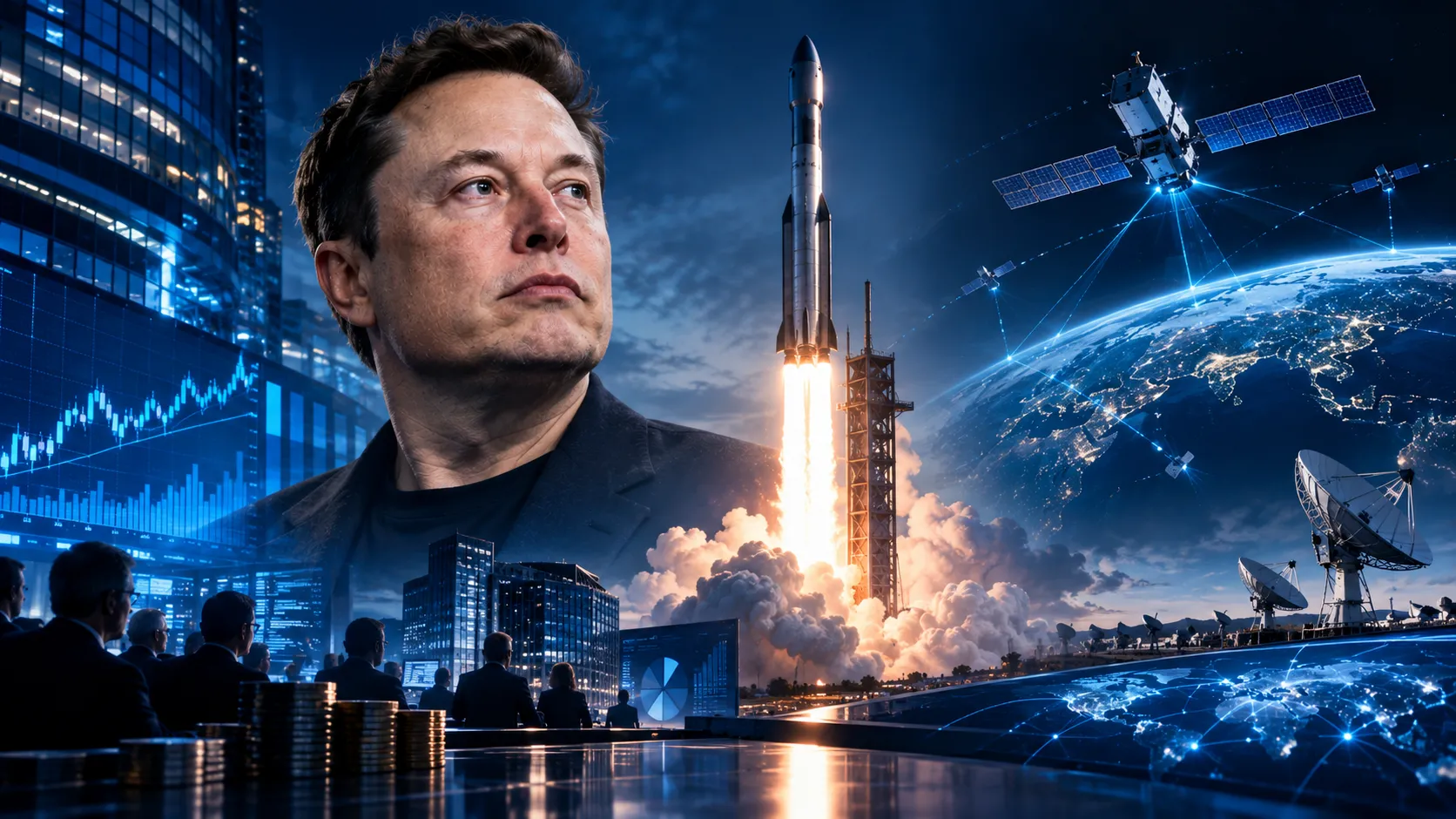
A little-known investment firm has emerged as one of the biggest financial winners from Elon Musk’s SpaceX.
Vy Capital, a relatively secretive venture capital firm, has accumulated a 3.4% stake in SpaceX that is now worth approximately $40 billion, according to the Financial Times. That makes Vy one of SpaceX’s five largest shareholders and puts it ahead of several better-known Silicon Valley venture firms.
But there is an important distinction behind the headline: Vy Capital did not simply write a new $40 billion cheque to SpaceX. The $40 billion figure represents the estimated current value of its accumulated ownership stake.
The investment story is especially striking because Vy began backing SpaceX when the company was valued at around $15 billion in 2016.
Since then, SpaceX has evolved from a private rocket company into a much broader technology business spanning launch services, satellite connectivity, AI infrastructure and other space-related technologies.
Who bought the $40 billion SpaceX stake?
The investor is Vy Capital, a venture capital firm founded in 2014 and led by investors including Alexander Tamas and John Hering.
The Financial Times reports that Vy’s current SpaceX ownership stands at approximately 3.4%, with the stake valued at around $40 billion.
The firm is known for maintaining a relatively low public profile compared with major Silicon Valley investors such as Andreessen Horowitz and Sequoia Capital.
Its SpaceX investment dates back to 2016, when SpaceX was valued at roughly $15 billion.
That early entry is crucial to understanding how a relatively modest original investment eventually became such a valuable asset.
Is Vy Capital a new SpaceX investor?
No.
This is one of the most important points behind the $40 billion headline.
Vy has been a SpaceX investor for years. Its stake has grown in value alongside SpaceX rather than representing a single newly announced $40 billion investment round.
The firm’s reported 3.4% holding is therefore a reflection of the extraordinary increase in SpaceX’s valuation over the past decade.
Why has Vy Capital’s SpaceX stake become so valuable?
The answer is the dramatic expansion of SpaceX’s business.
When Vy invested in 2016, SpaceX was primarily known for developing reusable rockets and launching satellites.
Today, its business ecosystem is much larger.
Starlink changed the investment story
One of SpaceX’s biggest growth engines has been Starlink, its satellite internet business.
Instead of relying only on rocket launches, SpaceX can generate recurring revenue from satellite connectivity while simultaneously building one of the world’s largest commercial satellite constellations.
This has transformed investor perceptions of the company.
SpaceX is no longer simply a launch company.
It has become a combination of:
- Aerospace company
- Satellite communications provider
- Launch-services business
- Space infrastructure company
- AI and computing infrastructure player
That diversification helps explain why early investors have seen enormous gains.
SpaceX’s 2026 IPO changed its investment landscape
Another major reason the value of SpaceX investments has become easier to track is the company’s historic 2026 IPO.
SpaceX priced its initial public offering at $135 per share and began trading on Nasdaq under the ticker SPCX on June 12, 2026.
The company ultimately raised approximately $85.7 billion from the IPO after underwriters exercised their full overallotment option.
That public listing fundamentally changed SpaceX’s financial profile.
Before the IPO, investors and analysts had to rely heavily on private-market transactions and funding rounds to estimate the company’s value.
After the IPO, SpaceX shares began trading publicly, allowing the market to continuously revalue the company.
That also made large shareholder positions far more visible.
Who are the biggest SpaceX investors?
Vy Capital is now among SpaceX’s largest shareholders, but it is not the only major investor with a huge exposure to the company.
Elon Musk remains by far the most important shareholder and voting power holder.
A SpaceX regulatory filing showed Musk held a substantial ownership position through multiple classes of shares, trusts and other interests. The filing also showed the importance of SpaceX’s dual-class share structure to Musk’s control of the company.
Other major investors include institutions that backed SpaceX before or around its transition to public markets.
Alphabet’s enormous SpaceX bet
One of the most notable examples is Alphabet, Google’s parent company.
Reuters reported that Alphabet’s SpaceX stake was worth approximately $94 billion at the end of June 2026, compared with an original investment of about $900 million in 2015.
That investment illustrates the scale of returns early SpaceX backers have potentially generated.
Alphabet’s position also demonstrates why SpaceX has become such an important asset for major technology investors.
Why is SpaceX attracting so much investor interest?
The company’s appeal comes from several businesses that could potentially grow simultaneously.
1. Starlink
Starlink provides satellite broadband and has turned SpaceX’s satellite network into a commercial service.
Its global reach gives SpaceX exposure to telecommunications in addition to the space industry.
2. Reusable rockets
SpaceX’s reusable launch technology has significantly changed the economics of orbital launches.
The Falcon 9 system allows the company to reuse major rocket components, helping it maintain a high launch cadence.
3. Starship
SpaceX is also developing Starship, its much larger next-generation launch system.
If Starship achieves its long-term goals, it could dramatically expand the company’s launch capacity and support missions involving satellites, cargo and eventually human spaceflight.
4. AI and computing
SpaceX’s business strategy has increasingly intersected with artificial intelligence and computing infrastructure.
Recent reporting has highlighted the company’s growing AI-related ambitions and data-center investments, adding another potential growth avenue beyond traditional aerospace.
This broader technology strategy is one reason some investors increasingly view SpaceX as more than a rocket manufacturer.
What makes Vy Capital’s SpaceX investment unusual?
Vy’s strategy stands out because of its long-term relationship with Musk’s companies.
The firm has invested in several businesses associated with Musk, including The Boring Company and Neuralink, and it also contributed about $700 million toward Musk’s 2022 acquisition of Twitter.
That gives Vy something few investors have: extensive exposure to multiple parts of Musk’s technology ecosystem.
The firm is reportedly managing about $50 billion in assets, according to the Financial Times, despite maintaining a relatively small investment team and a low public profile.
Its SpaceX position therefore represents a major concentration of capital around one of the world’s most valuable technology companies.
Did Vy Capital invest $40 billion in SpaceX?
No. The $40 billion figure refers to the estimated value of Vy Capital’s current SpaceX stake, not the amount it originally invested.
Vy started investing in SpaceX in 2016, when the company was valued at approximately $15 billion. Its reported 3.4% ownership is now worth around $40 billion because SpaceX’s valuation has increased dramatically.
This distinction matters because saying that Vy “invested $40 billion” could incorrectly suggest a recent financing transaction.
The more accurate description is that Vy has built a SpaceX stake now worth about $40 billion.
What does the $40 billion SpaceX stake mean for Elon Musk?
For Musk, the development highlights the enormous amount of outside institutional capital now tied to SpaceX.
However, the arrival of large institutional shareholders does not mean Musk has lost control.
SpaceX’s share structure gives different voting rights to different classes of stock, and regulatory filings have shown Musk maintaining overwhelming voting influence.
That means investors can own economically significant portions of SpaceX without necessarily having equivalent control over corporate decisions.
This distinction is especially important for investors assessing Musk-led companies.
Why SpaceX’s valuation matters to investors
SpaceX’s valuation is no longer just a measure of how much its rockets are worth.
Investors are increasingly assigning value to an interconnected ecosystem.
| Business area | Why investors care |
|---|---|
| Rocket launches | Commercial and government launch revenue |
| Starlink | Recurring satellite internet revenue |
| Starship | Potential next-generation launch platform |
| Space infrastructure | Long-term orbital economy |
| AI infrastructure | Potential high-growth computing business |
| Government contracts | Large and strategically important customers |
This combination gives SpaceX multiple potential sources of future growth.
But it also means investors are effectively betting on several ambitious businesses at once.
What are the risks for SpaceX investors?
The enormous valuation also creates significant risks.
High expectations
The higher SpaceX’s valuation becomes, the more growth investors need to see to justify it.
Capital intensity
Rocket development, satellite networks, AI infrastructure and other large-scale projects require enormous amounts of capital.
Regulatory risk
SpaceX operates in highly regulated industries involving communications, national security, launch licensing and government contracts.
Execution risk
Projects such as Starship and large-scale AI infrastructure involve substantial technical and financial challenges.
Concentration around Elon Musk
Musk’s central role creates both an advantage and a risk. His ability to move quickly is a major part of SpaceX’s identity, but investors also have significant exposure to his strategic decisions.
Why the Vy Capital deal matters for the broader market
The biggest takeaway from the $40 billion figure is not simply that one venture capital firm made a huge return.
It shows how the private technology investment model has evolved.
Early investors can now participate in companies that eventually become enormous publicly traded businesses.
SpaceX is a particularly extreme example.
Vy invested when SpaceX was valued around $15 billion. A decade later, its 3.4% position is estimated at roughly $40 billion.
That kind of appreciation helps explain why venture capital firms are willing to take large positions in capital-intensive technologies such as space, AI, robotics and advanced infrastructure.
It also shows why early access to transformational technology companies can be extraordinarily valuable.
What happens next for SpaceX investors?
The next phase of SpaceX’s story will depend on whether the company can turn its technological ambitions into sustained financial growth.
Starlink remains central to that strategy, while Starship could reshape the launch business if it reaches its intended operational scale.
At the same time, SpaceX’s growing involvement in AI and computing could create an entirely new revenue stream.
For investors such as Vy Capital, the calculation is straightforward: if SpaceX continues expanding across space, connectivity and AI, a 3.4% stake could become even more valuable.
But public-market investors will also scrutinize SpaceX more closely than private investors did.
Quarterly revenue, cash flow, capital spending, launch performance and the profitability of its various businesses will increasingly influence the company’s valuation.
The bottom line
The $40 billion SpaceX investment headline is really a story about an early bet paying off on an extraordinary scale.
Vy Capital began backing SpaceX when it was worth around $15 billion. Today, its reported 3.4% stake is estimated at about $40 billion, making the relatively obscure firm one of SpaceX’s largest shareholders.
The story also highlights how dramatically SpaceX has changed.
What began as a rocket company has developed into a much broader technology platform spanning launch services, Starlink, space infrastructure and AI.
For Elon Musk, it is another sign of SpaceX’s enormous financial importance.
For investors, it is a reminder that the biggest fortunes in technology are often created by getting into transformative companies long before they become household names.
FAQ
Who owns the $40 billion stake in SpaceX?
Vy Capital owns a reported 3.4% stake in SpaceX that is currently estimated to be worth around $40 billion.
Did Vy Capital recently invest $40 billion in SpaceX?
No. The $40 billion figure represents the estimated current value of Vy Capital’s accumulated SpaceX stake. The firm began investing in SpaceX in 2016.
How much of SpaceX does Vy Capital own?
Vy Capital reportedly owns approximately 3.4% of SpaceX, making it one of the company’s five largest shareholders.
When did Vy Capital first invest in SpaceX?
According to the Financial Times, Vy Capital initially invested in SpaceX in 2016, when the company was valued at approximately $15 billion.
Who are the biggest SpaceX investors?
Elon Musk remains the company’s dominant shareholder and voting power holder. Other major investors include Alphabet and early institutional backers, while Vy Capital has become one of the largest shareholders with its reported 3.4% position.
When did SpaceX go public?
SpaceX began trading publicly on Nasdaq under the ticker SPCX on June 12, 2026. The IPO ultimately generated approximately $85.7 billion in gross proceeds for the company.
Why is SpaceX attractive to investors?
Investors are attracted by SpaceX’s combination of launch services, Starlink satellite internet, reusable rocket technology, Starship and emerging AI/computing infrastructure businesses.
“Must Read” – Aman Sanger Cursor Story