




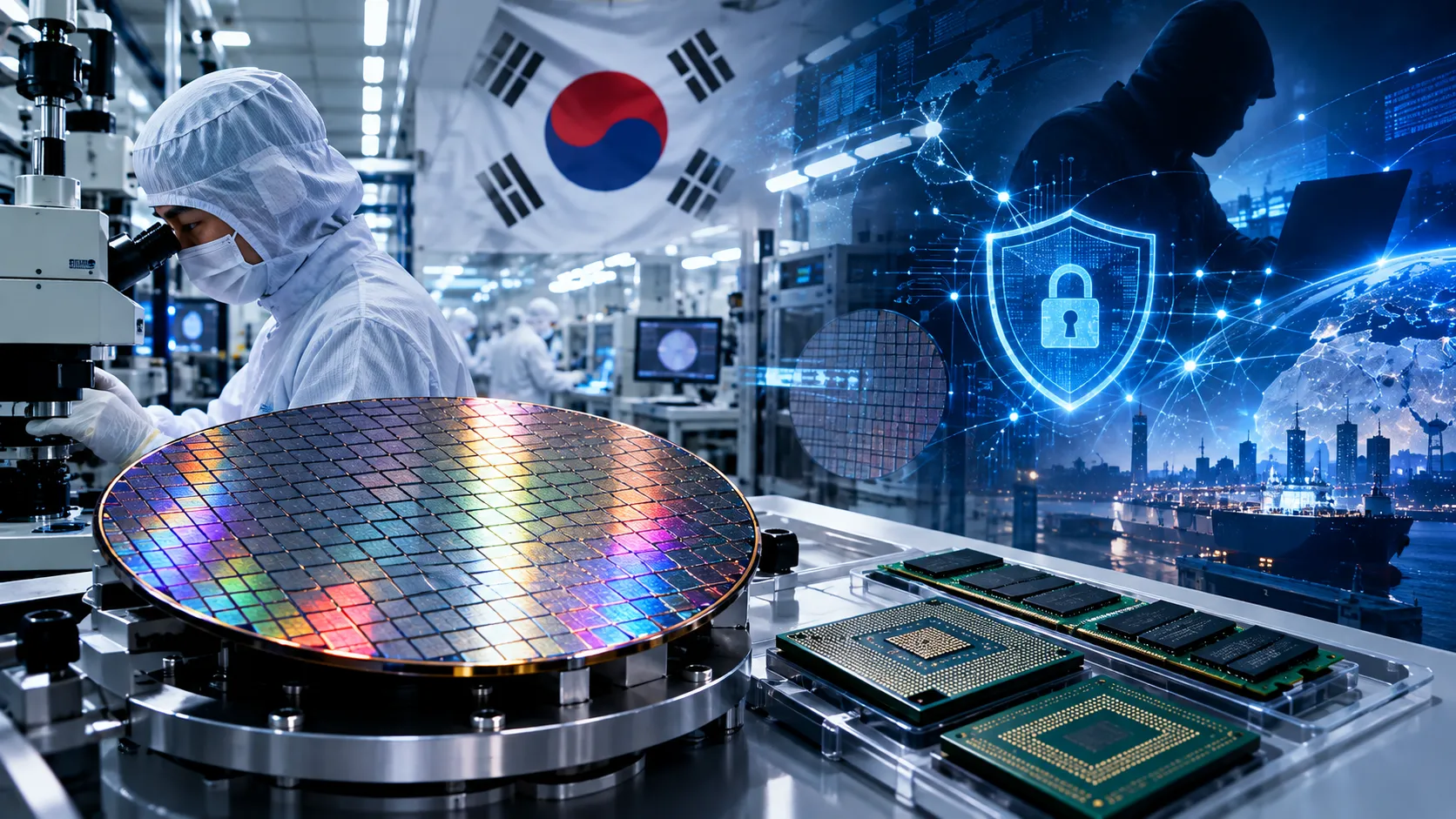
South Korea’s semiconductor industry has become a national-security asset, and Seoul has now expanded its espionage law to protect it.
A revised espionage law took effect on September 13, 2026, broadening the scope of espionage offenses beyond activities involving North Korea to cover foreign countries more generally. The change comes as South Korea faces growing concerns about the theft of advanced economic, scientific and technological information, particularly from its strategically important semiconductor sector.
The timing is significant.
South Korea is home to global memory-chip leaders Samsung Electronics and SK Hynix, while its semiconductor industry sits at the center of the global race for artificial intelligence hardware, high-bandwidth memory and advanced computing.
For Seoul, losing proprietary chip technology is therefore no longer viewed simply as a corporate problem. It can affect national competitiveness, economic security and strategic power.
What changed in South Korea’s espionage law?
The most important change is the expansion of what can qualify as espionage.
For decades, South Korea’s traditional espionage framework was heavily focused on hostile activity connected to North Korea. That created a legal gap when sensitive information was allegedly transferred to companies or organizations connected to other foreign countries.
The revised framework now allows foreign-country-related activity involving protected national secrets to fall within the broader espionage regime.
South Korea’s Ministry of Justice had already announced amendments expanding the relevant Criminal Act provisions from an “enemy state” to foreign countries or equivalent organizations. The revised provisions cover activities such as obtaining, collecting, leaking, transmitting or facilitating the transfer of national secrets under foreign direction or influence.
That change is particularly important for industrial technology.
Why are semiconductor secrets so important to South Korea?
Semiconductors are among South Korea’s most strategically important industries.
Companies such as Samsung Electronics and SK Hynix are global leaders in memory chips, including technologies increasingly important for AI data centers.
Advanced memory technologies such as HBM — High Bandwidth Memory — are critical components in AI computing systems because they allow processors to access large volumes of data at extremely high speeds.
That makes Korean semiconductor technology valuable not only commercially but strategically.
If a competitor obtains advanced manufacturing processes, design information or production know-how without spending years and billions of dollars developing it independently, the consequences can extend beyond one company’s lost revenue.
It can potentially accelerate the technological development of another country’s semiconductor industry.
Is semiconductor espionage a growing problem in South Korea?
South Korean authorities have reported a significant increase in overseas technology leakage cases.
According to data reported from South Korea’s National Office of Investigation, authorities identified 179 technology-leakage cases in 2025, including 33 involving overseas destinations. China accounted for 18 of those 33 overseas cases, or 54.5%. Semiconductor technology represented the largest category among the overseas technology cases, accounting for five cases.
Another important finding is that insiders are frequently involved.
Current or former employees were responsible for 148 of the 179 cases, or 82.7%, according to the reported police data. Small and medium-sized enterprises were also disproportionately affected, accounting for 155 cases, or 86.8% of the companies involved.
That means semiconductor espionage is not necessarily about a spy breaking into a factory.
It can involve an employee taking confidential documents, photographs, production information or other proprietary material before moving to another company.
Why is China part of the semiconductor espionage debate?
China is a major factor because it is simultaneously one of the world’s largest semiconductor markets and a country seeking greater domestic chip self-sufficiency.
South Korean companies occupy a leading position in memory technology, while Chinese chipmakers are rapidly expanding their capabilities.
That creates a powerful competitive incentive.
However, it is important to distinguish legitimate industrial competition from alleged technology theft.
South Korea’s new law is not simply a law against Chinese companies. It establishes a broader legal framework covering foreign-related espionage.
The concern is that sensitive Korean technology could be transferred illegally to foreign companies or organizations regardless of nationality.
What happened in the Samsung and CXMT technology-leak case?
One of the most significant recent cases involved Samsung Electronics and China’s ChangXin Memory Technologies (CXMT).
South Korean prosecutors charged 10 people in 2025 over allegations involving the leakage of Samsung’s advanced 10-nanometer-class DRAM technology to CXMT. Among those charged was a former Samsung executive who allegedly moved to the Chinese company.
Prosecutors alleged that hundreds of manufacturing steps and technical details were copied and transferred.
The case became particularly significant because DRAM is a core component of modern computing, while the technology involved was designated as South Korean national core technology.
Investigators said the alleged technology transfer could have caused losses worth tens of trillions of won to Samsung and other companies. Those figures are allegations and estimates associated with the investigation, not a court-established final loss figure.
The case illustrates why Seoul increasingly treats advanced semiconductor technology as an economic-security issue.
What happened to the former SK Hynix employee?
There have also been cases involving SK Hynix.
In August 2026, a former SK Hynix employee was sentenced to 18 months in prison for leaking confidential semiconductor manufacturing information to a Chinese company, according to reporting based on a Yonhap report. The leaked material concerned CMOS image-sensor technology used in non-memory chips.
In another case, a Chinese former SK Hynix employee was sentenced by an appeals court to five years in prison after being convicted of leaking thousands of pages of semiconductor manufacturing information to Huawei. The court described the material as core technology with significant national-level economic implications.
These cases show the challenge facing South Korean companies:
The vulnerability often sits inside the workforce, not outside the factory gate.
How does South Korea’s technology-protection law work?
The expanded espionage law is only one part of South Korea’s technology-security system.
The country already has the Act on Prevention of Divulgence and Protection of Industrial Technology, which specifically addresses the protection of industrial technologies.
South Korea’s law allows certain technologies to be designated as national core technologies when they have significant implications for national security and the national economy.
Companies possessing national core technologies must implement protective measures.
These can include:
- Restricted access to protected areas
- Entry authorization
- Inspection of belongings
- Management of employees handling sensitive technology
- Confidentiality agreements
- Security procedures designed to prevent unauthorized disclosure
The law also places restrictions on exporting certain state-supported national core technologies to foreign companies without government approval.
This means South Korea’s approach combines criminal law, industrial-security regulations and export controls.
How severe are the penalties for technology leaks?
South Korea has significantly increased the consequences for serious industrial technology theft.
Under the Industrial Technology Protection Act currently in force, knowingly taking certain national core technology overseas for foreign use can result in at least three years’ imprisonment, along with a possible fine of up to 6.5 billion won. Other covered industrial-technology offenses can carry imprisonment of up to 15 years or fines of up to 3 billion won.
The revised espionage framework adds another layer when the conduct meets the legal definition of espionage involving foreign entities.
Reports on the revised law say individuals who steal qualifying national secrets for foreign entities can face penalties of up to 30 years in prison.
The distinction matters: not every technology leak automatically becomes an espionage case. Prosecutors still need to establish the legal elements of the relevant offense.
Why did Seoul act now?
Several developments have converged.
1. The AI boom has increased the value of advanced memory
The explosive growth of AI has dramatically increased demand for high-performance memory.
HBM and advanced DRAM technologies are now critical to AI accelerators and data-center infrastructure.
That makes Korean memory technology more strategically valuable than ever.
2. China’s semiconductor industry is advancing
Chinese chipmakers are investing heavily in domestic semiconductor production.
South Korean officials and companies therefore have stronger incentives to prevent competitors from obtaining Korean know-how illegally.
3. Technology leakage has increased
The reported rise in overseas technology-leak cases has added political pressure for stronger enforcement. South Korean authorities identified 33 overseas technology-leak cases in 2025, compared with nine in 2021 according to figures cited by the Korea Enterprises Federation.
4. Economic security has become national security
The global semiconductor industry has become deeply connected to national power.
Chips are essential for:
- Artificial intelligence
- Smartphones
- Cars
- Data centers
- Telecommunications
- Defense systems
- Satellites
- Advanced computing
A country’s ability to design and manufacture advanced chips can therefore influence both its economic and strategic independence.
Is South Korea targeting China specifically?
The new espionage framework is broader than China.
It applies to foreign-related espionage rather than being written exclusively around one country.
However, China is an important part of the current debate because more than half of South Korea’s identified overseas technology-leak cases in 2025 were linked to China.
That does not mean every Chinese company or researcher is involved in espionage.
The issue is the protection of sensitive technology and the enforcement of laws against unauthorized acquisition or transfer.
That distinction will be important for South Korea as it tries to strengthen technology security without damaging legitimate international research, investment and business cooperation.
Why are SMEs especially vulnerable?
The technology-security problem is not limited to Samsung and SK Hynix.
Small and medium-sized Korean technology companies are particularly vulnerable because they may have fewer resources for cybersecurity, employee monitoring and physical security.
In 2025, SMEs represented roughly 86.8% of companies affected by reported technology-leak cases, according to police data cited by Korean media.
This creates a major policy challenge.
A country’s semiconductor ecosystem depends not only on its biggest chipmakers but also on hundreds of suppliers, equipment manufacturers, materials companies and specialized technology firms.
A security weakness at a small supplier can potentially expose technology that is valuable to the entire industry.
What does this mean for Samsung and SK Hynix?
For South Korea’s two largest memory-chip companies, stronger legal protection could provide an additional deterrent against employee-driven technology leakage.
But laws alone cannot solve the problem.
Companies also need:
- Strong internal access controls
- Employee cybersecurity training
- Better monitoring of sensitive files
- Stronger protection during employee departures
- Restrictions on copying and transferring confidential information
- Cooperation with government investigators
The South Korean government’s own industrial technology law already requires organizations holding national core technologies to take protective measures, including controls around personnel handling sensitive information.
What does South Korea’s move mean for the global chip industry?
South Korea’s tougher approach is part of a much broader global trend.
The semiconductor industry is increasingly being treated as strategic infrastructure rather than an ordinary commercial sector.
The United States has imposed technology controls affecting advanced chips and semiconductor equipment. China is investing heavily in domestic semiconductor capabilities. Taiwan remains central to advanced chip manufacturing, while Japan and Europe are trying to strengthen their own semiconductor ecosystems.
South Korea sits directly in the middle of this competition.
Its companies possess valuable expertise in memory chips, displays, batteries and other advanced technologies.
Protecting that knowledge is therefore becoming a central part of Seoul’s economic strategy.
Could tougher espionage laws affect foreign companies?
Potentially, yes — particularly companies, researchers or individuals seeking access to protected Korean technology.
But the purpose of the law is not to prevent legitimate international cooperation.
The key distinction is whether protected information is obtained or transferred unlawfully and whether the conduct meets the statutory requirements for an offense.
For international companies operating in South Korea, the development reinforces the importance of strict compliance with intellectual-property, confidentiality and technology-transfer rules.
Why semiconductor technology has become a national-security asset
The South Korean case demonstrates a fundamental change in the global technology race.
In previous decades, economic espionage might have been viewed primarily as a corporate problem.
Today, advanced semiconductor technology can influence a country’s ability to build AI systems, military platforms, telecommunications networks and advanced computing infrastructure.
That is why governments increasingly treat semiconductor know-how as part of economic security.
For South Korea, the stakes are particularly high.
Its technology companies are among the world’s leaders, but that leadership also makes their intellectual property a valuable target.
What happens next?
The biggest test for South Korea will be enforcement.
The revised espionage law gives prosecutors a broader legal framework for pursuing foreign-related espionage, while existing industrial-technology legislation provides additional protections for national core technologies.
But successful enforcement will depend on proving cases and preventing leaks before they happen.
The government has already been increasing enforcement. South Korea’s Intellectual Property Office said in September 2026 that 347 people were referred to prosecutors for intellectual-property infringement offenses during the first half of the year, 32% more than in the same period of 2025. Technology-related cases alone rose 33%.
The direction is clear:
South Korea increasingly sees technology protection as a national-security priority.
And with AI driving demand for advanced memory chips, the value of those secrets is likely to continue increasing.
The bottom line
South Korea tightened its espionage framework because the country’s most valuable technology is increasingly tied to national economic and strategic power.
The September 13, 2026 expansion means foreign-related espionage can now be addressed more broadly than under the previous framework, which was heavily centered on North Korea.
At the same time, existing industrial-technology laws already provide strong protections for designated national core technologies.
The combination reflects a larger geopolitical reality: the battle for semiconductor leadership is no longer only about factories, investment and innovation. It is also about protecting the knowledge inside those factories.
FAQ
Why did South Korea tighten its espionage law?
South Korea expanded its espionage framework to address foreign-related espionage more broadly and better protect sensitive national, economic, scientific and technological information. The change comes amid rising technology-leak concerns, particularly involving strategic industries such as semiconductors.
Why are semiconductor secrets important to South Korea?
Semiconductors are a critical part of South Korea’s economy and global technology position. Companies such as Samsung Electronics and SK Hynix are major global memory-chip producers, making their advanced manufacturing know-how strategically valuable.
Is the new South Korean law aimed at China?
The revised law is broader than China and applies to foreign-related espionage generally. However, China is central to the current debate because 18 of South Korea’s 33 reported overseas technology-leak cases in 2025 were linked to China.
What is semiconductor espionage?
Semiconductor espionage refers to the unauthorized acquisition, transfer or use of confidential chip-related technology, manufacturing processes, designs or other protected information for another party’s benefit.
Are Samsung and SK Hynix affected?
Yes. Both companies have been involved in recent technology-leak cases and investigations. South Korean prosecutors have pursued cases involving alleged transfers of Samsung DRAM technology to Chinese chipmaker CXMT, while former SK Hynix employees have also faced convictions or prosecution over confidential technology.
How does South Korea protect national core technology?
South Korea’s Industrial Technology Protection Act allows strategically important technologies to be designated as national core technologies and requires organizations holding them to implement protective measures. Certain overseas transfers can also require government approval.
Can someone go to prison for leaking Korean semiconductor technology?
Yes. Depending on the offense and technology involved, South Korean law provides substantial prison terms and fines. Serious offenses involving national core technology can carry at least three years’ imprisonment, while the revised espionage framework provides much heavier penalties for qualifying espionage offenses.