



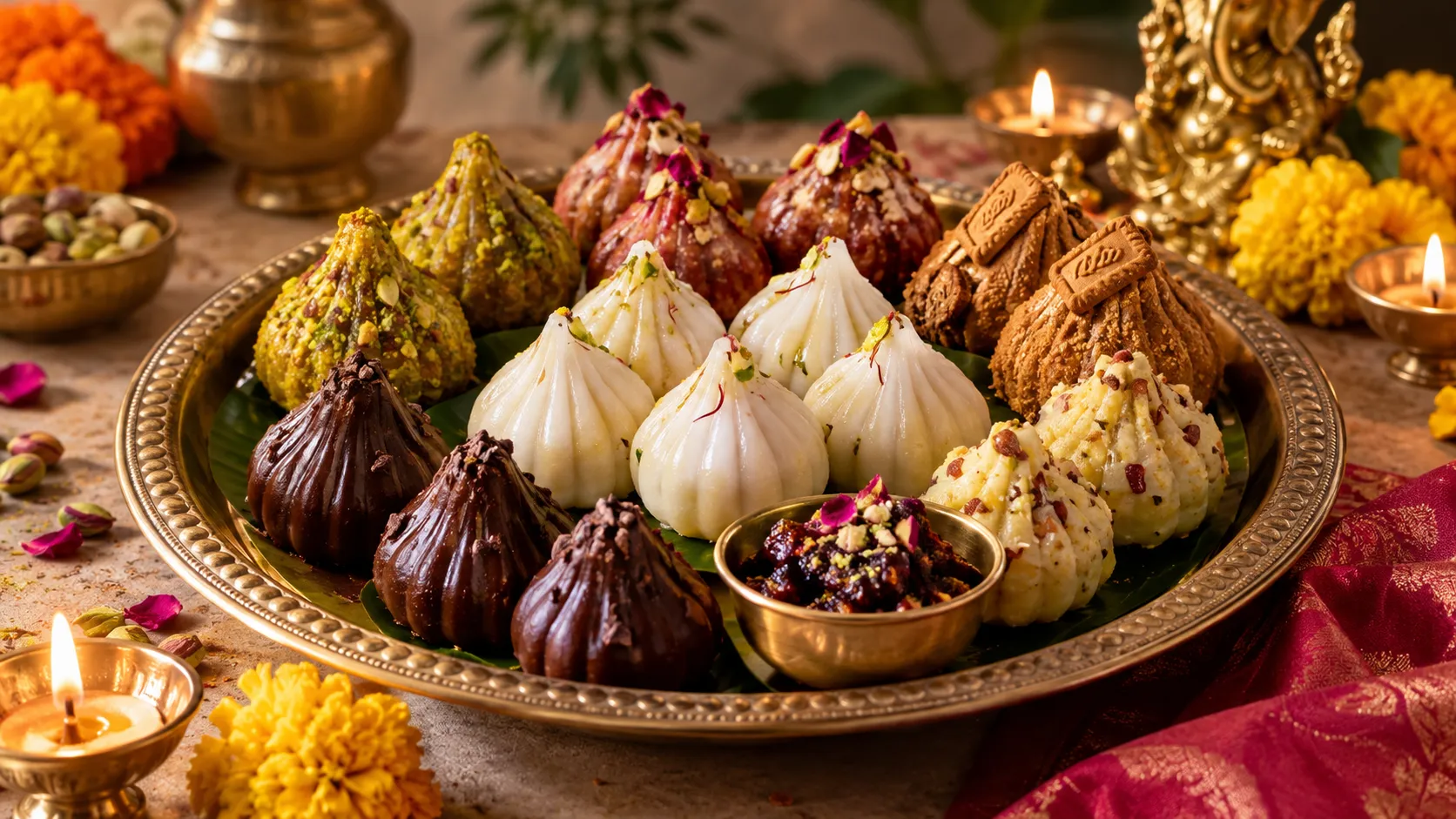
Modak is one of the most recognisable sweets associated with Ganesh Chaturthi, but in 2026 the traditional festive favourite is getting a distinctly modern makeover.
Alongside the classic Ukadiche Modak, people are exploring chocolate, paan, pistachio, Biscoff, Oreo, sandesh, dry-fruit, mawa and other creative versions.
Recent reporting based on Google Search data points to growing curiosity around contemporary flavours such as chocolate and paan, while traditional varieties continue to remain important during the festival.
The trend reflects a broader change in Indian festive food: people are increasingly looking for ways to preserve familiar traditions while adapting flavours to modern tastes.
So, which modaks are getting the most attention this festive season?
1. Chocolate Modak: The Modern Favourite
If there is one flavour that has become almost synonymous with fusion modak, it is chocolate.
Chocolate Modak combines the familiar shape of the traditional sweet with the flavour profile of a chocolate dessert.
Depending on the recipe, it can include:
- Dark or milk chocolate
- Cocoa powder
- Condensed milk
- Khoya or mawa
- Coconut
- Nuts
- Chocolate ganache
- Pistachios or almonds
The appeal is easy to understand. Chocolate is already a familiar flavour across age groups, making this version particularly attractive to children and people who prefer contemporary desserts.
Food coverage this season has featured chocolate modak in several forms, including chocolate-coconut combinations.
Why is chocolate modak trending?
It brings together two familiar ideas: the traditional festive shape of modak and the globally popular taste of chocolate.
For home cooks, it is also relatively easy to customise.
2. Paan Modak: A Distinctly Indian Fusion
Paan Modak is another interesting modern variation.
Instead of relying primarily on the traditional coconut-jaggery profile, paan-inspired versions borrow flavours associated with the Indian after-meal mouth freshener.
A paan modak may feature ingredients such as:
- Betel-leaf flavour
- Gulkand
- Fennel
- Coconut
- Cardamom
- Dry fruits
- Rose
- Nuts
The result is a sweet with a floral, aromatic and distinctly Indian flavour profile.
Recent Google Search-based reporting has specifically highlighted paan alongside chocolate as one of the contemporary modak flavour trends attracting attention.
3. Paan Gulkand Modak
Paan and gulkand naturally complement each other, which has helped create another popular fusion combination.
Gulkand is a sweet preserve traditionally made from rose petals.
In a modak, it can be combined with:
- Khoya
- Coconut
- Rose
- Nuts
- Cardamom
- Paan flavour
The combination gives the modak a fragrant and dessert-like character.
Paan-gulkand modaks have also appeared among the varieties being suggested for Ganesh Chaturthi 2026.
4. Pistachio Modak
Pistachio is another flavour increasingly associated with premium Indian desserts.
A pistachio modak can use pistachio paste, crushed pistachios, milk solids or khoya.
Its appeal comes from the combination of:
- Nutty flavour
- Creamy texture
- Mild sweetness
- Premium appearance
Pistachio also pairs well with saffron, rose and white chocolate, giving home cooks plenty of room for experimentation.
5. Biscoff Modak
The fusion trend is not limited to traditional Indian flavours.
Biscoff Modak is an example of how international dessert flavours are being incorporated into Indian festive sweets.
The caramelised biscuit flavour can be introduced through:
- Biscoff spread
- Crushed biscuits
- Cream-based fillings
- Chocolate
- Nuts
Recent coverage of the 2026 Ganesh Chaturthi food trend has specifically mentioned Biscoff-filled modak as part of the contemporary makeover of the traditional sweet.
6. Oreo Modak
Oreo Modak follows a similar concept.
Crushed chocolate sandwich biscuits can be mixed with ingredients such as condensed milk or cream and then shaped using a modak mould.
This version is particularly suited to people looking for an easy no-fuss fusion dessert.
Oreo has also appeared in recent 2026 modak variety guides alongside chocolate, pistachio and paan flavours.
7. Dry Fruit Modak
Not every modern modak has to be chocolate-based.
Dry Fruit Modak remains a popular option for people looking for a richer nut-based sweet.
Common ingredients include:
- Almonds
- Cashews
- Pistachios
- Walnuts
- Dates
- Raisins
- Figs
Some recipes use dates as a natural sweetener instead of adding large quantities of refined sugar.
However, “dry fruit” does not automatically mean low-calorie. Nuts and dates are nutrient-dense but also energy-dense, so portion size still matters.
8. Kesar-Pista Modak
Saffron and pistachio are classic Indian dessert flavours, making Kesar-Pista Modak a natural festive combination.
The flavour profile is generally:
- Creamy
- Nutty
- Aromatic
- Mildly sweet
- Saffron-forward
It can be made with khoya or milk solids and finished with pistachio slivers and saffron strands.
For people who want something more traditional than chocolate but more elaborate than plain coconut modak, this combination offers a middle ground.
9. Sandesh Modak
The fusion trend is also bringing regional Indian desserts into the modak format.
A Sandesh Modak takes inspiration from the Bengali milk-based sweet.
Recent food coverage of 2026 modak trends has highlighted Bengali-style adaptations, including sandesh-inspired versions.
This is an interesting example of Indian culinary traditions crossing regional boundaries.
Instead of replacing one regional tradition with another, the modak shape becomes a platform for experimenting with different Indian dessert traditions.
10. Mawa Modak
Mawa Modak is another rich option that continues to attract attention.
Unlike Ukadiche Modak, which typically features a rice-flour outer layer and coconut-jaggery filling, mawa modak is based around milk solids.
The texture is:
- Soft
- Creamy
- Rich
- Fudge-like
It can also be combined with saffron, pistachios, cardamom or rose.
What Is the Traditional Modak?
Before discussing the modern versions, it is important to understand the original.
Ukadiche Modak is a traditional Maharashtrian preparation generally made with a steamed rice-flour outer layer and a filling of coconut and jaggery.
The filling is commonly flavoured with cardamom and sometimes other aromatic ingredients.
The dough is shaped into the familiar pleated form before steaming.
It remains one of the most closely associated foods with Ganesh Chaturthi.
Recent 2026 food coverage continues to identify Ukadiche Modak as the classic variety, even while highlighting the growing range of modern alternatives.
Why Is Modak Getting a Modern Makeover?
The rise of fusion modaks is part of a much larger food trend.
Consumers are increasingly comfortable mixing traditional Indian ingredients with international flavours.
That can be seen in combinations such as:
- Chocolate + coconut
- Pistachio + saffron
- Paan + gulkand
- Biscoff + milk solids
- Oreo + condensed milk
- Motichoor + pistachio
- Kunafa + Indian mithai
- Sandesh + modak
The objective is not necessarily to replace traditional food.
Instead, modern varieties give families more choices while keeping the familiar festive shape and cultural association intact.
Hindustan Times described this year’s development as a contemporary makeover of the traditional sweet, with innovations ranging from chocolate-filled creations to motichoor-pistachio-kunafa combinations and Bengali-inspired sandesh versions.
Is Traditional Ukadiche Modak Losing Its Popularity?
Not necessarily.
The current trend is better understood as expansion rather than replacement.
Traditional Ukadiche Modak continues to occupy a central position during Ganesh Chaturthi, while fusion versions appeal to people who want different flavours.
This creates two parallel categories:
Traditional
- Ukadiche Modak
- Fried Modak
- Coconut Modak
- Mawa Modak
- Kesar Modak
Modern and Fusion
- Chocolate Modak
- Paan Modak
- Paan Gulkand Modak
- Biscoff Modak
- Oreo Modak
- Pistachio Modak
- Sandesh Modak
- Kunafa-inspired Modak
This combination of old and new is one of the most noticeable characteristics of the 2026 festive food trend.
Which Modak Is Easiest to Make at Home?
For beginners, chocolate, mawa and dry-fruit modaks can be relatively straightforward because they often involve preparing a mixture and shaping it in a mould.
Traditional Ukadiche Modak can require more technique because the rice-flour covering has to be prepared correctly and shaped without tearing.
Paan-gulkand and pistachio versions can also be adapted to no-cook or reduced-cooking recipes depending on the ingredients.
The best recipe therefore depends on whether the priority is authenticity, speed, flavour experimentation or presentation.
Healthy Modak Trends Are Also Emerging
The fusion trend is not limited to new flavours.
There is also growing interest in recipes that reduce or replace refined sugar.
Examples include:
- Date-sweetened modak
- Dark chocolate modak
- Dry-fruit modak
- Protein-focused modak
- Millet-based modak
- Sugar-free recipes
For example, a recent recipe shared by a Mumbai nutritionist featured dark chocolate and pistachio modaks without added sugar, with about 5 grams of protein per serving according to the report.
Another recent festive recipe uses flour and dates to create a modak without added sugar.
However, “sugar-free” or “healthy” should not automatically be interpreted as unlimited or low-calorie. Ingredients such as dates, nuts, chocolate and ghee can still contribute substantial calories.
How to Choose the Right Modak?
The best choice depends on the occasion and personal preference.
| Preference | Modak to Try |
|---|---|
| Traditional flavour | Ukadiche Modak |
| Chocolate lovers | Chocolate Modak |
| Indian fusion | Paan Gulkand Modak |
| Premium nut flavour | Pistachio Modak |
| Rich dessert | Mawa Modak |
| International twist | Biscoff Modak |
| Kids’ favourite | Oreo or Chocolate Modak |
| Floral flavour | Rose or Gulkand Modak |
| Nut-based option | Dry Fruit Modak |
| Bengali-inspired | Sandesh Modak |
| Saffron lovers | Kesar-Pista Modak |
What Makes a Modak “Trending”?
Search interest is one indicator, but it does not necessarily mean one particular flavour is universally the most popular.
A food trend can be influenced by:
- Search behaviour
- Social media videos
- Recipe content
- Restaurant menus
- Sweet-shop offerings
- Food influencers
- Seasonal demand
- Consumer experimentation
This is why terms such as “trending” should be interpreted as rising interest or visibility, rather than a definitive nationwide sales ranking.
Recent Google Search-based reporting specifically points to increased curiosity around chocolate and paan variations, while broader 2026 coverage shows a wider movement toward fusion flavours.
The Bigger Trend: Tradition Meets Experimentation
The evolution of the modak reflects something larger about Indian festive food.
Traditional recipes remain deeply connected to religious and cultural celebrations, but younger consumers and home cooks are increasingly experimenting with presentation, ingredients and flavours.
The result is a festive table where a classic steamed Ukadiche Modak can sit alongside a chocolate-filled, paan-gulkand or pistachio version.
That does not necessarily mean the traditional sweet is disappearing.
Instead, the modak is becoming a flexible format through which different culinary traditions can be expressed.
Final Takeaway
The trending modak story of 2026 is not simply about replacing traditional sweets with chocolate.
It is about how a centuries-old festive favourite is adapting to contemporary tastes.
Chocolate Modak and Paan Modak are among the modern flavours attracting attention, while Biscoff, Oreo, pistachio, sandesh, mawa, dry-fruit and other creative versions are also expanding the category.
At the same time, Ukadiche Modak remains the traditional benchmark for Ganesh Chaturthi.
From coconut and jaggery to chocolate and gulkand, the modern modak trend shows how Indian festive food can evolve without losing its cultural identity.
FAQ
Which modak is trending in 2026?
Chocolate and paan variations are among the contemporary modak flavours attracting increased search interest, while pistachio, Biscoff, Oreo, sandesh, mawa and dry-fruit versions are also appearing in 2026 festive coverage.
What is the most traditional modak?
Ukadiche Modak is one of the best-known traditional varieties, particularly associated with Maharashtra’s Ganesh Chaturthi celebrations.
What is Chocolate Modak?
Chocolate Modak is a contemporary version of the traditional sweet that incorporates chocolate or cocoa into the filling or outer mixture while retaining the characteristic modak shape.
What is Paan Modak?
Paan Modak is a fusion sweet inspired by the flavours of paan. It can include ingredients such as gulkand, rose, fennel, cardamom, coconut and nuts.
Which modak is good for children?
Chocolate and Oreo-style modaks can appeal to children because their flavours are familiar, although portion size and overall sugar content should be considered.
Are modern modaks healthier than traditional modaks?
Not necessarily. A modern modak can be made with dates, nuts or dark chocolate, but ingredients such as chocolate, ghee, condensed milk and nuts can still make it calorie-dense. The nutritional profile depends on the specific recipe.
Can modaks be made without refined sugar?
Yes. Recipes can use dates or other ingredients for sweetness instead of adding refined sugar. However, the final nutritional profile depends on the complete recipe.
What are some unique modak flavours?
Some contemporary options include chocolate, paan gulkand, Biscoff, Oreo, pistachio, sandesh, kunafa-inspired, dry-fruit and saffron-pistachio modaks.
“MUST READ” – Food Tourism Is Having a Moment: Why Travelers Are Planning Entire Trips Around What They Eat