



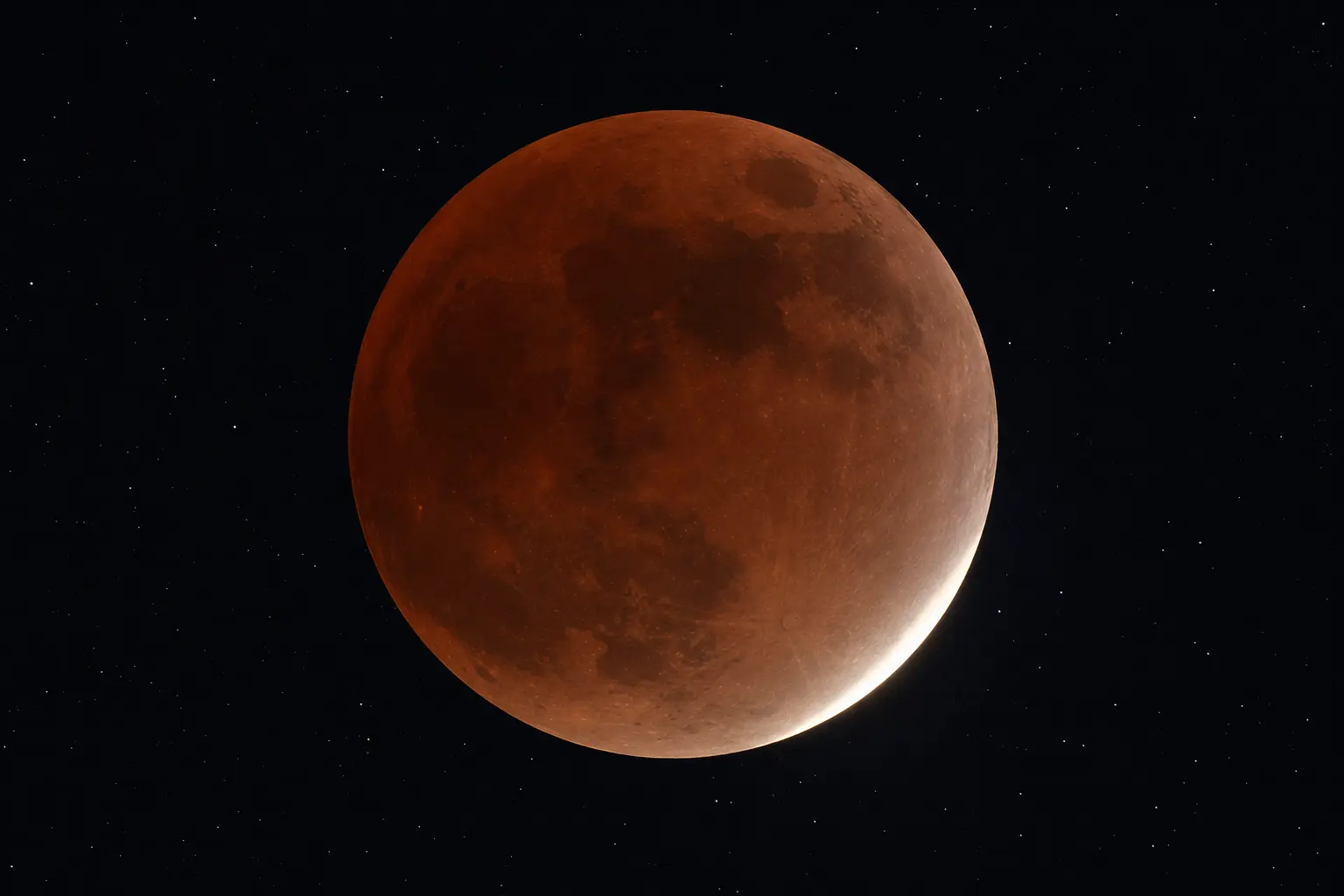
The Blood Moon August 2026 spectacle captured attention around the world as the Moon appeared dramatically dark and copper-red during a deep partial lunar eclipse on August 27–28, 2026.
But there is one important correction to many “Blood Moon” headlines: this was not a total lunar eclipse. NASA classifies the event as a partial lunar eclipse. At maximum eclipse, about 96.3% of the Moon’s disk was inside Earth’s dark central shadow, or umbra, leaving a small portion outside the umbra.
That near-total coverage explains why the event looked so much like a traditional “Blood Moon.”
Was the August 2026 Blood Moon a total lunar eclipse?
No. The August 2026 event was a deep partial lunar eclipse, not a total lunar eclipse.
NASA’s eclipse calculations show that the Moon reached maximum eclipse at approximately 4:13 a.m. UTC on August 28, with 96.3% of its disk inside the umbra. The partial phase began at about 2:34 a.m. UTC and ended around 5:52 a.m. UTC.
The distinction matters because a total lunar eclipse requires the entire Moon to enter Earth’s umbra. During a partial eclipse, some portion of the Moon remains outside the central shadow.
In this case, however, the eclipse came extremely close to totality. That is why photographs and observations showed a Moon with a strong reddish or coppery appearance.
“Sources Used”
https://svs.gsfc.nasa.gov/5672
Why did the Moon turn red?
The red color comes from Earth’s atmosphere.
During a lunar eclipse, Earth moves between the Sun and the Moon. Earth blocks direct sunlight from reaching the Moon, while some sunlight passes through the atmosphere surrounding our planet.
Earth’s atmosphere scatters shorter blue wavelengths of light more effectively than longer red and orange wavelengths. Some of the remaining red-orange light is bent through the atmosphere and reaches the Moon inside the shadow.
NASA explains that this is essentially the same atmospheric effect responsible for the reddish colors seen during sunrises and sunsets.
So the Moon does not actually become red because of a change in its surface.
The red glow is sunlight filtered through Earth’s atmosphere.
The exact shade can vary. Atmospheric dust, clouds and other conditions can influence how dark, orange or red the eclipsed portion appears.
Why was this called a “Blood Moon” if it was partial?
“Blood Moon” is a popular, informal term rather than the scientific classification of the eclipse.
It is most commonly associated with the reddish appearance of the Moon during a lunar eclipse, particularly a total lunar eclipse. But a deep partial eclipse can also produce a strong red or copper color over the portion of the Moon inside the umbra.
The August 2026 eclipse was an unusually deep partial eclipse. NASA’s visualization shows that once the partial phase began, the Earth’s umbra covered an increasingly large portion of the lunar disk. Near maximum eclipse, only a small section remained directly illuminated.
That visual effect made the phrase “Blood Moon” understandable even though “partial lunar eclipse” is the technically correct description.
Where was the August 2026 Blood Moon visible?
The eclipse was visible from large parts of the Americas, Europe and Africa, depending on the phase and local horizon conditions. NASA lists the August 27–28 partial lunar eclipse as visible across the Americas, Europe and Africa, with some visibility extending into Western Asia.
The deep partial phase was particularly favorable for observers in the Americas and parts of western Europe and western Africa. NASA’s Scientific Visualization Studio notes that the umbral portion of the event was visible in the Americas, western Europe and western Africa.
Because a lunar eclipse is visible from the nighttime side of Earth, visibility changed according to local time and the Moon’s position above the horizon.
Americas
Observers across much of North and South America had opportunities to see the eclipse. For many locations in North America, the event occurred during the evening or around midnight on August 27, local time.
The maximum eclipse occurred at approximately 4:13 UTC, corresponding to different local times across the continent.
Europe
In Europe, the eclipse occurred during the early morning hours of August 28 in many locations.
The Moon was approaching the western horizon as the eclipse progressed, meaning local viewing conditions depended heavily on the observer’s location, weather and horizon visibility.
Africa
Parts of Africa also had an opportunity to observe the event, particularly toward the western side of the continent during the relevant nighttime/early-morning period.
Western Asia and India
Visibility was much more limited farther east.
India did not have a practical direct view of the deep partial eclipse because the relevant eclipse stages occurred when the Moon was below the horizon. Contemporary visibility guides specifically noted that India, along with China, Japan and Australia, missed the event.
For viewers in locations where the Moon had already set or the Sun had risen, online livestreams and astronomical recordings provided an alternative way to follow the event.
What time did the August 2026 lunar eclipse happen?
The key eclipse phases, in Universal Time (UTC), were approximately:
| Eclipse phase | Time, August 28, 2026 |
|---|---|
| Penumbral eclipse begins | 1:24 UTC |
| Partial eclipse begins | 2:34 UTC |
| Maximum eclipse | 4:13 UTC |
| Partial eclipse ends | 5:52 UTC |
| Penumbral eclipse ends | 7:02 UTC |
NASA’s official eclipse calculations give the maximum at approximately 04:13 UTC.
The date can appear as August 27 or August 28 depending on the viewer’s time zone. This is why searches for both “August 27 Blood Moon” and “August 28 Blood Moon” can refer to the same astronomical event.
What is the difference between a total and partial lunar eclipse?
The difference is determined by how the Moon moves through Earth’s shadow.
Total lunar eclipse
A total lunar eclipse occurs when the entire Moon enters Earth’s umbra, the darkest central part of Earth’s shadow.
The Moon can then take on a pronounced red or orange appearance.
Partial lunar eclipse
During a partial lunar eclipse, only part of the Moon enters the umbra.
The remainder stays outside the central shadow and continues receiving direct sunlight.
The August 2026 eclipse belongs to this second category, even though approximately 96.3% of the Moon’s disk entered the umbra at maximum eclipse.
Penumbral lunar eclipse
A penumbral eclipse occurs when the Moon passes through the lighter outer portion of Earth’s shadow, called the penumbra. The change can be subtle and considerably harder to notice.
NASA identifies all three as different types of lunar eclipses.
Was it safe to look at the Blood Moon?
Yes. Lunar eclipses can be viewed safely with the naked eye.
Unlike a solar eclipse, there is no need for special eclipse glasses simply to look at an eclipsed Moon. Binoculars or a small telescope can make the changing shadow and reddish surface easier to see.
For photographers, the event also offered an opportunity to capture the contrast between the bright uneclipsed portion and the much darker copper-colored region.
Why did some people see a red Moon while others did not?
The appearance depended on several factors.
First, the Moon had to be above the local horizon during the relevant eclipse phase. Second, local weather and cloud cover could completely obscure the event.
Even among observers who saw the eclipse, the Moon’s color could vary because Earth’s atmosphere is not identical everywhere. Atmospheric dust and clouds can affect how much red and orange light reaches the eclipsed Moon.
This means there was no single “correct” shade of red for the August 2026 Blood Moon.
Why was the August 2026 eclipse so visually dramatic?
The key number was 96.3%.
The eclipse was officially partial, but at maximum nearly the entire lunar disk was inside Earth’s umbra. NASA described it as a deep partial eclipse, and its visualization shows only a small portion of the Moon remaining outside the central shadow.
That combination created a striking visual middle ground:
- It was not technically total.
- Almost the entire Moon entered the umbra.
- The eclipsed portion could take on a copper or reddish color.
- The remaining illuminated section created a strong contrast.
- Large parts of the Americas, Europe and Africa had visibility opportunities.
This is why “Blood Moon” became such a strong description in public discussion even though astronomers classified the event as a partial lunar eclipse.
What was the next major lunar eclipse?
The August 2026 event was followed by a penumbral lunar eclipse on February 20–21, 2027, which NASA lists as visible from the Americas, Europe, Africa, Asia, Australia and Antarctica.
A much more dramatic future event is the total lunar eclipse on December 31, 2028, according to NASA’s lunar eclipse catalog.
The bottom line
The Blood Moon August 2026 was real in appearance but technically a deep partial lunar eclipse. At maximum eclipse, 96.3% of the Moon’s disk was inside Earth’s umbra, just short of totality.
The reddish-copper color was produced by sunlight passing through Earth’s atmosphere, where blue wavelengths are scattered more strongly and red-orange light can reach the Moon inside Earth’s shadow.
For skywatchers in the Americas, Europe and Africa, the August 27–28 event offered a rare near-total-looking lunar spectacle. For much of Asia, including India, the eclipse was not directly visible because of the Moon’s position below the horizon during the key phases.
FAQ
Why is the Moon red tonight?
If you are referring to the August 27–28, 2026 eclipse, the Moon appeared red or copper because part of it was inside Earth’s umbra while sunlight filtered through Earth’s atmosphere and reached the Moon.
Was the August 2026 Blood Moon a total lunar eclipse?
No. It was a deep partial lunar eclipse. Approximately 96.3% of the Moon’s disk entered Earth’s umbra, but the entire Moon did not.
Where was the August 2026 lunar eclipse visible?
The eclipse was visible from much of the Americas, Europe and Africa, with visibility varying according to local time and the Moon’s position. Some parts of Western Asia also had visibility opportunities.
Could people in India see the August 2026 Blood Moon?
No, India was not in a favorable position to see the eclipse directly. The key eclipse phases occurred while the Moon was below the horizon in India.
Why do lunar eclipses turn red?
Earth’s atmosphere scatters blue light more strongly than red light. Some red-orange light is refracted through the atmosphere toward the Moon, giving the eclipsed surface its characteristic reddish appearance.
Is it safe to watch a lunar eclipse without glasses?
Yes. A lunar eclipse is safe to watch with the naked eye. Binoculars or a telescope are optional for a closer view.
What was the maximum eclipse time?
The maximum occurred at approximately 4:13 a.m. UTC on August 28, 2026. Local times varied by location.