



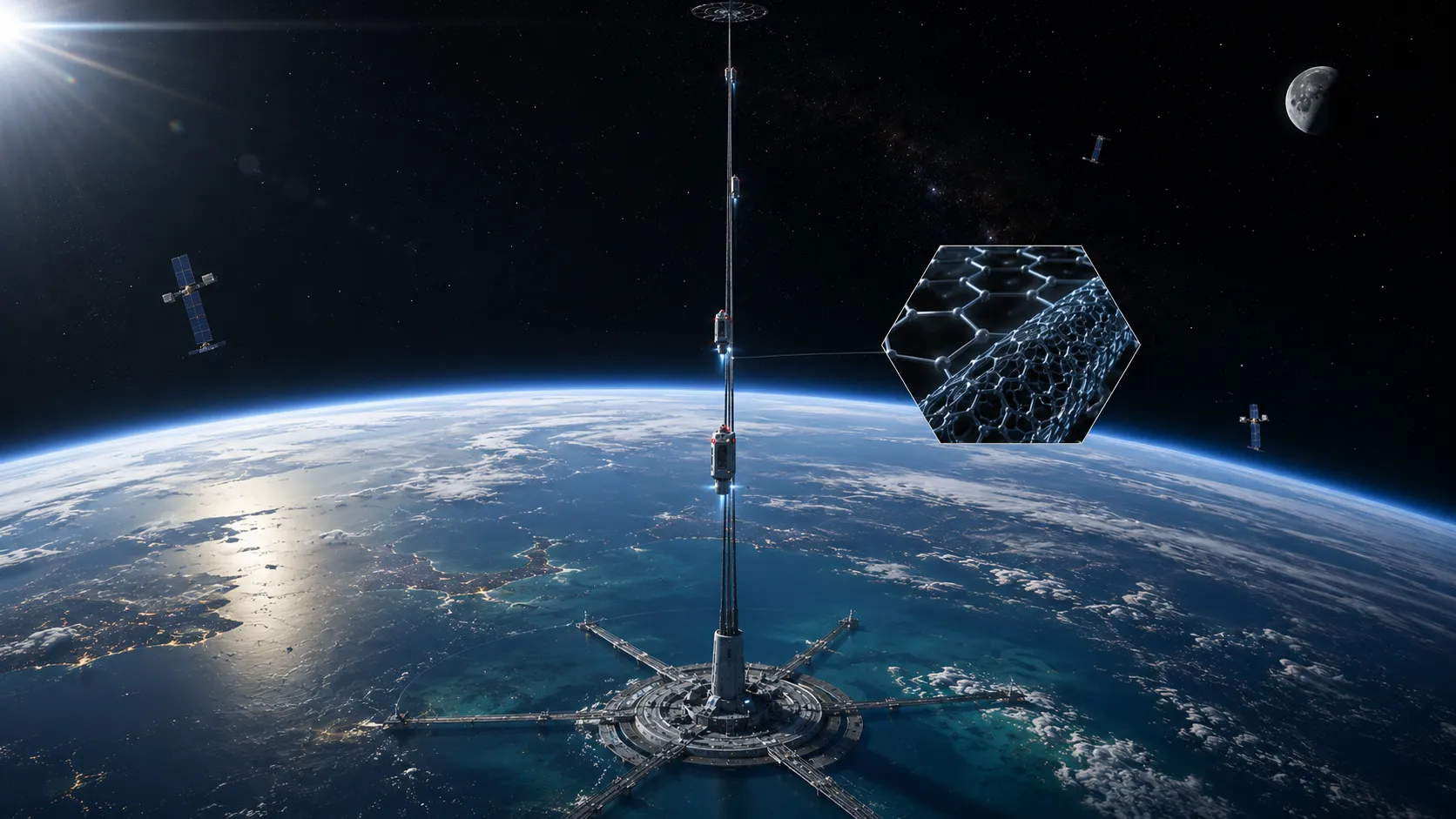
A space elevator sounds like science fiction: instead of launching rockets vertically, spacecraft and cargo would climb a giant tether from Earth into space.
But the concept is based on a real physical principle.
A tether extending from Earth toward and beyond geostationary orbit could remain aligned with a point on Earth’s equator because the system would rotate with the planet. Powered climbers could then travel along the tether carrying people and cargo upward.
The idea has been studied by NASA and other researchers for decades.
The biggest problem has also remained remarkably consistent:
We do not yet have a practical material from which to build the required Earth-to-orbit tether.
NASA studies identified ultra-high-strength carbon-nanotube composites as a critical technology for an Earth-based space elevator.
More recent research has expanded the discussion to materials including single-crystal graphene and hexagonal boron nitride, while emphasizing that producing tether-quality material at the necessary scale remains a major challenge.
So, in 2026, the space elevator remains a future transportation concept rather than an operational technology.
For readers following the wider technology landscape, this article is part of HNN24x7’s Future Technology 2026 pillar.
What Is a Space Elevator?
A space elevator is a proposed transportation system that would use an extremely long, high-strength tether and mechanical climbers to move people and payloads from Earth toward space.
Instead of using rocket engines to accelerate a spacecraft from the surface, an elevator climber would travel upward along the tether.
The basic system would require:
- an Earth-based anchor,
- an extremely strong tether,
- climbers,
- a power system,
- a structure extending beyond geostationary orbit,
- a counterweight or equivalent mass distribution,
- sophisticated control and safety systems.
The concept is radically different from conventional rockets.
A rocket carries its own propellant and generates thrust.
A space elevator would rely primarily on orbital mechanics, tension and mechanical climbing.
How Does a Space Elevator Work?
The basic principle depends on Earth’s rotation.
A conventional elevator cannot simply extend upward indefinitely because gravity pulls it toward Earth.
A space elevator solves this by extending the tether beyond geostationary orbit, approximately 35,786 kilometres above Earth’s equator.
At geostationary orbit, an object circles Earth at the same angular speed as the planet rotates.
If enough tether extends beyond that orbit, the outward centrifugal effect associated with the rotating system can balance the inward pull of gravity.
The result is a tensioned structure that can remain approximately fixed over a point on the equator.
A simplified system looks like this:
Earth
↓
Anchor station
↓
Tether
↓
Geostationary orbit
↓
Tether continues outward
↓
Counterweight
Climbers could then travel along the tether.
Why Does the Tether Have to Extend Beyond Geostationary Orbit?
This is one of the most important parts of the concept.
A cable reaching only to geostationary orbit would not provide the required balance.
The tether needs to extend farther outward so that the rotating system can generate the tension necessary to support the structure.
This is why space-elevator concepts involve extraordinarily long structures.
A 2023 review of tether materials describes a typical Earth space-elevator tether as roughly 100,000 kilometres long, depending on the design.
That is more than twice the distance from Earth to geostationary orbit.
Why Advanced Materials Are the Key
The entire concept depends on one seemingly simple requirement:
The tether must be incredibly strong without becoming impossibly heavy.
A normal steel cable would collapse under its own weight long before reaching the required length.
Even many advanced aerospace composites do not have the necessary combination of:
- tensile strength,
- low density,
- durability,
- manufacturability,
- defect tolerance.
NASA’s studies identified carbon-nanotube-reinforced composites as a potential route because their theoretical strength-to-weight characteristics could approach the requirements of a space elevator.
This creates the central engineering challenge:
The material must be strong enough to hold itself up.
Why Carbon Nanotubes Became Famous in Space Elevator Research
Carbon nanotubes are microscopic cylindrical structures made from carbon atoms.
Their attraction for space-elevator designers comes from their exceptional theoretical mechanical properties combined with low density.
NASA’s early space-elevator research specifically identified carbon nanotube materials as a potential solution to the tether problem.
But there is a huge difference between:
a microscopic carbon nanotube with exceptional theoretical strength
and
a continuous, defect-resistant tether tens of thousands of kilometres long.
That gap is the reason the space elevator has not been built.
The Real Problem With Carbon Nanotubes
The challenge is not simply producing carbon nanotubes.
Industry can produce CNT materials today, and NASA continues to investigate CNT-reinforced composites for aerospace applications.
NASA’s Superlightweight Aerospace Composites project, updated in June 2026, describes the need to mature CNT manufacturing toward commercial-scale volumes and quality for advanced aerospace structures.
But a space elevator requires something dramatically more demanding.
The tether would need to maintain extremely high strength over enormous distances.
Tiny defects can matter.
Manufacturing inconsistencies can matter.
Connections between nanotubes can matter.
Environmental damage can matter.
The resulting material must behave as a giant structural system—not merely as an impressive laboratory sample.
Could Graphene Make a Space Elevator Possible?
Graphene is one of the leading advanced-material candidates being studied for future space-elevator tethers.
A 2023 review of space-elevator tether materials highlighted single-crystal graphene and graphene super-laminates alongside carbon nanotubes and hexagonal boron nitride as candidate material systems.
Graphene is attractive because it combines:
- very high tensile strength,
- low density,
- electrical conductivity,
- thermal conductivity,
- flexibility at very small scales.
But once again, the problem is scale.
Producing graphene is not the same as producing a flawless, ultra-long structural ribbon capable of supporting an Earth-to-orbit elevator.
What Is Single-Crystal Graphene?
A simplified way to think about single-crystal graphene is:
a large graphene structure without the network of grain boundaries found in ordinary polycrystalline material.
Grain boundaries and defects can weaken a material.
For a space elevator, that matters enormously because the tether would experience continuous mechanical stress.
Research on tether materials therefore focuses not merely on whether graphene is strong in theory, but whether sufficiently large quantities can be produced with the required quality.
What About Hexagonal Boron Nitride?
Another candidate is hexagonal boron nitride, sometimes described as a two-dimensional material structurally related to graphene.
It has attractive mechanical and thermal properties.
Researchers have considered:
- carbon nanotubes,
- graphene,
- hexagonal boron nitride
as potential ultra-high-strength tether materials.
However, none has yet solved the complete Earth-based space-elevator engineering problem.
The issue is not simply finding a material that is strong.
It is finding a material that can be:
manufactured continuously + at enormous scale + with very low defect rates + at acceptable cost + while surviving the space environment.
How Strong Would the Tether Need to Be?
The exact requirement depends on the design, taper ratio, material properties and safety assumptions.
But the required tensile strength is far beyond ordinary structural materials.
A NASA study identified roughly 67 GPa as an important threshold in one development framework for practical demonstration of an Earth space-elevator tether, while another NASA study described the target for ultra-high-strength CNT-reinforced ribbon construction in the roughly 100-GPa range.
These numbers illustrate the problem.
The tether cannot merely be “strong like steel.”
It needs to operate in an entirely different material-performance regime.
Why Strength-to-Weight Matters More Than Strength Alone
Imagine two materials:
Material A
- extremely strong
- extremely heavy
Material B
- slightly less strong
- extremely light
For a space elevator, Material B could potentially be more useful.
Why?
Because the tether has to support itself.
As the cable becomes longer, its own mass becomes a dominant engineering problem.
That means engineers care about specific strength—strength relative to density.
This is why nanoscale carbon materials are so interesting.
Their theoretical properties offer a combination that conventional metals struggle to match.
Why Can’t We Just Make the Tether Thicker?
Because adding material adds weight.
A thicker cable might be stronger, but its increased mass creates additional stress.
The system therefore requires a carefully designed tapered tether.
Near the lower portion, where the gravitational load is significant, the tether geometry differs from the upper sections.
The design must balance:
- self-weight,
- tensile strength,
- climber loads,
- dynamic forces,
- safety margins,
- manufacturing limitations.
This is a structural-engineering problem on a planetary scale.
What Are the Space Elevator Climbers?
The climber would be the equivalent of an elevator car.
Instead of hanging inside a shaft, it would grip or interact with the tether and travel upward.
Possible propulsion concepts include:
- electric motors,
- mechanical traction,
- electromagnetic systems,
- externally supplied power.
The climber would need enough energy to overcome gravitational potential while moving upward.
NASA concepts have considered wireless power transmission, including laser power beaming, as one of the technologies that could support such a system.
How Would the Elevator Get Electricity?
One proposed approach is to transmit power from the ground to the climber.
Potential methods include:
- lasers,
- microwaves,
- electrical systems integrated into the tether,
- other remote-power concepts.
The advantage of remote power is that the climber does not need to carry a huge fuel supply.
That could make the vehicle much lighter.
But power transmission introduces another engineering problem:
How do you safely deliver enormous amounts of energy over tens of thousands of kilometres?
Could a Space Elevator Replace Rockets?
Not completely, at least not based on today’s technology.
Rockets would still have advantages for:
- rapid missions,
- locations away from the elevator,
- military and emergency launches,
- polar or high-inclination trajectories,
- missions requiring flexible launch locations.
A space elevator would instead offer a potentially revolutionary alternative for repetitive transport of mass to orbit.
That distinction matters.
The elevator is not necessarily a replacement for every rocket.
It could become a new transportation layer.
Why Would a Space Elevator Be So Important?
The biggest potential advantage is reusability.
A conventional rocket must accelerate its own propellant and, depending on the system, discard large amounts of hardware.
A space elevator would have a permanent infrastructure.
Climbers could repeatedly travel up and down the tether.
That could potentially change the economics of moving:
- satellites,
- raw materials,
- spacecraft components,
- fuel,
- scientific equipment,
- eventually passengers.
NASA research has long described the concept as a possible low-energy transportation system to orbit.
Could a Space Elevator Make Space Travel Cheaper?
Potentially, but there is no operational system from which to establish a real-world cost per kilogram.
Historical NASA studies suggested that an operational elevator could dramatically lower transportation costs compared with conventional rocket launch under favorable assumptions.
But those estimates are conceptual.
They depend on solving:
- tether manufacturing,
- construction,
- power,
- climbers,
- maintenance,
- orbital safety,
- financing,
- deployment.
Therefore, it would be misleading to quote an old theoretical cost estimate as if it were a current commercial price.
The correct statement is:
A successful space elevator could potentially reduce the marginal cost of repeated transport to orbit, but that has not yet been demonstrated.
The Biggest Threat: Space Debris
A space elevator would operate in an increasingly crowded orbital environment.
Satellites and debris could threaten the tether.
NASA’s space-elevator research identified orbital object avoidance as one of the critical technologies for an Earth-based system.
This creates an extraordinary safety challenge.
A conventional spacecraft can change trajectory.
A huge tether is much less mobile.
A collision could damage a section of the structure.
Therefore, an operational elevator would need:
- continuous tracking,
- collision prediction,
- active avoidance,
- structural redundancy,
- repair strategies,
- traffic management.
Would the Tether Survive the Space Environment?
That is another major unresolved question.
The tether would be exposed to:
- atomic oxygen in low Earth orbit,
- ultraviolet radiation,
- temperature changes,
- micrometeoroids,
- orbital debris,
- mechanical vibration.
Research on carbon nanotubes has investigated degradation from space exposure, including damage from atomic oxygen and associated reductions in tensile strength.
So even if engineers produce a sufficiently strong material in a laboratory, they must prove that it remains strong after years in space.
How Would a Space Elevator Be Built?
This may be even harder than manufacturing the material.
A conventional construction strategy would be impossible because no rocket can simply carry a 100,000-kilometre tether into orbit.
One concept involves deploying an initial tether from a spacecraft or orbital platform and then progressively increasing its mass and length.
NASA research has examined concepts involving deployment from space and mechanical climbers that could help build the structure.
The construction process would therefore itself be a major space-engineering project.
Why the Equator Matters
A conventional Earth space elevator would most naturally be located near the equator.
The reason is orbital mechanics.
A geostationary orbit exists above the equatorial plane.
The tether needs to remain synchronized with Earth’s rotation.
That creates geographic limitations.
The system could not simply be built anywhere on Earth.
An equatorial ocean platform is one commonly discussed concept because it could potentially offer:
- mobility,
- fewer land constraints,
- ocean access,
- flexibility for avoiding certain weather systems.
But it would also face:
- storms,
- waves,
- corrosion,
- maritime traffic,
- political and legal issues.
Could a Space Elevator Be Built on the Moon?
A lunar space elevator may be substantially easier in some respects than an Earth-based elevator.
The Moon has:
- lower gravity,
- no atmosphere,
- no terrestrial weather,
- different orbital requirements.
Some NASA research specifically noted that the extreme material requirements for an Earth-to-GEO elevator do not necessarily apply in the same way to systems involving the Moon, Mars or other orbital tether configurations.
This creates an intriguing possibility.
The first practical “space elevator” may not be an Earth elevator at all.
What About a Mars Space Elevator?
Mars also has lower gravity than Earth.
Concepts involving Mars-based space elevators have therefore attracted theoretical interest.
But Mars presents its own challenges:
- atmospheric conditions,
- planetary rotation,
- tether dynamics,
- suitable anchoring,
- material requirements,
- transportation infrastructure.
The lower gravity can reduce some requirements, but it does not make the engineering trivial.
Space Elevator vs Rocket
| Feature | Space Elevator | Rocket |
|---|---|---|
| Primary mechanism | Climber + tether | Propulsion |
| Reusable infrastructure | Yes, conceptually | Depends on rocket |
| Fuel carried by vehicle | Potentially minimal | Large propellant requirement |
| Launch site | Equatorial region | Flexible |
| Main technology barrier | Tether | Propulsion and launch systems |
| Space debris sensitivity | Very high | Mission-dependent |
| Current status | Concept/research | Operational |
| Potential advantage | High-frequency mass transport | Flexibility and speed |
| Major risk | Tether failure | Launch/vehicle failure |
The important point is that rockets are real transportation systems today.
The space elevator remains a future concept.
What Advanced Materials Could Change
The space elevator is one of the clearest examples of a technology whose feasibility depends on materials science.
If researchers could develop a material that combines:
ultra-high tensile strength
very low density
continuous manufacturing
defect tolerance
space durability
then a major barrier would be reduced.
That would not instantly create an operational elevator.
But it could move the concept from:
“materially impossible”
toward:
“engineering problem.”
That distinction is enormous.
The Important 2026 Development: Advanced Materials Are Still Improving
Although an Earth space elevator is not close to construction, the underlying material technologies are not standing still.
NASA’s Superlightweight Aerospace Composites project, updated in 2026, is working on maturation of carbon-nanotube-reinforced composites for advanced aerospace structures and specifically identifies manufacturing scale and material quality as areas requiring further development.
This is important because space-elevator research does not have to succeed for the materials research to be valuable.
CNT composites could have applications in:
- spacecraft structures,
- pressure vessels,
- trusses,
- thermal systems,
- lightweight aerospace components.
So the space elevator can function as a technology driver even before the elevator itself exists.
What Is the Current Material Gap?
A 2023 review concluded that candidate materials such as carbon nanotubes, graphene and hexagonal boron nitride have promising theoretical properties, but manufacturing tether-quality material at the necessary scale remains unresolved.
That is perhaps the most important fact about the technology in 2026.
The question is not:
“Do ultra-strong materials exist?”
Some do.
The question is:
“Can we manufacture enough continuous, defect-resistant material with the right mechanical properties to build a planetary-scale tether?”
That remains unanswered.
Could AI Help Build a Space Elevator?
AI could become useful in several parts of the development process.
Materials Discovery
AI can help researchers screen materials and predict properties.
Structural Design
Machine-learning models could explore enormous numbers of tether geometries and load conditions.
Manufacturing
AI could monitor production for defects.
Orbital Safety
Algorithms could predict satellite and debris trajectories.
Maintenance
AI could identify early signs of damage.
Power Optimization
AI could optimize energy delivery to climbers.
This does not mean AI can “solve” the space elevator.
But it could accelerate several supporting technologies.
Digital Twins Could Also Matter
A future space elevator could require a sophisticated digital twin.
The digital model could continuously simulate:
- tether stress,
- temperature,
- climber traffic,
- satellite positions,
- debris threats,
- weather,
- structural damage.
Real sensor data could then be compared against simulations.
This would allow operators to detect abnormal conditions before they become catastrophic.
The concept therefore connects naturally with another major future-technology trend:
AI + advanced materials + digital twins + space infrastructure.
What Happens If Part of the Tether Breaks?
This is one of the hardest questions.
A 100,000-kilometre tether cannot simply be repaired like a normal cable.
Engineers would need:
- redundant structures,
- modular sections,
- robotic repair systems,
- damage detection,
- controlled load redistribution.
The system would need to be designed around the possibility of defects and damage.
This is one reason fracture toughness and defect tolerance matter alongside raw tensile strength.
A material can have extraordinary theoretical strength and still be unsuitable for a giant structure if a small crack causes catastrophic failure.
Is a Space Elevator Possible in 2026?
The physics behind the concept is well understood, but an Earth-based space elevator is not technically feasible with today’s available tether materials and manufacturing capabilities.
NASA’s historical research explicitly described an Earth-to-GEO space elevator as not feasible with then-current technology and identified the development of ultra-high-strength tether materials as a critical requirement.
More recent research continues to focus on candidate materials and manufacturing.
So the 2026 status can be summarized as:
Physics: established concept
Candidate materials: promising but insufficient at required scale
Tether manufacturing: unresolved
Construction: not demonstrated
Operational system: does not exist
Research value: significant
Could a Space Elevator Be Built?
There is no scientifically established construction date.
Older studies proposed ambitious timelines, but those predictions depended on material breakthroughs that did not occur on schedule.
The responsible way to frame the timeline is:
A space elevator is a long-term technology possibility whose schedule depends primarily on advances in tether materials, manufacturing, orbital safety and construction.
Any article claiming that a commercial Earth space elevator will definitely open by a specific year should be treated skeptically unless supported by a credible, funded development program.
What Would Happen If It Worked?
If the material and engineering barriers were eventually solved, the consequences could be enormous.
A successful elevator could provide a permanent route from Earth toward orbit.
That could enable:
- cheaper satellite deployment,
- large-scale space infrastructure,
- orbital manufacturing,
- regular cargo transportation,
- construction of space stations,
- lunar logistics,
- deep-space infrastructure.
It could also change the economics of space in the same way railways and ports changed terrestrial transportation.
The critical difference is that this would be infrastructure, not simply another spacecraft.
Could a Space Elevator Enable a Space Economy?
Potentially.
Today, getting mass into orbit is expensive and technologically demanding.
A permanent transportation system could make repeated movement of materials much easier.
That could support:
Earth
↓
Space elevator
↓
Low Earth orbit
↓
Space stations
↓
Lunar infrastructure
↓
Deep-space missions
In such a future, rockets might increasingly become specialized vehicles rather than the only practical way of moving mass from Earth into space.
“Sources Used”
https://ntrs.nasa.gov/citations/20040161582
https://www.sciencedirect.com/science/article/pii/S0094576523001704
The Biggest Obstacles to a Space Elevator
1. Tether Material
The central problem remains sufficient strength-to-weight performance at enormous scale.
2. Manufacturing
Laboratory material is not enough. The tether must be manufactured continuously and reliably.
3. Defects
Microscopic imperfections could become catastrophic over extreme lengths.
4. Space Environment
Radiation, atomic oxygen, micrometeoroids and debris can degrade materials.
5. Orbital Debris
The tether would have to avoid satellites and debris.
6. Construction
Deploying and building the structure would itself require advanced space infrastructure.
7. Power
Climbers need a reliable energy source.
8. Maintenance
A planetary-scale tether would need continuous monitoring and repair.
9. Economics
The first system would require enormous investment.
10. Governance
An equatorial international infrastructure would raise complex legal and geopolitical questions.
Why the Space Elevator Still Matters
It may seem strange to include a technology that is not currently buildable in a list of future technologies.
But that is exactly what makes the space elevator interesting.
It forces progress in areas that have applications far beyond the elevator itself:
- advanced materials,
- nanotechnology,
- lightweight composites,
- robotics,
- wireless power,
- orbital tracking,
- autonomous systems,
- AI-based structural monitoring.
NASA’s research has explicitly noted that intermediate space-elevator technology demonstrations could provide useful advances for other spaceflight and terrestrial applications.
So even if the elevator itself takes decades—or ultimately proves impractical—the research can still produce valuable technologies.
Space Elevator 2026: The Bottom Line
The space elevator is not a working transportation system in 2026.
The basic physics is understood.
The engineering concept is extensively studied.
But the decisive component—a sufficiently strong, lightweight, continuous and manufacturable tether—remains beyond today’s capabilities.
Carbon nanotubes were among the earliest leading candidates, while modern research has expanded attention to advanced two-dimensional materials such as graphene and hexagonal boron nitride.
NASA continues to work on carbon-nanotube-reinforced composites for advanced aerospace applications, showing that the underlying materials science remains an active area of development.
That makes the space elevator less a “building project for the 2020s” and more a long-term test of how far advanced materials and space infrastructure can go.
The Future of Space Transportation May Depend on Materials
The space race of the 20th century was dominated by:
rockets + engines + guidance.
The next stage of space infrastructure could increasingly depend on:
materials + automation + AI + permanent infrastructure.
The space elevator represents the extreme version of that idea.
If engineers can eventually manufacture a material capable of supporting a structure stretching from Earth toward and beyond geostationary orbit, transportation to space could be fundamentally redesigned.
But until that breakthrough happens, rockets remain the practical route to orbit.
The real story in 2026 is therefore not:
“The space elevator is finally here.”
It is:
“Advanced materials are slowly bringing an old space-transportation dream closer to the boundary of engineering possibility.”
And that is why the space elevator remains one of the most fascinating concepts in future transportation and space technology.
For the broader emerging-technology landscape, readers can explore HNN24x7’s Future Technology 2026 pillar.
FAQ
What is a space elevator?
A space elevator is a proposed transportation system using an extremely long tether extending from Earth toward and beyond geostationary orbit. Mechanical climbers would travel along the tether carrying people and cargo.
How does a space elevator work?
The tether would use Earth’s rotation and a counterweight or extended mass beyond geostationary orbit to maintain tension. Powered climbers could then move along the tether toward space.
Is a space elevator possible in 2026?
The concept is physically plausible, but an Earth-based operational space elevator is not currently feasible. The biggest obstacle remains manufacturing a tether with sufficient strength, low mass and durability at the required scale.
What material would a space elevator use?
Carbon nanotubes have historically been a leading candidate. Current research also examines materials such as single-crystal graphene and hexagonal boron nitride. None has yet demonstrated the complete combination of properties and manufacturability required for an Earth space elevator.
Why are carbon nanotubes important?
Carbon nanotubes combine extremely high theoretical strength with low density, making them attractive for a structure that must support its own enormous length.
Could graphene build a space elevator?
Graphene has potentially suitable mechanical properties and is being studied as a candidate tether material. However, producing tether-quality graphene continuously at the enormous scale required remains a major challenge.
Would a space elevator replace rockets?
Not necessarily. It could provide a reusable infrastructure for high-volume transportation to orbit, while rockets would likely remain useful for missions requiring flexibility, speed or access to different orbital inclinations.
How long would a space-elevator tether be?
Designs vary, but Earth-based concepts generally require a structure extending well beyond geostationary orbit. Some studies use approximately 100,000 kilometres as an illustrative total tether length.
Why can’t we build a space elevator today?
The primary problem is the tether. No currently available material has demonstrated the required combination of ultra-high strength, low density, continuous length, defect tolerance, manufacturing scale and space durability.
Could a space elevator be built on the Moon?
Lunar and other non-Earth tether concepts can have different material requirements because of the Moon’s lower gravity and lack of atmosphere. NASA research has specifically examined such alternative space-elevator and tether applications.