
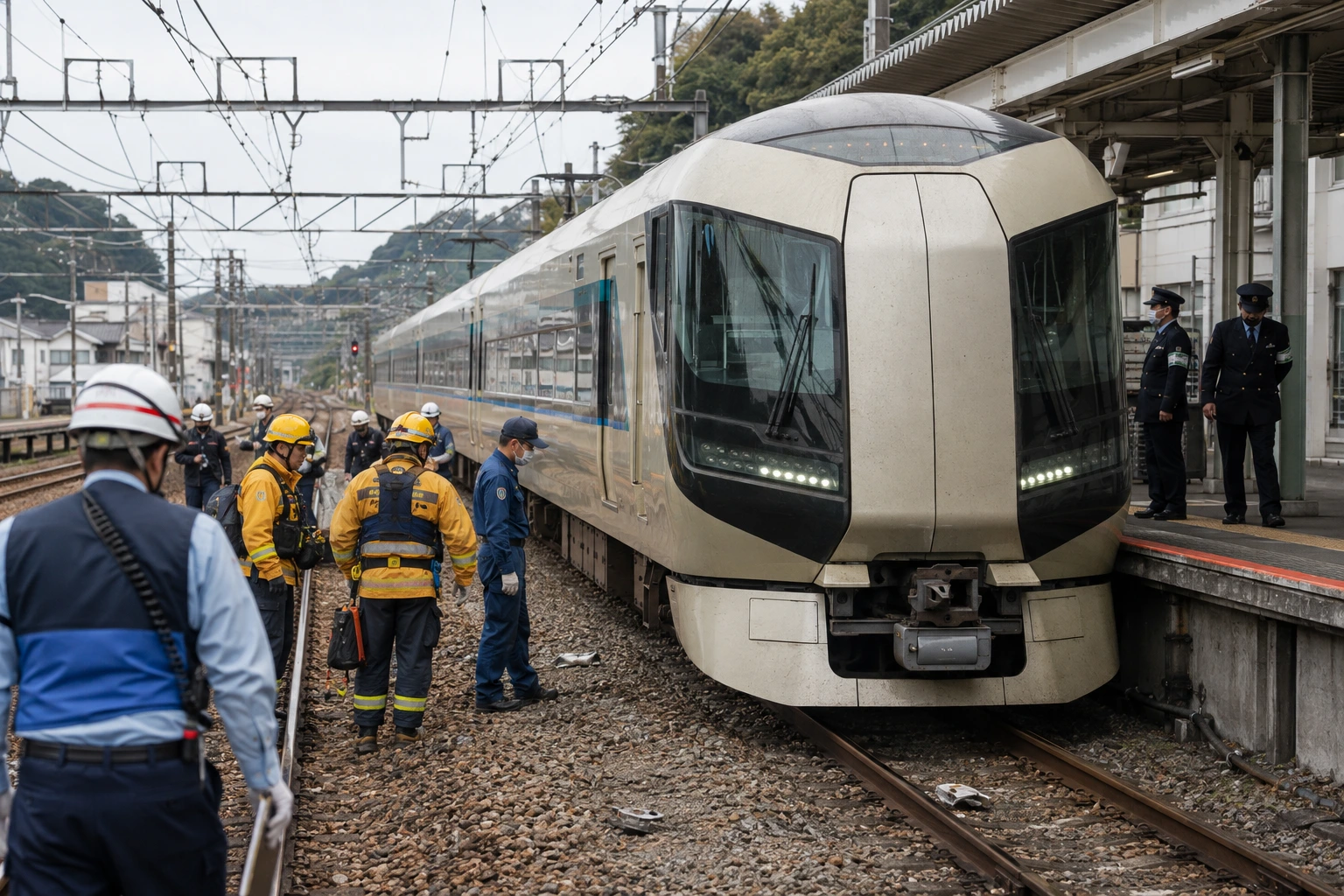
A Japan railway accident at Shin-Kanuma Station in Tochigi Prefecture has left four railway maintenance workers dead after they were struck by a limited express train on Thursday, August 20, 2026.
The workers were carrying out vegetation-control work on railway tracks when a Tobu Railway Spacia X limited express entered the station and hit them. All four workers were taken to hospital but were later pronounced dead. Around 50 passengers on the train were reportedly unharmed.
The accident has prompted an investigation into how the track workers, lookout personnel and train crew communicated before the train entered the station.
The latest information also indicates that Japan’s transport authorities have issued a warning to Tobu Railway, asking the company to establish the cause and take measures to prevent a recurrence.
What Happened in the Japan Railway Accident?
The accident occurred at approximately 10:45 a.m. local time on August 20 at Shin-Kanuma Station on the Tobu Nikko Line in Kanuma, Tochigi Prefecture, north of Tokyo.
Four male workers were carrying out vegetation-control and weed-removal work around the railway tracks.
As the six-car Spacia X No. 2 limited express train approached the station, it came into contact with the workers.
The four workers were seriously injured and unconscious when emergency services arrived. They were subsequently confirmed dead.
Other people working at the site were not injured, and approximately 50 passengers aboard the train were also reported safe.
The train itself stopped after the collision.
Where Did the Japan Train Accident Happen?
The accident happened at Shin-Kanuma Station in Kanuma, Tochigi Prefecture, on the Tobu Nikko Line.
Tochigi is located north of Tokyo and is known for tourist destinations including Nikko.
Shin-Kanuma is served by Tobu Railway, and the line connects the Tokyo metropolitan area with destinations in Tochigi.
The location is therefore part of an important regional railway network used by both commuters and tourists.
Who Were the Victims?
The four victims were male railway workers who had been involved in trackside maintenance work.
Japanese reports identified them as workers aged between their 50s and 60s. The group included a supervisor from the contractor responsible for the maintenance work.
Their work involved removing vegetation and controlling weeds around the railway tracks.
The identities and circumstances of the victims have been reported by Japanese authorities and media, while the investigation continues into the exact sequence of events that led to the collision.
What Train Was Involved?
The train involved was a Tobu Railway Spacia X limited express.
It was a six-car train operating as Spacia X No. 2, travelling toward Tokyo when the accident occurred at Shin-Kanuma Station.
Tobu Railway said the train was entering the station when the collision happened.
A report based on Tobu Railway information said the train was travelling at approximately 50 kilometres per hour when it entered the station area.
The investigation is examining whether emergency braking was used and what information the driver received before entering the area where the workers were present.
Why Were the Workers on the Railway Track?
The workers had been assigned to vegetation-control work, including removing weeds around the railway.
Railway maintenance often requires workers to operate close to or directly on railway infrastructure while trains continue running elsewhere on the network.
In this case, Tobu Railway said the company believed daytime maintenance could be performed safely if appropriate safety arrangements were in place.
The investigation is now focusing on whether those arrangements actually worked as intended.
What Went Wrong With the Safety System?
This is one of the central questions in the investigation.
Tobu Railway said lookout personnel were positioned at different locations around the work area.
One lookout was reportedly positioned approximately 300 metres from the workers, while another lookout was closer to the station and responsible for monitoring approaching trains.
According to information released after the accident, communication between the workers and lookout personnel may not have functioned properly.
Japanese reports also said the driver told the company that a lookout worker appeared to give a signal indicating that it was safe for the train to enter.
Another report said the lookout reportedly signalled the train with a flag even though workers remained on the tracks.
These details are part of the ongoing investigation and should not be interpreted as a final determination of responsibility.
Was There a Communication Failure?
A possible communication and coordination failure is one of the main issues being investigated.
Tobu Railway has indicated that the workers and lookout personnel were not necessarily in a position where they could communicate effectively.
The railway operator is examining how information about the approaching train was transmitted and why the workers did not leave the track area before the express train arrived.
Investigators will need to establish:
- Who was responsible for monitoring the approaching train?
- What warning was given to the workers?
- What signal was given to the driver?
- Whether the signal was correctly understood.
- Whether the workers had enough time to leave the tracks.
- Whether emergency braking was attempted.
- Whether established railway safety procedures were followed.
Until the investigation is completed, it would be premature to assign blame to a particular individual.
Did the Train Driver Know Workers Were on the Track?
Available reports indicate that the driver did not appear to have been warned that workers were still in the danger area.
According to the driver’s account reported after the accident, a lookout gave a signal indicating that the train could enter, and the driver sounded the horn after seeing the signal.
The precise sequence of signals and communications remains under investigation.
This distinction is important because the accident involved multiple layers of railway safety: track workers, lookout personnel, supervisors and the train crew.
What Did Tobu Railway Say?
Tobu Railway apologised following the accident and said it would cooperate with the investigation.
The company has acknowledged that serious questions remain about the safety arrangements surrounding the maintenance work.
The railway operator has also been asked to investigate the cause and implement measures to prevent another accident.
Tobu Railway’s railway operations chief apologised and pledged stronger safety measures following the deaths.
The company’s internal investigation will be important in determining whether procedures were followed and whether additional safeguards are required.
Japan Transport Authorities Issue Warning to Tobu Railway
The Kanto District Transport Bureau, under Japan’s Ministry of Land, Infrastructure, Transport and Tourism, issued a warning document to Tobu Railway after the accident.
The warning called on the company to determine the cause, take measures to prevent a recurrence and ensure railway safety.
This is an important development because it shows that the accident is being treated not simply as an isolated incident but as a matter requiring a formal review of safety practices.
Were Train Passengers Injured?
Reports indicate that approximately 50 passengers aboard the Spacia X train were not injured.
Other workers and supervisors who were at the site also escaped injury. Six people at the work location, including workers, lookout personnel and a supervisor, were reported safe.
The fatalities were therefore concentrated among the four maintenance workers who were struck by the train.
Were Train Services Suspended?
Train operations on the affected section were temporarily disrupted following the accident while emergency services and investigators worked at the station.
Services later resumed.
Passengers travelling on the Tobu Nikko Line should nevertheless check the latest Tobu Railway service information before travelling, because individual delays or operational changes can occur during investigations or infrastructure inspections.
Why Is This Accident Significant?
Japan is internationally known for its extensive railway network and strong reputation for punctuality and safety.
Fatal accidents involving railway maintenance workers are therefore particularly significant.
The incident raises questions about how railway operators can balance:
- Daytime maintenance
- Worker protection
- Train operations
- Communication between track crews and drivers
- Lookout procedures
- Emergency braking
- Contractor supervision
The accident may lead to a review of maintenance practices, especially where workers are operating on active railway lines.
Japan Railway Accident Investigation: What Happens Next?
The investigation is expected to examine both human and operational factors.
Authorities will likely review:
Train data
Investigators can examine the train’s operating data to establish speed, braking and other operational information.
Driver statements
The driver’s account can help establish what signals and warnings were visible before the collision.
Worker and lookout procedures
Investigators will examine how the maintenance team was organised and who had responsibility for stopping work when a train approached.
Communication systems
The investigation will determine whether communication between the work group and lookout personnel was functioning correctly.
Safety protocols
Authorities will compare the actual procedures used at Shin-Kanuma with Tobu Railway’s established safety rules.
CCTV and other evidence
Station surveillance footage and other records could help reconstruct the final moments before the collision.
The final findings will be important for determining what changes should be made to prevent similar accidents.
Japan Railway Accident Timeline
| Time/Date | Development |
|---|---|
| August 20, 2026, around 10:45 a.m. | Four maintenance workers are struck at Shin-Kanuma Station. |
| August 20 | Emergency services respond and the workers are taken to hospital. |
| August 20 | All four workers are confirmed dead. |
| August 20 | Tobu Railway holds a press conference and explains the initial circumstances. |
| August 20 | Railway services are temporarily disrupted. |
| August 20-21 | Authorities investigate the cause and safety procedures. |
| August 21 | Reports emerge about the train’s speed and possible communication/signalling problems. |
| August 21 | Kanto District Transport Bureau issues a warning to Tobu Railway. |
Was the Accident Caused by Human Error?
It is too early to say.
Initial information points to possible failures involving communication, lookout procedures and coordination between railway workers and the approaching train.
However, the investigation has not yet established a final cause.
It is important to distinguish between reported circumstances and confirmed responsibility.
Authorities will need to determine whether the accident resulted from an individual mistake, a breakdown in communication, inadequate procedures, organisational problems or a combination of factors.
What Does the Accident Mean for Railway Safety in Japan?
The accident could prompt railway operators to reassess procedures for maintenance work on active lines.
Potential areas for review include:
- Better communication systems
- Additional physical protection for track workers
- Stronger train-approach warnings
- Improved lookout arrangements
- Clearer authority to stop trains
- More restrictions on daytime maintenance
- Additional monitoring technology
- Better coordination between railway companies and contractors
The goal would be to ensure that a train cannot enter a work zone while workers remain exposed to danger.
Is Japan’s Railway System Safe?
Japan continues to have a highly developed railway system with sophisticated operating and safety procedures.
However, no railway network is completely free of accidents.
The Shin-Kanuma incident is particularly serious because it involved railway workers carrying out routine maintenance rather than a conventional passenger-train collision or derailment.
That makes the investigation important for worker safety as well as passenger safety.
What Is the Latest Update on the Japan Railway Accident?
As of August 21, 2026, the four maintenance workers have been confirmed dead, the investigation into the cause is continuing, and Japanese transport authorities have issued a warning to Tobu Railway.
New information indicates that the train entered the station at approximately 50 km/h, while investigators are examining whether communication between lookout personnel and workers failed.
Reports also indicate that the train driver said a lookout appeared to signal that entry was safe.
However, the investigation has not yet established a final cause or assigned responsibility.
Japan Railway Accident: Key Facts
| Detail | Information |
|---|---|
| Date | August 20, 2026 |
| Location | Shin-Kanuma Station, Kanuma, Tochigi |
| Railway | Tobu Nikko Line |
| Operator | Tobu Railway |
| Train | Spacia X No. 2 limited express |
| Victims | 4 railway maintenance workers |
| Passengers injured | None reported |
| Work underway | Weed/vegetation control |
| Reported train speed | About 50 km/h |
| Investigation | Ongoing |
| Transport authority action | Warning issued to Tobu Railway |
FAQ
What happened in the Japan railway accident?
Four railway maintenance workers were struck and killed by a Tobu Railway Spacia X limited express train at Shin-Kanuma Station in Tochigi Prefecture on August 20, 2026.
Where did the Japan train accident happen?
The accident occurred at Shin-Kanuma Station on the Tobu Nikko Line in Kanuma, Tochigi Prefecture, north of Tokyo.
How many people died in the accident?
Four railway maintenance workers died after being struck by the train.
Were any passengers killed or injured?
No passenger deaths or injuries were reported. Around 50 passengers were aboard the train.
What caused the Japan railway accident?
The final cause has not been established. Investigators are examining possible communication and coordination failures involving workers, lookout personnel and the train crew.
How fast was the train travelling?
Tobu Railway information indicated that the train entered the station area at approximately 50 km/h.
Was the train driver warned about the workers?
Reports indicate that the driver said a lookout gave a signal indicating that the train could enter. The precise circumstances are still being investigated.
Did Japan’s transport authorities take action?
Yes. The Kanto District Transport Bureau issued a warning to Tobu Railway demanding investigation of the cause, preventive measures and continued attention to safety.
Are train services operating normally?
Services were temporarily disrupted following the accident and later resumed. Travellers should check the latest Tobu Railway service information before travelling.
“Sources Used“
https://apnews.com/article/japan-train-accident-8759a27eaae86cd916de5dde7423b49d
https://www.oita-press.co.jp/1002000000/2026/08/21/NP2026082001001972
https://www.ndtv.com/world-news/express-train-hits-kills-4-workers-at-railway-station-in-japan-11939024
Conclusion
The Japan railway accident at Shin-Kanuma Station has raised serious questions about the safety of railway maintenance work.
Four workers were killed after being struck by a Tobu Railway Spacia X limited express train while carrying out vegetation-control work on the Tobu Nikko Line.
The latest investigation is focusing heavily on communication between the workers, lookout personnel and train driver, as well as the safety procedures that allowed workers to remain on the track as the train approached.
The Kanto District Transport Bureau has already warned Tobu Railway to establish the cause and take steps to prevent a recurrence.
For now, the exact cause remains under investigation. The most important unanswered question is how a train was allowed to enter an area where four railway workers were still working.
As investigators reconstruct the incident, the findings could have wider implications for railway worker protection and maintenance safety procedures across Japan.
“Must Read”
Crude Oil Price Today: Why Oil Prices Are Rising and What It Means for India
Iran-US Conflict: How New Sanctions Could Impact India and Global Markets