




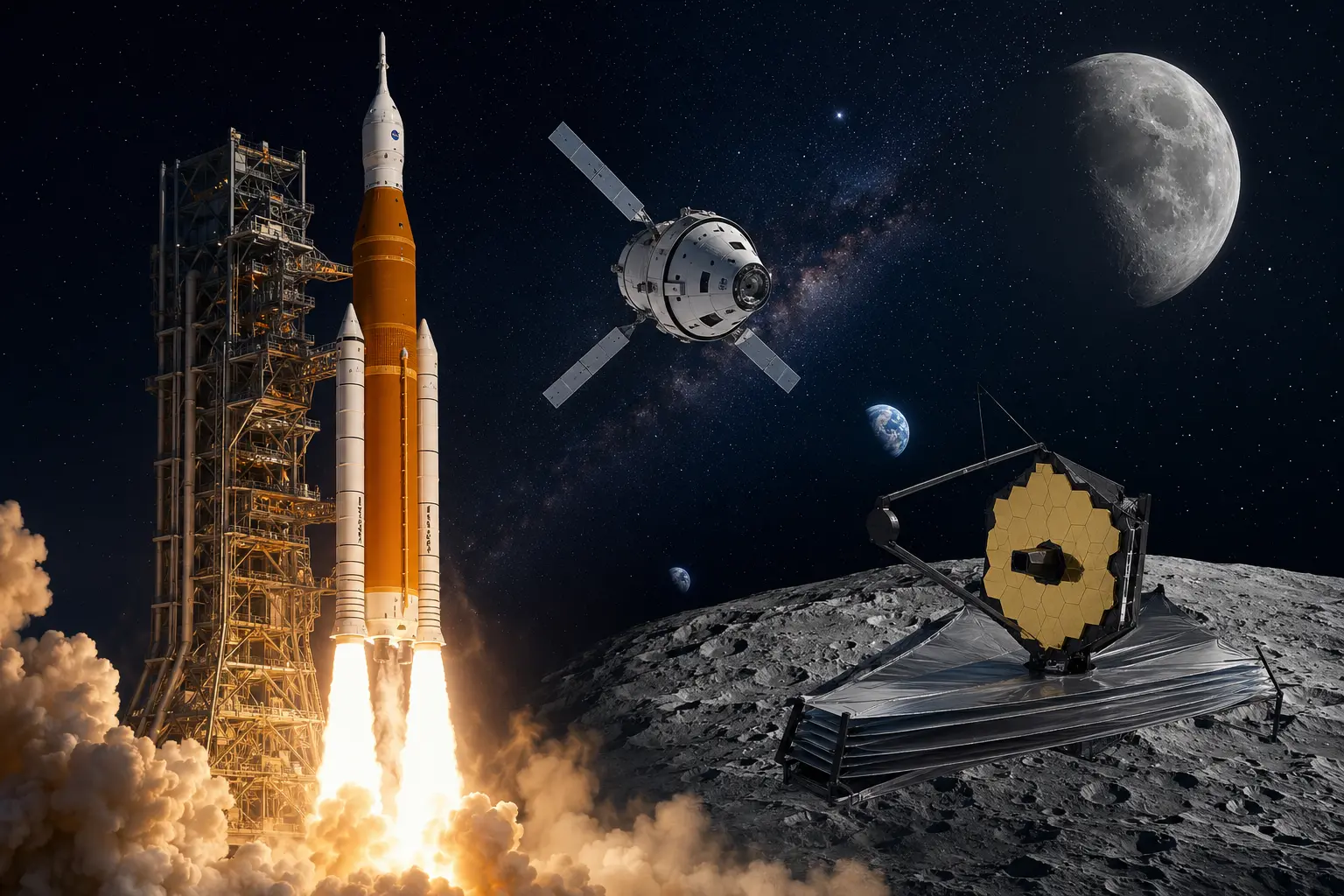
NASA’s 2026 space program is entering a particularly important period, with major missions spanning the Moon, deep-space astronomy, Earth science and commercial spaceflight.
The agency’s biggest near-term science milestone is the Nancy Grace Roman Space Telescope, currently targeted to launch on August 30, 2026, aboard a SpaceX Falcon Heavy from Kennedy Space Center. Meanwhile, NASA is preparing Artemis III for 2027, a crewed demonstration mission that will test critical rendezvous and docking operations ahead of the planned Artemis IV lunar landing mission in 2028.
NASA’s official 2026 launch schedule also includes commercial lunar missions, cargo flights, crew missions and other spacecraft, making the year much broader than the Artemis program alone.
What are NASA’s biggest space missions in 2026?
The most important NASA-related missions and developments to watch include:
- Nancy Grace Roman Space Telescope — targeted for August 30, 2026
- Artemis III preparations — major hardware integration for the 2027 crewed mission
- Commercial lunar lander missions — part of NASA’s preparations for sustained lunar exploration
- Crew-13 — NASA’s next SpaceX crew rotation mission, targeted for September 2026
- SunRISE and other science missions — additional spacecraft and investigations scheduled during 2026
- Continued operations of NASA’s major observatories and planetary missions
The important point is that Artemis III is now scheduled for 2027, not 2026. NASA’s current plan uses Artemis III as a crewed demonstration in Earth orbit, with Artemis IV targeted as the first planned crewed lunar South Pole mission in 2028.
Nancy Grace Roman Space Telescope: NASA’s biggest 2026 science launch
The Nancy Grace Roman Space Telescope is one of the most anticipated NASA missions of 2026.
NASA currently lists August 30, 2026 as the target launch date, at approximately 7:26 a.m. EDT, aboard a SpaceX Falcon Heavy from Launch Complex 39A at Kennedy Space Center in Florida.
The mission was originally scheduled later, but NASA has accelerated the launch by approximately nine months.
Roman will travel to the Sun-Earth L2 point, roughly one million miles from Earth. From there, the telescope will conduct wide-field surveys of the universe.
What will the Roman Space Telescope study?
Roman has several major scientific goals.
It will investigate:
- Dark energy
- Dark matter
- Exoplanets
- Galaxy formation and evolution
- Black holes
- The structure and history of the universe
NASA says Roman’s enormous field of view will allow it to survey billions of galaxies and discover new exoplanets using techniques including gravitational microlensing.
The telescope will complement rather than replace the James Webb Space Telescope and Hubble. Roman’s strength will be its ability to survey enormous areas of the sky quickly.
Artemis III: NASA’s next major human-spaceflight milestone
Artemis III has undergone an important change in mission planning.
Rather than sending astronauts directly to the lunar surface, NASA now plans to use Artemis III as a crewed demonstration mission in Earth orbit in 2027. The mission will test rendezvous and docking capabilities between Orion and test versions of commercial human landing systems developed by Blue Origin and SpaceX.
NASA says the demonstration is intended to reduce risk before future crewed lunar landings.
Who is on the Artemis III crew?
NASA announced four prime crew members in June 2026:
- Randy Bresnik
- Andre Douglas
- Luca Parmitano, European Space Agency astronaut
- Frank Rubio
The crew will conduct the Earth-orbit demonstration mission planned for 2027.
Artemis III hardware is already moving forward
Despite the change in mission profile, hardware development is advancing.
NASA joined the Orion crew and service modules for Artemis III on July 30, 2026. Engineers are now preparing the combined spacecraft for integrated testing.
The Artemis III SLS hardware is also progressing. NASA says all four RS-25 engines for the mission were delivered to the Vehicle Assembly Building by July 21, while solid rocket booster processing and stacking work has been underway.
This is significant because Artemis III is intended to demonstrate technologies and procedures that support the later lunar missions.
What happened with Artemis II?
Artemis II marked a historic step in NASA’s return-to-the-Moon campaign.
The mission launched in April 2026 with four astronauts aboard Orion, making it the first crewed flight of NASA’s Space Launch System and Orion spacecraft. The mission traveled around the Moon and returned the crew safely to Earth.
The mission provided NASA with important operational experience before Artemis III.
NASA is also reusing selected components from the Artemis II Orion spacecraft for later missions. According to NASA, more than 250 Artemis II Orion components will be reused for Artemis IV and Artemis V.
When will NASA return astronauts to the Moon?
Under NASA’s current plan, Artemis IV is targeted for 2028 and is intended to be the first planned crewed lunar landing mission in the current Artemis sequence.
NASA describes Artemis III as the Earth-orbit demonstration that will precede that landing mission.
This means readers should be careful with headlines claiming that NASA is sending astronauts to the lunar surface in 2026. That is not the current NASA schedule.
The agency is instead using 2026 and 2027 to prepare and test the systems needed for later lunar surface operations.
NASA’s commercial Moon missions continue
NASA’s lunar strategy extends beyond SLS and Orion.
The agency is working with commercial companies through the Commercial Lunar Payload Services (CLPS) program and human landing system contracts.
NASA’s 2026 schedule lists several lunar-related missions, including:
- Blue Origin Blue Moon Mark 1
- Astrobotic Griffin-1
- Intuitive Machines IM-3
- Firefly Aerospace Blue Ghost Mission 2
These missions are part of NASA’s broader effort to deliver scientific instruments and technology to the lunar surface ahead of sustained human exploration.
The agency is also developing lunar infrastructure and technology demonstrations intended to support future operations around the Moon.
NASA’s Moon base plans are taking shape
NASA’s current lunar strategy increasingly involves infrastructure rather than one-off visits.
The agency recently highlighted commercial lunar landers being prepared for upcoming missions, describing them as part of the work needed to build capabilities for future lunar operations.
The long-term objective is to establish a sustainable presence around and eventually on the Moon, using commercial partners alongside NASA’s own spacecraft and systems.
That infrastructure could eventually support scientific research, technology demonstrations and preparation for missions farther into the solar system.
Crew-13 and NASA’s space station operations
NASA’s 2026 schedule also includes continued human activity in low Earth orbit.
SpaceX Crew-13 is currently targeted for no earlier than September 12, 2026. The mission will support NASA’s commercial crew operations and International Space Station activities.
The commercial crew program has become an essential part of NASA’s human-spaceflight strategy, allowing NASA to rely on commercially operated spacecraft for routine transportation to and from the International Space Station.
Other NASA missions to watch in 2026
NASA’s 2026 schedule includes considerably more than Moon and crew missions.
The agency lists SunRISE, additional commercial lunar payload missions, cargo flights and other spacecraft among the year’s activities. Some launch dates remain listed broadly as summer, fall or 2026 rather than having firm dates.
This distinction matters because spaceflight schedules frequently change because of technical problems, weather, range availability and readiness of spacecraft or launch vehicles.
NASA 2026 mission snapshot
| Mission/program | Current timing | Main purpose |
|---|---|---|
| Roman Space Telescope | Aug. 30, 2026 target | Dark energy, dark matter, exoplanets and astronomy |
| Crew-13 | Sept. 12, 2026 target | International Space Station crew rotation |
| Commercial lunar missions | 2026 | Science and technology delivery to the Moon |
| SunRISE | 2026 | Solar and space-weather science |
| Artemis III | 2027 | Crewed Earth-orbit demonstration |
| Artemis IV | Early 2028 | Planned crewed lunar South Pole mission |
Dates marked as targets are subject to change. NASA’s official launch schedule should be treated as the authoritative source for current dates.
Why 2026 is important for NASA
NASA’s 2026 program is important because several different strands of space exploration are converging.
The Roman Space Telescope will expand humanity’s ability to survey the universe. Commercial lunar missions are building experience in operating around and on the Moon. Artemis hardware is progressing toward future crewed missions. And commercial crew operations continue supporting humans in low Earth orbit.
Rather than representing a single dramatic launch, 2026 is becoming a year of infrastructure, science and preparation.
The success of these missions could influence NASA’s ability to maintain a sustained lunar exploration campaign in the second half of the decade.
FAQ
What is NASA’s biggest mission in 2026?
One of NASA’s biggest 2026 missions is the Nancy Grace Roman Space Telescope, currently targeted for launch on August 30, 2026, aboard a SpaceX Falcon Heavy. It will study dark energy, dark matter, exoplanets and the wider universe.
Is NASA going back to the Moon in 2026?
NASA is continuing its return-to-the-Moon campaign in 2026, but Artemis III is no longer planned as a lunar landing mission in 2026. Artemis III is currently planned for 2027 as a crewed Earth-orbit demonstration.
When is Artemis III launching?
Artemis III is planned for 2027, although NASA’s current schedule does not provide a specific launch date. The mission will test Orion’s rendezvous and docking capabilities with commercial human landing systems in Earth orbit.
When will NASA astronauts land on the Moon?
NASA currently identifies Artemis IV in 2028 as the first planned crewed mission to the lunar South Pole region following the Artemis III demonstration.
When will the Roman Space Telescope launch?
NASA currently targets August 30, 2026, at approximately 7:26 a.m. EDT, for Roman’s launch on a SpaceX Falcon Heavy from Kennedy Space Center.
What will the Roman Space Telescope discover?
Roman will investigate dark energy, dark matter, exoplanets, galaxies and black holes. Its wide field of view will allow it to survey enormous areas of the sky much faster than narrower-field observatories.
What lunar missions are planned for 2026?
NASA’s 2026 schedule includes commercial lunar missions involving Blue Origin, Astrobotic, Intuitive Machines and Firefly Aerospace, although individual launch dates can change.
What was Artemis II?
Artemis II was NASA’s first crewed SLS/Orion mission. It launched in April 2026 and sent four astronauts on a mission around the Moon before returning them safely to Earth.
“Sources Used“
https://science.nasa.gov/mission/roman-space-telescope/
What happens next?
The most immediate NASA milestone is the Roman Space Telescope launch currently targeted for August 30, 2026. NASA will then continue preparing for Crew-13 and other scheduled missions later in the year.
For Artemis, the major focus is on completing Orion and SLS integration for Artemis III, while NASA and its commercial partners continue testing the systems required for future lunar operations.
The next major human-spaceflight milestone is therefore not an Artemis lunar landing in 2026. It is the Artemis III Earth-orbit demonstration planned for 2027, followed by the planned Artemis IV lunar mission in 2028.
Bottom line
NASA’s 2026 space program is centered on major science missions, commercial lunar exploration and preparation for the next phase of Artemis. The Nancy Grace Roman Space Telescope is currently scheduled for launch on August 30, while Artemis III hardware is being assembled for its 2027 crewed demonstration mission.
The most important development for readers to understand is the revised Artemis timeline: Artemis III is now a 2027 Earth-orbit demonstration, while Artemis IV is planned as the first crewed lunar South Pole mission in 2028.
NASA’s 2026 missions therefore represent more than a list of launches. Together, they are building the scientific and technological foundation for the agency’s next era of lunar and deep-space exploration.
“Must Read”
AI Tools & AI Updates 2026: Latest News, New Models and Top AI Tools
iPhone 18 September Event 2026: What Apple Is Expected to Announce
Google Pixel Android 17 Update: Latest News, Features and Supported Phones