



The next major battery breakthrough may not be a single invention.
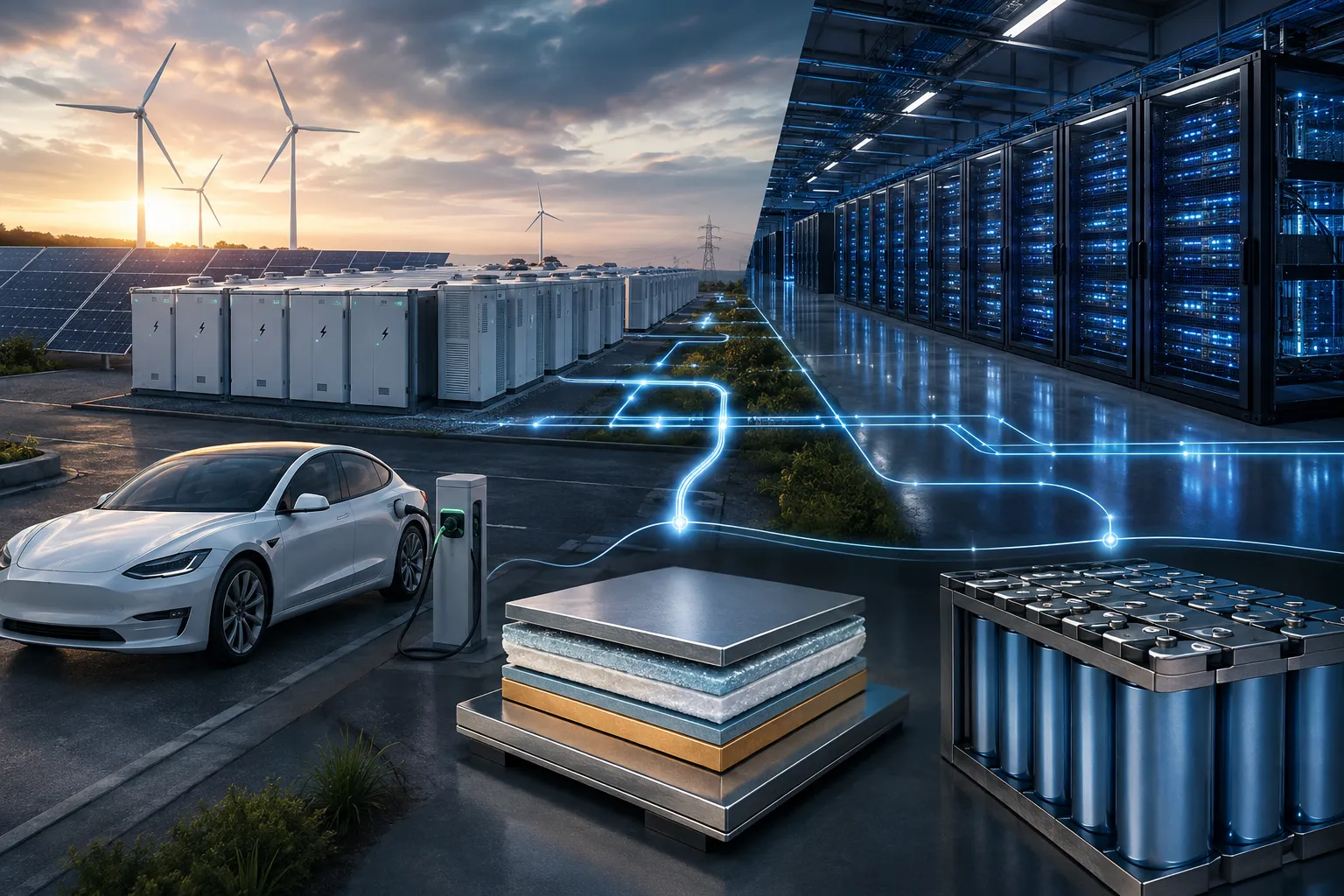
In 2026, the battery industry is moving in several directions at once: solid-state batteries are progressing toward commercial production, sodium-ion batteries are entering the scale-up phase, lithium iron phosphate remains dominant in many applications, and battery storage is expanding rapidly across electricity grids and data centers.
The reason is simple: batteries are no longer just components inside smartphones and electric cars.
They are becoming critical infrastructure for the wider energy system.
Electric vehicles need batteries with greater range, faster charging and lower costs. Renewable-energy systems need storage that can shift electricity from sunny or windy periods to times of high demand. Meanwhile, the rapid expansion of AI is creating new requirements for reliable power and backup storage at data centers.
The International Energy Agency (IEA) reports that global EV battery deployment reached 1.2 TWh in 2025, almost 30% higher than in 2024. At the same time, global battery-storage additions reached 108 GW in 2025, up 40% from the previous year.
That makes the next generation of batteries one of the most important technologies to watch in 2026.
What Are Next-Generation Batteries?
Next-generation batteries are advanced energy-storage technologies designed to improve one or more characteristics of conventional lithium-ion batteries, such as energy density, safety, charging speed, lifespan, cost, temperature performance or availability of raw materials.
The phrase does not refer to one specific chemistry.
It can include technologies such as:
- solid-state batteries
- sodium-ion batteries
- lithium-sulfur batteries
- lithium-metal batteries
- iron-air batteries
- flow batteries
- advanced lithium-ion chemistries
- new battery designs and manufacturing methods
Some are intended primarily for electric vehicles.
Others may be better suited to stationary grid storage.
That distinction is important because the best battery for an EV is not necessarily the best battery for a solar farm or an AI data center.
Why Do We Need New Battery Technology?
Lithium-ion batteries have transformed modern technology.
They power smartphones, laptops, electric vehicles and enormous amounts of energy-storage infrastructure.
But lithium-ion is not a single technology. Different chemistries have different trade-offs.
For example, lithium iron phosphate (LFP) generally offers lower cost and strong cycle performance, while nickel-based chemistries can provide higher energy density.
The industry is therefore trying to improve batteries without assuming that one chemistry will dominate every application.
Several challenges are driving research.
Higher Energy Density
Higher energy density means more energy can be stored in a given mass or volume.
For an EV, this can potentially mean:
- longer driving range
- lighter battery packs
- less space required for batteries
Faster Charging
Consumers increasingly want EV charging to approach the convenience of conventional refuelling.
Battery chemistry, thermal management, charging infrastructure and battery design all influence charging performance.
Lower Cost
Battery prices have fallen dramatically, but cost remains a major factor in EV affordability and energy storage.
The IEA reports that average battery prices fell 8% in 2025, although lithium and cobalt prices increased toward the beginning of 2026.
Better Safety
Some next-generation designs seek to reduce the risk associated with flammable liquid electrolytes or improve thermal stability.
Reduced Dependence on Critical Minerals
Battery supply chains are highly concentrated.
The IEA notes that production capacity for important battery components remains heavily concentrated in China, creating supply-chain and strategic risks.
This is one reason sodium-ion technology has attracted attention
The Battery Technologies to Watch in 2026
1. Solid-State Batteries
Solid-state batteries are perhaps the most widely discussed next-generation EV battery technology.
The key difference is the electrolyte.
Conventional lithium-ion batteries use a liquid electrolyte. Solid-state batteries use a solid electrolyte.
In theory, this could enable batteries with:
- higher energy density
- improved safety
- potentially longer range
- different cell designs
- reduced reliance on flammable liquid electrolytes
But there is an important reality check.
Solid-state batteries are not yet a mass-market replacement for conventional lithium-ion batteries.
The IEA’s 2026 assessment says solid-state technology is progressing but that its commonly cited advantages have not yet been demonstrated at scale in real-world applications. Manufacturing is also more complex and expensive.
Several manufacturers are targeting commercial production in the second half of the decade.
The IEA identifies Toyota, BYD and Samsung among companies pursuing all-solid-state battery development, with early deployments expected to remain limited before wider adoption.
Why Solid-State Batteries Matter
If manufacturing challenges can be solved, solid-state batteries could be particularly important for applications where energy density and safety are worth paying a premium.
That could initially include:
- premium EVs
- high-performance vehicles
- specialised mobility
- robotics
- potentially aviation applications
But widespread adoption depends on cost and manufacturing scale.
2. Sodium-Ion Batteries
Sodium-ion batteries are taking a very different approach.
Instead of relying on lithium ions, they use sodium ions.
Sodium is abundant and widely available, potentially reducing exposure to lithium supply constraints.
The technology also has an interesting temperature advantage.
The IEA reports that the latest sodium-ion cells can retain around 90% of nominal capacity at temperatures as low as -40°C, depending on the technology.
That could make sodium-ion particularly attractive in certain climates and applications.
However, sodium-ion batteries currently have a major disadvantage:
lower energy density than leading lithium-ion batteries.
The IEA reports that the latest sodium-ion cells can reach up to around 175 Wh/kg, compared with up to around 205 Wh/kg for LFP and 265 Wh/kg for NMC.
That makes sodium-ion less attractive when maximum range and minimum weight are the priorities.
But stationary storage does not necessarily need the same energy density as an EV.
That is why sodium-ion could become important for:
- grid storage
- stationary batteries
- smaller EVs
- two- and three-wheelers
- urban commercial vehicles
- industrial equipment
The IEA describes sodium-ion batteries as entering the scale-up phase, although their manufacturing ecosystem remains much smaller than lithium-ion
3. Lithium-Sulfur Batteries
Lithium-sulfur batteries replace the conventional cathode materials used in many lithium-ion designs with sulfur.
The attraction is potentially high energy density and the relative abundance of sulfur.
The technology is being studied for applications where weight matters significantly.
Potential applications include:
- aviation
- drones
- aerospace
- long-range transportation
- specialised EVs
But lithium-sulfur batteries face substantial technical challenges, including cycle life and degradation mechanisms.
The IEA lists lithium-sulfur among the advanced battery technologies under development and notes its potential relevance to sectors requiring higher energy densities.
This is an important example of why “next-generation battery” does not necessarily mean “future mass-market car battery.”
Some technologies may succeed first in specialised markets
4. Iron-Air and Long-Duration Batteries
Not every future battery needs to make an electric car travel farther.
Some are designed to store electricity for much longer periods.
Iron-air batteries are one example.
They are being developed for grid applications where the objective is not maximum energy density but long-duration electricity storage.
Other approaches include:
- flow batteries
- zinc-based batteries
- thermal storage
- other long-duration storage systems
The IEA notes that iron-air and redox-flow technologies target different applications from conventional lithium-ion, particularly longer-duration grid storage.
This distinction is crucial.
A battery that is too heavy for an EV could still be extremely valuable for a stationary power plant.
Next-Generation Batteries and Data-Center Energy
One of the most important new battery markets may be hiding behind the AI boom.
Data centers are becoming major electricity consumers, and batteries are increasingly important to their power infrastructure.
The IEA estimates that global data centers consumed around 415 TWh of electricity in 2024 and projects consumption to reach around 945 TWh by 2030 in its base case. AI is identified as the most important driver of that growth.
But the challenge isn’t simply the amount of electricity.
AI data centers can experience high-density and rapidly changing power demand.
The IEA’s 2026 analysis says AI is pushing data-center power density to the limits of current technologies. It estimates that by 2027, an individual advanced server rack could have peak power demand equivalent to roughly 65 households.
That makes energy storage increasingly valuable.
Why Do AI Data Centers Need Batteries?
Data centers need extremely reliable electricity.
Even a short interruption can cause problems for computing workloads and critical infrastructure.
Batteries can provide several services.
1. Backup Power
Uninterruptible power supply (UPS) batteries can bridge the gap between a grid outage and longer-duration backup generation.
2. Power Quality
Batteries can help manage sudden changes and disturbances in electricity supply.
3. Peak Management
Energy storage can potentially reduce the amount of grid power drawn during periods of extreme demand.
4. Renewable Integration
Batteries can store electricity generated by solar or wind and release it when needed.
5. Grid Flexibility
Large battery systems can potentially provide services to the electricity grid when appropriate market structures and technical systems are available.
The IEA estimates that around 20–25 GW of battery storage could be installed in data centers globally by 2030. It says such batteries could potentially become a grid asset if incentives and system designs allow it.
This is an important shift.
The battery inside a future AI data center may not simply be emergency backup equipment.
It could become part of the facility’s broader energy strategy.
Battery Storage Is Already Growing in Data Centers
This is not purely a future concept.
The IEA’s 2026 Global Energy Review reports that battery-based UPS capacity, primarily associated with data centers, increased 30% to 45 GW in 2025.
That does not mean all of this capacity uses experimental battery chemistries.
In fact, today’s systems are predominantly based on mature technologies.
But it demonstrates a growing market for batteries around computing infrastructure.
As AI data centers become larger, the distinction between IT infrastructure and energy infrastructure is becoming increasingly blurred.
Next-Generation Batteries and Electric Vehicles
Electric vehicles remain the biggest battery application.
The IEA reports that EVs accounted for more than 70% of global battery deployment in 2025, with EV battery deployment reaching 1.2 TWh.
That means even relatively small improvements in battery performance can have enormous consequences.
What EV Drivers Want From Future Batteries
The ideal EV battery would offer:
- high energy density
- low cost
- fast charging
- long lifespan
- excellent cold-weather performance
- strong safety
- low degradation
- sustainable materials
- easy recycling
No current chemistry delivers all of these characteristics perfectly.
That is why the industry is exploring multiple solutions.
LFP vs NMC vs Next-Generation Batteries
Lithium-ion itself is continuing to improve.
This is sometimes overlooked in discussions about “the next battery.”
The IEA reports that LFP accounted for more than 55% of EV batteries deployed globally in 2025, up from nearly 50% in 2024.
LFP has lower energy density than some nickel-based chemistries, but it offers advantages in cost, durability and material availability.
That means the future is unlikely to be:
Lithium-ion disappears → solid-state takes over.
A more realistic scenario is:
Several battery technologies coexist for different jobs.
| Battery Technology | Major Strength | Likely Best-Fit Applications |
|---|---|---|
| LFP | Cost, durability, cycle life | Mass-market EVs, stationary storage |
| NMC | Higher energy density | Longer-range EVs |
| Sodium-ion | Material availability, cold-weather performance | Stationary storage, smaller EVs |
| Solid-state | Potential energy density and safety | Premium EVs, specialised mobility |
| Lithium-sulfur | Potentially high specific energy | Aviation, aerospace, specialised vehicles |
| Iron-air | Long-duration potential | Grid-scale storage |
| Flow batteries | Long-duration cycling | Stationary/grid applications |
These categories are not fixed. Technologies can improve, costs can change and commercial applications can overlap.
“Sources Used”
https://www.iea.org/reports/global-ev-outlook-2026/electric-vehicle-batteries
Next-Generation Batteries and Renewable Energy
Renewable energy creates a fundamental timing problem.
Solar power is strongest during daylight hours.
Wind generation varies with weather and location.
Electricity demand does not necessarily follow either pattern.
Batteries help bridge this gap.
A solar farm can generate electricity during the afternoon, while a battery stores some of that electricity and releases it later.
This is called energy shifting.
The IEA reports that battery storage was the fastest-growing power technology in 2025, with 108 GW of new capacity deployed globally, 40% more than in 2024. Around 80% of those additions were utility-scale projects.
That is already changing electricity systems.
Why Batteries Matter for Solar and Wind
Batteries can provide several functions for renewable-energy systems.
Store excess solar power
Electricity generated when solar output is high can be stored for later.
Smooth wind generation
Batteries can respond quickly to changes in wind output.
Reduce renewable-energy curtailment
When electricity supply exceeds demand or grid capacity, some renewable generation may otherwise be curtailed. Storage can absorb some of that excess electricity.
Provide grid flexibility
Batteries can rapidly respond to changes in electricity supply and demand.
The IEA says battery storage can help integrate wind and solar by providing balancing services, capacity and the ability to shift renewable generation to periods of higher demand.
Are Batteries the Missing Link for Renewable Energy?
They are an important part of the solution, but not the only one.
A modern renewable-heavy power system may need a combination of:
- batteries
- transmission lines
- flexible power plants
- demand response
- interconnections
- pumped-storage hydropower
- long-duration storage
- forecasting
- smart-grid technology
Batteries are particularly useful because they respond quickly.
But a battery cannot economically store every unit of electricity needed for every possible weather event.
That is why longer-duration storage and broader grid flexibility will remain important.
How Much Battery Storage Will the World Need?
The scale is growing rapidly.
The IEA has previously estimated that global energy-storage capacity needs to expand dramatically this decade to support renewable-energy deployment. In its batteries and secure energy transitions analysis, it found that global energy storage capacity would need to increase sixfold to 1,500 GW by 2030 in its Net Zero Emissions scenario, with batteries accounting for most of the increase.
The more recent 2026 data show how quickly deployment is already moving: 108 GW of new battery storage capacity was added in 2025 alone.
The challenge is therefore shifting from:
Can batteries store renewable electricity?
to:
Can manufacturing, supply chains, grids and markets scale battery storage quickly enough?
The Critical-Mineral Problem
Next-generation batteries are partly motivated by concerns over raw materials.
Today’s battery supply chain relies on materials such as:
- lithium
- graphite
- nickel
- cobalt
- manganese
- copper
Different chemistries use these materials in different quantities.
Sodium-ion technology is attractive partly because it does not require lithium.
But replacing one supply chain with another does not automatically eliminate supply-chain risks.
The IEA says sodium-ion manufacturing remains far smaller than lithium-ion and that its hard-carbon supply chain is still poorly developed and heavily concentrated in China.
The future battery industry therefore needs not only new chemistries but also:
- diversified mining
- refining capacity
- manufacturing
- recycling
- material recovery
- responsible sourcing
Battery Recycling Will Become More Important
A growing battery fleet eventually creates a growing waste stream.
Recycling can recover materials from batteries and reduce pressure on new mineral extraction.
The IEA says recycling will become increasingly important for battery supply security, although end-of-life batteries currently contribute less material than production scrap because the large wave of batteries deployed in recent years has not yet reached the end of its useful life.
This means the battery economy of the 2030s could look very different from today’s.
Instead of relying almost entirely on newly mined materials, battery manufacturers could increasingly combine:
new minerals + recycled materials + improved chemistries + longer battery life
That could make the overall system more resilient.
Will Solid-State Batteries Replace Lithium-Ion Batteries?
Not immediately.
Solid-state batteries have significant potential, but commercial-scale manufacturing remains difficult.
The IEA says all-solid-state cells are being produced at small scale for testing, but manufacturing remains more complex and costly than conventional lithium-ion production.
The first commercial applications are therefore more likely to appear in premium or specialised markets.
Mass-market adoption will depend on whether manufacturers can:
- manufacture cells reliably,
- increase production volume,
- reduce costs,
- maintain performance over many charging cycles,
- integrate cells into vehicle packs,
- satisfy safety requirements.
A laboratory cell can be impressive.
A commercially competitive battery pack is a much harder engineering problem.
Will Sodium-Ion Batteries Replace Lithium-Ion Batteries?
Probably not across the entire market.
Sodium-ion batteries currently have lower energy density than leading lithium-ion technologies.
That makes them less attractive for applications where weight and volume matter greatly.
But they may become important alongside lithium-ion.
Their potential advantages make them especially interesting for:
- stationary storage
- smaller EVs
- two- and three-wheelers
- cold-weather applications
- industrial equipment
The IEA expects sodium-ion to remain a smaller part of the overall battery market in the near term, while its manufacturing capacity is still much smaller than lithium-ion.
What Could Be the Best Battery for AI Data Centers?
There is no single answer.
Data centers have different battery requirements from EVs.
For an EV, energy density is extremely important.
For a data center, priorities may include:
- reliability
- power output
- cycle life
- safety
- cost
- rapid response
- duration
- thermal management
- integration with the electrical grid
That means technologies such as LFP may remain attractive for many stationary applications even if another chemistry eventually dominates premium EVs.
The IEA notes that LFP batteries accounted for around 90% of global stationary battery-storage installations in 2025, illustrating how application-specific battery choices can be.
Next-Generation Batteries and the AI Energy Challenge
The battery industry is increasingly becoming part of the AI infrastructure story.
AI requires computing.
Computing requires electricity.
Electricity systems increasingly need flexibility.
Batteries can provide some of that flexibility.
The IEA estimates that accelerated servers, driven mainly by AI adoption, could account for almost half of the net increase in global data-center electricity consumption through 2030 in its base case.
At the same time, AI data centers can create large, concentrated electricity loads.
This creates a three-way relationship:
AI → more data centers → more electricity demand
and:
Renewables → variable electricity generation → need for storage
and therefore:
Batteries → flexibility for both the grid and energy-intensive computing
That is why next-generation batteries are not simply an EV story.
They are becoming part of the infrastructure required for the digital economy.
What Will Battery Technology Look Like by 2030?
The most likely answer is diversification.
Rather than one battery replacing everything else, different technologies could specialize.
EVs
Improved LFP and NMC batteries may remain dominant while solid-state technology enters premium segments.
Small EVs and Two-Wheelers
Sodium-ion batteries could become increasingly competitive where range requirements are moderate.
Renewable Energy
LFP is likely to remain important, while longer-duration technologies expand into applications where four-hour storage is insufficient.
AI Data Centers
Battery systems could become larger and more sophisticated, serving both backup and grid-flexibility functions.
Aviation and Aerospace
Higher-specific-energy technologies such as lithium-sulfur could receive greater attention if their durability and safety challenges are solved.
Grid Storage
Iron-air, flow batteries and other long-duration technologies could complement lithium-ion systems.
This is why the phrase “next-generation battery” should be understood as an ecosystem rather than a single product.
The Biggest Challenges Ahead
Even promising battery technologies face significant barriers.
Manufacturing Scale
A battery chemistry can work in a laboratory and still fail to become commercially viable.
Cost
New manufacturing processes are generally expensive before they achieve economies of scale.
Supply Chains
Raw materials and specialized components can become bottlenecks.
Safety
New chemistries need extensive testing before widespread adoption.
Cycle Life
High energy density is not useful if a battery degrades rapidly.
Recycling
New chemistries may require new recycling processes and infrastructure.
Infrastructure
EVs need charging networks. Grid batteries need suitable transmission and market structures. Data-center batteries need integration with complex power systems.
Competition From Existing Batteries
The biggest competitor to a new battery technology may not be another emerging chemistry.
It may simply be a cheaper, improving version of lithium-ion.
That is one of the biggest reasons why next-generation battery adoption is likely to be gradual.
Next-Generation Batteries: What Matters Most in 2026?
The battery story in 2026 is not about waiting for one revolutionary technology.
The more important development is that batteries are becoming increasingly specialized.
LFP is expanding because cost and durability matter.
Sodium-ion is advancing because material availability and cold-weather performance matter.
Solid-state batteries are progressing because higher performance and safety could justify higher costs.
Long-duration technologies are being developed because renewable-heavy grids need storage beyond conventional short-duration systems.
And AI is creating another demand center for batteries because data centers increasingly require reliable, flexible electricity.
The IEA’s latest figures show the scale of this transition: EV battery deployment reached 1.2 TWh in 2025, while global battery-storage additions reached 108 GW.
The next battery revolution, therefore, may not be about replacing lithium-ion overnight.
It may be about building a portfolio of batteries, each optimized for a different part of the economy.
Why Next-Generation Batteries Matter for Future Technology
Batteries sit at the intersection of three major technological transitions.
First: transportation.
Electric vehicles need batteries that can deliver affordable range, fast charging and long service life.
Second: renewable energy.
Solar and wind generation require flexible storage and grid infrastructure to become increasingly integrated into electricity systems.
Third: artificial intelligence.
AI data centers are creating rapidly growing electricity demand and increasing the importance of reliable power and energy storage.
These trends reinforce one another.
More EVs increase electricity demand.
More renewable generation increases the value of storage.
More AI increases the need for reliable electricity.
And better batteries can help connect all three.
That makes next-generation batteries one of the clearest examples of a technology that can affect transportation, energy and computing simultaneously.
For the wider technology landscape, read HNN24x7’s Future Technology 2026.
FAQ
What are next-generation batteries?
Next-generation batteries are advanced energy-storage technologies designed to improve characteristics such as energy density, safety, charging speed, lifespan, cost or material availability compared with existing battery technologies.
What is the next battery technology after lithium-ion?
There is no single successor. Solid-state, sodium-ion, lithium-sulfur, iron-air and flow batteries are all being developed for different applications, while lithium-ion itself continues to improve.
Are solid-state batteries better than lithium-ion?
Solid-state batteries have the potential to offer higher energy density and improved safety, but these advantages have not yet been demonstrated at mass-production scale across real-world applications. Manufacturing remains a major challenge.
Are sodium-ion batteries the future?
Sodium-ion batteries are unlikely to replace lithium-ion everywhere, but they could become important in stationary storage, smaller EVs, two- and three-wheelers and applications where lower energy density is acceptable.
Which battery is best for renewable energy?
There is no universal best battery. LFP is already widely used for stationary storage, while longer-duration technologies such as flow and iron-air batteries could become important for applications requiring storage over longer periods.
How will batteries help AI data centers?
Batteries can provide backup power, improve power quality, manage peaks and potentially help data centers participate in grid-flexibility programs. The IEA estimates that 20–25 GW of battery storage could be installed in data centers globally by 2030.
How much electricity will data centers use by 2030?
The IEA’s base case projects global data-center electricity consumption to reach around 945 TWh in 2030, more than double the estimated 415 TWh consumed in 2024.
How fast is battery storage growing?
In 2025, around 108 GW of new battery-storage capacity was deployed worldwide, 40% more than in 2024.
Will next-generation batteries make EVs cheaper?
They could, but not automatically. New technologies initially tend to have higher manufacturing costs. Cost reductions depend on production scale, materials, manufacturing efficiency and supply-chain development.
Will batteries replace fossil fuels?
Batteries can help reduce fossil-fuel dependence by storing renewable electricity and supporting electrification, but they are only one part of the broader energy transition. Grid expansion, renewable generation, other storage technologies and firm electricity sources will also matter.
When will solid-state batteries become mainstream?
Early commercial deployments are expected before the end of the decade, but widespread mass-market adoption is uncertain. The IEA expects solid-state batteries to remain limited initially, with broader competitiveness depending on manufacturing scale and cost reductions.