



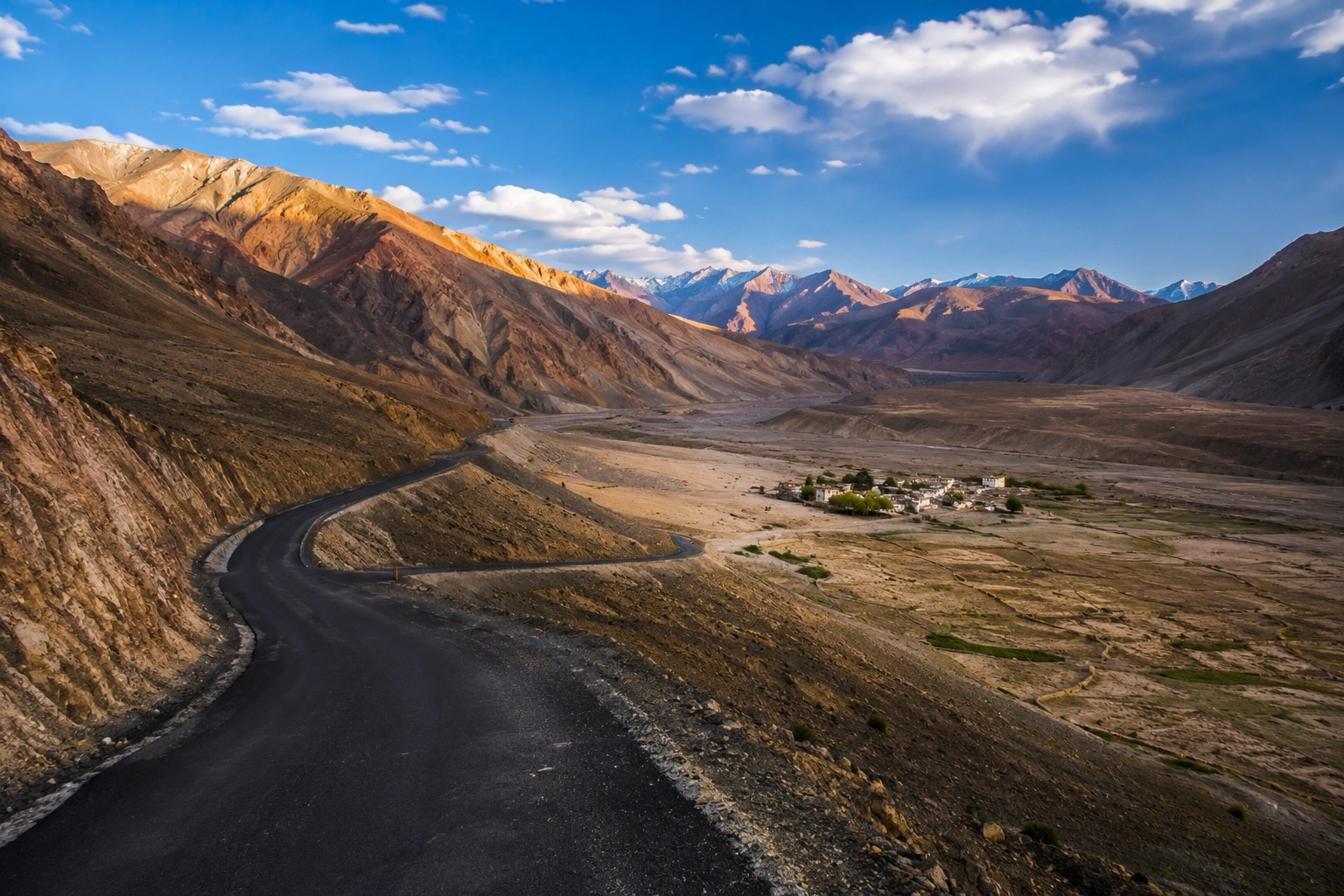
If you have already seen the usual Ladakh itinerary—Leh, Nubra Valley, Khardung La and Pangong Lake—the next question is obvious:
Where should you go in Ladakh in 2026 if you want something different?
The answer lies beyond the region’s most photographed stops.
Ladakh’s official tourism information itself identifies destinations such as Zanskar, Suru Valley, Changthang, Tso Moriri and the Drokpa villages around Dha-Hanu as important tourism areas beyond the most familiar circuit.
And current traveler discussions suggest the appetite for these alternatives is growing. In 2026, travelers looking specifically for quieter itineraries are discussing Zanskar, Hanle and Tso Moriri as alternatives to a rushed Pangong–Nubra circuit.
That does not mean these places are completely unknown.
In fact, some—especially Hanle and Tso Moriri—are becoming increasingly popular.
The better description is offbeat: destinations that require a detour, more travel time, a slower itinerary or a different reason for visiting.
Here are seven offbeat places in Ladakh worth putting on your 2026 travel map.
1. Zanskar Valley: The Biggest Detour That Can Change Your Entire Ladakh Trip

If you want to experience a dramatically different side of Ladakh, start with Zanskar.
Zanskar is not a quick day trip from Leh. It is a large, remote region spread across more than 5,000 square kilometres, and the Ladakh administration describes it as one of the least interfered-with cultural regions of Ladakh.
That remoteness is exactly the attraction.
The journey through the Suru Valley, across Pensi La and into Zanskar feels very different from the highly photographed Leh–Pangong route.
The landscape gradually changes from green valley sections to immense barren mountains, glaciers and high-altitude plateaus.
What makes Zanskar worth visiting in 2026?
It gives you a journey rather than a checklist.
Instead of driving to one famous viewpoint, you move through a succession of landscapes and settlements.
The official Ladakh description notes that the Pensi La section includes high-altitude turquoise lakes and views toward the Drang-Drung area, while Zanskar historically remained isolated for much of the year because of the winter closure of Pensi La.
That geographic isolation is slowly changing as road connectivity improves.
For travelers, that creates an interesting moment: Zanskar is becoming more accessible without losing all of its remote character.
Best for
- Long road trips
- Motorcyclists
- Trekkers
- Landscape photographers
- Repeat Ladakh visitors
- Travelers with 2–4 extra days
Why it beats another rushed sightseeing day
Recent 2026 Reddit discussions repeatedly show experienced travelers recommending Zanskar when visitors say they want to get away from the standard tourist route.
Verdict: One of the strongest choices for travelers genuinely looking beyond the conventional Ladakh circuit.
2. Suru Valley and Rangdum: Ladakh’s Green-to-Wild Transition

Before Zanskar becomes the destination, Suru Valley provides one of the most visually dramatic approaches.
The official Kargil tourism information divides the valley into several areas, including Sankoo, Panikhar, Parkachik and Rangdum. It highlights trekking, mountaineering, rafting, glaciers and high-altitude landscapes across the valley.
Rangdum is particularly interesting.
The administration describes it as an ideal camping location in Himalayan wilderness and a place of isolation, with an 18th-century monastery standing on a hillock like an old fort.
That combination makes Rangdum one of the best less crowded places in Ladakh for travelers who care more about landscape than tourist infrastructure.
Why Suru Valley feels different
Much of Ladakh is associated with dry, barren scenery.
Suru Valley can surprise first-time visitors with greener agricultural sections and dramatic mountain backdrops before the terrain becomes progressively harsher toward Rangdum.
The official tourism page also identifies Parkachik Glacier and the Nun-Kun massif as major attractions in the region.
Best for
Photographers, campers, bikers, trekkers and adventure travelers.
The trade-off
Facilities are more limited than in Leh or the major tourist hubs.
That is precisely why this should not be treated as a casual day trip.
Verdict: If your definition of an offbeat destination is wild, spacious and road-trip worthy, Suru–Rangdum is a standout.
3. Hanle: The Offbeat Destination That Became an Astro-Tourism Star

Hanle is a fascinating case because it is no longer truly obscure.
It is becoming one of Ladakh’s best-known destinations among astrophotographers.
But for mainstream tourists, Hanle is still far outside the standard Leh–Nubra–Pangong itinerary.
The District Leh administration describes Hanle as a remote village approximately 260 km from Leh at around 4,500 metres, known for clear skies, minimal light pollution and the Indian Astronomical Observatory.
The area also falls within the broader Changthang wildlife landscape, where visitors may encounter species including kiang, marmots and rare birds.
Why Hanle is different
At Pangong, the lake is the attraction.
At Hanle, the landscape and the sky are both attractions.
During the day, you get the vast, almost empty Changthang landscape.
After sunset, the destination changes completely.
The dark sky becomes the experience.
Recent 2026 traveler discussions show visitors specifically planning two nights in Hanle rather than treating it as a one-night stop, particularly when astrophotography is a priority.
That is important.
If you travel all the way to Hanle just to photograph stars, giving yourself only a few hours is risky because clouds, moonlight and weather can completely change the night.
Best for
- Stargazing
- Astrophotography
- Wildlife enthusiasts
- Photographers
- Couples seeking quiet
- Travelers wanting a different landscape from Nubra
Is Hanle still a hidden gem?
Not really—but it remains an offbeat destination.
The difference matters.
Hanle is now actively promoted as an astro-tourism destination, but it still requires considerably more effort than the classic Ladakh attractions.
Verdict: One of the best offbeat choices for 2026, particularly if you care about astronomy.
4. Tso Moriri: The Quieter Alternative to Pangong
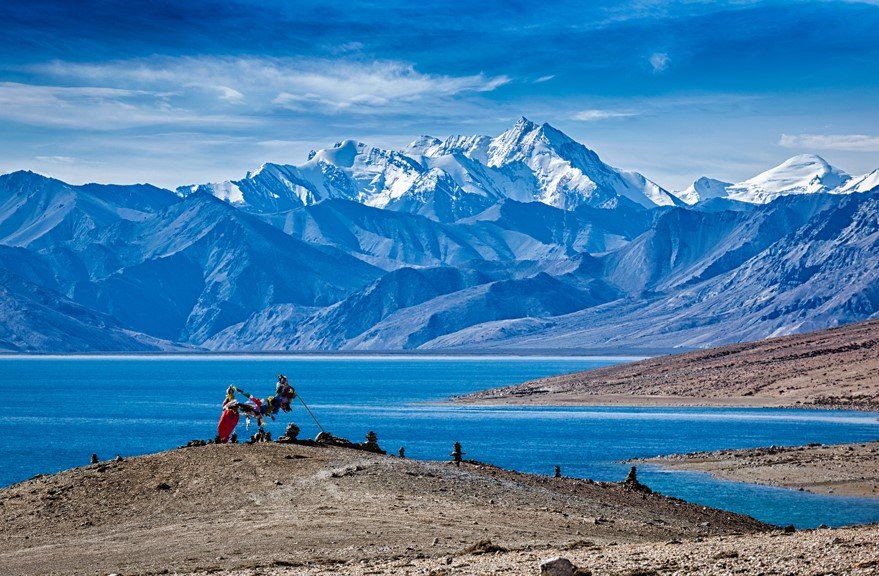
If someone asks for a lake that can offer the drama of Pangong without exactly repeating the Pangong experience, Tso Moriri is the obvious answer.
And this is one destination where the official tourism description supports the “less crowded” comparison directly.
The District Leh tourism page calls Tso Moriri a lesser-known lake compared with Pangong Lake and says that its relative isolation makes it less crowded and peaceful.
Tso Moriri is approximately 19 km long and up to 8 km wide, surrounded by high mountains on the Changthang Plateau. It is also part of the Tsomoriri Wetland Conservation Reserve, a Ramsar wetland.
That gives the destination another layer beyond scenery.
It is also a habitat for migratory and high-altitude wildlife, including bar-headed geese, brown-headed gulls, great crested grebes and Himalayan hares.
Why choose Tso Moriri instead of another Pangong night?
Because the experience is quieter.
A 2026 traveler planning discussion specifically compared Pangong and Tso Moriri when looking for a less commercial experience.
The lake is also considerably more isolated.
The official road information gives the Leh–Korzok route at roughly 240 km, passing through Karu, Upshi, Chumathang, Mahe and Sumdo.
Best for
Nature lovers, birdwatchers, photographers, couples and travelers who want a quieter lake experience.
Verdict: If Pangong is already on your itinerary, Tso Moriri is one of the strongest alternatives for seeing another side of Ladakh’s high-altitude lake country.
5. Dha-Hanu: Go for the Culture, Not Just the Landscape
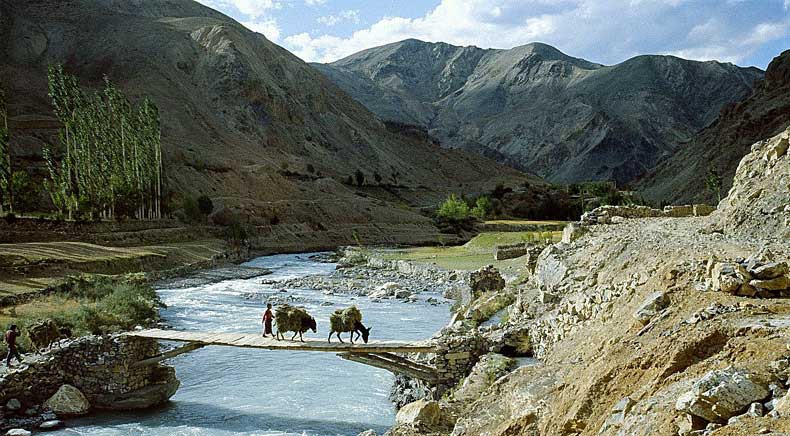
Some of the most valuable hidden gems in Ladakh are not mountains or lakes.
They are communities.
The Dha-Hanu region in western Ladakh is known for its Dardic cultural heritage. Ladakh’s official tourism information identifies villages including Dha, Biama, Darchigs, Garkon and Batalik as culturally and ethnographically important settlements.
This is a very different experience from spending another day photographing mountain roads.
The attraction is:
- Traditional village life
- Local architecture
- Agriculture and orchards
- Cultural traditions
- Festivals
- Local food and hospitality
- Dardic heritage
In April 2026, the Apricot Blossom Festival at Dha-Bema Lasthang brought together local performers and visitors from India and overseas, with cultural performances from Dha, Hanu and neighboring villages.
That shows how the region is gradually moving onto the tourism map while still being fundamentally different from Ladakh’s major commercial destinations.
Why Dha-Hanu is worth your time
Because it answers a question that landscape tourism often ignores:
How do people actually live in this part of the Himalayas?
Best for
Culture travelers, photographers, food explorers, history enthusiasts and slow travelers.
Important etiquette
Do not treat residents as part of the scenery.
Ask before photographing people, homes or ceremonies, and respect local religious and cultural practices.
Verdict: One of the strongest options for travelers who want cultural depth rather than another scenic viewpoint.
6. Sumda Chun: A Tiny Village With a Much Bigger Story

Sumda Chun is for travelers who like finding the story behind a place.
It is a small settlement in the Leh region and is associated with historic Buddhist heritage. Government records confirm Sumda Chun as an established village, while heritage documentation identifies its historic religious importance.
The village is not a major tourist center.
That is exactly the point.
Instead of arriving at a huge attraction surrounded by commercial activity, you get a more intimate encounter with Ladakh’s older cultural landscape.
The wider region around Sumda also connects with the ancient Buddhist heritage of western Leh, where early Tibetan Buddhist art and architecture remain important.
Why visit?
Because it is a heritage detour rather than a sightseeing stop.
Travelers interested in old monasteries, Buddhist art, village architecture and photography can get more from Sumda Chun than someone simply looking for another panoramic viewpoint.
Best for
- History lovers
- Architecture enthusiasts
- Photographers
- Cultural travelers
- Repeat visitors to Ladakh
Verdict: Small, quiet and culturally significant—the kind of place that makes an itinerary feel genuinely personal.
7. Puga Valley: The Strange Landscape Between the Famous Lakes
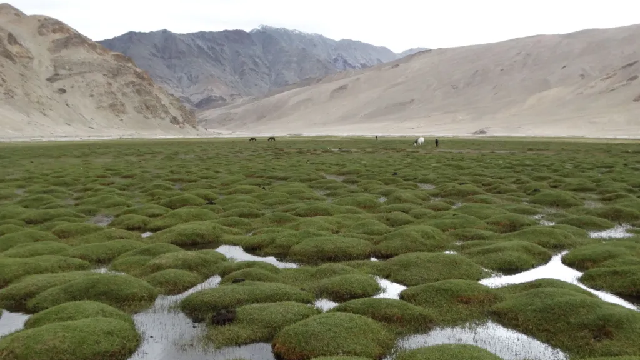
Puga Valley is one of the most interesting choices for travelers who want to explore Changthang beyond Pangong.
The valley sits on the route toward the Tso Moriri region, and the official Ladakh tourism circuit specifically includes Puga on the Leh–Upshi–Puga–Tso Moriri–Korzok route.
What makes Puga interesting is its unusual geothermal landscape.
This is not another blue-water lake destination.
Instead, the valley is associated with geothermal activity, hot springs and a stark high-altitude environment.
The larger Changthang landscape is also recognized by Ladakh Tourism for its high-altitude lakes, vast pastures and wildlife.
Why Puga deserves a stop
Most travelers see the route as simply a way to get to Tso Moriri.
That is a mistake.
The route itself is part of the experience.
Puga gives you another look at Changthang’s geological and ecological character before reaching Korzok.
Best for
Road-trippers, photographers, geology enthusiasts and travelers already planning Tso Moriri.
Verdict: Not necessarily a destination for a full multi-day stay, but one of the smartest offbeat stops to add to a Changthang route.
The 7 Offbeat Places in Ladakh at a Glance
| Destination | What Makes It Different | Crowd Level* | Best For |
|---|---|---|---|
| Zanskar Valley | Remote valleys and dramatic road journey | Lower | Adventure |
| Suru–Rangdum | Wilderness, glaciers and monastery | Lower | Road trips |
| Hanle | Dark skies and astronomy | Lower than main circuit | Stargazing |
| Tso Moriri | Quieter alternative to Pangong | Lower | Nature |
| Dha-Hanu | Dardic cultural heritage | Lower | Culture |
| Sumda Chun | Heritage and village experience | Very low | History |
| Puga Valley | Geothermal Changthang landscape | Very low | Exploration |
*“Crowd level” is an editorial comparison, not an official visitor-count ranking. Ladakh does not publish a directly comparable 2026 visitor figure for each destination in the sources reviewed.
Which Offbeat Place in Ladakh Is Best for 2026?
There is no single winner.
The best destination depends on why you want to leave the main circuit.
For the biggest adventure: Zanskar
If you have extra days and want the journey itself to be memorable, choose Zanskar.
For the quietest landscapes: Rangdum
Suru Valley and Rangdum offer a stronger feeling of wilderness.
For stargazing: Hanle
Hanle is the clear choice because of its dark skies and astronomical infrastructure.
For a quieter lake: Tso Moriri
The official District Leh tourism page explicitly describes Tso Moriri as less crowded than Pangong.
For culture: Dha-Hanu
This is the choice for travelers interested in communities and heritage rather than only scenery.
For heritage: Sumda Chun
Choose it if ancient Buddhist culture interests you more than another mountain viewpoint.
For an unusual road-stop: Puga Valley
Add Puga when traveling toward Tso Moriri.
What Are the Less Crowded Places in Ladakh?
The answer depends on the season and route, but Suru–Rangdum, Sumda Chun, Puga Valley and parts of Dha-Hanu are stronger candidates for a quieter experience than the main tourist hubs.
Tso Moriri also has an official advantage: the District Leh administration explicitly describes it as less crowded than Pangong because of its relative isolation.
But travelers should be careful with the phrase “less crowded.”
A destination can be quiet on one day and noticeably busier during a festival, holiday period or peak travel window.
Are These Really “Unknown Places in Ladakh”?
Not literally.
That distinction is important for accurate travel journalism.
Zanskar, Hanle and Tso Moriri are already known destinations.
What makes them “offbeat” is that they are less central to the short, mainstream Ladakh itinerary.
Recent 2026 traveler discussions demonstrate this shift. Visitors are actively considering Hanle, Tso Moriri and Zanskar when trying to avoid a rushed Leh–Nubra–Pangong trip.
So if you’re searching for unknown places in Ladakh, think of “unknown” as less familiar to the average tourist, not literally undiscovered.
That distinction makes the guide more useful—and more honest.
How Many Days Do You Need for an Offbeat Ladakh Trip?
This depends heavily on the destination.
A conventional Ladakh trip can squeeze several major attractions into a week, but recent traveler discussions repeatedly warn that this can become a daily 5–6-hour driving exercise rather than a relaxed holiday.
For an offbeat itinerary, adding days is usually more valuable than adding destinations.
7–8 days
Consider:
Leh → Hanle → Tso Moriri → Leh
This gives you a Changthang-focused trip.
9–11 days
Consider:
Leh → Dha-Hanu → Suru Valley → Rangdum → Zanskar
This creates a much more adventurous route.
12+ days
You can start combining:
Nubra → Pangong → Hanle → Tso Moriri
or build a deeper Zanskar circuit.
The exact route should depend on current road conditions and local access.
Why You Should Not Build an Offbeat Ladakh Trip Like a Checklist
This may be the biggest lesson from current traveler discussions.
A standard itinerary often looks like:
Leh → Nubra → Pangong → Leh
and repeats the pattern of:
Drive → photograph → drive → sleep → repeat.
Recent 2026 Reddit discussions show travelers actively questioning this approach and arguing for longer stays rather than adding another destination every day.
That is particularly important for offbeat travel.
If you spend all your time driving, you can technically visit an offbeat destination without actually experiencing it.
Instead:
Stay two nights where the place deserves it.
Watch the weather.
Talk to locals.
Walk around.
Eat locally.
Photograph at different times of day.
Let the landscape change.
That is what makes an offbeat Ladakh trip different from a standard package itinerary.
A Practical 2026 Offbeat Ladakh Strategy
Before finalizing your route, check the latest official information.
Ladakh launched a new official tourism portal in April 2026 as part of a wider push to improve tourism and cultural outreach.
The administration is also actively working on heritage conservation. In July 2026, 23 heritage sites were approved for declaration as protected monuments, highlighting how seriously Ladakh is beginning to approach the preservation of its cultural landscape.
That matters for travelers.
Some sites may have changing access rules, conservation work or restrictions.
Before you leave, check:
- Current road conditions
- Weather
- Local accommodation availability
- Required permits or access restrictions
- Fuel availability
- Mobile connectivity
- Medical facilities
- Local tourism advisories
Foreign travelers should pay particular attention to protected/restricted-area requirements. The District Leh administration updated its protected-area permit information in July 2026 and lists several restricted destinations, including Tso Moriri.
The Best Offbeat Ladakh Trip May Not Include Seven Places
This is the counterintuitive part.
You do not need to visit all seven.
In fact, trying to do so may defeat the purpose.
If you have only eight days, choose Hanle + Tso Moriri.
If you have ten or more and love road trips, consider Suru + Rangdum + Zanskar.
If culture is your priority, build around Dha-Hanu + heritage villages.
If you want the quietest experience, prioritize Sumda Chun + Rangdum + Puga.
The best offbeat places in Ladakh are not necessarily the ones you can fit into the most crowded itinerary.
They are the ones you can actually experience.
How This Article Connects With Other Hidden Ladakh Destinations
For an even deeper list of lesser-known destinations—including places such as Phuktal, Saspol Caves and other heritage-focused stops—see HNN24x7’s hidden places in Ladakh guide.
That article should function as the broader hidden-gems cluster, while this page targets the slightly different search intent around offbeat places in Ladakh and alternative 2026 itineraries.
Final Verdict: Where Should You Go Beyond Pangong and Nubra?
If you have already done the classic Ladakh circuit, 2026 is a good year to travel deeper rather than simply travel farther.
Zanskar is the best major adventure.
Suru and Rangdum are among the strongest wilderness experiences.
Hanle is the destination for stars.
Tso Moriri is the quieter lake alternative.
Dha-Hanu brings culture into the itinerary.
Sumda Chun rewards travelers interested in heritage.
Puga Valley adds something unusual to the Changthang route.
The bigger lesson is that Ladakh does not need another viral viewpoint.
It needs travelers willing to slow down.
The region’s official tourism strategy is increasingly promoting adventure, eco-tourism, wildlife, heritage and remote landscapes alongside its established attractions.
So, if your idea of a great Ladakh trip is not simply “How many famous places can I cover?” but rather “How much of Ladakh can I actually experience?”, these seven destinations are where the journey gets interesting.
FAQ
What are the best offbeat places in Ladakh?
Some of the strongest choices for 2026 are Zanskar, Suru Valley and Rangdum, Hanle, Tso Moriri, Dha-Hanu, Sumda Chun and Puga Valley. They offer different experiences ranging from wilderness and astronomy to cultural heritage.
Where can I go in Ladakh instead of Pangong and Nubra?
For an alternative itinerary, consider Zanskar, Suru Valley, Hanle, Tso Moriri or Dha-Hanu. Tso Moriri is particularly relevant if you want another high-altitude lake, while Zanskar is better for a major road-trip adventure.
Which are the less crowded places in Ladakh?
There is no official 2026 ranking of destinations by crowd levels, but places such as Suru–Rangdum, Sumda Chun and Puga Valley generally offer a more remote experience. The District Leh administration specifically describes Tso Moriri as less crowded than Pangong because of its isolation.
What are the hidden gems in Ladakh?
“Hidden gems” is best understood as a relative term. Destinations such as Sumda Chun, Puga Valley, Rangdum and parts of Dha-Hanu receive less mainstream attention than Pangong and Nubra, while Hanle and Zanskar are becoming increasingly known.
Is Zanskar worth visiting in 2026?
Yes, particularly for travelers with enough time for a road-focused itinerary. The region remains relatively remote and culturally distinctive, although improving connectivity is making it increasingly accessible.
Is Tso Moriri less crowded than Pangong?
According to the District Leh tourism administration, yes. Tso Moriri is described as a lesser-known lake compared with Pangong and as relatively isolated and less crowded.
Is Hanle worth visiting in 2026?
Yes, especially for stargazing and astrophotography. Hanle is around 260 km from Leh, sits at approximately 4,500 metres and is home to the Indian Astronomical Observatory.
What is the best offbeat place in Ladakh for culture?
Dha-Hanu is one of the strongest options because of its Dardic cultural heritage, village life and cultural events. Official Ladakh tourism information recognizes the region for its anthropological and ethnographic importance.
How many days are enough for an offbeat Ladakh trip?
At least 7–8 days can work for a focused Changthang itinerary, but deeper routes such as Zanskar and Suru Valley deserve additional time. Trying to cover too many destinations in a few days can turn the trip into a driving schedule rather than a travel experience.
Are these places suitable for first-time Ladakh travelers?
Some are. Tso Moriri and Hanle can work with careful planning, while Zanskar and Rangdum are better suited to travelers comfortable with longer journeys, changing road conditions and fewer facilities.
Do I need permits for offbeat places in Ladakh?
Some protected or restricted areas have additional requirements, particularly for certain foreign travelers and specific routes. The District Leh administration’s current information lists Tso Moriri among restricted/protected destinations and specifies categories of passport holders who require Protected Area Permits.