



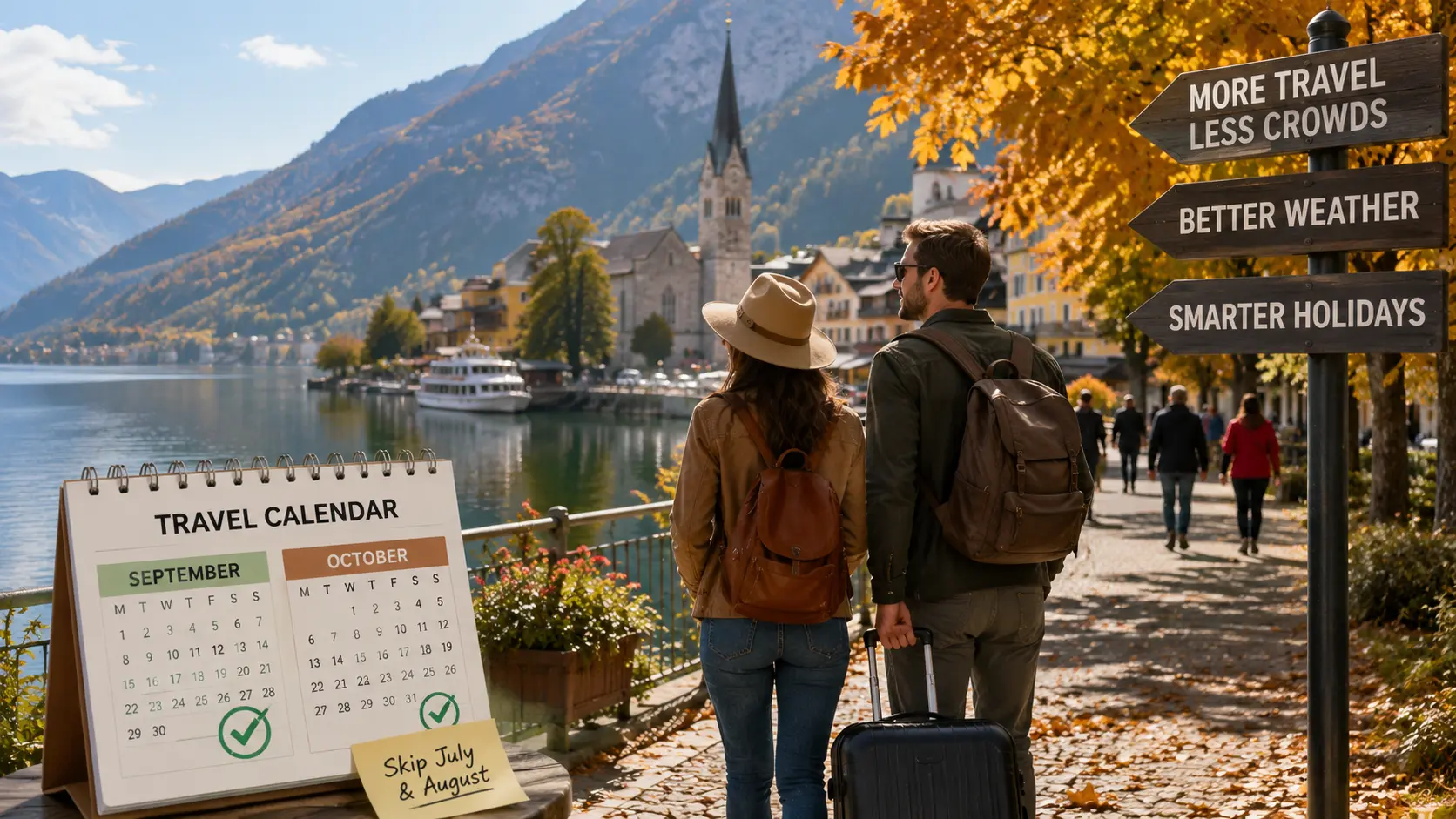
The peak creeping travel trend is changing an old travel habit: instead of taking holidays exclusively during the traditional summer peak, more travelers are moving their trips toward the edges of the season.
Think late spring instead of June, or September and October instead of July and August.
The term “peak creeping” was highlighted by travel company Byway in its 2026 trends report. It describes the way the traditional peak travel period is effectively stretching outward as travelers increasingly choose the shoulder periods for better weather, fewer crowds and potentially better value.
The trend is particularly relevant in 2026 because travel companies and search data are showing stronger demand for fall and shoulder-season trips.
Expedia Group, for example, reported that global searches for travel between September 15 and October 31 were up 10% year over year, with strong interest in fall foliage destinations.
But there is an important catch:
Shoulder season is becoming more popular precisely because people are trying to escape peak season—and that popularity can eventually make shoulder-season travel less cheap and less quiet.
What does “peak creeping” mean?
Peak creeping means travelers are shifting their holidays toward the beginning or end of traditional peak season instead of traveling during the busiest weeks.
For example:
Traditional pattern
June → July → August peak → September
Peak-creeping pattern
May → June → September → October
The idea is not necessarily to travel completely outside the tourist season.
Instead, travelers are moving just far enough away from the peak to potentially find a better combination of:
- comfortable weather;
- fewer tourists;
- lower demand;
- better accommodation availability;
- more manageable prices.
It is essentially a more strategic version of shoulder-season travel.
Why is peak creeping becoming a 2026 travel trend?
Several factors are pushing travelers away from the traditional summer peak.
1. Extreme summer heat
One of the strongest reasons is weather.
In many popular destinations, particularly parts of southern Europe, summer temperatures have become a serious consideration when planning holidays.
A recent survey reported by Forbes found that 48% of travelers would consider moving their annual vacation to fall rather than peak summer, while 52% said they would actively avoid southern Europe during summer because of heat.
That creates an obvious incentive:
Instead of visiting a Mediterranean destination in July when temperatures and crowds can both be intense, travelers may choose September or October.
The trip is still a summer-style holiday in spirit—but the calendar has moved.
2. Travelers want fewer crowds
Overtourism is another major factor.
Popular destinations can become dramatically different during peak periods.
A famous city may mean:
- packed attractions;
- long queues;
- crowded restaurants;
- higher hotel demand;
- busy beaches;
- more expensive transportation.
Skyscanner’s 2025–26 research found that 32% of travelers said overtourism negatively affected the quality of their holidays. It also found that 31% planned to continue visiting popular destinations but during shoulder seasons when crowds are lighter.
That is almost a perfect description of the logic behind peak creeping.
People aren’t necessarily abandoning popular destinations.
They’re changing when they visit them.
3. Shoulder season can offer a better weather-to-crowd balance
The traditional peak season often exists because weather conditions are at their most predictable.
But the best travel experience does not always require the absolute hottest or sunniest period.
September can still provide beach weather in many Mediterranean destinations while avoiding some of July and August’s extreme heat.
Similarly, spring can offer pleasant sightseeing conditions in European cities before summer demand reaches its highest level.
That creates a useful middle ground:
Peak season: better predictability, but often more crowds.
Off-season: fewer crowds, but potentially less favorable weather or limited services.
Shoulder season: potentially the best compromise.
That balance is the core reason shoulder-season travel is gaining attention.
Is peak creeping the same as shoulder-season travel?
Not exactly, but the two concepts overlap heavily.
Shoulder season is an established travel term describing the period between peak and off-peak seasons.
Peak creeping is a newer, more descriptive phrase for the way travel demand appears to be moving toward those periods.
Byway’s 2026 trend report describes peak creeping as the traditional shoulder season shrinking because the edges of summer are becoming more popular.
So you can think of it this way:
Shoulder season is the period. Peak creeping is the behavioral trend pushing more travelers into it.
Are more people actually traveling in fall?
Yes, multiple 2026 indicators point in that direction.
Expedia Group reported that global searches for trips between September 15 and October 31 increased 10% year over year.
Backroads reported another notable signal on August 26: its fall reservations have increased more than 30% since 2023, making autumn one of its fastest-growing travel periods.
The company said demand is increasing for fall trips from September through November, including active travel such as hiking and cycling.
That suggests the trend isn’t simply an internet phrase.
Travel demand is visibly shifting toward autumn in parts of the market.
Why September may become the new “sweet spot”
September is particularly well positioned because it sits between the traditional summer peak and the colder months in many destinations.
For many travelers, it can provide:
- warm but less extreme temperatures;
- fewer school-holiday crowds;
- better sightseeing conditions;
- continued access to summer attractions;
- more availability than July or August.
The appeal is especially strong in destinations where summer heat has become uncomfortable.
But the rise of September travel creates an interesting paradox.
The more people discover September, the less “off-peak” September becomes.
That’s the central tension behind peak creeping.
Does peak creeping mean cheaper holidays?
Not necessarily.
This is one of the biggest misconceptions readers should avoid.
Shoulder season has traditionally been associated with lower prices, but growing demand can reduce those savings.
Recent reporting from The Times found that September and October are becoming increasingly popular among British travelers, while hotel prices in some major destinations have also risen as demand increases.
That means the old formula:
“Travel outside summer = automatically cheap”
is becoming less reliable.
Flights may still be cheaper on certain routes, while hotels in popular destinations may remain expensive.
The best strategy is therefore not simply to search for an “off-season” month.
It is to compare specific dates and destinations.
Why peak creeping could actually make shoulder season more expensive
Imagine a destination where:
- July hotel demand = extremely high;
- August demand = extremely high;
- September demand = moderate;
- October demand = low.
Now thousands of travelers discover that September offers better weather and fewer crowds.
Demand shifts:
July ↓ slightly
August ↓ slightly
September ↑ significantly
The result?
September prices can rise.
That is already becoming visible in some popular fall destinations.
The shoulder season does not disappear overnight, but its traditional discount can become smaller.
What are travelers trying to avoid by peak creeping?
The trend is really about optimizing several things at once.
Heat
Travelers increasingly want comfortable temperatures rather than maximum summer heat.
Crowds
Popular attractions are often much easier to experience outside the busiest weeks.
High prices
Travelers are still searching for periods when demand is lower.
School-holiday pressure
Families remain tied to school calendars, but couples, solo travelers, remote workers and other groups may have more flexibility.
Overtourism
Choosing September instead of August can reduce pressure on some destinations while improving the individual travel experience.
Who is most likely to benefit from peak creeping?
The trend particularly favors travelers who have flexibility over when they travel.
Remote workers
People who aren’t tied to a traditional office calendar may be able to choose early autumn or late spring.
Retirees
Travelers without school or work-calendar restrictions can target less crowded periods.
Couples
Couples without children may have more freedom to avoid school-holiday peaks.
Solo travelers
Solo travelers can often change dates more easily than groups.
Gen Z and younger travelers
Younger travelers are increasingly interested in experiences, flexibility and alternatives to traditional tourism patterns.
Going’s 2026 travel research also found that more than 70% of respondents were conscious of overtourism when selecting destinations, while 41% of respondents in its previous survey said they had chosen a destination specifically because they expected fewer crowds.
What could peak creeping mean for popular tourist destinations?
The trend could have two very different effects.
Positive effect: Demand spreads across the year
If travelers stop arriving overwhelmingly during July and August, destinations could see a more balanced distribution of tourism.
That can help businesses operate for longer periods instead of experiencing an extreme peak followed by a sharp slowdown.
It could also make popular attractions more manageable.
Negative effect: The peak simply moves
If everyone starts traveling in September instead of August, September eventually becomes crowded too.
That is why the term “peak creeping” is particularly useful.
It describes not just avoiding the peak—but potentially expanding the peak itself.
Could climate change make peak creeping more common?
Climate is likely to remain an important factor in seasonal travel decisions.
When traditional summer destinations become too hot during July and August, travelers have an incentive to move their trips earlier or later.
That does not mean every destination will experience the same change.
Some places may become more attractive in spring or autumn, while colder destinations could develop longer summer seasons.
The broader result is that the traditional definition of “best time to visit” may become less fixed.
Peak creeping vs traditional peak travel
| Factor | Traditional peak travel | Peak creeping |
|---|---|---|
| Timing | July–August in many destinations | Edges of peak season |
| Crowds | Usually highest | Potentially lower |
| Weather | Often hottest/warmest | Often milder |
| Prices | Usually high | Can be lower, but not guaranteed |
| Availability | More competition | Often better |
| Flexibility | Less important | Very important |
| Main attraction | Maximum summer conditions | Better overall balance |
The key word is potentially.
Peak creeping does not guarantee cheaper prices or empty attractions.
What does peak creeping mean for 2026 travelers?
For travelers planning holidays in 2026, the trend suggests one simple strategy:
Don’t automatically search for “summer.”
Search for the best combination of date, weather, crowd level and price.
For example, instead of asking:
“When is the peak season?”
Ask:
“What are the two or three weeks around peak season that still have good weather but lower demand?”
That question can produce much better results.
How to use the peak creeping trend to plan a cheaper trip
1. Compare several weeks
Don’t compare only July and August.
Check June, September and October as well.
2. Compare weekdays
A Tuesday departure can sometimes be more attractive than a Friday departure even within the same season.
3. Check hotels separately from flights
A cheaper flight does not guarantee a cheaper vacation.
Accommodation can absorb the savings.
4. Look beyond the famous destination
If a destination becomes extremely popular during shoulder season, consider nearby alternatives.
Going’s 2026 research specifically recommends looking beyond the destinations dominating social media and considering less crowded alternatives.
5. Check what’s actually open
Shoulder season can mean shorter attraction hours or seasonal closures in some destinations.
6. Watch weather patterns
The best shoulder-season destination is not necessarily the one with the lowest price.
It is the one where price + weather + crowds + availability work together.
Is peak creeping good for travelers?
Overall, yes—but only if travelers understand the trade-off.
The biggest advantage is choice.
Instead of treating July and August as the only acceptable holiday months, travelers can consider a wider calendar.
That can mean:
- better temperatures;
- fewer crowds;
- more relaxed sightseeing;
- potentially lower costs;
- greater accommodation availability.
But there is also a warning.
As more travelers adopt the strategy, the most desirable shoulder-season weeks may become increasingly expensive.
That means today’s travel hack can become tomorrow’s peak season.
What is the future of peak creeping?
The trend could become more important as travelers respond to three major forces:
Climate: Hotter summers can encourage travelers to shift dates.
Overtourism: Crowded destinations encourage visitors to travel outside traditional peaks.
Pricing: Travelers increasingly compare dates and search for the best value rather than automatically booking the conventional holiday period.
The result could be a travel calendar where the old distinction between peak season, shoulder season and off-season becomes less clear.
Instead, demand may spread across a wider portion of the year.
“Source used”
https://www.travolution.com/news/travel-sectors/peak-creeping-and-athleisure-tourism-make-byways-trends-list/
https://partner.expediagroup.com/en-us/resources/blog/q3-2026-travel-trends-insights
The bottom line
The peak creeping travel trend describes a simple but potentially significant change in travel behavior: people are moving holidays toward the edges of traditional peak season to find a better balance between weather, crowds and price.
The idea was highlighted as a 2026 travel trend by Byway, while broader industry data shows that fall and shoulder-season demand is already increasing.
But travelers should not assume that September or October will automatically be cheaper.
As demand moves away from July and August, the traditional shoulder-season discount can shrink.
So the smartest interpretation of peak creeping isn’t “never travel in peak season.”
It’s:
Look beyond the obvious travel calendar.
Sometimes the best holiday isn’t the one taken at the height of summer. It is the one taken just before—or just after—the crowds arrive.
FAQ
What is peak creeping in travel?
Peak creeping is the trend of travelers moving holidays toward the edges of traditional peak season, such as late spring or early autumn, instead of traveling during the busiest weeks.
Why is peak creeping becoming popular in 2026?
Growing concerns about summer heat, overtourism, crowds and travel prices are encouraging travelers to consider shoulder-season trips. Industry data is showing increased demand for fall travel.
Is peak creeping the same as shoulder-season travel?
Not exactly. Shoulder season describes the period between peak and off-peak travel. “Peak creeping” describes the behavioral shift toward those periods.
Is shoulder-season travel always cheaper?
No. Shoulder season can offer better value, but increasing demand can push prices higher in popular destinations.
Why are people traveling in September and October?
Many travelers want milder temperatures, fewer crowds and potentially better value while still enjoying many of the attractions and activities associated with summer.
Is peak creeping good for avoiding crowds?
It can be. Skyscanner’s research found that 31% of travelers intend to visit popular destinations during shoulder seasons when crowds are lighter.
Will peak creeping make shoulder season more expensive?
It could. If large numbers of travelers move from July and August into September and October, demand—and therefore prices—can rise in those months.
What is the best way to take advantage of peak creeping?
Compare several weeks around the traditional peak season, including flights, hotels, weather and attraction availability rather than assuming a particular month will automatically be cheaper.
“Read More”