



What if a solar power plant did not have to wait for sunrise?
That is the basic idea behind space-based solar power (SBSP).
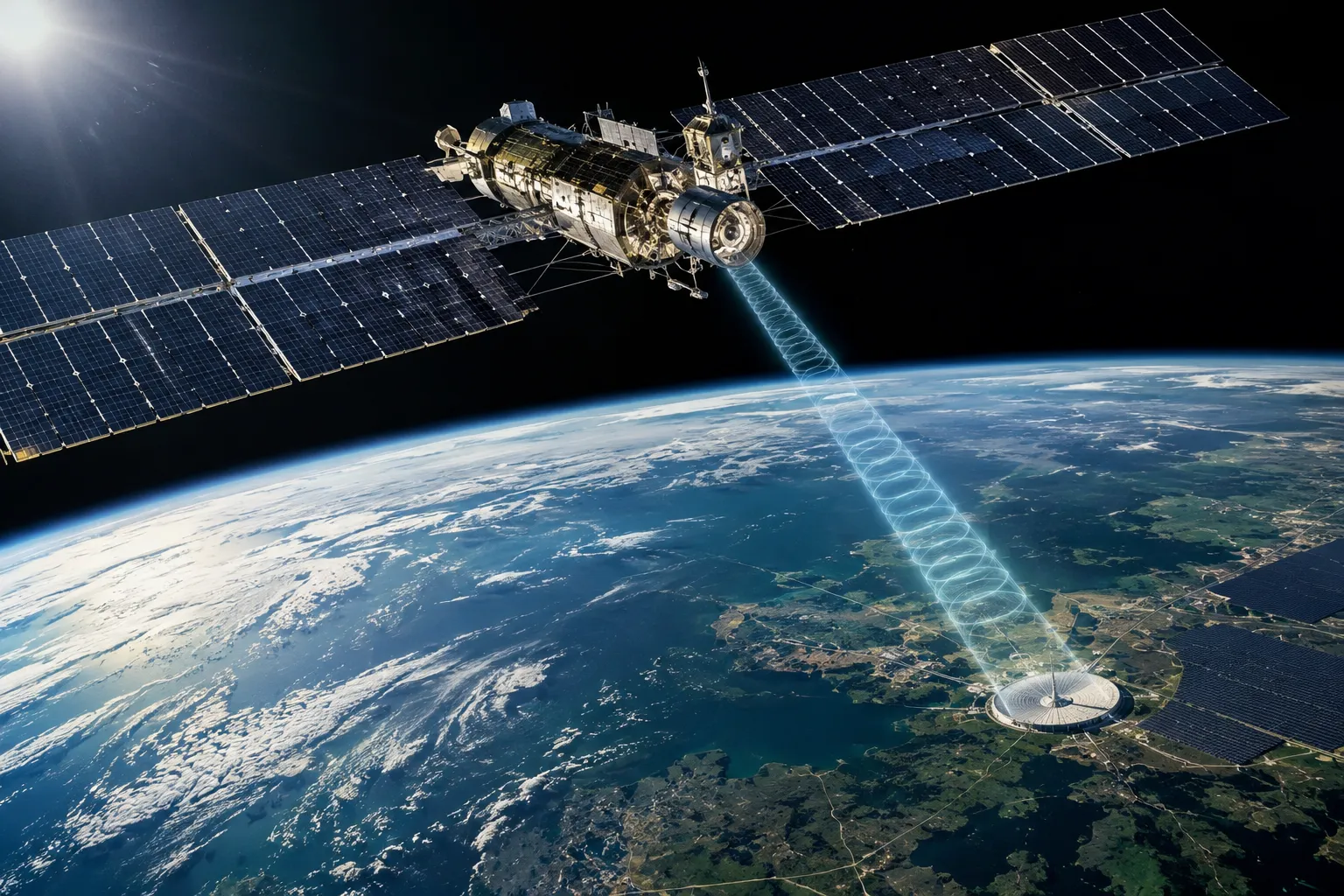
Instead of putting solar panels only on rooftops, deserts or floating platforms, enormous solar arrays would be placed in space. Satellites would collect sunlight, convert it into electrical energy and then transmit that energy wirelessly to receiving stations on Earth.
The concept sounds futuristic, but the underlying physics is not science fiction.
The real challenge is scale.
The systems would need enormous structures, high-efficiency solar cells, wireless power transmission, autonomous operation, in-orbit assembly and dramatically cheaper transportation to space.
NASA’s assessment concluded that space-based solar power is currently technically and economically challenging, while examining what would be required for systems potentially operating around 2050.
That makes SBSP one of the most intriguing but also most difficult technologies in the future-energy landscape.
For the wider technology picture, see HNN24x7’s Future Technology 2026 pillar.
What Is Space-Based Solar Power?
Space-based solar power is a proposed renewable-energy system in which satellites collect solar energy in space and transmit that energy wirelessly to Earth.
The basic process is:
Sunlight
↓
Solar panels in space
↓
Electricity
↓
Microwave or laser transmission
↓
Ground receiving station
↓
Electricity for the grid
The concept is sometimes called a “power plant in space.”
JAXA describes a Space Solar Power System (SSPS) as a system that collects solar energy in space, converts it into microwave or laser beams, transmits the energy to Earth and converts it back into electricity.
The critical difference from terrestrial solar power is where the sunlight is collected.
On Earth, solar panels face:
- nighttime,
- clouds,
- atmospheric losses,
- changing weather,
- seasonal variations.
A suitably positioned satellite could receive sunlight for much longer periods and, depending on its orbit, potentially provide near-continuous generation.
Why Collect Solar Energy in Space?
The biggest attraction is simple:
The Sun is available above Earth’s atmosphere much more consistently than at a solar farm on the ground.
ESA says the atmosphere, clouds and day-night cycle reduce the average availability of sunlight at Earth’s surface. A space-based system could collect sunlight continuously for much longer periods.
JAXA says solar irradiance in space is roughly 40% stronger than on the ground, while ESA describes the Sun’s energy as more intense in space and emphasizes the potential for continuous collection.
That creates a major theoretical advantage.
A terrestrial solar plant might produce strongly during daylight and less or nothing at night.
A solar-power satellite could potentially generate electricity across a much larger portion of the day-night cycle.
This makes SBSP interesting not simply as another solar technology, but as a possible source of firm renewable power.
How Does Space-Based Solar Power Work?
A future SBSP system would contain several major components.
1. Solar Collection System
Large photovoltaic arrays collect sunlight.
The solar cells convert sunlight into electricity.
Because launch mass is extremely expensive, future systems would need solar arrays that are both lightweight and highly efficient.
2. Power Conversion
The generated electricity must be converted into a form suitable for wireless transmission.
Two major approaches are being studied:
- microwave transmission,
- laser transmission.
3. Wireless Power Transmission
The energy is transmitted from the satellite toward a receiving station on Earth.
Microwave systems use controlled electromagnetic waves.
JAXA is researching microwave wireless power transmission in which arrays of antenna elements can synchronize their signals to form and direct a power beam toward a receiving site.
Laser-based concepts use concentrated optical energy instead.
JAXA is also researching laser wireless power transmission as part of its SSPS program.
4. Ground Receiving Station
The transmitted energy is received at a specially designed ground facility.
For microwave systems, this can involve a rectenna, short for rectifying antenna.
The rectenna converts the received electromagnetic energy back into electricity.
That electricity can then enter the grid or be delivered to another energy system.
NASA’s SBSP study describes the overall chain as collection in space, transmission to Earth, conversion to electricity and delivery to the grid or batteries
What Is a Solar Power Satellite?
A solar power satellite is the spacecraft that would collect solar energy and transmit it toward Earth.
Unlike a conventional communications satellite, its primary job would not be transmitting information.
Its job would be transmitting energy.
That creates a dramatic difference in scale.
ESA has noted that a working space-based solar power system could require satellites several kilometres in size to produce power comparable to a typical nuclear power station, depending on the design.
This is one of the reasons SBSP is so challenging.
Building and operating a kilometre-scale structure in space is fundamentally different from building a conventional satellite.
Why SBSP Satellites Would Be So Large
Electricity generation requires collecting a lot of sunlight.
A satellite needs a large photovoltaic area.
Then it needs:
- power-conversion electronics,
- transmission antennas,
- structural systems,
- thermal management,
- control systems,
- communication systems,
- maintenance capabilities.
And the entire system has to survive the space environment.
The result could be a structure vastly larger than today’s typical satellites.
That leads to a central question:
How do we build something that large in orbit?
In-Space Manufacturing Could Be the Missing Technology
Launching a giant structure from Earth in one piece would be impractical.
A more realistic approach could involve:
Launch → transport components → assemble in orbit → operate → maintain in orbit
This means future SBSP depends on progress in:
- robotic assembly,
- autonomous spacecraft,
- in-space manufacturing,
- reusable launch vehicles,
- lightweight materials,
- high-efficiency solar cells,
- orbital servicing.
NASA’s assessment specifically identifies in-space servicing, assembly and manufacturing as capabilities that could benefit SBSP development.
ESA is also researching in-orbit manufacturing and large-scale structures as part of its broader solar-power-from-space work.
This means SBSP is actually several technologies bundled together
Why Satellites Could Generate Solar Power 24/7
This is the strongest argument for SBSP.
A satellite placed in an appropriate orbit can receive sunlight for much longer periods than a ground-based solar plant.
ESA’s SBSP work describes the concept as potentially delivering reliable electricity continuously, while JAXA highlights its ability to provide power around the clock and largely independent of weather conditions.
That could help solve one of renewable energy’s biggest challenges:
variability.
Solar energy is abundant.
But solar power on Earth changes with:
- time of day,
- clouds,
- weather,
- seasons,
- location.
SBSP aims to reduce some of those limitations by moving the collection system above the atmosphere.
Does Space-Based Solar Power Actually Work Today?
Not as a commercial electricity-generation system for Earth’s grid.
This distinction is essential.
The underlying technologies exist individually.
We already have:
- satellites,
- solar panels in space,
- wireless power transmission,
- microwave systems,
- lasers,
- autonomous spacecraft.
But integrating those technologies into a massive, economically viable power station in orbit is a much harder problem.
NASA’s assessment states that SBSP is currently cost-prohibitive and technically infeasible at the envisioned large scale, although future capability improvements could change that assessment.
So in 2026:
SBSP is a research and development technology, not a mainstream source of electricity.
What Are the Biggest Advantages of Space-Based Solar Power?
1. Near-Continuous Solar Collection
The satellite could collect sunlight for much longer periods than ground-based solar systems.
2. Reduced Weather Dependence
Space-based collection avoids clouds and much of the atmospheric interference experienced by terrestrial solar panels.
3. Renewable Energy
The primary energy source is sunlight.
4. Potentially Large Power Output
Very large satellites could theoretically generate substantial quantities of electricity.
5. Wireless Energy Delivery
Power could potentially be transmitted to strategically located receiving stations.
6. Reduced Dependence on Ground-Based Generation at Specific Locations
Energy could be delivered to selected receiving sites without physically transporting fuel to the power station.
JAXA identifies continuous availability, stronger solar radiation in space and flexible wireless delivery among the potential advantages of SSPS.
But each of these advantages comes with engineering and economic trade-offs.
Why Space-Based Solar Power Is So Difficult
The biggest misconception about SBSP is that the hardest part is collecting sunlight.
It isn’t.
Solar panels already work.
The real challenge is building the entire infrastructure around them.
1. Launch Costs
Everything needed to build the system must somehow reach orbit.
Even with reusable rockets, transporting enormous quantities of material into space remains expensive.
NASA identified launch and manufacturing costs as major challenges because large amounts of mass would need to be moved into orbit.
2. Massive Structures
A commercial system could require kilometre-scale structures.
Those structures must be assembled, stabilized and controlled in orbit.
3. Wireless Power Efficiency
Energy is lost during multiple conversion stages:
Sunlight → electricity → microwave/laser → transmission → receiver → electricity
Improving efficiency at every stage is critical.
4. Beam Control
The energy must be directed accurately toward the receiving station.
Microwave transmission systems require precise beam forming and control.
JAXA is researching antenna arrays capable of controlling microwave phase and amplitude to shape and direct the transmitted beam.
5. Space Maintenance
A huge orbital power station cannot simply be repaired by sending technicians with a toolbox.
Robotic systems and autonomous maintenance would be essential.
6. Radiation and Space Environment
Solar cells and electronics must survive:
- radiation,
- temperature extremes,
- vacuum,
- micrometeoroids,
- orbital debris.
Long-term reliability is therefore a major issue.
Microwave vs Laser: How Would Space Solar Power Reach Earth?
There are two major concepts.
Microwave Power Transmission
The satellite converts electricity into microwaves.
The microwave beam travels to Earth.
A receiving antenna converts it back into electricity.
Advantages:
- mature electromagnetic technology,
- can transmit over long distances,
- can potentially use broad, low-power-density beams.
Challenges:
- large antennas,
- beam control,
- conversion losses,
- large ground receiving areas.
JAXA is actively researching this approach.
Laser Power Transmission
The satellite converts electricity into a laser beam.
The laser is directed toward a receiving system.
The receiver converts the energy into electricity.
Advantages:
- narrower beam,
- potentially smaller receiving equipment.
Challenges:
- atmospheric effects,
- cloud interference,
- precise pointing,
- safety,
- conversion efficiency.
JAXA’s SSPS program includes dedicated research into laser wireless power transmission.
Is Space-Based Solar Power Safe?
It could potentially be designed safely, but safety is one of the issues that must be demonstrated rather than assumed.
A power beam carrying significant energy must be carefully controlled.
Any system would need safeguards against:
- unintended beam movement,
- aircraft interference,
- satellite interference,
- biological exposure,
- ground-system failures.
ESA has highlighted the need for further research into the effects of low-power-density microwave transmission on humans and animals and compatibility with aircraft and satellites.
This does not mean that SBSP would automatically be dangerous.
It means large-scale wireless energy transmission requires rigorous engineering and regulation.
Could Space Solar Power Replace Solar Farms?
Not in the foreseeable future.
Terrestrial solar power has an enormous advantage:
it already exists at commercial scale.
Solar panels can be installed on:
- rooftops,
- utility-scale sites,
- industrial facilities,
- floating solar platforms,
- agricultural land where appropriate.
The infrastructure is mature compared with SBSP.
Space-based solar power therefore has to overcome a very high economic and engineering bar.
NASA’s 2024 analysis found that its modeled SBSP concepts for operation around 2050 were more expensive than terrestrial sustainable alternatives under the assumptions used in the study.
That is perhaps the most important reality check.
Could Space Solar Power Be Cheaper in the Future?
Possibly, but there is no guarantee.
The economics depend heavily on technologies that are still developing.
For example:
Cheaper Launches
If transporting materials into orbit becomes dramatically cheaper, SBSP economics improve.
Lightweight Solar Arrays
Less mass means fewer launches.
In-Space Manufacturing
More components could potentially be produced or assembled in orbit.
Autonomous Construction
Robots could build large structures without humans being continuously present.
Better Wireless Transmission
Higher conversion efficiency would reduce energy losses.
Longer System Lifetimes
Long-lived satellites could spread construction costs over many years.
NASA’s analysis explicitly noted that SBSP costs could fall if important capability gaps are addressed.
What Does NASA Say About the Future?
NASA’s 2024 assessment is unusually useful because it does not simply promote or dismiss the concept.
It examined two representative 2-gigawatt utility-scale SBSP designs assumed to begin operating in 2050.
The analysis found that SBSP could have potential as a future energy technology, but its costs and emissions depend strongly on assumptions about future launch systems, manufacturing, assembly, maintenance and other capabilities.
NASA also identified major capability gaps in:
- autonomous operations,
- large-scale orbital assembly,
- maintenance,
- wireless power transmission,
- launch and manufacturing costs.
In other words:
The technology’s future depends heavily on the future of the space industry itself.
What Is ESA Doing?
The European Space Agency has developed the SOLARIS initiative to investigate the technologies and feasibility of space-based solar power.
ESA says SOLARIS is intended to mature key technologies and provide European decision-makers with enough information to determine whether operational implementation should eventually be pursued.
ESA’s work includes:
- photovoltaic technology,
- wireless power transmission,
- in-orbit manufacturing,
- large structures,
- system-level studies.
The agency has described a concept capable of providing a reliable 24/7 supply of energy to Earth using radio-frequency transmission.
But ESA is also clear that significant technological hurdles remain.
What Is Japan Doing With Space Solar Power?
Japan’s JAXA has conducted long-running research into Space Solar Power Systems.
Its work includes:
- microwave wireless transmission,
- laser transmission,
- large-scale space structures,
- solar cells,
- orbital assembly,
- debris mitigation.
JAXA says the long-term objective is practical application in the latter half of the 21st century.
Importantly, JAXA has revised earlier expectations.
Its current FAQ says a previous target for a 1-GW SSPS in the 2030s was found to be difficult and that the development plan has been reconsidered, with current research aimed at realization from the latter half of the 21st century onward.
That is a useful reminder that technological timelines can move when engineering realities become clearer.
Could Space-Based Solar Power Work With Batteries?
Yes.
In fact, SBSP would not necessarily eliminate the need for energy storage.
NASA’s SBSP description explicitly includes delivery of received energy to the grid or to batteries for storage.
A future system could potentially look like:
Space solar satellite
↓
Wireless power transmission
↓
Ground receiving station
↓
Grid + battery storage
↓
Homes + industry + data centers + EV charging
This would allow space-generated electricity to become one component of a broader energy system.
That is more realistic than imagining SBSP replacing every other power technology.
Space Solar Power and Renewable Energy
The most interesting question is not whether SBSP is “better” than terrestrial solar.
It is whether it could complement existing renewable generation.
Imagine a future energy mix containing:
- terrestrial solar,
- wind,
- hydro,
- batteries,
- nuclear,
- long-duration storage,
- space-based solar power.
Terrestrial solar could produce large quantities of cheap daytime electricity.
Wind could provide generation under different weather conditions.
Batteries could handle short-duration fluctuations.
Nuclear could provide firm generation.
SBSP could potentially provide another source of continuous renewable electricity.
This diversified model is much more plausible than a single technology dominating the global grid
Why Space-Based Solar Power Could Matter for Future Power Generation
The world’s electricity system is becoming more demanding.
Electric vehicles are adding electricity consumption.
Data centers are increasing electricity demand.
AI computing is accelerating the growth of high-density power infrastructure.
Industry is increasingly electrifying.
At the same time, countries are trying to reduce fossil-fuel emissions.
That creates demand for:
more electricity + cleaner electricity + reliable electricity.
SBSP theoretically addresses all three.
But only if its costs can eventually become competitive.
That is the fundamental test.
Could SBSP Power AI Data Centers?
Potentially, but this is a long-term possibility rather than a current solution.
AI data centers need large quantities of reliable electricity.
A future SBSP system could theoretically provide continuous renewable power to a grid serving data centers.
The benefit would be particularly interesting if the technology could deliver electricity independently of terrestrial weather conditions.
But building an orbital solar-power infrastructure specifically for AI would require enormous capital investment and technological maturity.
For now, terrestrial renewables, grid expansion, batteries, nuclear and other generation sources are much closer to commercial deployment.
Space-Based Solar Power vs Traditional Solar
| Feature | Ground Solar | Space-Based Solar Power |
|---|---|---|
| Solar collection | Earth | Orbit |
| Night-time generation | No | Potentially much longer/near-continuous depending on orbit |
| Weather impact | Significant | Much lower for collection |
| Atmospheric losses | Yes | Avoided during collection |
| Technology maturity | Commercial | Experimental/R&D |
| Infrastructure | Ground-based | Orbital + ground receiving station |
| Launch requirement | None | Major |
| Wireless transmission | Usually unnecessary | Essential |
| Construction complexity | Mature | Extremely high |
| Current economics | Established | Not yet competitive |
| Main advantage | Low-cost scalable solar | Potential continuous renewable power |
| Main challenge | Variability and land/grid integration | Cost, scale and orbital infrastructure |
The comparison makes the central trade-off obvious:
Earth solar is easier and cheaper today.
Space solar could theoretically offer characteristics that terrestrial solar cannot easily provide.
What Would a Space Solar Power Plant Look Like?
A mature SBSP system could be enormous.
Picture a satellite with:
- huge photovoltaic arrays,
- power-conversion equipment,
- a large transmission antenna,
- autonomous control systems,
- communication equipment,
- thermal-management systems.
Far below it would be a large receiving station.
The satellite would continuously track its orbital position and maintain the energy beam toward the receiving area.
Multiple satellites could potentially work together.
This would turn the concept from a conventional satellite into something closer to orbital energy infrastructure.
Could Space Solar Power Create a New Space Industry?
This is one of the less obvious potential benefits.
Even if SBSP never becomes a major terrestrial electricity source, developing it could accelerate other technologies.
For example:
- reusable launch systems,
- orbital manufacturing,
- robotic assembly,
- autonomous spacecraft,
- lightweight solar cells,
- high-power electronics,
- wireless power transmission,
- space servicing.
ESA explicitly notes that technologies developed for SBSP could have value in other spaceflight and terrestrial applications.
So SBSP could potentially act as a technology-development platform for the wider space economy.
What Happens If a Solar Power Satellite Breaks?
This is another major engineering question.
A terrestrial solar farm can be repaired by sending workers or equipment to the site.
A large orbital solar station could require:
- robotic repair,
- replacement modules,
- autonomous diagnostics,
- servicing spacecraft.
That means designing for maintenance would be essential.
Instead of constructing one giant irreversible structure, future systems may need modular architectures where damaged components can be replaced.
NASA has identified in-space servicing and assembly as important capability areas for SBSP.
What About Space Debris?
Large solar-power satellites would occupy valuable orbital space.
A collision with debris could damage solar arrays or transmission systems.
More importantly, large structures could themselves become debris risks if they fail.
That makes:
- orbital traffic management,
- debris avoidance,
- collision detection,
- end-of-life disposal,
critical parts of any future SBSP architecture.
JAXA lists debris mitigation among the technologies being researched for SSPS.
Is Space-Based Solar Power Environmentally Friendly?
The answer is complicated.
The energy source is renewable.
But building the infrastructure has an environmental footprint.
Potential impacts include:
- rocket launches,
- manufacturing,
- materials,
- spacecraft production,
- orbital debris,
- energy-intensive construction.
NASA’s study specifically evaluated lifecycle greenhouse-gas emissions rather than looking only at operational emissions.
That distinction matters.
A technology can generate clean electricity during operation while still having significant environmental costs during construction and deployment.
Therefore, the environmental case for SBSP depends on the complete lifecycle.
When Will Space-Based Solar Power Become Available?
There is no reliable commercial launch date.
Some earlier development roadmaps envisioned large systems in the 2030s.
But current assessments are more cautious.
JAXA’s current FAQ says its previous 1-GW target for the 2030s was found to be difficult and that its current development outlook points toward the latter half of the 21st century.
NASA’s study examined the possibility of systems beginning operation around 2050 but emphasized significant capability gaps and economic uncertainty.
So the responsible 2026 answer is:
Small demonstrations may arrive much earlier, but commercially competitive, utility-scale space-based solar power remains a long-term possibility rather than an established near-term technology.
What Needs to Happen Before SBSP Becomes Commercial?
Several breakthroughs do not necessarily need to be “new physics,” but they do need to become economically and technically practical.
1. Much Cheaper Access to Orbit
Launch costs must fall dramatically.
2. Lightweight Solar Arrays
Every kilogram matters.
3. Autonomous Orbital Assembly
Robots need to construct very large structures.
4. Efficient Wireless Transmission
Conversion losses must be minimized.
5. Precise Beam Control
Power must be directed safely and reliably.
6. Long-Term Maintenance
Systems must operate for many years.
7. Debris Management
Large structures must be safely operated in increasingly crowded orbits.
8. Ground Infrastructure
Large receiving stations must be built and connected to electricity networks.
9. Economic Viability
The final electricity price must compete with terrestrial alternatives.
This last point may ultimately determine everything.
The Biggest Question: Is Space Solar Power Worth the Cost?
This is where the excitement around SBSP needs to meet reality.
The technology offers an extraordinary theoretical benefit:
collect solar energy in space and deliver electricity continuously to Earth.
But terrestrial renewable energy is already improving rapidly.
Solar and wind farms do not require rockets.
Batteries do not need orbital maintenance.
Transmission lines are difficult, but they are far simpler than kilometre-scale space structures.
So SBSP has to deliver something valuable enough to justify its additional complexity.
That could be:
continuous renewable electricity at enormous scale.
If launch, manufacturing and orbital assembly costs fall sufficiently, the calculation could change.
If they do not, terrestrial energy technologies are likely to remain much more economical
The Future of Space-Based Solar Power
Space-based solar power is best understood as a long-term technology bet.
It is not a replacement for today’s solar farms.
It is not a commercially established electricity source.
And it is not guaranteed to become one.
But the underlying idea addresses a genuine energy problem:
How can renewable energy provide large quantities of electricity when sunlight on Earth is unavailable?
SBSP approaches that problem by moving the solar collector into space.
The technology also connects two rapidly developing industries:
space infrastructure + clean energy.
As reusable launch systems, autonomous robotics, in-space manufacturing and lightweight solar technologies improve, the economics could change.
That is why agencies such as NASA, ESA and JAXA continue researching the concept.
NASA’s assessment says significant capability gaps remain, while ESA’s SOLARIS programme is designed to mature key technologies and inform future decisions.
Why Space-Based Solar Power Matters for Future Technology
SBSP sits at the intersection of several major technology trends:
Satellites
→ provide the orbital platform.
Solar cells
→ collect renewable energy.
Wireless power
→ transfers electricity without physical cables.
Robotics
→ could assemble and maintain huge orbital structures.
AI and autonomous systems
→ could control and manage complex spacecraft.
Reusable launch
→ could reduce the cost of transporting hardware into orbit.
Renewable energy
→ provides the underlying power source.
That makes space-based solar power much more than a solar-panel concept.
It is a test of whether humanity can eventually build large-scale industrial infrastructure in space.
And that is perhaps the most important reason to watch it.
The first commercial space solar power station may still be decades away.
But the technologies being developed to make it possible could arrive much sooner.
“Sources Used”
https://www.nasa.gov/organizations/otps/space-based-solar-power-report/
https://www.ard.jaxa.jp/eng/research/ssps/ssps-ssps.html
FAQ
What is space-based solar power?
Space-based solar power is a proposed system in which satellites collect solar energy in space and transmit the energy wirelessly to Earth, where it is converted into electricity.
How does space-based solar power work?
Solar panels on an orbital satellite collect sunlight. The electricity is converted into microwave or laser energy, transmitted to a ground receiver and converted back into electricity for the grid or storage.
Why collect solar energy in space?
Sunlight is more consistently available in space because there is no nighttime at the collection point for much of the satellite’s orbit and no cloud cover or atmospheric attenuation during collection. This could allow more continuous power generation.
Can satellites really send electricity to Earth?
The underlying wireless power-transfer technology is real and is being researched for space solar power. The challenge is scaling it from demonstrations and small systems to a safe, efficient and economically viable utility-scale system.
Is space-based solar power available in 2026?
No. There is currently no commercially operating utility-scale SBSP system supplying Earth’s electricity grid. NASA describes the technology as currently cost-prohibitive and technically infeasible at the envisioned large scale.
When could space-based solar power become commercially available?
There is no confirmed commercial date. NASA has examined systems potentially operating around 2050, while JAXA’s current research outlook places practical realization later, in the latter half of the 21st century.
Is space-based solar power renewable energy?
Yes. Its primary energy source is sunlight, making it a proposed renewable-energy technology. Its overall environmental impact would nevertheless depend on the lifecycle of launches, manufacturing, operation and disposal.
Is space-based solar power better than solar farms?
Not currently. Terrestrial solar is vastly more mature and commercially deployed. SBSP’s potential advantage is its ability to collect sunlight more continuously and potentially provide renewable electricity when ground-based solar generation is unavailable.
How would electricity be transmitted from space?
Two major approaches are being researched: microwave transmission and laser transmission. JAXA is studying both technologies.
Would space solar power replace batteries?
No. SBSP could potentially provide electricity to grids or batteries. Batteries would remain useful for balancing supply and demand, backup power and short-duration storage.