




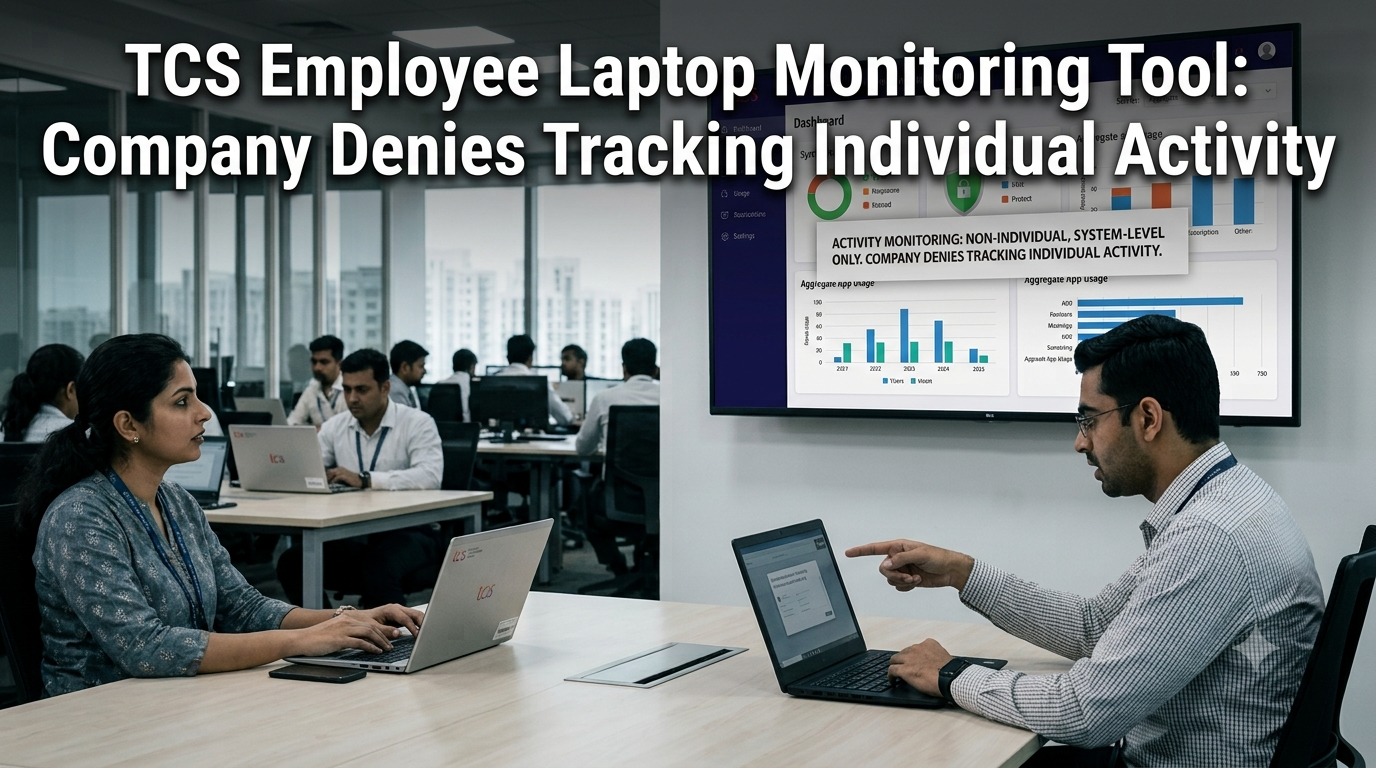
The TCS employee monitoring tool has sparked privacy concerns after reports claimed that a Digital User Experience Monitoring tool was deployed on company-issued laptops. TCS has denied allegations of employee surveillance, stating that it does not track individual employee activity.
According to a report by Money Central, the monitoring software installed on TCS laptops can provide visibility into applications being accessed and the amount of time spent on them. The report has raised questions about workplace privacy, data security and the extent to which companies can monitor activity on corporate devices.
TCS has rejected the characterization of the technology as employee surveillance. The company said reports about surveillance are “baseless and inaccurate” and clarified that it does not track individual employee activity on laptops. According to the company’s statement, its tools are used to monitor network performance at a macro level for security, availability and employee experience.
What Is the TCS Employee Monitoring Tool?
The software has been described in reports as a Digital User Experience Monitoring (DEX) tool. Such technology is generally used by organizations to understand how corporate IT systems and applications are performing.
Money control reported that the tool deployed on TCS-issued laptops can show which applications are accessed and how much time is spent on them. However, the full capabilities of the software, the identity of the vendor and the precise categories of information collected have not been independently established
This distinction is important because digital experience monitoring and employee surveillance are not necessarily the same thing.
A DEX platform can help IT teams identify problems such as application failures, slow systems, connectivity issues and other technical difficulties. At the same time, data generated from employee devices can potentially provide detailed information about how those devices are being used, which is why transparency around the scope and purpose of monitoring matters.
Is TCS tracking employees on their laptops?
TCS says no.
The company has specifically denied tracking individual employee activity on laptops and said its monitoring tools are intended to assess network performance, security, availability and the overall digital experience at a broader level.
The reports that triggered the controversy, meanwhile, described a tool capable of showing application usage and time spent on applications. That has led to questions about whether the technology is being used strictly for IT performance and security or whether it could also provide employee-level insights.
At present, the publicly available reporting does not establish that TCS is using the tool to evaluate individual employees based on their laptop activity.
Why has the TCS monitoring tool raised privacy concerns?
The incident is symptomatic of a larger tension that many technology firms are wrestling with, which is where to strike the balance between cybersecurity and employee surveillance. Security has a clear business case for companies in possession of confidential customer data. Monitoring can help guard against malfeasance, pinpoint security incidents, reduce the risk of data leakage and help IT departments resolve problems.
But many employees would likely be less comfortable if their every move on a computer is tracked.
Questions that ought to be asked of TCS regarding this roll-out include: What data does the software gather? Is the data anonymised or can it be attributed to individuals?
How long will it be stored?
Who has the ability to access the data?
Will it solely be used for IT security and cybersecurity, or will it also be used to evaluate individual employee performance?
The questions should matter all the more since TCS has commitments in place about privacy in general, a global data policy which reads, “Protecting personal information (including those of TCS clients, associates, and our other stakeholders) requires our commitment to principles like data protection and security, confidentiality and by design.”
Is the TCS tool the same as employee productivity-monitoring software?

Not necessarily.
Employee productivity-monitoring systems can be designed to record or analyse activities such as application usage, website visits, login times, inactivity periods, screenshots or keystrokes.
A digital experience monitoring system, by contrast, is primarily intended to provide IT teams with information about the performance and usability of digital systems.
The reported TCS deployment has therefore generated debate partly because the exact scope of the technology has not been publicly established. Moneycontrol reported that TCS had not disclosed the software vendor, its complete capabilities, the employee data collected or who could access the information.
TCS has a broader privacy policy for personal data

According to TCS’s publicly facing privacy policy, “TCS adheres to the applicable data protection and privacy requirements in those countries and regions in which it conducts its business operations,” and that “personal data is protected from unauthorized access, corruption and disclosure.”
TCS also says that employee policy notices and generally public website policy notices are distinct; “Employees can access the TCS’s Employee Privacy Notice via its intranet platform called Ultimatix.”
That provides context but doesn’t alone specify what data was being collected with the new laptop monitoring.
Employee monitoring is already a wider IT industry debate
TCS is not the first major technology company to have their employee monitoring investigated.
There has been a debate for years, over employer surveillance tools, in the IT industry and business process sector. Controversial discussions, concerning the use of these employee monitoring tools, have appeared before, when companies implemented tracking devices and software capable of monitoring computers, application use and employee activity.
Meta, among others, has also faced criticism with reports of monitoring practices which include information recorded from keystrokes and mouse usage, as part of a project concerning Artificial Intelligence, revealing the constant power struggle between the corporate appetite for data, security information and analysis, on one side, and the employees’ entitlement to privacy, on the other.
This problem gains, year by year, relevance, since, more and more tasks and jobs are being handled using portable computers and online-cloud based applications or remote access.
What happens next with the TCS laptop monitoring controversy?
The core problem now is transparency.
Questions raised about the tool’s capabilities in various reports have prompted TCS to deny that individual employee activity will be tracked by the software. Until these issues are fully explored and more details are revealed regarding the system, it’s probably too soon to judge whether these rollouts constitute an employee surveillance effort.
For employees and technology professionals, the answers to whether the tool collects individual data, what it’s used for, and who will see it are crucial.
For TCS, a thorough disclosure of these limitations could allow the company to differentiate real digital experience monitoring, security or performance work from activity monitoring.
Frequently Asked Questions
Does TCS track employee activity on laptops?
TCS has denied tracking individual employee activity on laptops. The company says its tools monitor network performance at a macro level to support security, availability and employee experience.
What is a Digital User Experience Monitoring tool?
A Digital User Experience Monitoring or DEX tool is designed to give IT teams visibility into the performance and usability of digital systems and applications. Such tools can help identify technical problems and improve the digital workplace.
What can the reported TCS monitoring tool see?
Moneycontrol reported that the tool can show applications accessed on company-issued laptops and the amount of time spent on them. However, the full scope of the software and whether it provides additional employee-level information has not been publicly established.
Is TCS using the tool to measure employee productivity?
There is currently no verified evidence establishing that TCS is using the reported tool to evaluate individual employee productivity. TCS has specifically denied tracking individual employee activity.
Why are employees concerned about laptop monitoring?
Employees may be concerned about privacy when corporate software can collect information about application usage or other activity on work devices. The level of concern depends on what data is collected, whether it is linked to individuals, how long it is retained and how it is used.
Is employee monitoring legal?
The legality of workplace monitoring depends on the jurisdiction, the type of data collected, the purpose of monitoring, applicable privacy and employment laws, and how employees are informed. Companies operating across multiple countries may therefore face different requirements.
Bottom line
Two of the critical facts currently associated with the TCS laptop-monitoring story is that a Digital User Experience Monitoring (DUEM) tool has supposedly been installed on all company laptops and is capable of monitoring application usage, while TCS deny monitoring employee actions at individual level.
What needs to be clarified is not just the use of the software, but what information the software accesses, to what extent, for what purpose, and to whose access this information would be available-these parameters would distinguish between a tool that monitors employee activity from one that is being used to manage IT performance and security issues.