



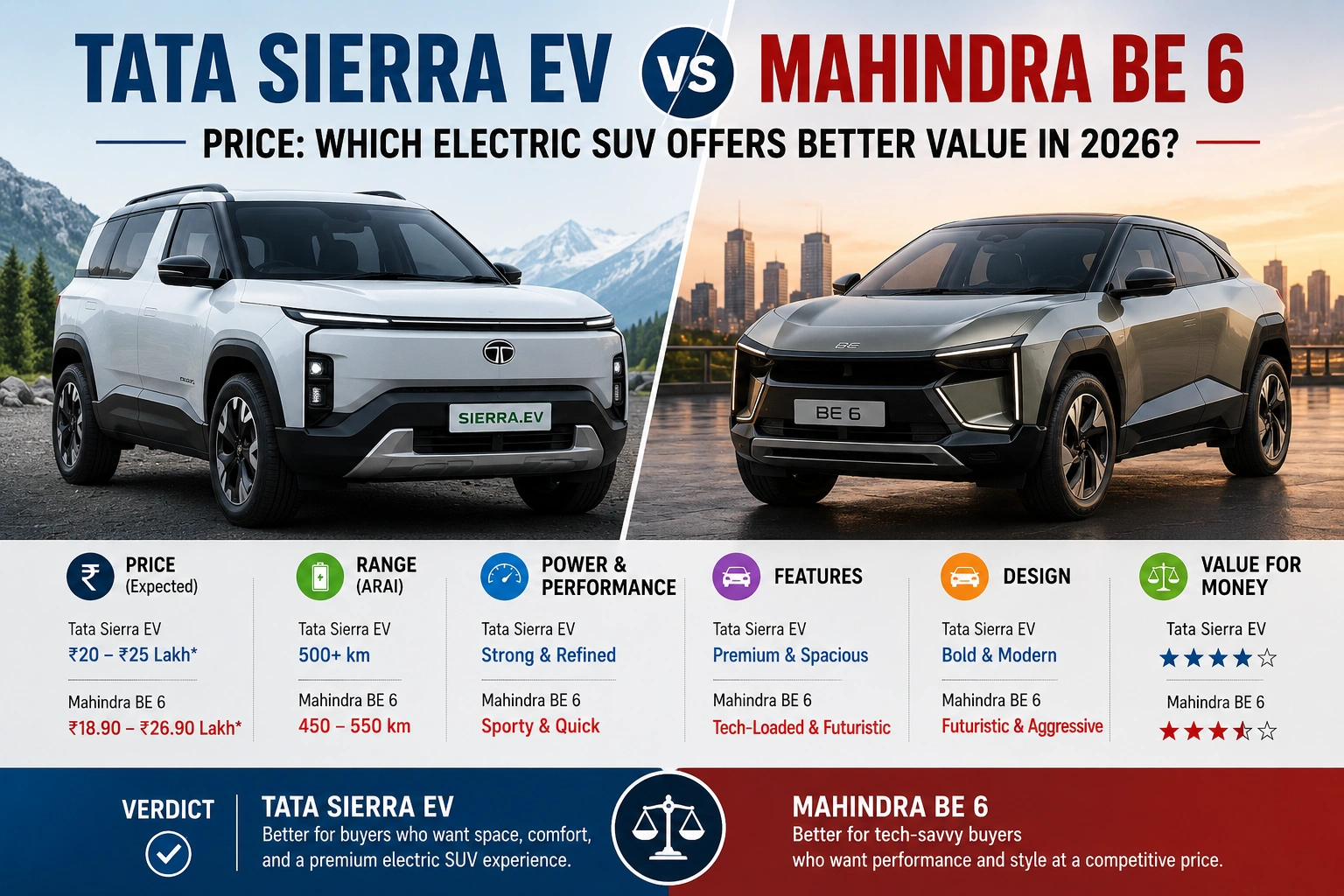
The Tata Sierra EV and Mahindra BE 6 are now closely matched on entry price, but the two electric SUVs take different approaches to range, performance and equipment. Tata’s Sierra EV starts at ₹18.79 lakh ex-showroom, marginally below the Mahindra BE 6’s ₹18.90 lakh starting price. At the top end, the Sierra EV is also priced below the BE 6, although the exact gap depends on the variant and configuration.
That makes this more than a simple price comparison. Buyers choosing between the two need to weigh the Sierra’s larger 63 kWh and 75 kWh battery options, available dual-motor all-wheel drive and family-oriented SUV packaging against the BE 6’s 59 kWh and 79 kWh batteries and higher claimed range.
Tata Sierra EV vs Mahindra BE 6: Price
The Sierra EV’s introductory ex-showroom range is ₹18.79 lakh to ₹25.99 lakh, according to current comparison data based on Tata’s pricing. The Mahindra BE 6 is listed at ₹18.90 lakh to ₹26.90 lakh.
At the entry level, therefore, the Sierra EV has an advantage of roughly ₹11,000. The difference becomes more noticeable toward the top of the range, with the Sierra EV’s highest-priced configuration listed below the BE 6’s ₹26.90 lakh Pack Three 79 kWh variant.
There is an important caveat: Mahindra’s listed BE 6 prices exclude the cost of the home charger and installation. Mahindra says customers can select charger options at additional cost. Tata also states that its vehicle prices can change and that the final price is the one applicable at invoicing or delivery.
Battery and range
This is where the BE 6 gains a clear advantage at the top end.
The Sierra EV is available with 63 kWh and 75 kWh battery packs. Depending on the configuration, claimed range figures extend from around 565 km to 665 km under the MIDC Part 1 + Part 2 testing cycle. The 75 kWh version is also available with a dual-motor all-wheel-drive setup.
The BE 6 gets 59 kWh and 79 kWh batteries. Mahindra’s official material quotes 557 km of certified range for the 59 kWh battery and up to 683 km for the 79 kWh version under MIDC Part 1 + Part 2 certification.
That gives the top-spec BE 6 a claimed range advantage of about 18 km over the highest-range Sierra EV configuration reported in the comparison data.
However, range is not the only consideration. Tata’s 75 kWh Sierra EV can be configured with dual motors and all-wheel drive, something that gives it a different positioning from the rear-wheel-drive BE 6 variants.
Performance and driving character
The Sierra EV’s single-motor version produces 238 PS and 315 Nm, while its dual-motor QWD configuration produces a combined 306 PS and 504 Nm. Tata claims a 0-100 km/h time of 5.8 seconds for the dual-motor version.
The BE 6’s 79 kWh version uses a 210 kW motor and can accelerate from 0-100 km/h in 6.7 seconds, according to Mahindra. The company also claims that the larger battery can deliver more than 500 km of real-world range in specified city-driving conditions.
The figures suggest that both SUVs offer strong performance, but their strengths differ. The BE 6 puts greater emphasis on outright range and its electric-origin platform, while the Sierra EV’s dual-motor version brings an all-wheel-drive option and higher combined output.
Features and technology
Both SUVs target buyers looking for considerably more than a basic electric vehicle.
The Sierra EV’s higher variants offer features including a triple-screen infotainment setup, Level 2+ ADAS, a 540-degree camera system, automatic parking assist, a head-up display, ventilated seats and a 12-speaker JBL audio system.
The BE 6 is similarly technology-heavy. Mahindra highlights its MAIA electronic architecture, Snapdragon 8295 processor, 24 GB RAM, 128 GB storage, over-the-air updates and advanced driver-assistance technology. Its higher variants also offer fast charging capability.
Independent comparison also shows both models offering six airbags, Level 2+ ADAS and automatic parking assistance on their higher variants. The Sierra EV uses a 540-degree camera setup, while the BE 6 has a 360-degree system.
Sources Used:
Ahmed LHM et al., Vitamin D Deficiency in Children with Asthma and Overweight/Obesity in Qatar, J Asthma Allergy (2026), as provided in the source material.
Which one makes more sense?
For buyers focused primarily on price and value, the Sierra EV has a compelling argument. Its starting price is slightly lower, and its top-end pricing remains below the BE 6’s highest listed price. It also offers the unusual combination of a 75 kWh battery and all-wheel drive.
The BE 6 makes more sense for buyers prioritising maximum claimed range. Its 79 kWh version reaches 683 km under MIDC certification, ahead of the Sierra EV’s highest published figure. It also offers strong performance and a technology-focused cabin.
There is no universal winner. A buyer who values AWD, family-oriented packaging and equipment may lean toward the Sierra EV. Someone who regularly drives long distances and places a higher priority on maximum certified range may prefer the BE 6.
For either vehicle, buyers should compare the exact variant, charger package, insurance, registration and current dealer pricing before calculating the final on-road cost. The headline ex-showroom figures alone do not represent the complete purchase price.
With both SUVs starting at roughly ₹19 lakh, the choice is increasingly about what buyers want from their electric SUV, rather than simply which one costs less. The Sierra EV has the small price advantage, while the BE 6 counters with a higher maximum range and a 79 kWh battery option.
“Must read”
Best Electric Cars Under 10 Lakh: ये 3 EV हैं सबसे खास
Tata Punch EV vs Tata Tiago EV: Price, Range, Features and Which One Makes More Sense in 2026