



Food Warning: India intends to introduce warning labels for foods with excessive sugar, salt, or fat content. This initiative is supported by an increasing number of obesity cases in childhood. The introduction of warning labels was ordered by the Supreme Court of India.
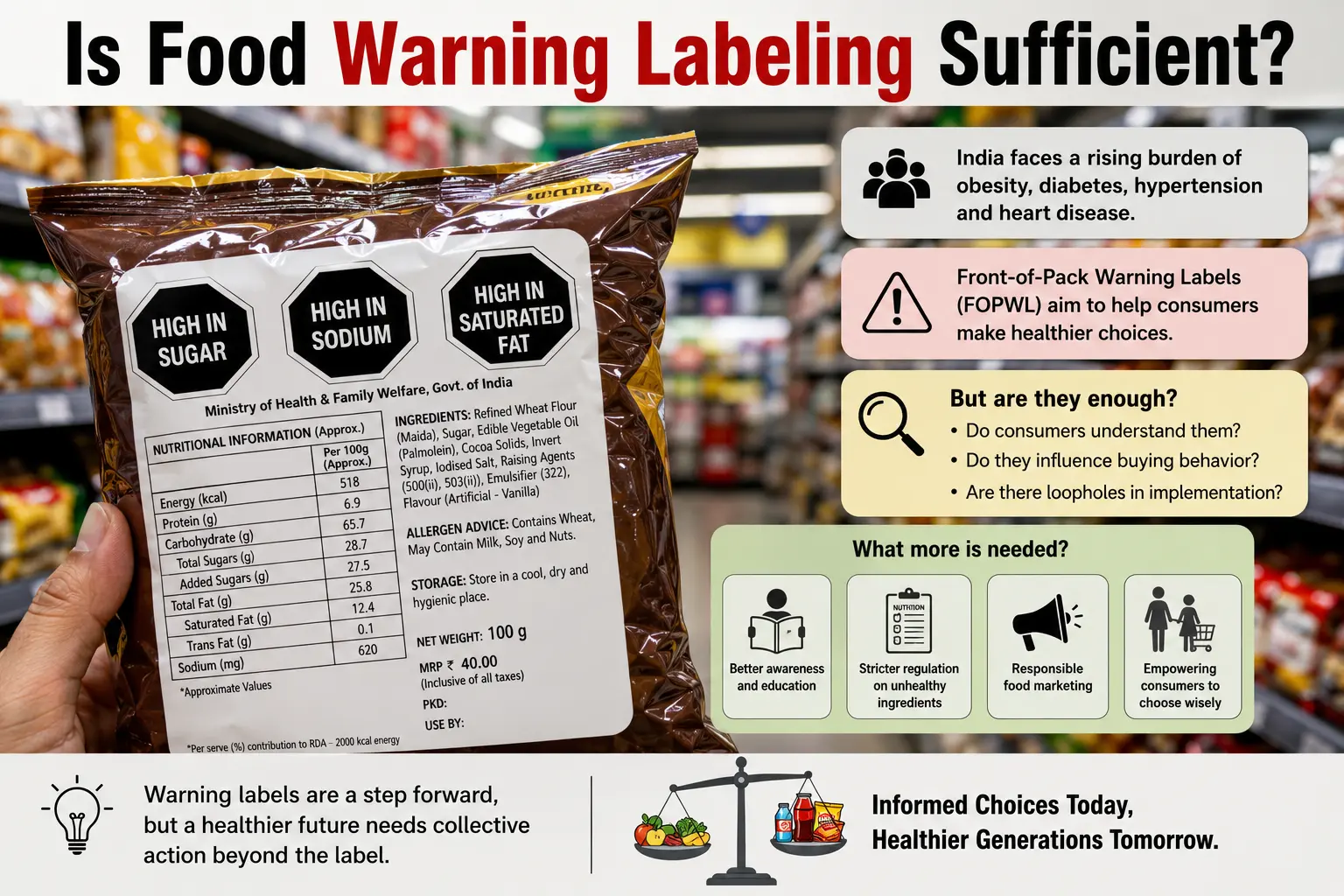
As proposed by the Supreme Court, packages of foods that exceed the allowed amount of sugar, salt, or fat will bear warning labels with red hexagons saying “SUGAR,” “HIGH SALT,” or “HIGH FAT”. In accordance with the new regulation, this program will be implemented in two phases. In the first stage, foods with excessive content of two or more of the listed nutrients will have warning labels. Further, in the second stage, even foods exceeding the allowable amount of just one nutrient might bear red hexagons.
Warning label standards are determined according to the Dietary Guidelines for Indians, 2024, developed by the Indian Council of Medical Research-National Institute of Nutrition. Products consisting of single components such as oil, salt, sugar, ghee and honey will not need to be labeled.
Children – a growing concern
Currently, unhealthy dietary preferences are spreading among children in India. Government reports provided to Parliament indicate the issues related to the marketing of junk food, excessive sugar, fat and salt in foods, and the mandatory front-of-package labels.
While making its decision, the Supreme Court indicated its concern about the excessive consumption of snacks by children and asked why front-of-package warning labels had not been introduced. The involvement of the Supreme Court in this issue raised the issue of child obesity and the harm of processed foods to public health in India.
Purpose of warning labels: Food Warning
The warning labels are intended to solve one problem only: people do not know the sugar, salt, or fat content of products until they read information on the back side of the package. The warning label on the front side of a product will help to solve the problem. In particular, labels will help parents who need to know what their children eat. According to FSSAI, the system is easy to use.
Is Food Warning Labeling Sufficient?
Health experts agree with the direction of the initiative for the Food Warning. However, there are concerns regarding its implementation. Firstly, it relates to the first-stage requirement: a product has to contain high amounts of two or more nutrients to have a warning label. Thus, snacks with excessive sugar content but no salt or fat would not be labeled.
Moreover, there are many concerns about the effectiveness of the program. Can warning labels influence dietary preferences of people? There are a lot of factors that influence the preferences of children, among them advertising, consumption of sugary drinks and snacks, meals in schools, and lack of physical activity.
The introduction of warning labels in India can become the start of a campaign aimed at changing the dietary preferences of children. Families will reconsider the ingredients of the foods used by children, schools will reconsider their menus, and stores will reconsider snack stocking.
At the moment, the program of introducing warning labels has not been fully implemented in the country yet. The schedule of the process has not been developed. The main question is whether it is possible to change dietary preferences with the help of a sign on packaging.
If implemented effectively, the warning-label system could also encourage food manufacturers to reformulate products and reduce unhealthy ingredients. Public awareness campaigns should accompany the labels so that consumers understand their meaning. Schools, parents, healthcare professionals, and policymakers can work together to promote healthier choices. Therefore, warning labels should be viewed as one important step toward improving children’s nutrition and preventing obesity.
Read More..
Sugar Price Hike 2026: चीनी का भाव ₹74 किलो तक पहुंचा, राहत का इंतजार
Banda Mandi Bhav Today: गेहूं का भाव ₹2,625 तक, सब्जियों के दाम में तेजी