

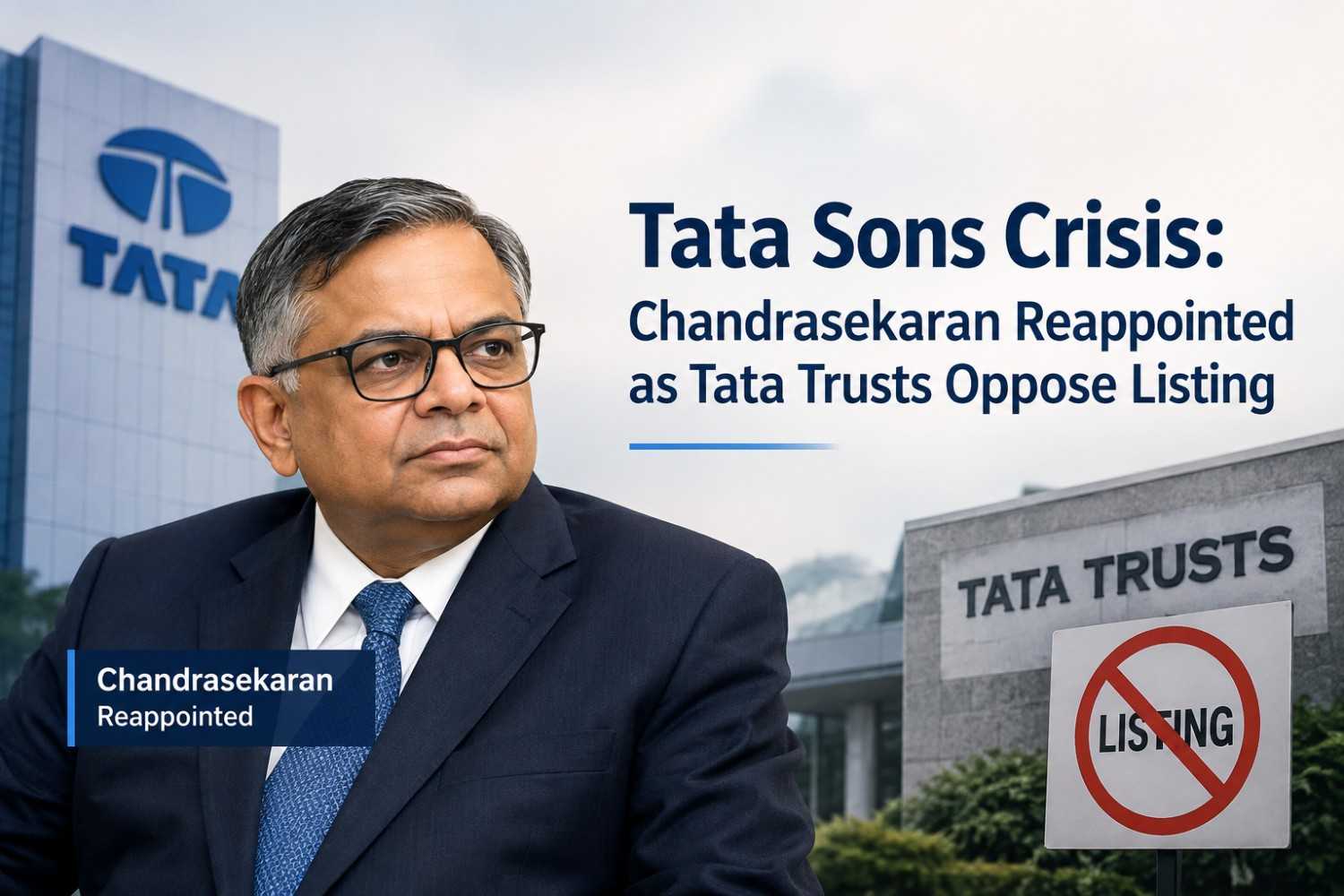
Tata Sons is facing a major corporate-governance dispute after its board approved N. Chandrasekaran’s fresh five-year term as executive chairman, while Tata Trusts has opposed the reappointment and challenged its validity. At the same time, the RBI’s decision on Tata Sons’ NBFC status has renewed the debate over a potential Tata Sons listing.
What is happening at Tata Sons?
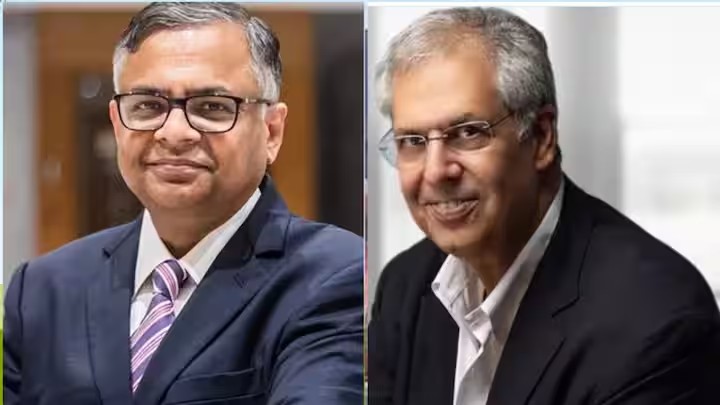
A significant corporate governance conflict has emerged as Tata Sons’ board has extended N Chandrasekaran’s term as executive director for another five years while Tata Trust has questioned the decision’s legality. Simultaneously, Tata Sons is working towards addressing the Reserve Bank of India’s requirements regarding its status as an upper-layer NBFC and the potential for going public.
These developments have led to the reemergence of three connected issues regarding the future of Tata Group:
- Chandrasekaran’s reappointment as executive chairman
- Tata Sons’ potential public listing
- The governance and ownership relationship between Tata Trusts and Tata Sons
Why is Tata Sons facing a governance dispute?
The conflict first emerged soon after Chandrasekaran announced in August 2026 that he was planning to step down at the end of his current term on February 20, 2027.
In the words of Tata Trusts, his announcement was accepted and the succession process began. Tata Trusts supported the move to form a Selection Committee.
In contradiction, Tata Sons claims that its Nomination and Remuneration Committee advised Chandrasekaran to reevaluate his decision on September 3 and he did so during the Board meeting on September 17.
These discrepancies serve to provide reason for the conflict between the parties.
Why are Tata Trusts calling Chandrasekaran’s reappointment illegal?
Tata Trusts claims that the resolution passed by the board is not valid.
The Collectively, Tata Trusts represent around 66 percent of equity holdings of Tata Sons and are of the view that the Articles of Association of the company clearly states that the appointment/re-appointment of chairman would require the support of the relevant nominees of Tata Trusts.
The argument is supported by Noel Tata who voted against the resolution in his capacity as nominee director of Tata Trusts.
Tata Trusts said that had the legal opinion been presented by Noel Tata from ex Chief Justice of India, D.Y. Chandrachud, supporting the viewpoint of the Trusts regarding the Articles of Association. However, it is a claim and is not a judgment.
The two positions at a glance
| Issue | Tata Trusts’ position | Tata Sons’ position |
| Chandrasekaran’s August decision | It was final and accepted | He was asked to reconsider |
| Reappointment | Trusts dispute its validity | Board approved a fresh five-year term |
| Trusts’ nominee vote | Noel Tata voted against the resolution | Other directors supported the resolution |
| Succession | Selection Committee should proceed | Board reconsidered Chandrasekaran’s continuation |
| Legal position | Trusts say the resolution is invalid | Tata Sons proceeded with the board resolution |
The final legal and corporate outcome will depend on the company’s governing documents, applicable law, shareholder processes and any future regulatory or judicial proceedings.
What does the RBI decision have to do with Tata Sons’ listing?
The second major issue is Tata Sons’ regulatory status.
Tata Sons had been classified as an upper-layer non-banking financial company (NBFC) under the Reserve Bank of India’s scale-based regulatory framework. The company had sought to surrender its NBFC registration, a move connected to its efforts to remain unlisted.
On September 11, 2026, the RBI rejected Tata Sons’ application to surrender its registration and asked the company to take the necessary steps applicable to an upper-layer NBFC. Reporting on the RBI communication indicates that the letter itself did not simply state that an immediate IPO was the only possible action.
The regulatory decision nevertheless puts renewed attention on Tata Sons’ listing obligations.
Why is this important?
Tata Sons’ initial conclusion was to continue being unlisted.
As per the news published by India Today, the board arrived at a conclusion in March 2024 that Tata Sons should remain private, following which they repaid loans and redeemed preference shares prematurely valued at ₹20,000 crores.
The decision made by the RBI in September 2026 has brought the question on how Tata Sons will follow the regulatory framework while keeping its preferred share ownership structure.
Why does Noel Tata oppose a Tata Sons listing?
Noel Tata has indicated that this matter concerns more than just evaluations or proprietorship. Tata Trusts have an approximate shareholding of 66% in Tata Sons. Accordingly, the organization of the holding company is closely tied to philanthropic endeavors of Tata Trusts. The argument for the Trusts is that if Tata Sons is public, the company will attract shareholders with other objectives who will compete with Tata Group’s long-term objectives.
Noel Tata expressed concern over instances when Tata Sons might be required to financially assist other group companies, carry out project financing related to long-term investments, and similar processes when financial rewards can take years to be realized.
Moreover, he proposed studying alternative options, including legal and regulatory reform, before listing Tata Sons. If all of that fails, according to India Today, the company should have more time to prepare.
What is Shapoorji Pallonji Group’s position?
The Tata Sons dispute also involves another major shareholder: the Shapoorji Pallonji Group.
The group holds a significant minority stake in Tata Sons and has supported the RBI’s position concerning Tata Sons’ listing obligations. Shapoorji Pallonji Group chairman Shapoor Mistry has also called for closer ties between the group and Tata Trusts.
This creates an important contrast among Tata Sons’ major stakeholders:
- Tata Trusts: oppose a Tata Sons listing and have challenged the chairman’s reappointment.
- Tata Sons board: has approved Chandrasekaran’s fresh five-year term and decided to move forward with the listing process in response to the regulatory situation.
- Shapoorji Pallonji Group: has backed the RBI’s position concerning the listing requirement.
These positions demonstrate why the dispute is about more than a change in chairman. It also concerns ownership, governance, regulation and the future structure of Tata Sons.
What happens next for Tata Sons?
Several developments could determine the next stage of the dispute.
1. The chairman’s reappointment could face further scrutiny
Tata Trusts has disputed the validity of the September 17 board resolution. The disagreement could therefore move into formal legal or corporate-governance processes if the parties do not reach an understanding.
At present, it is important to distinguish between Tata Trusts’ legal interpretation and a final judicial ruling.
2. Tata Sons must address its RBI obligations
The RBI has rejected the application to surrender Tata Sons’ NBFC registration and has asked the company to comply with the requirements applicable to an upper-layer NBFC.
How Tata Sons responds to that direction will be closely watched.
3. The listing question remains unresolved
The board’s decision to move toward a listing does not by itself mean that Tata Sons shares are immediately available to the public.
A public listing would involve substantial preparation, including regulatory compliance, financial disclosures, valuation, due diligence, shareholder approvals and other corporate processes.
4. Tata Trusts and other shareholders could remain central to the process
Because Tata Trusts holds approximately 66% of Tata Sons, its position remains highly significant to any major ownership or governance decision.
The Shapoorji Pallonji Group’s minority stake and its position on the RBI’s listing-related direction add another important shareholder perspective.
Will Tata Sons be listed?
Tata Sons is moving toward addressing the listing implications of its RBI-regulated status, but that does not mean an immediate IPO is taking place. The RBI rejected Tata Sons’ request to surrender its NBFC registration on September 11, 2026, after which the board decided to proceed toward listing-related compliance. The exact timing, structure and process remain subject to regulatory and corporate requirements.
Will N Chandrasekaran remain chairman of Tata Sons?
On September 17, 2026, the board at Tata Sons sanctioned a renewal of N Chandrasekaran’s term for an additional five years. Tata Trusts, however, took issue with the legitimacy of this resolution claiming that consent from its appointed directors had not been obtained. Tata Sons, on its part, claimed a different version to the story stating that Chandrasekaran had reviewed his previous stance following the recommendation of the Nomination and Remuneration Committee of Tata Sons.
The controversy hence stays a matter of corporate regulation and likely legal examination.
Why does the Tata Sons dispute matter to Tata Group companies?
Tata Sons is the chief holding firm for the Tata Group across its diversified businesses such as technology, automobiles, steel, aviation, banking, and consumer areas.
As a result, the dispute has relevance beyond Tata Sons itself as the adjudication in regard to the firm’s ownership, control, and capital structure has broader implications for the way the Tata Group functions and obtains funds.
In its annual report for FY2024-25, Tata Sons identifies N. Chandrasekaran as the Executive Chairman and notes the presence of entities associated with Tata Trusts as the investors of the company thus emphasizing the importance of ownership and governance aspects.
Tata Sons dispute: Key facts at a glance
| Question | Current position |
| ‘Who is Tata Sons’ chairman? | The board approved a fresh five-year term for N Chandrasekaran |
| When was the reappointment approved? | September 17, 2026 |
| Do Tata Trusts support it? | No. Tata Trusts has challenged the resolution |
| Who opposed the resolution? | Noel Tata voted against it |
| How much of Tata Sons do Tata Trusts hold? | Approximately 66% |
| What did the RBI do? | Rejected Tata Sons’ application to surrender its NBFC registration |
| Is Tata Sons moving toward listing? | The board has decided to move toward listing-related compliance |
| Does that mean an immediate IPO? | No; substantial regulatory and corporate steps would still be required |
| Who supports the RBI’s listing position? | Shapoorji Pallonji Group has expressed support |
| Is the chairman dispute legally settled? | No; Tata Trusts’ challenge remains contested |
Frequently Asked Questions
What is the Tata Sons controversy in 2026?
The current controversy involves two connected issues: Tata Trusts’ challenge to N Chandrasekaran’s reappointment as Tata Sons executive chairman and disagreement over whether Tata Sons should proceed toward a public listing after the RBI rejected its request to surrender its NBFC registration.
Why do Tata Trusts oppose the Tata Sons IPO?
Tata Trusts has argued that listing Tata Sons could change the company’s traditional operating and ownership model by introducing public shareholders with different investment objectives. The Trusts also point to Tata Sons’ connection with the philanthropic activities of the Tata Trusts.
What did the RBI decide about Tata Sons?
On September 11, 2026, the RBI rejected Tata Sons’ application to surrender its registration and asked the company to take necessary steps applicable to an upper-layer NBFC.
Who is Noel Tata?
Noel Tata is chairman of Tata Trusts and a nominee director on the Tata Sons board. He opposed the September 2026 resolution concerning Chandrasekaran’s reappointment and has also opposed Tata Sons moving toward a public listing.
What is Shapoorji Pallonji Group’s stake in Tata Sons?
The Shapoorji Pallonji Group is a significant minority shareholder in Tata Sons. Its chairman, Shapoor Mistry, has supported the RBI’s position concerning Tata Sons’ listing obligations.
Does Tata Sons have to list immediately?
The RBI’s September 11 communication rejected Tata Sons’ application to surrender its NBFC registration and directed the company to comply with the applicable upper-layer NBFC framework. The exact process and timing for any listing remain subject to regulatory and corporate requirements.
The bigger picture
The Tata Sons dispute is now simultaneously a leadership question, a regulatory question and an ownership-structure question.
The immediate disagreement is over Chandrasekaran’s five-year reappointment. Running alongside it is the question of how Tata Sons responds to the RBI’s decision and whether the company ultimately moves toward a public listing.
Tata Trusts’ approximately 66% ownership, the position of other shareholders such as the Shapoorji Pallonji Group, the company’s Articles of Association and the RBI’s regulatory framework will all be relevant to what happens next.